The Asante Empire: Gold, War and the Kingdom That Resisted Britain
A kingdom built around Kumasi turned gold, alliances and military power into an empire. Britain could seize its capital and exile its king, but Asante identity survived.
In 1900, a British governor demanded the Golden Stool at Kumasi. To colonial officials, possessing the kingdom's most sacred object promised authority. To Asante people, the demand threatened something larger than a ruler: the spiritual unity of their nation. The confrontation helped ignite a war led by Yaa Asantewaa, queen mother of Ejisu. A. Adu Boahen, Encyclopaedia Africana: Yaa Asantewaa National Army Museum: the War of the Golden Stool
The Asante Empire, also spelled Ashanti, was an Akan state centered on Kumasi in present-day Ghana. It emerged around the turn of the eighteenth century and became a major West African power through gold, commerce, political organization and military expansion. Its resistance to Britain is inseparable from that longer history, including its own conquest of neighboring peoples and participation in slavery. J. K. Fynn, Encyclopaedia Africana: Osei Tutu J. K. Fynn, Encyclopaedia Africana: Opoku Ware Gareth Austin: Asante and the end of the Atlantic slave trade
OSEI TUTU AND THE MAKING OF A UNION
Before Asante became an empire, the forest region contained competing Akan states. Denkyira exercised power over communities that would form the Asante union. Osei Tutu, ruler of Kumasi, joined with the priest and adviser Okomfo Anokye to bind several states into a stronger coalition. The achievement was political as well as military: rulers with separate interests accepted institutions that could mobilize them together. J. K. Fynn, Encyclopaedia Africana: Osei Tutu
Victory over Denkyira in 1701, associated with the battle of Feyiase, marked a decisive turning point. It broke the older power's supremacy and strengthened Asante's position in coastal trade. The kingdom did not appear fully formed on a single day. The late seventeenth-century coalition, its military victories and the later expansion of its institutions belong to one process of state formation. J. K. Fynn, Encyclopaedia Africana: Osei Tutu
THE GOLDEN STOOL: AUTHORITY BEYOND ONE KING
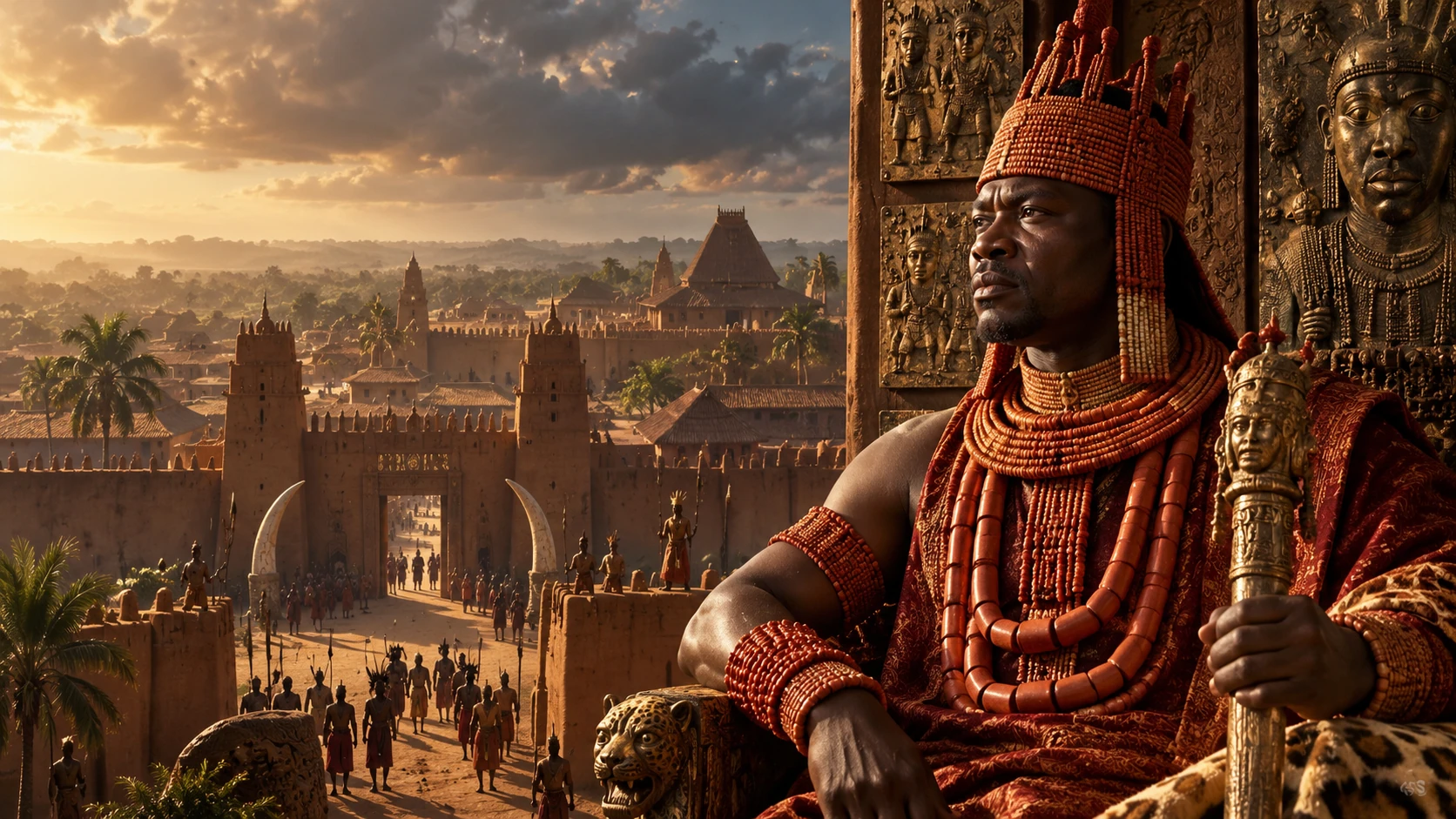
According to Asante tradition, Okomfo Anokye brought the Golden Stool down from the sky onto Osei Tutu's lap. This is a sacred foundation narrative, not an event that historians can verify in the same way as a treaty or a military campaign. Its historical importance lies in the authority it gave the union: the stool represented a shared people rather than one chief's possessions. Metropolitan Museum of Art: Asante gold weights and the Golden Stool
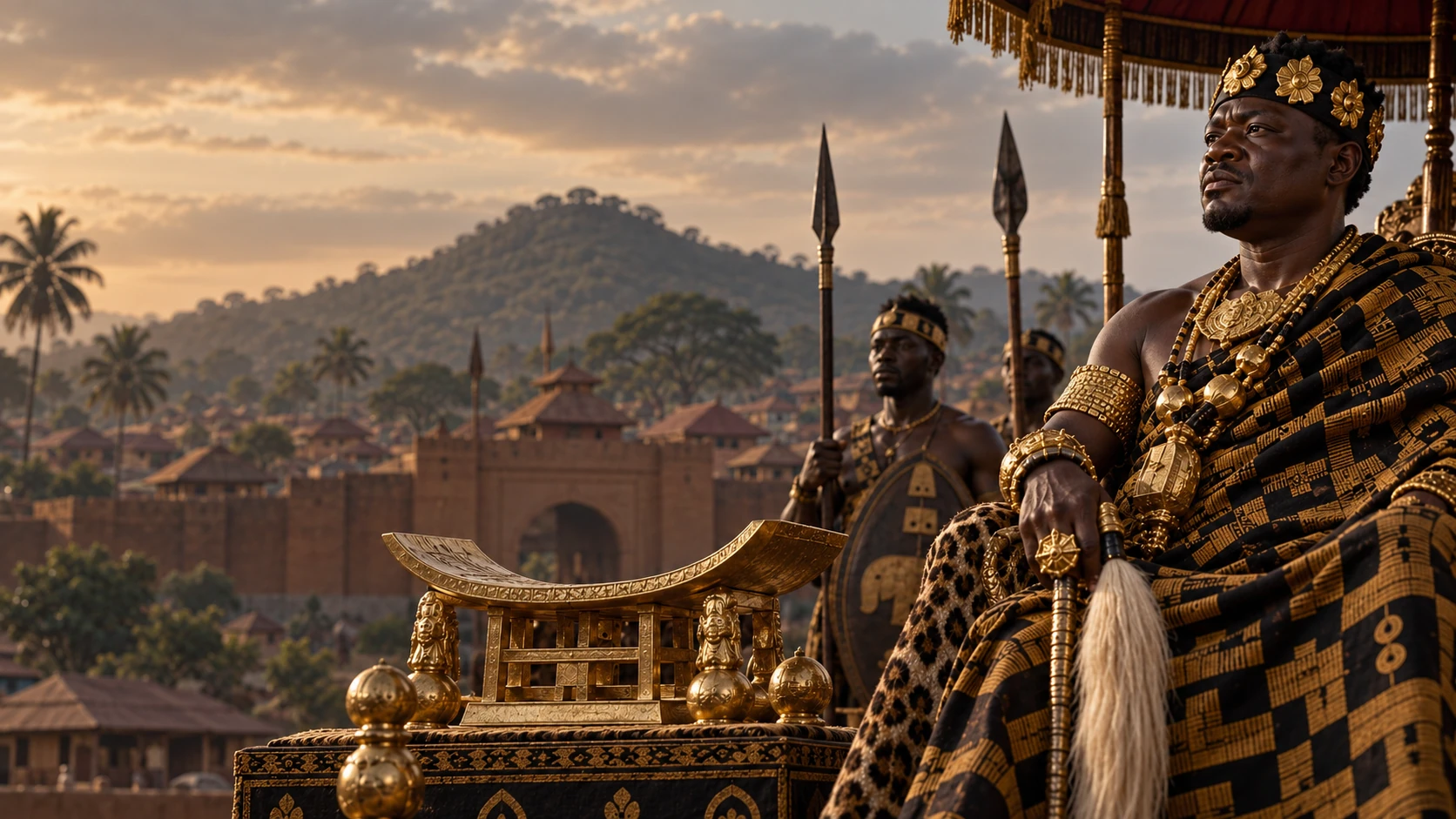
The Golden Stool embodies the soul and unity of Asante. It is not an ordinary royal seat to be occupied at will, even by the king. The Asantehene's authority is associated with it, but the sacred object is distinct from the everyday or ceremonial stools used by rulers. That distinction would become central when Britain tried to turn military occupation into unquestioned sovereignty. Encyclopaedia Africana: Ghana's historical development Manhyia Palace: the Golden Stool at the 2024 royal jubilee
KUMASI: CAPITAL, COURT AND POLITICAL CENTER
Kumasi concentrated royal authority, administration and ceremonial life. The Asantehene governed through a political order in which chiefs and officeholders retained important roles. Gold-covered staffs, swords, textiles and stools were more than decoration: they identified rank, office and obligations. The empire's visible magnificence was also a language of government. Metropolitan Museum of Art: royal staffs, stools and authority
The surviving Asante Traditional Buildings near Kumasi offer a different kind of evidence from royal treasure. UNESCO's protected group includes ten shrines, built with materials such as timber, bamboo and earth plaster, arranged around courtyards and decorated with relief designs. Their vulnerability to weather and deterioration makes conservation essential. Asante civilization cannot be reduced to the objects carried away by foreign armies. UNESCO: Asante Traditional Buildings
GOLD, MARKETS AND THE REACH OF TRADE
Gold helped make Asante powerful. It was mined and collected from river deposits, circulated as gold dust and transformed by skilled goldsmiths into regalia. Scales and brass weights made exchange possible. The weights could take geometric or figurative forms, combining practical measurement with cultural meaning. Gold was therefore currency, a commodity and an expression of authority. Metropolitan Museum of Art: Asante gold weights and the Golden Stool Metropolitan Museum of Art: royal staffs, stools and authority
Trade connected the forest interior to coastal markets and wider commercial networks. Royal power mattered, but the economy was not simply a treasury controlled from the palace. Historian Gareth Austin's research identifies a substantial role for private producers and traders, including commoners who accumulated wealth. Internal markets and ordinary commercial activity sustained an empire that outsiders often described mainly through kings and gold. Gareth Austin, Journal of African History: ownership and slavery in Asante
Asante belongs to a broader history of African states shaped by valuable exports, but it should not be confused with the much earlier Ghana Empire of Wagadu or the Mali Empire of Mansa Musa. Those states occupied different regions and historical settings.
EXPANSION AND THE COST OF IMPERIAL POWER
Osei Tutu's successors enlarged the kingdom's reach. Under Opoku Ware, Asante defeated Akyem and extended its influence over additional states and trading routes. Military success brought territory, tribute and commercial advantages. It also created obligations that dependent communities could resist, especially when succession disputes or conflicts within Kumasi weakened the center. J. K. Fynn, Encyclopaedia Africana: Opoku Ware
The empire was not a uniform block of willing subjects. Its history includes provincial rebellions and struggles over the authority of the Asantehene and chiefs. Understanding those tensions explains why later conflicts with Britain involved African political choices and alliances, rather than a single united African side facing a wholly European army. J. K. Fynn, Encyclopaedia Africana: Opoku Ware Manhyia Archives: Prempeh I, diplomacy, exile and return
ASANTE AND THE SLAVE TRADE
Asante was a significant supplier of enslaved people to the Atlantic trade through the Gold Coast. Campaigns and control over trade routes connected its expansion to the sale of captives. European demand and coastal intermediaries formed part of that system, but they do not remove the responsibility of Asante rulers and traders who participated in it. Resistance to British conquest does not erase this history. Gareth Austin: Asante and the end of the Atlantic slave trade
Slavery also existed within Asante society. Austin's research describes chiefs and commoners owning enslaved people and incorporating them into households and economic production. The end of Britain's participation in the Atlantic slave trade in 1807 did not end slavery in Asante. Overseas trafficking, domestic enslavement and changing nineteenth-century commerce must be distinguished rather than treated as one event. Gareth Austin, Journal of African History: ownership and slavery in Asante Gareth Austin: Asante and the end of the Atlantic slave trade
These facts complicate both imperial propaganda and heroic national narratives. British conquest should not be explained as a simple humanitarian rescue, and Asante power should not be romanticized as freedom for everyone within its reach. For the wider systems involved, read PRESDA's history of slavery.
THE ANGLO-ASANTE WARS: A LONG STRUGGLE
The Anglo-Asante wars were a sequence of conflicts, not one uninterrupted campaign. Their setting included coastal commerce, competing claims to authority and alliances with African states that had their own interests. Britain was not an inevitable victor from the first encounter. In January 1824, Asante forces defeated a column led by Sir Charles MacCarthy at Nsamankow; the British governor was killed. National Army Museum: the 1824 Asante victory
Conflict returned in 1863 after a dispute involving people who had fled Asante territory. The confrontation did not produce a British conquest of Kumasi. A decade later, the balance shifted: in the 1873–74 war, forces commanded by Sir Garnet Wolseley advanced into the interior and captured Kumasi in February 1874. Encyclopaedia Africana: Ghana's historical development National Army Museum: capture and destruction at Kumasi, 1874
The British destroyed parts of the capital, including the royal palace, and removed royal treasures. The V&A's own provenance history identifies gold regalia looted in 1874 and subsequently acquired by the museum. The loss was not just financial. Objects tied to state authority and religious life were taken out of the society that gave them meaning. National Army Museum: capture and destruction at Kumasi, 1874 V&A: the history and 2024 loan of Asante gold
Asante survived the 1874 invasion as a political force, but its position had been badly weakened. Britain's expanding coastal power, internal disputes and renewed pressure on the monarchy narrowed its options. The larger colonial setting is explored in PRESDA's history of the British Empire. Manhyia Archives: Prempeh I, diplomacy, exile and return
PREMPEH I: DIPLOMACY, OCCUPATION AND EXILE
Prempeh I tried to defend Asante independence through diplomacy as well as the restoration of royal authority. An Asante delegation went to Britain in 1895. When a British expedition reached Kumasi in January 1896, Asante did not mount military resistance. Avoiding a battle did not preserve the king's freedom: British authorities arrested Prempeh and other members of the ruling establishment. Manhyia Archives: Prempeh I, diplomacy, exile and return
His deportation was a process, not a direct journey to the Seychelles in 1896. The detainees were first held on the Gold Coast, then transferred to Sierra Leone in 1897 and to the Seychelles in 1900. This chronology matters because the next war erupted while Asante's king had already been removed from power and territory. Cambridge University Press: colonial detention, 1896–1901
YAA ASANTEWAA AND THE WAR OF THE GOLDEN STOOL
In 1900, Governor Frederick Hodgson demanded the Golden Stool and asserted a right to sit on it. The demand was an assault on an institution the British had failed to understand. It intensified opposition already shaped by the king's exile and colonial interference. Yaa Asantewaa, the queen mother of Ejisu, became a leading organizer of resistance. National Army Museum: the War of the Golden Stool A. Adu Boahen, Encyclopaedia Africana: Yaa Asantewaa
Her position was a political office, not simply a description of motherhood. She helped rally resistance that besieged the British fort at Kumasi. British relief forces eventually broke the siege, and the wider campaign suppressed the uprising. Fighting and its aftermath extended into 1901. The familiar name War of the Golden Stool captures its central symbol, but the struggle concerned sovereignty and colonial rule as well. A. Adu Boahen, Encyclopaedia Africana: Yaa Asantewaa National Army Museum: the War of the Golden Stool Encyclopaedia Africana: Ghana's historical development
Yaa Asantewaa was captured and exiled to the Seychelles, where she died in 1921. Her leadership became a lasting symbol of resistance. This account does not reproduce the dramatic speeches often attributed to her as verbatim quotations: the historical importance of her actions does not depend on treating later retellings as a recorded transcript. A. Adu Boahen, Encyclopaedia Africana: Yaa Asantewaa
ANNEXATION DID NOT END ASANTE IDENTITY
Formal British annexation took effect in 1902, placing Asante under colonial administration linked to the Gold Coast. This ended the empire's independent sovereignty. It did not erase its people, institutions or attachment to the Golden Stool. Political conquest and cultural disappearance are different historical outcomes. Encyclopaedia Africana: Ghana's historical development
Prempeh I returned in 1924. Colonial authorities initially treated him as a private person, while many Asante continued to recognize his royal standing; he was later recognized as Kumasihene. These distinctions show how colonial government could restrict an office without extinguishing its legitimacy among the people who sustained it. Manhyia Archives: Prempeh I, diplomacy, exile and return
A LIVING LEGACY IN GHANA
Ghana became independent on March 6, 1957. Today, Asante identity and the monarchy exist within that sovereign republic, not as a separate internationally sovereign empire. Ghana's Constitution guarantees the institution of chieftaincy while barring chiefs from active party politics. Traditional authority and republican government operate within the same national framework. Encyclopaedia Africana: Ghana's historical development Ghana Judicial Service: constitutional provisions on chieftaincy
The Golden Stool remains a living symbol, not merely an exhibit illustrating a vanished civilization. Manhyia Palace documented its ceremonial appearance beside Otumfuo Osei Tutu II during his 2024 silver jubilee. That continuing significance helps explain why questions about royal regalia, museums and ownership remain politically and emotionally important. Manhyia Palace: the Golden Stool at the 2024 royal jubilee
In 2024, Asante regalia from the V&A and British Museum returned to Kumasi under loan arrangements. A loan permits display without necessarily transferring ownership, so it should not be described as full restitution. The objects' return to view in Ghana reopened questions about the legacy of conquest and who should control the material heritage of a people. V&A: the history and 2024 loan of Asante gold
The Asante story holds several truths together. It is a history of statecraft and artistry, wealth and coercion, military expansion and resistance to colonial domination. Britain ended the empire's sovereignty. It did not make Kumasi, the Golden Stool or Asante historical memory irrelevant to Ghana's present.
The hero is an AI-generated historical illustration. Its ruler, setting and ceremonial stool are not authenticated portraits or exact reconstructions. Sacred tradition is identified as tradition; the narrative draws on historical scholarship, Ghanaian institutions and museum records.
FAQ
Frequently Asked Questions
Where was the Asante Empire?
The Asante Empire was centered on Kumasi in present-day Ghana. Its authority extended beyond its core through conquest, alliances and tributary relationships.
Who founded the Asante Empire?
Osei Tutu was its principal founder, working with Okomfo Anokye to unite several states. Victory over Denkyira in 1701 was a decisive stage in the union's rise.
Why was the Golden Stool important?
It embodies the spiritual unity of Asante. It is a sacred symbol of the people, not an ordinary throne that a ruler or colonial governor could simply sit on.
Who was Yaa Asantewaa?
Yaa Asantewaa was the queen mother of Ejisu and a leading organizer of the 1900 resistance to British rule. She was captured, exiled to the Seychelles and died there in 1921.
Did Asante participate in the slave trade?
Yes. Asante supplied enslaved people to the Atlantic trade through the Gold Coast, and slavery also existed within its own society. British abolition of the slave trade in 1807 did not end domestic slavery in Asante.
PRESDA Dispatch
Stay Informed. Stay Aware.
A sharp briefing across AI, gaming, sport, business, world affairs, paparazzi, and lifestyle.