BRITISH EMPIRE: HOW A SMALL ISLAND BUILT THE LARGEST EMPIRE IN HISTORY
Ships, trade, industry and conquest built an empire spanning oceans. Its story connects extraordinary power with slavery, resistance and consequences that outlasted colonial rule.
An empire can look deceptively simple on a map. Color enough coastlines and continents red, and centuries of negotiation, invasion, labor and resistance become a single shape. The British Empire was never that simple. Behind its borders stood trading companies, plantation owners, naval dockyards, Indian soldiers, African rulers, settlers, tax collectors and people who had never agreed to be governed from London.
Its extraordinary reach requires an explanation. How did a state based on islands off northwestern Europe acquire influence across oceans and govern territories vastly larger than itself? Ships were indispensable, but ships alone could not collect a village's taxes. Commerce created opportunities, but commerce did not automatically produce sovereignty. Power emerged where military force, money, local alliances and institutions reinforced one another.
At its greatest territorial extent after the First World War, this became the largest empire in history. Its expansion connected distant societies while imposing conquest, enslavement, racial hierarchy and extraction. Both the connections and the coercion belong at the center of the story.
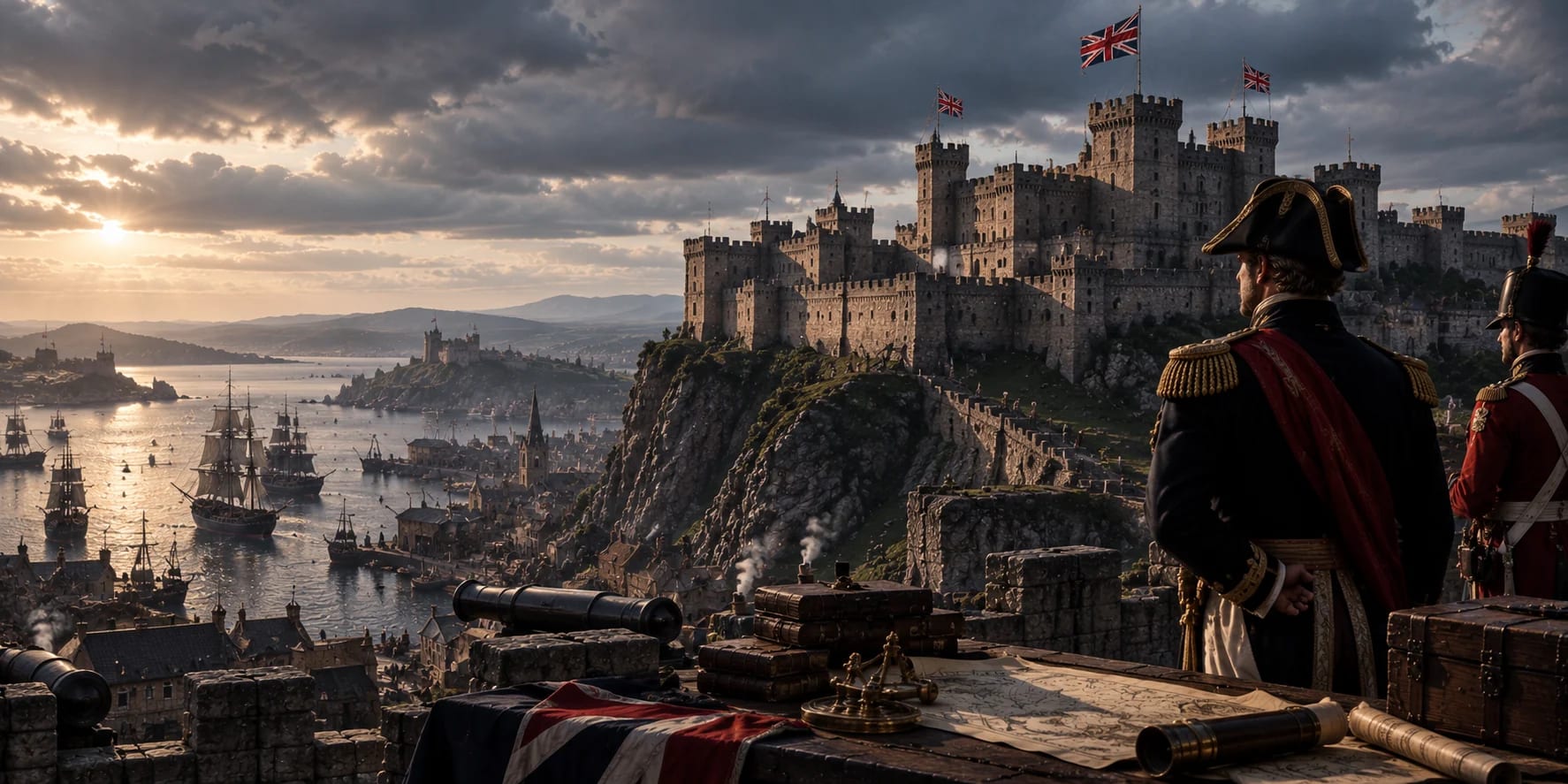
*The hero is an editorial historical reconstruction: an imagined castle, harbor and imperial scene, not a documentary image of a particular place, event or ruler.*
BEFORE BRITAIN: ENGLAND LOOKS OVERSEAS
The story begins before a state called Great Britain existed. England's early overseas ventures competed with better-established European imperial powers and frequently failed. Atlantic ambitions involved merchants, royal charters and settlers as well as the Crown. Success was uncertain, and surviving a first winter could matter more immediately than any grand imperial design.
Jamestown, established in Virginia in 1607, became the first permanent English settlement in North America. It stood within an inhabited Indigenous world, not an empty landscape awaiting discovery. Disease, hunger and conflict threatened the settlement; its survival eventually helped establish a colonial society whose demand for land and labor transformed the region. US National Park Service: a short history of Jamestown
England and Scotland united as Great Britain in 1707. The union also opened English colonial markets to Scottish participation. Calling all earlier activity “British” can conceal that constitutional change, just as calling the later empire exclusively “English” obscures the roles of Scots, Welsh people and Irish participants. UK Parliament: the union, constitution and trade
THE ATLANTIC EMPIRE: LAND, SUGAR AND ENSLAVED LABOR
North American colonies and Caribbean plantation societies developed together within an Atlantic economy. Islands such as Barbados and Jamaica became central to a system producing commodities for distant consumers. British ports, merchants and manufacturers participated in the exchange, while Indigenous dispossession and the forced labor of enslaved Africans underpinned colonial growth. The prosperity visible in a port could originate in suffering far beyond its horizon. Royal Museums Greenwich: Atlantic Worlds
Britain was a major participant in the transatlantic slave trade. The National Archives estimates that British trafficking carried more than three million Africans across the trade's history, with many dying before arrival. Estimates vary with the voyages and dates counted; no uncertainty about the precise total alters the scale of Britain's involvement. People were bought, confined, transported and forced to work under systems that treated them as property. The National Archives: slavery and the British transatlantic slave trade
Slavery was not a remote exception to an otherwise ordinary trading system. Plantation products, shipping, credit and insurance connected it to economic life in Britain. Nor were enslaved people passive: resistance, escape and rebellion challenged an order sustained by law and violence. An account centered only on merchants' enterprise leaves out the people whose labor made that enterprise profitable.
Abolition came after participation
The 1807 abolition of the British slave trade did not abolish slavery in British colonies. Campaigning, testimony and resistance helped force change, and naval suppression of slave trading subsequently became an important British activity. These developments matter without erasing the earlier history. Royal Museums Greenwich: how the slave trade ended in Britain
The Slavery Abolition Act of 1833 took effect in 1834 across most British colonies, with exceptions and a coercive apprenticeship transition. Parliament allocated £20 million in compensation to slave owners, not to the people they had enslaved. Abolition changed the law; it did not restore stolen lives, distribute plantation wealth equally or end every form of coerced colonial labor. The National Archives: the 1833 Act and compensation claims
AMERICA: AN EMPIRE LEARNS IT CAN LOSE
The American Revolution exposed the limits of authority across an ocean. Disputes about taxation and political representation developed into war between Britain and rebellious colonists. Fighting lasted from 1775 to 1783, ending with recognition of the independence of the Thirteen Colonies. Britain could deploy powerful armed forces without making its preferred political settlement endure. The National Archives: the American Revolution
The loss did not end British power in the Americas. Canada and Caribbean possessions remained, connected through a maritime system in which smaller vessels carried supplies, information and people between larger ports. Empire depended on these ordinary movements as much as on famous fleet battles. The Atlantic network survived, but its political geography had changed. Royal Museums Greenwich: Islands and Empires
It is misleading to imagine a government simply replacing America with India according to a new master plan. British territorial power in South Asia was already growing before American independence. Different imperial projects overlapped, competed for resources and produced consequences their sponsors had not fully anticipated.
THE EAST INDIA COMPANY: WHEN A COMPANY RULED MILLIONS
The East India Company began with an English royal charter in 1600. It sought commercial privileges and established trading settlements in Asia; it did not begin as the government of India. Its monopoly depended on political protection, and its relationship with the English, later British, state changed repeatedly. Corporate interests and state authority were intertwined from the beginning. NBER: the East Indian monopoly, 1600–1813
During the eighteenth century, the weakening of Mughal central authority created opportunities within a still-powerful and competitive South Asian political world. The Company negotiated with rulers, fought rivals and recruited armies containing large numbers of Indian soldiers. Its growing influence cannot be explained as a handful of Europeans defeating an undifferentiated continent.
At Plassey on June 23, 1757, Robert Clive defeated the forces of Bengal's nawab, Siraj-ud-Daulah. The result depended heavily on political conspiracy and the conduct of Mir Jafar, a commander promised the nawabship, alongside military action. In 1765 the Company secured the *diwani*, revenue-collection rights in Bengal and associated territories. Tax income could now help finance its army and the purchase of Indian goods. A commercial enterprise had acquired the means to sustain territorial power. National Army Museum: the Battle of Plassey
Plassey was a turning point, not the conquest of all India in one afternoon. Further warfare, including Buxar in 1764, and subsequent treaties expanded Company authority. Its officials could accumulate fortunes while its finances remained unstable: the crisis of 1772 prompted parliamentary intervention. The contradiction was revealing. Private enrichment did not guarantee responsible government or even a solvent corporation. UK Parliament: Parliament and the East India Company
1857: REBELLION AND THE BRITISH RAJ
The Indian Rebellion of 1857 began among Company soldiers and widened into a major challenge to British authority. Cartridge grievances became an immediate flashpoint, but annexation, military conditions, dispossessed interests and fears of interference with religion contributed to the crisis. Different participants fought for different futures; other Indian soldiers and rulers supported the British. Neither a purely military mutiny nor a completely unified national uprising captures its full character. National Army Museum: why the Indian Rebellion happened
The revolt and its suppression involved extreme violence. In 1858 government passed from the Company to the Crown. The British Raj combined directly administered provinces with princely states under British supremacy. That arrangement preserved local rulers while restricting their independence; it was not a single, uniform system of direct rule. UK Parliament: government of the Raj, 1858–1914
India became fundamental to the wider empire as a source of revenue, military manpower and trade. Protecting routes to South Asia helped shape British commitments elsewhere. The empire was therefore not merely a collection of independent acquisitions: control of one territory could become the argument for occupying another.
HOW DID A SMALL ISLAND CONTROL SO MUCH OF THE WORLD?
Ships required a state behind them
The Royal Navy protected routes, transported force and threatened an opponent's access to the sea. Naval power rested on dockyards, stores, skilled workers, administrative systems and sustained expenditure. A warship represented an immense organized effort before it fired a shot. Britain’s island geography offered advantages, but geography did not build or maintain the fleet. The National Archives: Royal Naval dockyards and their organization
Finance made power usable over time. Governments needed credit and taxation; merchants needed payment systems, insurance and information. Maintaining distant positions also generated costs. Imperial strength depended on repeatedly mobilizing resources, not on winning a single battle that made every subsequent campaign free.
Industry changed distance and force
Industrialization expanded productive capacity and changed the relationship between energy, labor and machinery. Economic historian Robert Allen emphasizes Britain's combination of relatively high wages and cheap energy, within its global commercial setting, as an incentive to develop labor-saving technologies. Industry and empire reinforced each other, but industrial invention needs its own explanation. Robert Allen, Cambridge University Press: the British Industrial Revolution in global perspective
Steamships reduced some of sailing's constraints while creating new demands for fuel, maintenance and ports. Telegraph networks accelerated communication, allowing decisions and commercial information to travel far faster than a vessel. These were changing nineteenth-century capabilities, not technologies that explain England's seventeenth-century colonies. Science Museum: steam engines, ships and telegraphy
Military technology could give British forces devastating advantages, but those advantages were uneven and never made defeat impossible. Local knowledge, supply, political alliances and the willingness of troops to fight remained essential. Technological superiority could destroy an army without securing lasting consent to government.
Local allies and divided authority
The Company’s rise demonstrates how alliances could multiply British power. Local bankers, soldiers, rulers and intermediaries pursued interests of their own, sometimes using the British against rivals. Cooperation did not mean equality, and it could become dependency. Conversely, treating every local participant as a powerless instrument removes their decisions from the history.
Divide-and-rule is useful when tied to evidence, not employed as an explanation for every disagreement. The partition of Bengal in 1905 was defended on administrative grounds but widely opposed as a means of weakening nationalist strength; it also attracted support from interests expecting to benefit in the new eastern province. Colonial decisions could sharpen political and religious divisions without having invented every underlying difference. Banglapedia: the partition of Bengal in 1905
AUSTRALIA, CANADA AND UNEQUAL SELF-GOVERNMENT
In 1788 the First Fleet established a convict settlement at Sydney Cove. Penal transportation was central to early British colonization of Australia, but the country was already home to Indigenous peoples with their own societies and relationships to land. The founding of a colonial settlement was also the beginning of a new process of dispossession. National Museum of Australia: convict cargo and Sydney Cove
Settler colonies developed substantial autonomy. Canada's federation was established through the British North America Act of 1867; Australia's colonies federated in 1901. Such changes created new political institutions while retaining imperial connections. UK Parliament: the British North America Act National Museum of Australia: Federation
Self-government did not necessarily mean equal participation for everyone living in those territories. Settler political freedom coexisted with Indigenous exclusion and racial restrictions. A colony could become more democratic for its enfranchised population while retaining structures of domination over others. “Freedom within the empire” therefore needs the further question: freedom for whom?
VICTORIA'S EMPIRE: A GLOBAL SYSTEM, NOT ONE KIND OF COLONY
Queen Victoria's reign, from 1837 to 1901, became closely associated with imperial confidence. The Royal Titles Act of 1876 authorized her imperial title in India, ceremonially proclaimed there in 1877. The symbolism suggested unity across enormous distances, even though the machinery of government remained diverse. The Royal Family: Victoria's reign
Canada, India and Australia occupied very different places within this system. Across Asia and the Pacific, ports, islands and larger territorial possessions served commerce and strategy. In Africa, colonial expansion joined earlier coastal connections to new claims over extensive inland regions. Crown colonies, protectorates and other dependencies did not share one constitution or a common level of local autonomy. The National Archives: colonies and dependencies
Egypt illustrates the difference between effective control and formal labels. British forces occupied it in 1882, although it remained nominally connected to the Ottoman Empire. The Suez route, commercial interests and regional power made the country strategically important. An imperial map could make these relationships look cleaner than they were. National Army Museum: Egypt and Sudan
OPIUM WARS: COMMERCE ENFORCED BY WAR
The First Opium War of 1839–1842 exposed the coercive side of commercial expansion. British interests in Indian opium conflicted with Chinese attempts to suppress its importation. Britain’s victory forced concessions, including the cession of Hong Kong Island under the Treaty of Nanjing. Trade was not simply spreading because consumers and governments freely welcomed it. National Army Museum: the First China War
A second war, fought in 1856–1860 with French participation, imposed further concessions. These conflicts belong to Chinese history as invasions and violations of sovereignty, as well as to British imperial history as demonstrations of military reach. Remembering only the growth of ports and commerce removes the force that helped determine the terms. MIT Visualizing Cultures: the Opium Wars
AFRICA AND THE BOER WARS
The late nineteenth-century partition known as the Scramble for Africa involved competing European states, commercial ambitions, local negotiations and conquest. Britain was a major participant, not the owner of the whole continent. Nor were the eventual borders simply completed at one European meeting: their formation involved subsequent agreements, geography and African political realities as well as external imposition. American Political Science Review: how colonial African borders formed
The Boer conflicts demonstrate both British limits and the enormous coercive resources it could mobilize. The First Boer War of 1880–1881 followed Britain's annexation of the Transvaal; the larger South African War lasted from 1899 to 1902. These were struggles over political power in a region where African societies also faced dispossession and exclusion. The National Archives: the South African War
During the later war, British forces destroyed farms and confined Boer civilians and Black Africans in camps. Inadequate food, sanitation and medical care produced mass death. The National Army Museum gives approximately 28,000 Boer deaths, mainly women and children, and around half that number among Black Africans in separate camps. These are historical estimates, not grounds for excluding less thoroughly recorded victims from the story. National Army Museum: the Boer War and its camps
The Union of South Africa followed in 1910. Reconciliation between British and Afrikaner political leaders did not bring equal political power to the Black majority. The settlement helped consolidate white minority rule, demonstrating how an imperial transition could accommodate former enemies while excluding much of the population. South African History Online: the background to the ANC
THE WEALTH AND THE COST
Empire created enduring routes for goods, people, ideas and capital. It also distributed power unequally over those connections. A railway could help a cultivator reach a market, move troops to suppress resistance and carry exports to a port. Those functions could exist in the same infrastructure.
Dave Donaldson's research on colonial Indian railways finds reductions in trade costs and regional price differences, increased trade and gains in real income. Such evidence deserves attention. It does not establish that railway construction was charitable, that benefits were equally distributed, or that every feature of colonial government improved welfare. A study of transport's effects is not a verdict on the whole British Raj. Donaldson: Railroads of the Raj
Legal systems, schools and administrative institutions likewise developed within unequal political arrangements. People under colonial rule adapted them, contested them and used them for purposes their rulers had not intended. Their later usefulness does not make foreign domination a necessary precondition for education, law or development.
Famine was never only a question of weather
The Great Famine in Ireland began in 1845. Crop failure became catastrophic within a society marked by poverty and dependence, and the record of relief and distress remains central to understanding government responses. Ireland's experience cannot be explained away by noting that a plant disease existed. Institutions determined what protection people could obtain when their livelihood failed. National Archives of Ireland: famine records and relief
Bengal's famine of 1943 similarly demands attention to war, disrupted supplies, purchasing power, distribution and failures of relief. Scholarship debates the relative importance of food availability and entitlement—the ability to acquire food. It does not support a comforting account of an unavoidable natural disaster. Millions died; exact estimates and the weighting of causes remain subjects of historical research. Cambridge University Press: the Bengal famine and the nationalist case for food
These disasters should not be combined with every imperial war into an apparently precise universal death toll. Different events have different evidence, causes and uncertainties. Naming those limits is compatible with recognizing responsibility; it makes the account more defensible.
DID BRITAIN GET RICH BECAUSE OF THE EMPIRE?
The answer depends on what is being measured. Profits earned by a plantation owner, income received by a manufacturing district and gains to the entire British economy are related but different things. So are the financial returns to Britain and the economic consequences for a colonized society. One country's gain does not reveal the size of another's loss.
Economic historians Maxine Berg and Pat Hudson emphasize slavery's role in production, finance and the structure of British economic development. Their argument reaches beyond counting the direct profits of slave voyages: coerced production fed wider commercial and industrial networks. Economic History Society: Berg and Hudson on slavery and the British economy
Research by Stephan Heblich, Stephen Redding and Hans-Joachim Voth links slavery-derived wealth to industrial development using compensation records, local economic evidence and a quantitative model. Their findings support a substantial contribution to industrialization. The estimated magnitude depends on the study's design and assumptions; it should not be converted into a universally accepted percentage of everything Britain possesses today. NBER: Slavery and the British Industrial Revolution
Other research examines different mechanisms. Mitchener and Weidenmier find that imperial relationships increased trade during 1870–1913. Allen's account emphasizes how commerce interacted with wages, energy prices and technological incentives. These approaches need not be mutually exclusive: access to resources and markets could matter alongside institutions, skills, coal and invention. NBER: Trade and Empire
The difficult comparison is with a plausible world in which Britain traded without governing the same territories. Imports, investment and industrialization cannot all be credited to conquest merely because they happened during an imperial period. Conversely, counting only a government's colonial budget misses gains accruing to private interests and costs borne overseas.
Viral exact sums often mix extraction estimates with disputed assumptions about exchange rates, investment returns and centuries of compounded interest. They should be evaluated as arguments with methods, not treated as recovered bank statements. The defensible conclusion is that empire and slavery materially shaped British wealth, while historians continue to debate the scale, distribution and indispensability of those contributions.
HOW LARGE WAS THE EMPIRE AT ITS PEAK?
The territorial high point came after the First World War, not during Victoria's lifetime. Guinness World Records describes an empire covering more than 34 million square kilometers in 1922—roughly a quarter of the world's land area. Historical totals vary with dates and the treatment of dependencies and mandates. This was the largest empire by total area, distinct from the Mongol Empire's record as the largest contiguous land empire. Guinness World Records: largest empire by area
The population ran into hundreds of millions. That scale did not imply uniform citizenship or uniform control. Saying “the sun never sets” expressed the geographical spread of territories across time zones: somewhere in the empire it was daylight. It did not mean Britain owned the whole world, or that its power could never diminish.
The First World War drew on imperial soldiers, labor and resources. Its settlement extended British responsibilities into former German and Ottoman territories, often through the League of Nations mandate system. Palestine, Iraq and Tanganyika illustrate this new political geography. Mandates had a different international legal basis from outright annexation, even when their administration perpetuated unequal imperial power. US Office of the Historian: the mandate system and territories
The empire could therefore reach its greatest mapped extent at the same time that its underlying position was becoming more contested. Area was not the same thing as strength, and a new responsibility was not necessarily a new source of profit.
AMRITSAR, GANDHI AND THE POLITICS OF RESISTANCE
In 1919, repression undermined hopes that wartime service would be rewarded with meaningful political freedom in India. At Amritsar, troops under Reginald Dyer fired on an unarmed gathering at Jallianwala Bagh. Hundreds died. Official counts and later estimates differ; the massacre's importance does not depend on presenting one contested total as complete. The National Archives: loyalty, dissent and Amritsar
Gandhi helped make mass nonviolent resistance a central force in the struggle against British rule. But independence was not achieved by one man alone. Congress politicians, other nationalist movements, workers, soldiers and competing visions of India's future shaped events. In 1942 Gandhi launched Quit India after the wartime government had committed India to war without consulting its elected provincial representatives. National Army Museum collection: Gandhi and the Congress movement
Resistance took different forms across the empire: petitions and elections, strikes and boycotts, rural movements, armed struggle and international campaigning. These were not merely reactions arriving at the end of an otherwise accepted system. Opposition accompanied imperial expansion and helped determine how it changed.
IRELAND: THE EMPIRE'S NEARBY CONTRADICTION
Ireland's relationship with Britain complicates any neat division between an imperial homeland and distant colonies. Conquest, settlement and unequal power formed part of its history, while Irish people also served as soldiers, officials and migrants across the empire. From 1801 Ireland was formally incorporated into the United Kingdom through parliamentary union. Constitutional incorporation did not settle disputes about legitimacy or national self-government. UK Parliament: parliamentary union with Ireland
The Anglo-Irish Treaty of 1921 led to the Irish Free State in 1922. Northern Ireland remained within the United Kingdom; partition had already been provided for before the Treaty. The settlement itself produced bitter disagreement. Ireland demonstrates why the end of British authority cannot be described as one orderly process applied to every territory. House of Commons Library: the Anglo-Irish Treaty
Elsewhere, the Statute of Westminster in 1931 marked a major stage in the legislative independence of the dominions. Imperial relations could change through constitutional negotiation as well as revolt. Yet these privileges were not extended equally across the empire. UK Parliament: the settler colonies and legislative independence
WORLD WAR II: VICTORY WITHOUT IMPERIAL RECOVERY
Britain's war effort was global and multi-ethnic. Combatants and civilians across South Asia, Africa, the Caribbean and other regions supplied labor, resources and military service. Presenting the conflict as Britain acting alone removes imperial participation from the account of victory. The National Archives: the global Second World War
War also shattered assumptions about British invulnerability. Singapore fell to Japan in February 1942, a devastating failure at a supposed cornerstone of imperial defense. Britain ultimately belonged to the victorious alliance, but victory did not undo the political effects of occupation, defeat and nationalist mobilization in Asia. Australian War Memorial: the fall of Singapore
Maintaining empire after the war required resources, consent and international support that were increasingly difficult to secure. Reconstruction at home competed with overseas commitments. Nationalist movements had grown stronger, and Britain's relative position had weakened in a world dominated by the United States and Soviet Union. Decolonization was not simply a gift offered by an exhausted government; colonized peoples made continued rule increasingly untenable.
1947: INDIA AND PAKISTAN BECOME INDEPENDENT
British rule in India ended in August 1947 with the creation of independent India and Pakistan. Negotiations among British authorities, the Indian National Congress and Muhammad Ali Jinnah's Muslim League failed to produce an agreed united state. Partition brought mass displacement and appalling violence, particularly in Punjab and Bengal. Millions crossed new borders, and many families lost homes, relatives and any possibility of returning to their previous lives. National Army Museum: independence and Partition
The rushed transfer, institutional failures and competing political projects all require examination. No single slogan explains the catastrophe. Independence was a profound achievement, but the manner of transition left disputes and wounds that sovereignty alone could not resolve. For Britain, losing command of India's resources and army also transformed what it could attempt elsewhere.
SUEZ AND THE MANY ROADS OUT OF EMPIRE
In 1956 Egypt's Gamal Abdel Nasser nationalized the Suez Canal Company. Britain and France, acting in secret collaboration with Israel, invaded Egypt. International opposition, especially American pressure, and Britain's financial vulnerability forced a withdrawal. The crisis demonstrated that possessing military forces did not guarantee freedom to use them successfully against the wishes of more powerful allies. National Army Museum: the Suez Crisis
Suez was a turning point in prestige and strategy, not an event that ended every colonial relationship overnight. Decolonization continued at different speeds. Ghana became independent in 1957, Nigeria in 1960, and other African territories followed their own political paths. The National Archives: wartime propaganda and West African independence
Malaya gained independence in 1957 while the Emergency continued. Its transition unfolded alongside counterinsurgency, resettlement and political negotiation. The existence of a negotiated constitutional settlement does not mean the preceding process was peaceful. National Army Museum: the Malayan Emergency
Kenya, independent in 1963, provides another decisive correction to that myth. In 2013 the British government acknowledged torture and ill-treatment during the colonial emergency and announced a settlement with Kenyan claimants. It expressed regret while maintaining its legal position on liability. This was documented abuse, not merely a later allegation generated by changing attitudes toward empire. UK government: settlement of Mau Mau claims
In the Caribbean, Jamaica and Trinidad and Tobago became independent in 1962. Political activism and labor struggles formed part of this wider transformation. Migration to Britain also brought people shaped by colonial connections into the former imperial center, where they helped rebuild society while confronting racism and exclusion. UK government: independence and country-name chronology The National Archives: postwar Caribbean migration
HONG KONG, THE COMMONWEALTH AND WHAT REMAINS
On July 1, 1997, Britain transferred sovereignty over Hong Kong to China under the arrangements established by the 1984 Sino-British Joint Declaration. The handover became one of the most recognizable images of imperial retreat. It was an important ending, but not the date on which every surviving British territorial relationship disappeared. House of Commons Library: Hong Kong and the Joint Declaration
The modern Commonwealth is a voluntary association of independent states. Its development, especially the London Declaration of 1949, allowed a relationship beyond colonial subordination and shared allegiance to a monarch. The Commonwealth's official account lists 56 members at this article's September 2026 review. Members are not British possessions, and membership does not give the UK authority over their governments. The Commonwealth: history and modern membership
Overseas Territories, including Bermuda and Gibraltar, retain different constitutional relationships with the UK and substantial variations in self-government. They must not be confused with independent Commonwealth countries. Their present arrangements, inhabitants' political wishes and sovereignty disputes deserve attention in their own right rather than being treated as decorative remnants on an old map. UK government: Overseas Territory constitutional arrangements
BRITISH EMPIRE: MYTH VS REALITY
**“Britain acquired most of its empire peacefully.”** Warfare, intimidation and dispossession were recurrent. Treaties and local alliances mattered, but agreements made under unequal power cannot automatically be treated as free popular consent.
**“Railways were built simply as charity.”** Infrastructure could create real economic gains while serving military movement, export trade and investors. Its effects and the purposes behind it are separate questions.
**“Every colony was governed identically.”** Company territories, Crown colonies, protectorates, princely states, mandates and dominions had different institutions. Those arrangements also changed over time.
**“Britain's slavery story begins with abolition.”** Abolition was consequential, but followed extensive British participation in trafficking and plantation slavery. Owners received compensation; the formerly enslaved did not.
**“The empire controlled the entire world.”** Its enormous peak represented roughly a quarter of land area. Other powers and independent societies remained, while even territory colored British on a map could be contested.
**“Decolonization was universally peaceful.”** Partition, counterinsurgency, detention and violent repression stand alongside negotiated transfers. There was no single experience shared by all territories.
**“Modern Britain is economically identical to its empire.”** Historical wealth, institutions and inequalities have enduring effects. Today's UK economy is nevertheless a different system operating among sovereign states; an old imperial map is not a current national balance sheet.
WHY DOES THE BRITISH EMPIRE STILL MATTER?
Its influence remains visible in the spread of English, legal traditions, political institutions, migration routes and international cities. These inheritances did not remain unchanged. Communities made them their own, challenged them and combined them with older practices. English-language literature from formerly colonized societies, for example, cannot be reduced to a British cultural possession.
Sport offers a particularly vivid illustration of this transformation. Cricket became embedded in societies whose players and supporters gave it new meanings, including national pride against the former imperial center. The same is true more broadly of institutions that once signified British authority but now express independent identities.
Borders and territorial disputes preserve other consequences. So do arguments over museum collections, reparations, land and public memory. The difficulty of these debates is not a reason to avoid the history. It is evidence that empire helped distribute resources and opportunities in ways that outlasted its formal government.
For comparison, explore how the Mongol Empire expanded and connected Eurasia and how the Persian Empire governed diverse peoples. Their histories underline a recurring problem: acquiring territory and governing its inhabitants are different achievements.
Britain's empire became extraordinarily powerful through ships, commerce, industry, finance and local political control. Its reach also depended on conquest, coercion and extraction. A balanced history does not require those facts to cancel each other out. It requires understanding how they worked together—and why the people who lived within the empire often remembered the same institutions so differently.
The red on the map has largely disappeared. The world shaped beneath it has not.
FAQ
Frequently Asked Questions
What is this PRESDA article about?
Ships, trade, industry and conquest built an empire spanning oceans. Its story connects extraordinary power with slavery, resistance and consequences that outlasted colonial rule.
Which category does this story belong to?
This story is part of PRESDA's History coverage.
Who published this article?
BRITISH EMPIRE: HOW A SMALL ISLAND BUILT THE LARGEST EMPIRE IN HISTORY was published by PRESDA Editorial on PRESDA.
PRESDA Dispatch
Stay Informed. Stay Aware.
A sharp briefing across AI, gaming, sport, business, world affairs, paparazzi, and lifestyle.