ATLANTIS: DID THE LEGENDARY LOST CIVILIZATION EVER EXIST?
Explore what Plato actually wrote about Atlantis, why real disasters do not prove the legend and what archaeological evidence would need to show.
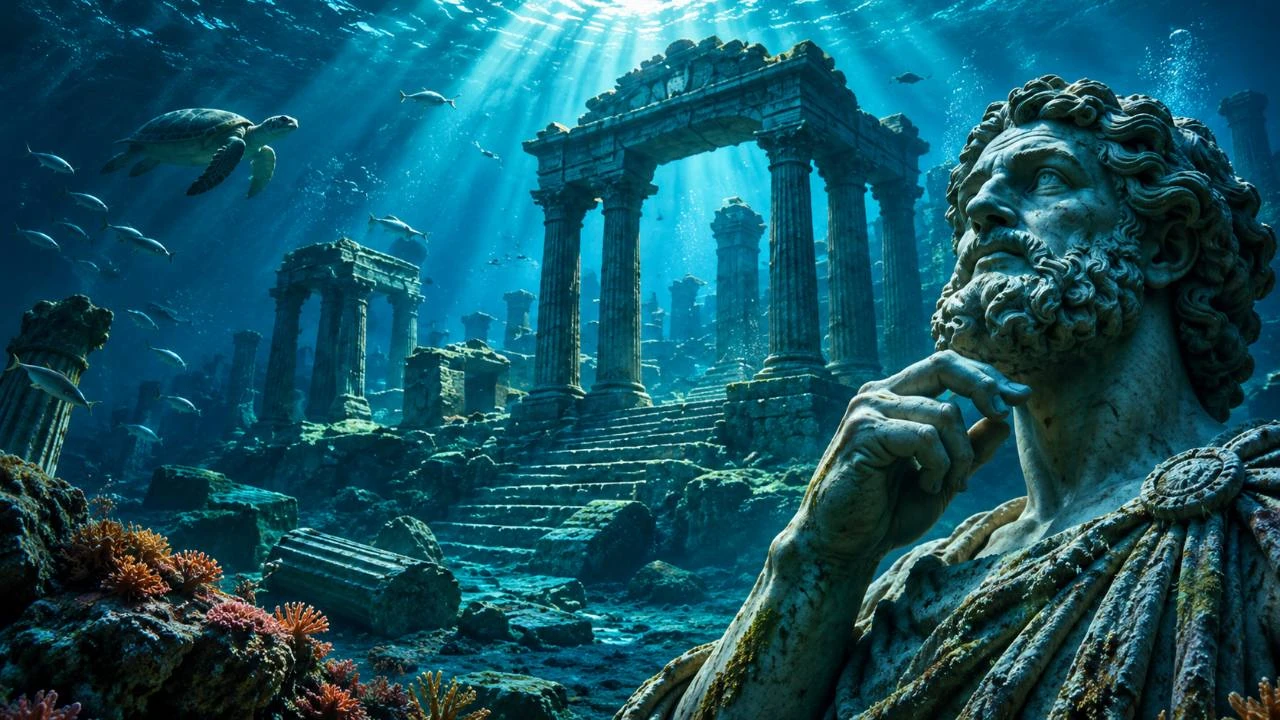
Historical fantasy illustration, not a photograph of Atlantis or an excavated site. The statue, architecture, marine life and underwater setting are imagined and do not constitute archaeological evidence. Editorial image supplied for PRESDA. Original creator and reuse licence not provided.
Atlantis is real as a story with a traceable ancient source. It has not been established as the lost civilization described in that story. That distinction leaves plenty to investigate: what Plato wrote, why his island empire mattered to his argument, and how later readers turned a philosophical narrative into a destination. A submerged wall or an impressive satellite image can be interesting without solving the mystery. The claim must be matched to evidence, rather than to the picture we already hope to find.
Where does the story begin?
In Timaeus, Plato places the account in the mouth of Critias, who connects it with Solon and Egyptian priests. The island power is located beyond the Pillars of Heracles and is set against an idealized ancient Athens. Its eventual destruction comes through catastrophe. These details belong to the dialogue’s narrated history. The chain of speakers inside the text is not the same thing as an independently verified archive from Egypt. It tells us how Plato presents the story’s authority, not that each link has been authenticated. Plato: Timaeus, translated by Benjamin Jowett
The magnificent city in Critias
Critias expands the account with a landscape of concentric rings, canals, temples, resources and royal power. Poseidon’s place in the genealogy and the movement from virtue toward corruption give the narrative a moral and political structure. Reading only its engineering details misses that setting. Plato was not writing a modern excavation report with coordinates and an inventory of dated finds. The text is primary evidence for an ancient literary and philosophical construction, even when a character insists that its events are true. Plato: Critias, translated by Benjamin Jowett
What does archaeology establish?
NOAA’s explanation states that there is no evidence that Atlantis existed. That does not mean people have never built coastal cities that later flooded or disappeared. It means such discoveries do not identify Plato’s particular civilization by resemblance alone. A persuasive identification would require a coherent site, an appropriate chronology and independent material evidence connecting the proposed place with the claim. A circular landform is not enough; neither are carved-looking rocks without a demonstrated human origin and historical context. NOAA: the Atlantis claim and ocean evidence
Real catastrophes are not the same as Atlantis
Akrotiri on Thera offers a useful comparison because its Bronze Age settlement is genuinely excavated. The National Archaeological Museum in Athens describes objects preserved beneath volcanic ash, evidence of a flourishing society devastated by an eruption. Those remains tell a real story through buildings and material culture. They do not, by themselves, establish the city as Atlantis. A real disaster might be proposed as an inspiration for a later tale, but inspiration is a different claim from literal identity and needs its own argument. National Archaeological Museum, Athens: antiquities of Thera
Why the imagined pictures feel convincing
The supplied hero gives the legend a visible world: underwater architecture, a classical-style statue and marine life. It is an illustration of an idea, not a discovery photograph. Its detail can make an imagined location feel documented, which is precisely why the distinction matters. Archaeological confidence comes from provenance, context and repeatable examination, not the richness of a reconstruction. A beautiful image may explain the emotional appeal of Atlantis without adding a single piece of evidence for the island.
The responsible conclusion preserves both curiosity and proportion. Plato’s Atlantis is a powerful ancient narrative; its existence as the civilization he describes remains unestablished. Future finds should be evaluated on their own evidence rather than forced into the name. The story remains worth reading for what it says about power, wealth and decline. Its most secure surviving location is in the texts, where the difference between a remembered disaster and a philosophical invention remains a question to investigate, not a license to invent facts.
Related reading: The ritual behind the El Dorado legend.
FAQ
Frequently Asked Questions
Has Atlantis been discovered?
No accepted archaeological identification establishes the civilization described by Plato. NOAA states that there is no evidence it existed.
Which ancient texts describe Atlantis?
Plato’s Timaeus and Critias are the foundational texts. Their narrated sources are not independently authenticated archives.
Does the eruption at Thera prove Atlantis was real?
No. Akrotiri is a real excavated Bronze Age settlement, but that does not establish identity with Plato’s island.
PRESDA Dispatch
Stay Informed. Stay Aware.
A sharp briefing across AI, gaming, sport, business, world affairs, paparazzi, and lifestyle.