CARAL: ONE OF THE OLDEST CITIES IN THE AMERICAS
Explore Caral’s ancient pyramids, sunken plazas and radiocarbon evidence, and discover what this Peruvian city reveals about early civilisation.
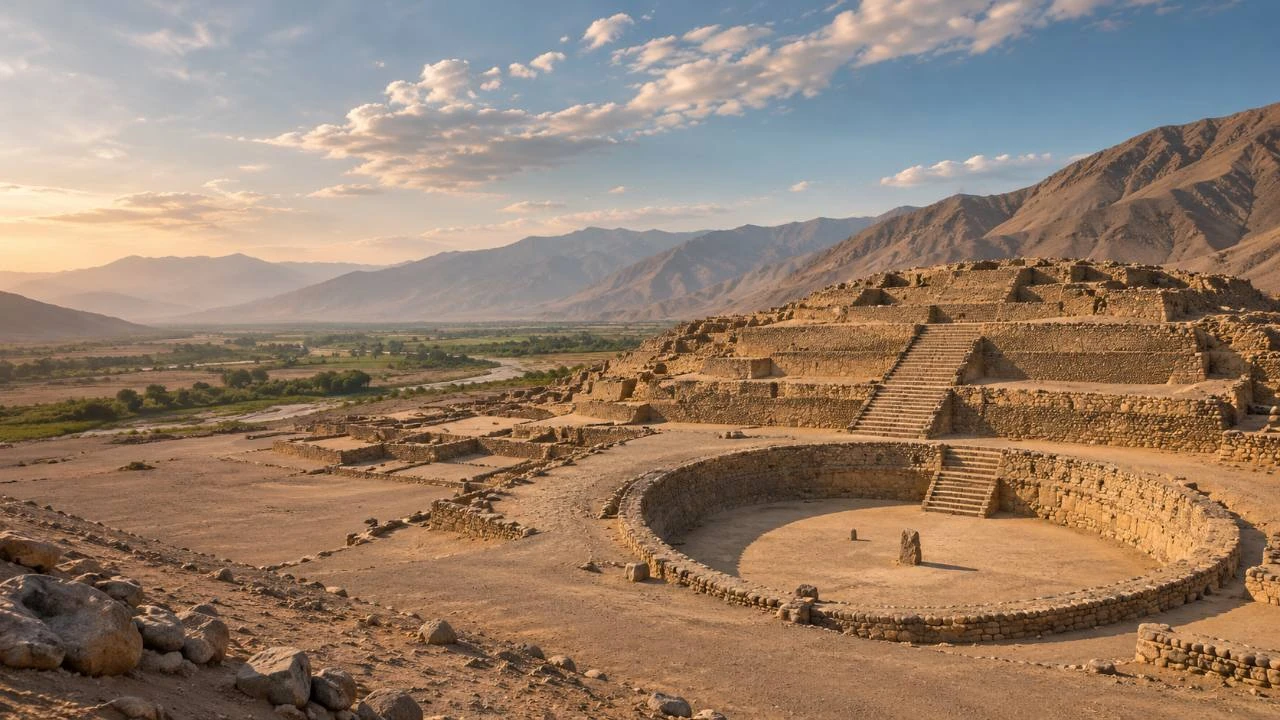
Editorial landscape depiction supplied for PRESDA. It illustrates Caral’s architecture; lighting and the exact arrangement shown are not authenticated archaeological documentation. Editorial image supplied for PRESDA.
Long before the Inca Empire, people in Peru’s Supe Valley were organising labour, raising monumental platforms and gathering in carefully planned public spaces. Caral is one of the oldest known urban centres in the Americas, with a history reaching back roughly five millennia. Its importance is not simply that it is old. It shows that complex societies in the Americas followed their own paths, and that stone buildings can preserve evidence of institutions whose names and spoken words have disappeared.
Where is Caral, and what survives?
Caral stands inland from Peru’s Pacific coast on a dry terrace above the Supe Valley. UNESCO’s World Heritage property, inscribed in 2009, covers 626 hectares. The remains include monumental platforms, six large pyramidal structures and sunken circular courts. These are not Egyptian pyramids transplanted to South America: they belong to a local architectural tradition. Shape alone cannot establish that distant societies shared builders, beliefs or a common origin. UNESCO: Sacred City of Caral-Supe
How do archaeologists know its age?
A landmark 2001 Science paper by Ruth Shady Solis, Jonathan Haas and Winifred Creamer reported radiocarbon dates associated with Caral’s architecture, including calibrated dates around 2627 to 1977 BCE. Those measurements transformed the chronology of early urban life in the region. They do not identify one exact founding day. A dated sample belongs to an archaeological context, and a building may have been constructed, modified and used across several generations. Shady, Haas and Creamer: Dating Caral, Science (2001)
A woven bag can be a historical clock
The researchers dated organic material associated with construction, including plant fibres from woven bags used to carry or contain stones. Short-lived plants help reduce a problem that can arise when old wood is reused long after a tree grew. The connection between sample and structure remains essential. Radiocarbon dates the once-living material; archaeological reasoning connects that material to a construction episode. The science is stronger when those two steps are kept visible. Shady, Haas and Creamer: Dating Caral, Science (2001)
A city within a regional network
Research published in Nature in 2004 broadened the picture by dating Late Archaic settlements across the Norte Chico region. Caral was not an isolated flash of sophistication in an empty landscape. Nearby valleys also contained substantial centres. The regional perspective changes the question from who built one astonishing monument to how communities sustained networks of production, exchange and authority over time. Haas, Creamer and Ruiz: dating the Norte Chico region, Nature (2004)
Peru’s archaeological authorities emphasise the relationship between farming communities and coastal fishing settlements. Cotton mattered because it could become fishing nets; marine resources and agricultural products linked different environments. This makes early urban life easier to understand as a system of relationships. Monumental construction required more than stone. It depended on food, materials and arrangements through which people could mobilise labour beyond one household. Peru Ministry of Culture: fishing and Caral’s economy
What can the buildings tell us about power?
Public architecture is evidence of coordination, but it does not provide a transcript of government. The size of a platform can reveal a substantial investment of work. Differences between spaces can suggest social distinctions. Neither observation tells us every rule by which leaders were selected or labour was organised. Words such as city, state and civilisation are useful analytical tools, provided they do not make an ancient society appear more fully known than it is.
Beyond the myths of a lost civilisation
Ruth Shady’s research programme has made Caral central to the study of early Andean knowledge and social organisation. The work is ongoing, which is precisely why a mystery need not become a legend. Unanswered questions about beliefs, authority or environmental pressures call for more evidence. They do not establish an unknown global empire. Nor does the absence of evidence for a particular practice prove that every generation at every settlement lived in the same way. Zona Arqueológica Caral: Ruth Shady on research and knowledge
Calling Caral one of the oldest cities is therefore more useful than turning antiquity into a competition with a permanent winner. Definitions of urban life differ, and new evidence can change chronologies. Its achievement remains remarkable without a superlative: people in this valley created monumental places and durable social connections thousands of years before the Inca state. Their history belongs to the Americas in its own right, not as a missing chapter borrowed from somewhere else.
Ancient does not mean primitive
The word preceramic describes an archaeological period; it is not a judgement about intelligence. A society need not reproduce the same sequence of objects and institutions as another to organise substantial collective work. Caral encourages a more precise question: which materials and relationships were available here, and what could people accomplish with them? That approach recognises innovation without imagining modern governments, markets or professions in evidence that cannot establish them.
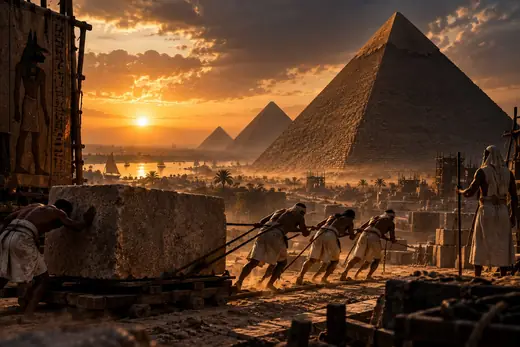
Further reading: How archaeologists explain the Egyptian pyramids.
Related reading: The much later rise of the Inca Empire.
FAQ
Frequently Asked Questions
How old is Caral?
Its history reaches back roughly 5,000 years. Radiocarbon results document major construction in the third millennium BCE; these are not an exact founding date.
Was Caral an Inca city?
No. Caral predates the Inca Empire by several thousand years and belongs to a much earlier phase of Andean history.
Is Caral the oldest city in the Americas?
It is widely recognised as one of the earliest urban centres. A single absolute ranking depends on definitions and the archaeological evidence available.
PRESDA Dispatch
Stay Informed. Stay Aware.
A sharp briefing across AI, gaming, sport, business, world affairs, paparazzi, and lifestyle.