INCA EMPIRE: HOW A CIVILIZATION IN THE ANDES BUILT A WORLD ABOVE THE CLOUDS
Roads crossed mountain passes, knotted cords recorded wealth and terraces fed an empire. Discover how the Inca governed the Andes—and why their fall took far more than one battle.
Stand above the Urubamba valley and the first impression is distance: ridges beyond ridges, a river far below, clouds moving between stone terraces. The second is human intention. Someone surveyed those slopes, carried materials, directed water and made a place to live where the landscape seems determined to resist settlement.
The Inca Empire was built from thousands of such decisions. Its spectacular masonry matters, but so do the farmers who maintained terraces, the communities that renewed bridges and the officials who counted provisions with knotted cords. Tawantinsuyu joined extraordinarily different environments through government, labor and movement.
It was also an empire. Its roads carried armies as well as supplies; its rulers offered protection and demanded obedience. Understanding its achievements means understanding those obligations—and why, when civil war and Spanish invasion collided, neither magnificent infrastructure nor enormous armies could guarantee survival.
BEFORE THE INCA: THE ANDES ALREADY HAD A HISTORY
The Inca did not invent Andean civilization. Long before their imperial expansion, societies had developed monumental architecture, irrigation, textile production, specialized farming and networks connecting different elevations. Chavín, Moche, Tiwanaku, Wari and Chimú belong to distinct histories, not a single ladder inevitably leading to Cusco.
Wari administrators had linked settlements through roads and provincial centers. Tiwanaku grew within the demanding environment around Lake Titicaca. On the northern coast, Chimú rulers governed from Chan Chan and drew wealth from irrigated valleys and skilled production. The Inca inherited a continent of experienced builders and organized communities. They appropriated and enlarged existing systems while introducing their own political priorities. Smithsonian: Andean ancestors and the beginnings of the road
That inheritance changes the central question. Rather than asking how an isolated people suddenly invented an empire, we should ask how one power near Cusco learned to mobilize so much of the knowledge already present in the Andes.
CUSCO, MANCO CÁPAC AND THE PROBLEM OF ORIGINS
Inca origin traditions describe sacred journeys and ancestral founders. In one influential account, Manco Cápac and Mama Ocllo emerge from the world of Lake Titicaca as children of the Sun and establish a new order at Cusco. Other traditions place ancestral emergence at caves near Pacaritambo. These narratives explained belonging, authority and relationships with a sacred landscape. They are not independently dated eyewitness biographies. Smithsonian: Children of the Sun
Archaeology instead reveals a long process of settlement, competition and political consolidation around the Cusco valley. The people who eventually called themselves Inca did not arrive with a fully formed continental government. They became dominant among neighboring communities and built a ruling identity around that success.
Cusco developed into the empire’s political and ceremonial center. Its importance was not simply that the ruler lived there: roads, ritual relationships and provincial obligations oriented a much larger world toward the city. Machu Picchu, despite its modern fame, was never the imperial capital. Smithsonian: Cusco, center of the Inka world
PACHACUTI AND THE MAKING OF TAWANTINSUYU
Colonial accounts place a crisis under Viracocha Inca at the turning point of the story. Chanca enemies threaten Cusco; the ruler withdraws; a younger royal figure successfully defends the city and becomes Pachacuti. It is a powerful foundation narrative, but its details come through later political memories. Archaeological research challenges the image of a single, straightforward Chanca state confronting an equally unified Inca kingdom. PUCP: a reassessment of Chancas and Incas
The year 1438 is conventionally attached to Pachacuti’s accession and the beginning of rapid expansion. It should not be treated as an archaeologically proven starting gun. Radiocarbon studies have complicated the tidy reign dates reconstructed from colonial chronicles. The broad picture—a major fifteenth-century acceleration of imperial power—is more secure than every year assigned to every ruler. Radiocarbon: reconsidering Inca imperial chronology
Pachacuti is associated with rebuilding Cusco and transforming regional dominance into an expansive imperial system. Topa Inca Yupanqui continued campaigns that greatly extended its reach; Huayna Capac consolidated power and fought farther north, especially in the region of present-day Ecuador. Expansion combined force with negotiation, marriage alliances and the incorporation of local rulers. Smithsonian: the empire builders
The realm of the four parts
Tawantinsuyu is commonly translated as the realm or land of the four parts. From Cusco, Chinchaysuyu extended broadly northwest, Antisuyu toward the eastern slopes and northeast, Qullasuyu southeast and Kuntisuyu southwest. Spellings vary because Quechua words have been recorded through different orthographic systems. These were imperial divisions, not equivalents of modern countries. Smithsonian: the four suyus
At its greatest reach, Inca authority extended from modern Ecuador through Peru and Bolivia into parts of Chile and Argentina, with a northern frontier reaching southern Colombia. Control was uneven. A provincial center, a tributary community and a contested frontier did not experience the same state presence. Modern maps make the empire look more uniform than it was. Smithsonian: roads and imperial integration
HOW DID THE INCA CONTROL SUCH A HUGE EMPIRE WITHOUT CARS, HORSES OR MODERN COMMUNICATION?
An empire in the Andes faced a problem that a flat map conceals: a short distance could include a dangerous descent, a river crossing and another exhausting climb. The Qhapaq Ñan road system addressed that reality through routes adapted to their surroundings—paved stretches, steps, retaining walls, drainage and bridges rather than one standardized highway.
UNESCO describes a network extending over more than 30,000 kilometers. That is an estimate for a far-reaching system accumulated and expanded over time, not a surviving odometer reading. The shorter collection of road sections inscribed as World Heritage represents selected components, not the entire network. Earlier Andean routes formed part of the foundation. UNESCO: Qhapaq Ñan, Andean Road System
Runners, way stations and the infrastructure of authority
Chasqui relay runners moved messages and small items between stations. Tambos offered way stations for authorized travelers and official movement. Storehouses supplied troops, administrators and workers. Llama caravans carried loads that people would otherwise have needed to shoulder. This was a transport system organized around human feet and pack animals, not horses or carts.
Communications depended on people trained to remember, relay and interpret information. Roads were therefore only one component: the government also needed labor, provisions, local cooperation and officials who could make an order meaningful when it arrived. Smithsonian: road administration
Fiber suspension bridges allowed crossings where a stone bridge would have been difficult to construct. Their success depended on repeated maintenance, not a single miraculous act of engineering. A bridge was a continuing social agreement as much as a physical structure. Smithsonian: five Inka engineering achievements
The comparison with Rome’s roads and imperial administration is useful precisely because the solutions differed. Both empires needed movement and supplies; the Andes demanded an infrastructure suited to steep gradients, dispersed ecological zones and different animals.
HOW DID THE INCA FEED MILLIONS OF PEOPLE IN THE ANDES?
Altitude divided the economy into overlapping worlds. Maize flourished in suitable warmer valleys; potatoes and other tubers supported life at higher elevations; quinoa offered another important crop. High pasture sustained llamas and alpacas, providing fiber, meat and, in the llama’s case, transport. No single environment supplied everything.
Communities used connections across elevations to reduce dependence on one harvest or one climate. Terraces created manageable growing surfaces, while irrigation directed water through difficult terrain. These were inherited Andean practices that imperial organization extended and supported, not inventions suddenly issued from a palace. Smithsonian Native Knowledge 360°: food diversification
Preservation helped turn seasonal production into reserves. Chuño, made through a process of freezing and drying potatoes, could be stored beyond the immediate harvest. Qollqas—state storehouses—held food and other supplies. Their location and construction could use cool air and ventilation to help preserve contents. Reserves supported state projects and could be distributed during shortages. Smithsonian Native Knowledge 360°: food preservation
This does not demonstrate that nobody went hungry. Storage capacity, political priorities and local access mattered. The achievement was a system for managing risk across an unusually varied environment, not the abolition of drought, crop failure or inequality. Feeding an army also meant extracting production and labor from communities that had their own needs.
THE STONES THAT STILL PUZZLE VISITORS
At Sacsayhuamán above Cusco, enormous shaped blocks produce an immediate question: how were they moved and fitted? The irregular joints can look impossible if we imagine builders limited to rough guessing. Archaeology and experimental work offer a more convincing explanation: skilled workers, suitable tools, repeated adjustment and sustained organization.
Jean-Pierre Protzen’s investigations of Inca quarries and stonecutting identified evidence for selecting and working stone with hammerstones. His experiments demonstrated how pounding and progressive dressing could shape surfaces. Quarry traces and unfinished pieces reveal stages of work that a completed wall conceals. They support human craftsmanship, not aliens or an otherwise unattested stone-softening technology. Protzen: Inca Quarrying and Stonecutting
Transport is less completely reconstructed for every monument. Organized labor, ropes, prepared routes and ramps offer plausible means, but the precise handling sequence of each giant block cannot simply be recovered from its final position. Admitting that gap is better archaeology than filling it with a supernatural explanation. Protzen: Inca Stonemasonry
Closely fitted masonry, broad wall bases, inward inclinations and carefully arranged openings helped some Inca buildings withstand seismic forces. Drainage and foundations were equally consequential. These structures were resilient, not earthquake-proof; different construction types behave differently and can still suffer damage. Engineering Structures: investigations of archaeological structures in Peru
The most important correction is that spectacular stonework was not the only Inca building method. Ordinary construction also used smaller stone, earth and perishable materials. A palace wall is evidence of concentrated resources, not a photograph of every household.
DID THE INCA REALLY BUILD WITHOUT THE WHEEL?
The empire did not depend on a system of wheeled transport. That statement is more defensible than the absolute claim that nobody in the Inca world could have understood a wheel. Wheeled objects are documented elsewhere in the pre-Columbian Americas, including examples from Mexico; they should not be confused with evidence for Inca carts. Mexico’s INAH: a pre-Columbian wheeled animal figure
Practical transport depends on an entire system: surfaces, gradients, vehicles, animals and the loads being moved. Many Andean routes used stairways and narrow crossings. Llamas were useful pack animals but not substitutes for teams of large draft horses or oxen. The transport network made sense within those conditions. Yale Peabody Museum: Machu Picchu and the Inca world
It is misleading to measure this achievement only by a European checklist of missing technologies. The relevant question is whether a system could move people, information and supplies through its own landscape—and the Inca system demonstrably could.
QUIPU: HOW DO YOU RUN AN EMPIRE WITHOUT CONVENTIONAL WRITING?
A quipu, also spelled khipu, consists of cords arranged with knots and other distinctions. Numerical examples use a decimal system in which knot type and position record values. Colors, cord groupings and relationships between strings help organize information. Trained specialists, often called quipucamayocs, interpreted records used in accounting, population counts and the administration of labor and goods. Harvard Library: Andean accounting systems
The system was concrete enough to leave archaeological evidence in a government storehouse. At Inkawasi, researchers studied quipus recovered in association with stored agricultural products. Their context connects knotted records with the movement and accounting of goods, rather than treating the cords as mysterious ornaments. Urton and Chu: the Inkawasi khipu archive
Whether and how some quipus encoded narrative or other non-numerical information remains an active research question. Studies of later Andean cords, including objects communities identify as messages, suggest possibilities beyond numerical totals. Those findings do not mean that scholars can now read every surviving Inca quipu as a paragraph of text. Numerical accounting is firmly established; universal narrative decipherment is not. Sabine Hyland: the inscriptive capacity of Andean khipus
WHAT WAS LIFE LIKE INSIDE THE INCA EMPIRE?
Most people’s lives revolved around households, fields, herds and obligations within local communities. The ayllu linked people through kinship, shared resources and social responsibilities, although its form varied. Inca rule operated through these existing relationships as well as through appointed authorities.
The mit’a required rotating labor service. Communities supplied workers for agriculture, construction, transport, military needs and other state demands. This was not taxation through modern salaries and bank accounts: labor and goods were central to the state’s resources. Mitmaq resettlement moved populations for economic and political purposes, sometimes coercively and far from their original homes. Annales: Andean institutions, labor and resettlement
These arrangements could provide access to resources and protection while also restricting choice. A household helping build a road was producing something useful, but that does not make its contribution voluntary. Reciprocity was an important language of government; imperial power determined how far an ordinary community could refuse its demands.
Women, specialists and unequal lives
Women’s agricultural work, weaving, household management and ritual responsibilities were fundamental. Aclla institutions selected girls and women for specialized service, including textile production and religious or courtly functions. Some acquired prestige, but selection also involved state control over their labor and futures. Fine cloth carried exceptional value: weaving was central to political gifts, ceremony and elite distinction. Metropolitan Museum of Art: an Inca tunic and specialized textile production
Soldiers, administrators, artisans and other specialists occupied different positions from farming households. Imperial elites enjoyed privileged access to land, labor and ceremonial goods. Regional exchange and barter continued, and local economies were not identical everywhere; calling the whole empire either a modern free market or a perfectly uniform moneyless commune obscures that variety. University of California Press: Andean communities and historical livelihoods
THE SAPA INCA: KING, EMPEROR AND SACRED RULER
The Sapa Inca combined political command with sacred authority. Royal ancestry and relationships with the Sun helped legitimate government, while royal kin groups, or panacas, sustained the interests and memories of particular rulers. Succession was not a simple, automatic transfer to the eldest son. Competing relatives and their supporters could turn it into a dangerous struggle.
Dead rulers remained part of political life. Their preserved bodies, attendants and estates sustained ancestral authority, and the kin groups responsible for them continued to command resources. The boundary between a living government and an ancestral order was therefore unlike a modern distinction between politics and private remembrance. Bauer and Coello Rodríguez: the royal mummies of the Incas
This helps explain why an emperor’s capture could be so consequential without making the whole empire a machine with a single switch. Provincial leaders, royal lineages and commanders still had their own interests. Sacred monarchy concentrated power, but it also created disputes over who could legitimately exercise it.
RELIGION, THE SUN AND THE SACRED LANDSCAPE
Inti, the Sun, held a central place in imperial religion. Viracocha was associated with creation—a deity distinct from the ruler called Viracocha Inca. Cusco’s Coricancha, the Golden Enclosure, was a major sacred complex linked with the imperial cult. Its surviving stonework later became part of a very different religious setting under Spanish rule. Getty: Coricancha
Religion also lived in the landscape. Huacas could be sacred places or objects; mountains understood as apus anchored local relationships with powerful beings. State worship did not erase every community’s older practices. Imperial expansion could incorporate existing shrines while directing ceremonies and resources toward a wider political order. Smithsonian: roads, religion and the sacred landscape
Capacocha ceremonies sometimes involved the sacrifice of children, associated with major events and sacred destinations, including mountain summits. Archaeological discoveries provide direct evidence that these deaths occurred. They should neither be denied nor turned into spectacle. The ceremonies formed one grave aspect of an extensive religious world that also involved offerings, pilgrimage, agricultural rituals and ancestor veneration. Ceruti: frozen mummies and Andean mountaintop shrines
MACHU PICCHU: WHAT WAS IT REALLY FOR?
Machu Picchu belongs to the fifteenth-century imperial world and is strongly associated with Pachacuti. A leading interpretation identifies it as a royal estate, with residences, agricultural support and spaces for ceremony. Religious and landscape-based interpretations emphasize other dimensions of its purpose; an estate could also be a sacred place. It need not have had only one function. UNESCO: Historic Sanctuary of Machu Picchu
Radiocarbon research published in 2021 placed occupation approximately between 1420 and 1530, earlier than some chronicle-based reconstructions expected. Those are estimated occupation dates, not an exact construction timetable. The findings illustrate why archaeological evidence can revise familiar ruler chronologies. Yale: research on Machu Picchu’s earlier occupation
The settlement lost its imperial support system during the upheavals of the sixteenth century and did not become a major Spanish colonial town. Its relatively secluded location mattered, but the precise sequence of abandonment is not fully documented. We should not replace that uncertainty with an elaborate story about a perfectly hidden city.
Hiram Bingham helped bring Machu Picchu to international attention in 1911. Local people already knew it: Melchor Arteaga guided him toward the ruins. “Rediscovery” is therefore best understood as entry into a particular international archaeological and publicity network, not the first human recognition of an unknown place. Yale Peabody Museum: the 1911 expedition and local knowledge
THE CIVIL WAR THAT WEAKENED THE EMPIRE BEFORE THE SPANIARDS ARRIVED
Huayna Capac died in the 1520s, although the exact year and diagnosis remain disputed. Smallpox is often identified as the cause, but the retrospective evidence is less decisive than many summaries imply. Colonial descriptions differ, and matching them to a modern disease diagnosis requires caution. Epidemic disease devastated Indigenous populations during the conquest era; that broader fact does not prove the cause of every individual death. McCaa and colleagues: reassessing the smallpox chronology
The succession crisis developed into war between Huáscar and Atahualpa. It divided royal supporters and armies, spreading violence through the political system. Atahualpa’s forces defeated Huáscar in 1532, shortly before the encounter with Francisco Pizarro. Victory did not immediately heal the divisions or make the conquered population uniformly loyal. Metropolitan Museum of Art: Golden Kingdoms and the conquest era
The Spaniards therefore entered a state still enormously powerful but politically wounded. The timing mattered: outsiders could exploit fears and rivalries that had already cost lives. Their arrival was not a contest between two intact societies meeting on equal terms for a single decisive battle.
CAJAMARCA: HOW WAS ATAHUALPA CAPTURED?
On November 16, 1532, Atahualpa entered Cajamarca to meet Pizarro. The Spanish expedition numbered in the low hundreds—commonly given as about 168—while the ruler arrived with a much larger entourage. That numerical contrast is striking, but an entourage gathered for an encounter is not the same thing as an entire imperial army deployed for battle. Adam Herring: Art and Vision in the Inca Empire, opening study of Cajamarca
Accounts describe a confrontation involving religious and political demands, followed by a prepared Spanish attack. Mounted men and infantry struck the assembled followers; weapons, noise and confinement produced confusion. Atahualpa was seized amid the killing. Precise dialogue and casualty totals differ among accounts and should not be presented as a modern transcript or verified census. R. Alan Covey: reading between the lines at Cajamarca
The decisive outcome was the capture of a ruler whose authority the invaders could exploit. It was a devastating ambush and a political seizure, not proof that 168 men had already defeated every army and community in Tawantinsuyu. Spanish accounts often celebrated divine favor and individual courage; historians must also ask what those narratives leave out. Archaeology magazine: the conquest and its longer sequence
THE ROOM FULL OF GOLD
While captive, Atahualpa offered a vast ransom. Gold and silver objects were gathered, and precious works were melted into a form the Spaniards could divide. Hernando Pizarro’s contemporary letter describes the promise of gold reaching a marked height in a room, but it is also a participant’s justification of Spanish conduct. It must be read as evidence with interests behind it. Hernando Pizarro’s 1533 letter, hosted by North Carolina State University
Paying did not secure Atahualpa’s freedom. The Spaniards executed him in 1533 after proceedings shaped by their own accusations and fears. Converting the ransom into a precise modern dollar total would conceal more than it explained: the value of sacred objects, political obligations and destroyed craftsmanship cannot be measured solely by a current bullion price.
The episode belongs within the wider history of gold, but it also reveals a collision over what wealth meant. Objects that expressed sacred and political relationships became divisible metal. As with the Mali Empire’s wealth, reducing an entire society to a ruler’s treasure misses the farms, labor and institutions behind it.
DID A FEW HUNDRED SPANIARDS REALLY DESTROY THE INCA EMPIRE?
Not by themselves. Horses and steel supplied serious advantages in particular encounters; firearms could contribute shock and disruption. None of these automatically occupied mountain provinces, fed an expedition or compelled every community to obey. The longer conquest involved reinforcements, Indigenous allies, local knowledge and the exploitation of existing political divisions.
Some Indigenous groups opposed Inca domination. Others acted within rival royal factions, sought protection or made alliances under rapidly changing pressures. Their decisions were not simply footnotes to European action, nor did alliance with Spaniards mean agreement with the colonial order that followed. Civil war, disease and the seizure of leadership multiplied the invaders’ opportunities.
The explanation is cumulative. Remove Indigenous assistance and the familiar picture of a tiny European force conquering millions becomes much harder to sustain. Remove civil conflict and the circumstances of Cajamarca look different. Guns alone explain neither the empire’s vulnerability nor the resistance that continued afterward.
CUSCO, MANCO INCA AND DECADES OF RESISTANCE
Spanish forces occupied Cusco in 1533. Manco Inca initially worked within the new political arrangement, but relations deteriorated under Spanish domination and abuse. In 1536 he led a major uprising, including the siege of Cusco. The city’s occupation had not ended the struggle over the Andes.
After the failure to expel the Spaniards, resistance continued from the Vilcabamba region. The Neo-Inca state maintained a surviving center of royal power through a mixture of warfare and negotiation. In 1572, a Spanish campaign ended that state; Túpac Amaru was captured and executed in Cusco. These events came roughly four decades after Cajamarca. PUCP: Inca resistance, Manco Inca and Vilcabamba
Even 1572 was not the disappearance of Andean people or culture. It marked the destruction of a remaining Inca royal government. Communities endured colonial extraction, forced changes and demographic catastrophe while preserving, adapting and rebuilding forms of life that conquest had failed to erase.
INCA EMPIRE: MYTH VS REALITY
“Machu Picchu was the capital.”
Cusco was the imperial center. Machu Picchu was an important estate and ceremonial landscape, not the headquarters of Tawantinsuyu.
“Aliens built the walls.”
Quarries, tool marks and experimental archaeology demonstrate human techniques. Uncertainty about an individual block’s transport does not constitute evidence for extraterrestrials or lost supertechnology.
“The Inca had no way to record information.”
Quipus supported sophisticated numerical accounting. Proposals about non-numerical encoding remain under investigation; recording did not require a familiar alphabet.
“Without wheeled transport, they could not have had roads.”
Their roads served walkers, runners, armies and pack animals. Stairs and suspension bridges were solutions to local conditions, not evidence of a failed highway system.
“A few Spaniards—and their guns—conquered millions alone.”
Cajamarca captured a ruler. The larger conquest depended on Indigenous participation, political division, disease, additional forces and sustained violence. Technology was one factor within that history.
“Atahualpa’s death ended Inca resistance.”
Manco Inca’s uprising and the Vilcabamba state came afterward. The chronology cannot stop in 1533.
“Everyone happily accepted Inca rule.”
Infrastructure and redistribution coexisted with conquest, compulsory labor and resettlement. Subjects had different interests and different reasons to cooperate or resist.
“Inca civilization vanished.”
The imperial state fell. Languages, agricultural knowledge, textiles, communities and relationships with the landscape continued, changing under colonial rule and into the present.
WHAT SURVIVED THE INCA EMPIRE?
The most visible survivors are buildings and roads, but living traditions matter more than the image of an empty ruin. Quechua languages continue to be spoken; terraces remain part of agricultural landscapes; potatoes, maize and quinoa connect modern diets with much longer histories. Textiles and communal practices carry knowledge that has been repeatedly adapted, not simply frozen since the fifteenth century.
At Q’eswachaka, communities renew a rope bridge through shared work and ritual. UNESCO’s recognition emphasizes the skills and social relationships involved. The bridge makes a larger point: continuity is an activity performed by living people, not merely something preserved in a museum. UNESCO: annual renewal of the Q’eswachaka bridge
Across Peru and neighboring countries, Andean communities have combined inherited practices with Christianity, modern politics, migration and new economic conditions. Festivals and sacred landscapes can express both continuity and religious change. Neither romantic timelessness nor a story of total disappearance does justice to that experience.
The Inca built an extraordinary imperial system by adapting government, agriculture, transport and labor to the mountains. Its power rested on knowledge and cooperation, but also on hierarchy and coercion. Its collapse was the interaction of civil war, disease, alliances, political fragmentation and conquest—not the inevitable result of a single technological gap.
Above the Urubamba valley, the terraces still make the same quiet argument. The Andes were never an empty obstacle waiting for an empire to overcome them. They were an inhabited world, understood through generations of work. The state that claimed that world is gone. The human history that made it possible is not.
About the hero image
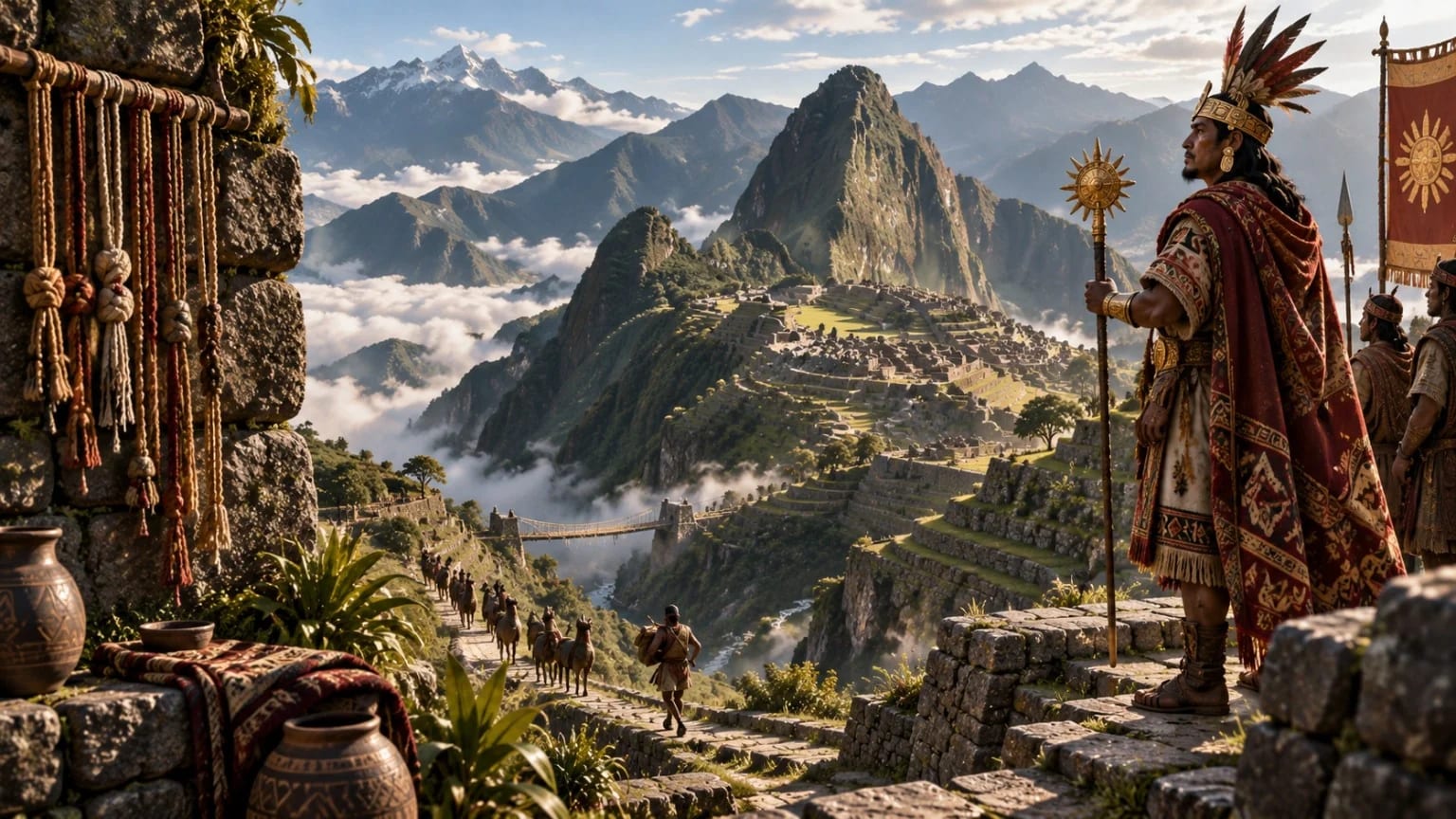
The hero is an editorial historical reconstruction inspired by Inca architecture and Andean landscapes. It is not a literal portrait of a specific ruler, a documented ceremony or an exact reconstruction of an ancient settlement.
FAQ
Frequently Asked Questions
What is this PRESDA article about?
Roads crossed mountain passes, knotted cords recorded wealth and terraces fed an empire. Discover how the Inca governed the Andes—and why their fall took far more than one battle.
Which category does this story belong to?
This story is part of PRESDA's History coverage.
Who published this article?
INCA EMPIRE: HOW A CIVILIZATION IN THE ANDES BUILT A WORLD ABOVE THE CLOUDS was published by PRESDA Editorial on PRESDA.
PRESDA Dispatch
Stay Informed. Stay Aware.
A sharp briefing across AI, gaming, sport, business, world affairs, paparazzi, and lifestyle.