Audi Plans $4 Billion US Factory in Major Expansion
Audi plans a Georgia plant with 4,500 jobs and capacity for 200,000 vehicles. The investment, differing timelines, tariffs and remaining approvals explained.
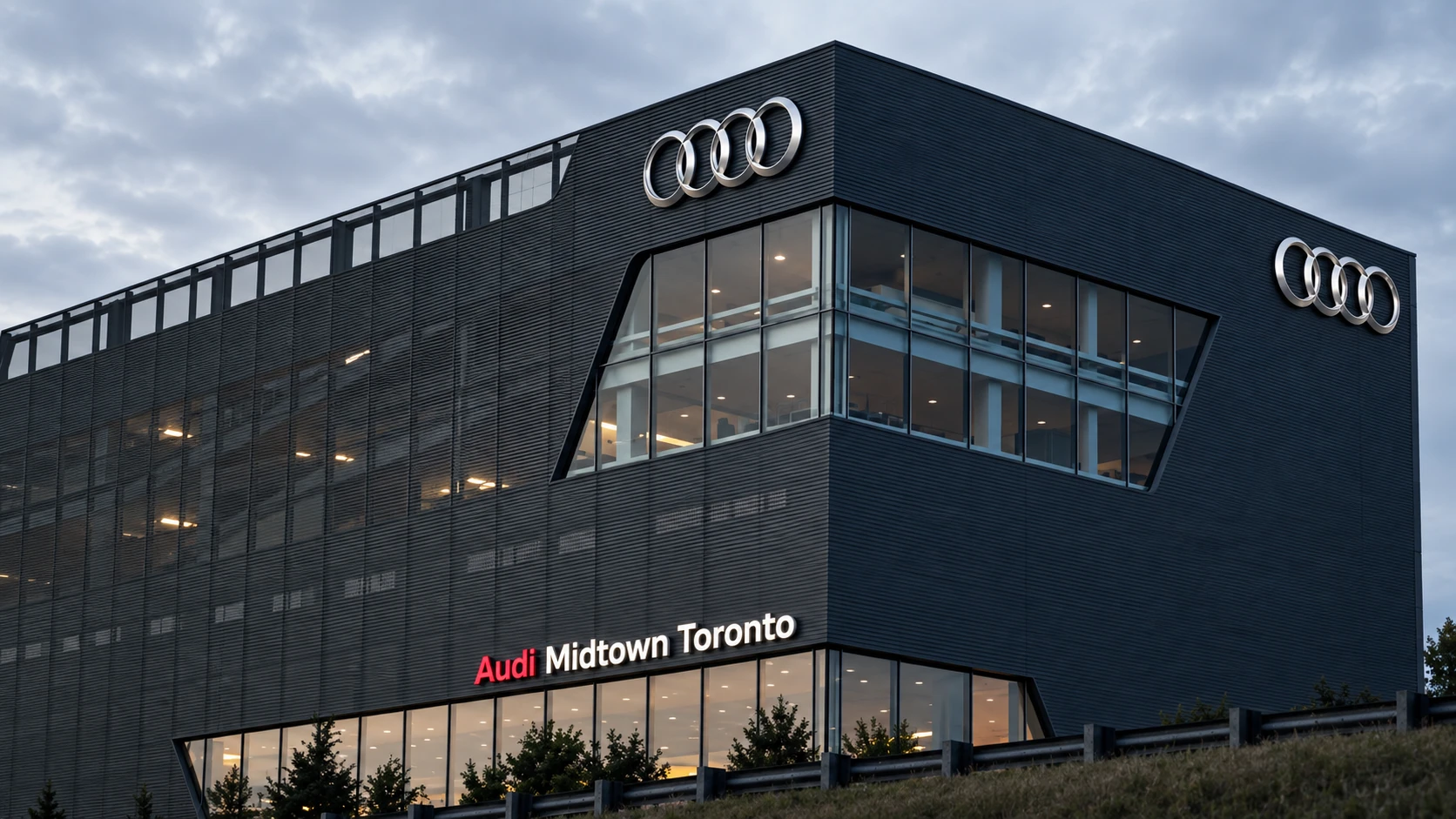
PRESDA editorial illustration generated with AI. The supplied scene is labeled Audi Midtown Toronto. It does not depict the Georgia site, construction work or an authenticated showroom photograph.
Audi plans to invest approximately $4 billion in its first United States manufacturing plant, a Georgia project intended to create about 4,500 jobs and accommodate up to 200,000 vehicles annually. Those are announced investment and capacity targets, not money already spent, people already employed or cars already sold. For the Volkswagen-owned premium brand, the proposal would change the geography of its American business. Audi's October 25 announcement
The attraction is straightforward: making vehicles closer to customers can change transport costs, currency exposure and the treatment of imported finished cars. The execution is much harder. A successful launch requires permits, infrastructure, suppliers, trained workers and buyers willing to pay for the finished product. This analysis distinguishes the announced plan from outcomes that remain to be delivered, using information available on October 25, 2026.
What has Audi announced?
The company identifies Georgia as its proposed production base for premium SUVs aimed at North American customers. Its announcement puts the investment at around $4 billion, employment at approximately 4,500 and designed annual capacity at up to 200,000 vehicles. Audi describes North America as a stronger third pillar alongside Europe and China. It does not provide a complete model-by-model product programme or a public breakdown of every construction contract.
Capacity deserves particular care. It describes what a factory is designed to produce under specified operating assumptions. Actual output depends on shifts, parts availability, product changes and demand. Nor does the announced investment represent annual revenue. A factory may cost billions to establish while generating either attractive returns or disappointing results over its operating life. These are different measures, and none can substitute for the others.
Where is the plant, and when could it open?
Georgia's governor identifies the Middle Georgia Megasite and names the development partnership involving Peach, Macon-Bibb and Houston counties. The state's October 24 statement anticipates grading in 2027, facility construction in 2028 and full production in 2031. Audi's statement uses a broader schedule: construction beginning in 2027 and production in the early 2030s. These descriptions should be attributed separately rather than compressed into an unconditional opening date. Georgia's project announcement
The distinction may reflect different definitions of site work and factory construction, but the published statements do not establish that explanation. PRESDA has not verified a complete register of final permits and approvals. Readers should therefore treat the schedule as a project target subject to the remaining approval and execution process, not as confirmation that every authorization has been granted. A named site and a public commitment are substantial milestones; they are not a completed plant.
Why some reports mention $4.2 billion
The Associated Press reported that Donald Trump cited $4.2 billion when announcing the project at a rally in Perry, Georgia. The company and state announcements use approximately $4 billion. This article uses the corporate figure and preserves the distinction. AP also reported that Trump credited tariffs for the decision, while Audi's chief executive Gernot Döllner emphasized a long-term commitment to the American market. AP's account of the announcement
A political explanation and a corporate investment case answer different questions. A president may present a factory as evidence that a trade policy is working; a manufacturer must justify whether the project can earn an adequate return under several possible policy environments. The announcements do not reveal Audi's internal financial model, so claims that tariffs alone caused the decision would go beyond the evidence.
Tariffs change the calculation, but do not erase costs
Audi's own second-quarter 2025 financial update explicitly identified US tariffs and restructuring expenses when revising its outlook. That is evidence that trade policy had already entered the company's planning. It is historical context, not a current tariff table or a forecast for the Georgia operation. Import charges depend on the product, origin and rules in force at the time goods enter a market. Audi's Q2 2025 financial update
As an economic proposition, local assembly can reduce exposure to duties on imported finished vehicles. It does not automatically make imported components duty-free, eliminate logistics or guarantee a lower retail price. A company still has to buy machinery, secure parts, manage inventories and recover its capital costs. The relevant comparison is the full cost of serving customers from different production locations, not a single tariff rate viewed in isolation.
The timing matters too. A plant expected to enter production in the next decade cannot solve every immediate pricing or inventory problem. Before it opens, existing supply arrangements still matter. After it opens, its competitiveness will depend on the model mix and operating costs as well as trade rules. That long interval is why a manufacturing investment should be judged across business cycles rather than through the reaction to one announcement.
Competition already has an American industrial base
BMW provides a useful comparison without making the projects interchangeable. The company reports that its Spartanburg plant in South Carolina assembled 412,799 vehicles in 2025 and exported nearly 200,000, worth about $9 billion. This is an established production and export operation, whereas Audi's 200,000 figure is planned annual capacity. Comparing those two numbers as if both were actual sales would be misleading. BMW's 2025 production and export results
The competitive lesson is about the surrounding system. A premium factory needs a dependable supplier base, delivery discipline and consistent quality before it can become a durable advantage. It also needs products customers want. Domestic production alone does not confer brand strength or insulate a manufacturer from price competition. Audi would be entering a market where industrial experience, dealer relationships and customer expectations already shape the contest.
Jobs, training and the public-interest test
Georgia says its Quick Start programme will work with Audi on a customized curriculum and a designated training facility, alongside technical-college partners. This is a concrete element of the workforce plan. The approximately 4,500 jobs remain a planned employment figure; it should not be expanded into a larger indirect-jobs total without a transparent economic-impact study. The announcement also does not establish a detailed wage schedule for every role.
For surrounding communities, the questions extend beyond the headline. How much infrastructure must be built? When will recruitment begin? Which skills will be transferable if production changes? What public commitments are conditional on investment or employment milestones? Those questions should be answered from agreements and implementation records as they become available. No verified total incentive package or public subsidy per job is established here.
SUVs, electrification and the global strategy
The announced emphasis on premium SUVs identifies a customer segment, not a fully specified propulsion strategy. PRESDA has not verified a complete Georgia model allocation, battery-manufacturing plan or powertrain split from the announcements cited here. Describing the site as an exclusively electric factory would therefore add a claim the available record does not support. The same caution applies to promised battery suppliers and future vehicle prices.
Manufacturing flexibility has value when customers and policy can move at different speeds. However, flexibility also requires engineering choices and investment; it is not simply a word that removes commercial risk. Our wider examination of the transition to electric cars explains why charging access, purchase costs and production decisions must be considered together. Audi's US proposal belongs within that wider industrial transition.
What would demonstrate that the plan is working?
The useful milestones are verifiable: approvals completed, site work started, major buildings and utilities delivered, suppliers contracted, workers recruited and vehicles produced to the required standard. Later, utilization, customer demand and financial returns will matter more than the original announcement. A plant operating below its intended scale can still be strategically important, but its economic performance must be judged using actual results.
Audi's proposal is consequently both a substantial commitment and an unfinished business story. Four billion dollars describes the intended scale of investment. The eventual test is whether the company can turn that capital into a competitive manufacturing operation and sustained employment. The next chapter will be written through construction, production and customer purchases, with each stage checked against the promises made in Georgia.
FAQ
Frequently Asked Questions
What is this PRESDA article about?
Audi plans a Georgia plant with 4,500 jobs and capacity for 200,000 vehicles. The investment, differing timelines, tariffs and remaining approvals explained.
Which category does this story belong to?
This story is part of PRESDA's Business coverage.
Who published this article?
Audi Plans $4 Billion US Factory in Major Expansion was published by PRESDA Editorial on PRESDA.
PRESDA Dispatch
Stay Informed. Stay Aware.
A sharp briefing across AI, gaming, sport, business, world affairs, paparazzi, and lifestyle.