McDonald's: The Real Estate Empire Behind the Burgers
How McDonald's makes money from rent, royalties and restaurants. Its origins, property ownership and 2025 accounts explained without confusing sales and profit.
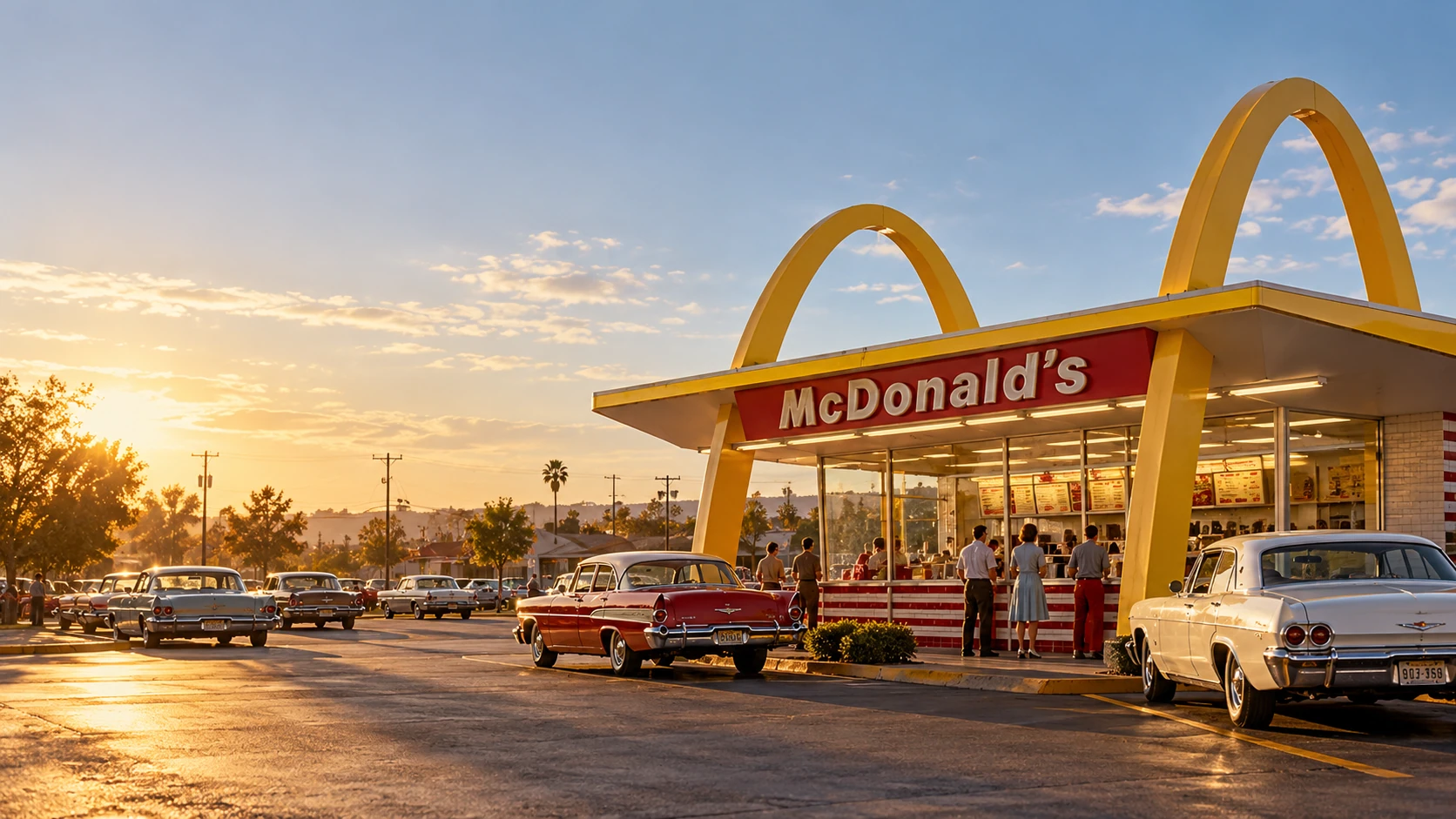
PRESDA AI-generated editorial illustration of an imagined vintage restaurant. This is not an archival photograph or a depiction of a verified McDonald's location.
The customer sees a restaurant. The franchisee sees a business to operate. McDonald's sees both, along with a location whose commercial life may last much longer than a menu promotion. That difference in perspective helps explain why the company behind the Golden Arches collects billions of dollars in rent as well as royalties.
Calling McDonald's a real estate empire captures an important part of its economics, but it can also obscure them. The company does not own every restaurant property, and rent is neither its only revenue nor pure profit. The more accurate story is about how a food brand, franchise contracts and control of valuable sites reinforce one another. Figures below distinguish the 2025 financial year from dated 2026 developments.
Before Ray Kroc: the brothers' operating idea
Richard and Maurice McDonald opened their San Bernardino restaurant in 1940. In 1948, they reorganized it around a limited menu and a faster, more standardized service system. The innovation was operational: reducing complexity made it easier to repeat tasks, coordinate workers and serve customers predictably. The Library of Congress documents the brothers' place in a history often retold as Kroc's achievement alone. Library of Congress history
Kroc, a milkshake-mixer salesman, encountered their operation in 1954. His Des Plaines restaurant opened on April 15, 1955, beginning the expansion of the business he organized. It was not the first McDonald's ever. In 1961, he bought the brothers' rights for $2.7 million. McDonald's own history records these milestones and the later international openings in Canada and Puerto Rico in 1967. McDonald's historical timeline
The historical distinction is commercially revealing. The brothers developed a restaurant system; Kroc built an organization capable of spreading it. Scaling required more than persuading people to sell hamburgers. It required rules, capital, consistent supplies and a way to maintain standards when the person serving the customer was an independent business owner.
The property insight that changed the model
Finance executive Harry Sonneborn helped establish the property strategy through Franchise Realty Corporation in 1956. Leasing sites and buildings, then making them available to franchise operators, provided a financial and contractual foundation for expansion. The Museum of American Finance describes how property became central to the company's development. Museum of American Finance account
The logic is straightforward. A restaurant license gives an operator permission to use a brand and its methods. Control of the premises adds another durable relationship. A busy location can remain commercially useful through changes in management, renovation and menu fashion. If a franchise agreement ends, control of the site can help preserve the company's presence there, subject to the relevant contracts and law.
This does not make the hamburger irrelevant. A site designed for a restaurant needs customers, and a landlord cannot indefinitely extract healthy rent from an unhealthy business. The property strategy is strongest when the operating restaurant succeeds. Brand appeal and real estate are interdependent, rather than rival explanations of where the money comes from.
Who owns the restaurant, the land and the business?
At the end of 2025, McDonald's had 45,356 restaurants, approximately 95% franchised. In its consolidated markets, it owned about 56% of the land and 80% of the buildings used by its restaurants. Those ownership percentages do not describe every property across the worldwide system. 2025 annual report
A conventional franchisee operates the restaurant business and commits capital to it. McDonald's generally owns or leases the premises and grants the franchise. Where the company leases a site, there may be a separate property owner receiving rent from McDonald's. Thus a franchised restaurant can combine a franchisee-run business, a company-owned building and land owned by somebody else. The logo does not tell a passer-by which arrangement applies.
Other markets use developmental licensees or affiliates with different investment responsibilities. Their economics should not be explained by simply copying the conventional US property model onto every country. The distinction also prevents a common error: counting franchised restaurants as if McDonald's employees directly operated all of them.
Following the money without counting it twice
The 2025 accounts report $10.442 billion of rental revenue, $6.018 billion of royalties and $88 million of initial fees. Together, these produced $16.548 billion in franchised revenue. Company-operated restaurant sales contributed $9.690 billion, and other revenue $647 million, bringing consolidated revenue to $26.885 billion. These are US dollars for one financial year, not the value of the property portfolio. Audited franchise revenue note Consolidated accounts
Rent therefore represented approximately 38.8% of total corporate revenue and 63.1% of franchised revenue, calculated from those reported figures. Both percentages are correct because their denominators differ. Neither means that rent represented the same share of profit. A large revenue stream can carry expenses, and the costs of a whole organization cannot be assigned simply by looking at its largest line of income.
Systemwide sales were $139.4 billion in 2025. This much larger measure includes sales made by franchise operators to customers. It is not an additional $139.4 billion earned by the parent company, nor should it be added to corporate revenue. The same customer's purchase can generate a franchisee sale and contractual payments to McDonald's without becoming two separate purchases. Full-year results
Why rent is not free money
Under conventional franchise arrangements, rent and royalties connect the company's income to restaurant operations, with contractual minimums as well as sales-related components. Franchisees must still fund the daily business: people, food, utilities and other costs. The company also has obligations on property it leases, maintenance-related responsibilities under applicable arrangements and the wider costs of running its system. The annual filing explains the different contractual structures. 2025 Form 10-K
A guaranteed contractual payment is not the same as guaranteed economic prosperity. Minimum rent may support predictability for the recipient while increasing pressure on an operator during weak trading. Conversely, a successful restaurant can support payments and reinvestment. Judging the system requires looking at both sides of the relationship, not assuming that a higher payment to the parent leaves the local operator equally well off.
Property ownership can offer security of tenure and exposure to changes in site value, but it also ties up capital. Leasing reduces the need to buy every site while creating future obligations. Neither choice is universally superior. The quality of the location, lease terms, financing costs and demand for the restaurant determine the result. An accounting book value should not be advertised as a current independent market valuation.
What the franchisee buys, and what it risks
The franchise proposition combines recognition with a repeatable operating framework. An owner does not begin with an unknown name and a blank menu. In exchange, the owner accepts contractual payments and constraints on how the restaurant operates. The attraction is a business with an established identity; the trade-off is that local autonomy is limited by the needs of a larger brand.
This creates recurring negotiations over modernization, promotions, equipment and the allocation of costs. A discount may make sense for attracting traffic across a network while looking less appealing to an individual restaurant with rising expenses. A renovation may help the brand over time while requiring immediate investment. These are structural tensions in franchising, not proof that every operator experiences the same dispute or earns the same margin.
For that reason, corporate earnings cannot be used as a shortcut to a typical franchisee's take-home income. Local rent, debt, labor costs, sales mix and operating performance matter. Nor does a familiar brand make a franchise a passive property investment. Running a restaurant remains an execution-intensive business in which staffing and service have immediate consequences.
Global scale, local adaptation
Expansion made McDonald's recognizable far beyond its American origins, but recognition alone does not make each new location successful. A standardized system must still work with local customers, regulations, suppliers and property conditions. The business has to balance consistency with relevance: too much variation weakens the common identity, while too little can make an international brand inattentive to the place where it operates.
Brand evolution also involves selling convenience in new ways. Drive-through service, delivery and digital ordering change how customers reach the restaurant and how orders move through it. They can increase convenience while creating new demands on kitchens and staff. A digital transaction is valuable only if the restaurant can fulfill it accurately and at an economics that works for the participants.
The physical site remains important in that process. Vehicle access, visibility, delivery coverage and the ability to handle different order channels can shape performance. A celebrated advertising campaign cannot move a poorly placed entrance or create kitchen capacity. This is where the property and restaurant stories meet most clearly: the building must support the service the brand is promising.
The 2026 test: affordability and execution
In its August 4 report for the second quarter of 2026, McDonald's said global comparable sales rose 1.3%, including 0.8% in the United States. These are same-period sales comparisons for qualifying restaurants, not a statement that every restaurant increased its customer count. Sales can change because of price, mix or traffic, and those drivers should not be treated as interchangeable. Second-quarter 2026 update
The strategic question is whether the company can maintain an affordable, dependable experience while sustaining investment and returns. Its scale does not remove competition from other restaurants, supermarkets or meals prepared at home. A price-sensitive customer evaluates the total bill and the experience, not the sophistication of a franchisor's balance sheet. The real estate supports the system, but customer demand continues to finance it.
McDonald's offers a useful comparison with two very different consumer businesses. SKIMS turns celebrity reach into an apparel and retail organization; Coca-Cola links a powerful brand to a bottling and distribution network. Each shows why the visible product is only part of the enterprise. At McDonald's, the durable advantage is the coordination of brand, operators and sites, provided that the restaurant at the center of it keeps earning the customer's next visit.
FAQ
Frequently Asked Questions
What is this PRESDA article about?
How McDonald's makes money from rent, royalties and restaurants. Its origins, property ownership and 2025 accounts explained without confusing sales and profit.
Which category does this story belong to?
This story is part of PRESDA's Business coverage.
Who published this article?
McDonald's: The Real Estate Empire Behind the Burgers was published by PRESDA Editorial on PRESDA.
PRESDA Dispatch
Stay Informed. Stay Aware.
A sharp briefing across AI, gaming, sport, business, world affairs, paparazzi, and lifestyle.