Coca-Cola: How a Simple Drink Became a Global Icon
From Atlanta in 1886 to a global brand: Coca-Cola's bottle, advertising, Pepsi rivalry, bottling system and 2025 finances, with the famous myths explained.
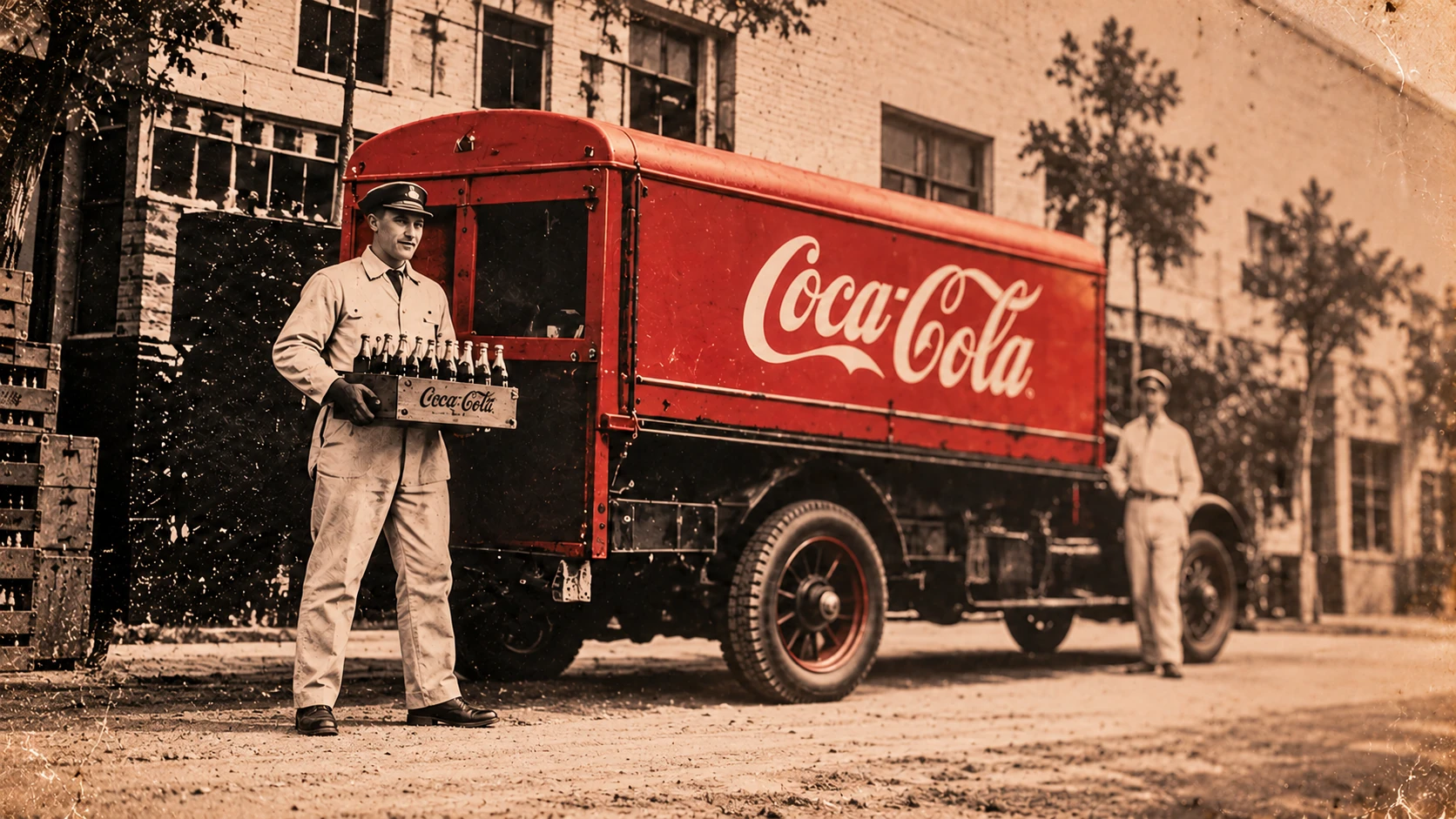
PRESDA AI-generated editorial illustration. The vintage truck, driver and street are imagined, not an archival photograph of a documented Coca-Cola delivery.
A bottle of Coca-Cola is a modest object carrying an unusually large amount of meaning. It can suggest a family meal, a roadside stop, American popular culture or simply something cold. Its commercial achievement is not that everyone reads the symbol in the same way. It is that a drink created in nineteenth-century Atlanta has remained recognizable across different languages, generations and occasions.
The business behind that recognition is more complicated than a secret recipe. Coca-Cola combines trademarks, marketing and beverage concentrates with a worldwide network of bottlers, distributors and retailers. Understanding that system explains both its resilience and its limits. This account uses the 2025 financial year for complete annual comparisons and identifies what was publicly available by October 25, 2026.
Atlanta, 1886: an invention becomes a business
Pharmacist John Stith Pemberton created Coca-Cola in Atlanta, where it was first served at Jacobs' Pharmacy on May 8, 1886. His bookkeeper, Frank M. Robinson, proposed the name and the script that became the brand's visual signature. Those are different contributions: developing the beverage and giving it a recognizable commercial identity. Coca-Cola's origins
Asa Candler subsequently acquired control of the business and expanded its merchandising. The Coca-Cola Company was incorporated in 1892. Candler's role was therefore different from Pemberton's invention and Robinson's naming: he helped turn a local preparation into an organized enterprise with a broader market. The Candler era
This division of credit matters because iconic brands often acquire a simplified founding legend. A drink does not distribute itself. A formula must become a consistent product, a name must become familiar, and a commercial organization must make the next purchase possible. Coca-Cola's later scale grew from the interaction of those tasks, rather than one inspired moment explaining everything that followed.
The formula: history without the mythology
The Royal Society of Chemistry's historical account describes early Coca-Cola's coca-leaf and kola-nut ingredients, associated with cocaine and caffeine respectively. That history should not be projected onto today's beverage. Coca-Cola states that its current products do not contain cocaine. Nor does the existence of a protected recipe mean that a journalist can reliably reconstruct it from internet rumors. Chemistry history Company clarification
The business value of secrecy is partly practical and partly cultural. It makes the product seem difficult to reproduce and gives the brand a story that can outlast an individual campaign. Yet consumers experience the drink through a disclosed ingredient label, packaging, temperature and context. The mystery of the recipe does not remove the need to comply with food rules or respond to changing preferences.
Bottling made the drink travel
In 1899, Benjamin Thomas and Joseph Whitehead secured bottling rights covering much of the United States; John Lupton helped develop the enterprise. Bottling allowed the drink to move beyond the soda fountain. Coca-Cola's historical account describes the arrangement as a crucial stage in its distribution model. The development of bottling
The innovation was organizational as well as physical. Moving a finished drink requires containers, equipment, transport and local commercial relationships. A brand owner working with bottling partners can spread those responsibilities while maintaining a shared identity. That does not eliminate coordination problems: a consumer encountering poor availability or an inconsistent product still sees the same name on the package.
Why the bottle became part of the brand
The contour bottle emerged from the Root Glass Company of Terre Haute, Indiana. Its design patent dates to November 16, 1915, with commercial adoption following in 1916. The Archives Foundation documents the patent's place in American design history. The familiar package was not present at the drink's 1886 debut. The bottle's patent
Coca-Cola's design history explains that a cacao pod, rather than a kola nut, helped inspire the shape. A distinctive silhouette made the container a recognition device, not merely a vessel. That commercial logic remains relevant even when the drink is sold in cans or plastic: a brand benefits when elements of its identity can survive a change in format. Contour bottle history
Advertising emotion, not just refreshment
The 1971 Hilltop commercial linked the product with an idealized scene of international togetherness. Its enduring reputation illustrates how advertising can attach a drink to a social feeling rather than a technical claim about ingredients. Coca-Cola's account of the campaign documents its creation; the film's emotional appeal should not be mistaken for evidence that buying the drink produces harmony. The Hilltop campaign
Another persistent myth gives Coca-Cola credit for inventing Santa Claus or his red suit. Haddon Sundblom's illustrations for the company, beginning in 1931, helped popularize a particular warm, rounded portrayal. Santa and red clothing already existed. The St. Nicholas Center traces that longer history, allowing the company's influence to be recognized without assigning it ownership of an entire cultural tradition. The evolution of Santa
The deeper strategy is repetition with variation. A script, a color, a bottle shape and a familiar occasion can recur while each campaign changes its setting. Familiarity reduces the effort needed to recognize the product. It can also make a global company a target for criticism: a symbol that is easy to recognize is easy to celebrate, parody or reject.
A worldwide system, with historical complications
World War II accelerated Coca-Cola's overseas infrastructure. Its corporate archive describes the establishment of 64 bottling plants abroad during the war as the company supplied American forces. That expansion supported postwar distribution. The archive's language of friendship is the company's interpretation; the documented business consequence was a larger physical network linked to military logistics and American influence. Wartime expansion
International recognition does not mean every market consumes the same package or understands the brand identically. Local purchasing power, retail formats, tastes and regulations influence how a global beverage business operates. The challenge is to preserve enough consistency to be recognizable while adapting distribution and the product portfolio to local demand. Advertising can introduce the promise; local execution determines whether the customer can buy it.
How Coca-Cola and its bottlers make money
The Coca-Cola Company and its bottling partners together form the Coca-Cola system. The parent does not own, manage or control most local bottling companies. It supplies concentrates and syrups and develops brands; partners commonly manufacture, package and distribute finished drinks. The company also has finished-product operations and bottling interests, so describing it as exclusively a seller of syrup would be incomplete. The Coca-Cola system
This division lets different businesses specialize. The brand owner can invest in product development and demand; a bottler works with production assets and local routes to market. Retailers and restaurants then provide the final customer encounter. Revenue earned by one part of that chain is not automatically revenue of every other part. A supermarket's selling price is not the amount Coca-Cola necessarily records for the transaction.
The 2025 annual filing reports $47.941 billion in net operating revenue. Of this, $28.462 billion came from concentrate operations and $19.479 billion from finished-product operations. Net income attributable to company shareowners was $13.107 billion. These are figures for The Coca-Cola Company and its consolidated operations, not the combined sales of all bottling partners or the Coca-Cola drink alone. 2025 annual filing
Reported annual revenue increased 2%, while the company reported 5% organic revenue growth, a non-GAAP measure excluding specified effects. These are not competing versions of the same calculation, and organic revenue growth should not be called growth in the number of drinks sold. Currency movements and changes in which operations are consolidated can alter reported revenue without an equivalent change in consumption. 2025 full-year results
Pepsi, New Coke and the limits of a taste test
Pepsi's 1975 Pepsi Challenge made comparative tasting a prominent part of the rivalry. Such tests gave the challenger an attention-grabbing argument, but a brief comparison is not a complete measure of purchasing behavior. Consumers also respond to familiarity, availability, price and occasion. PepsiCo's archive dates the campaign; its promotional claims should be read as a competitor's account. Pepsi's historical archive
Coca-Cola introduced a reformulated flagship drink on April 23, 1985. After a customer backlash, it announced the original formula's return as Coca-Cola Classic on July 11, 79 days later. The return did not mean the new version instantly disappeared from sale. The company's history documents the reversal, which is often compressed into a simpler story than the events justify. New Coke chronology
The episode exposed a difference between judging a sip and losing a familiar object. A company can test flavor without fully capturing how customers feel about continuity and choice. The lesson is not that research is useless or that every old product must remain unchanged. It is that the meaning attached to a product can be part of what customers believe they are buying.
The costs of remaining everywhere
A worldwide beverage system faces material responsibilities. Water availability, packaging waste, transport and regulation are not outside the business model: they affect how products are made, sold and accepted. The annual filing identifies water constraints, environmental requirements and taxes on sweetened beverages among its risks. A sustainability target is a commitment to be assessed against results, not proof that an impact has already been eliminated. Annual risk disclosures
The portfolio also extends beyond the original cola into other brands and beverage categories. This can respond to different preferences, but it complicates the meaning of growth. Strong results for the company do not necessarily imply that every brand is advancing. Equally, criticism of one drink should not be answered by treating a diversified portfolio as evidence that the original concern no longer matters.
As of this article's October 25, 2026 cutoff, the company had scheduled third-quarter results for October 27. Those results are therefore not presented here as known. Keeping reporting periods explicit is especially important for a business whose recognition encourages confident claims about its current performance. Official earnings timetable
Coca-Cola's history connects naturally with McDonald's combination of brand, franchise and property and SKIMS' effort to turn visibility into an enduring consumer company. In each case, the name attracts attention while an organization must deliver the product. Coca-Cola became an icon because its symbolism traveled with a distribution system. Its future depends on keeping both credible.
FAQ
Frequently Asked Questions
What is this PRESDA article about?
From Atlanta in 1886 to a global brand: Coca-Cola's bottle, advertising, Pepsi rivalry, bottling system and 2025 finances, with the famous myths explained.
Which category does this story belong to?
This story is part of PRESDA's Business coverage.
Who published this article?
Coca-Cola: How a Simple Drink Became a Global Icon was published by PRESDA Editorial on PRESDA.
PRESDA Dispatch
Stay Informed. Stay Aware.
A sharp briefing across AI, gaming, sport, business, world affairs, paparazzi, and lifestyle.