Kim Kardashian: The Business Empire Behind SKIMS
Inside SKIMS: Kim Kardashian's role, the Grede founding team, its $5 billion funding valuation, sales forecast, Nike partnership and global retail expansion.
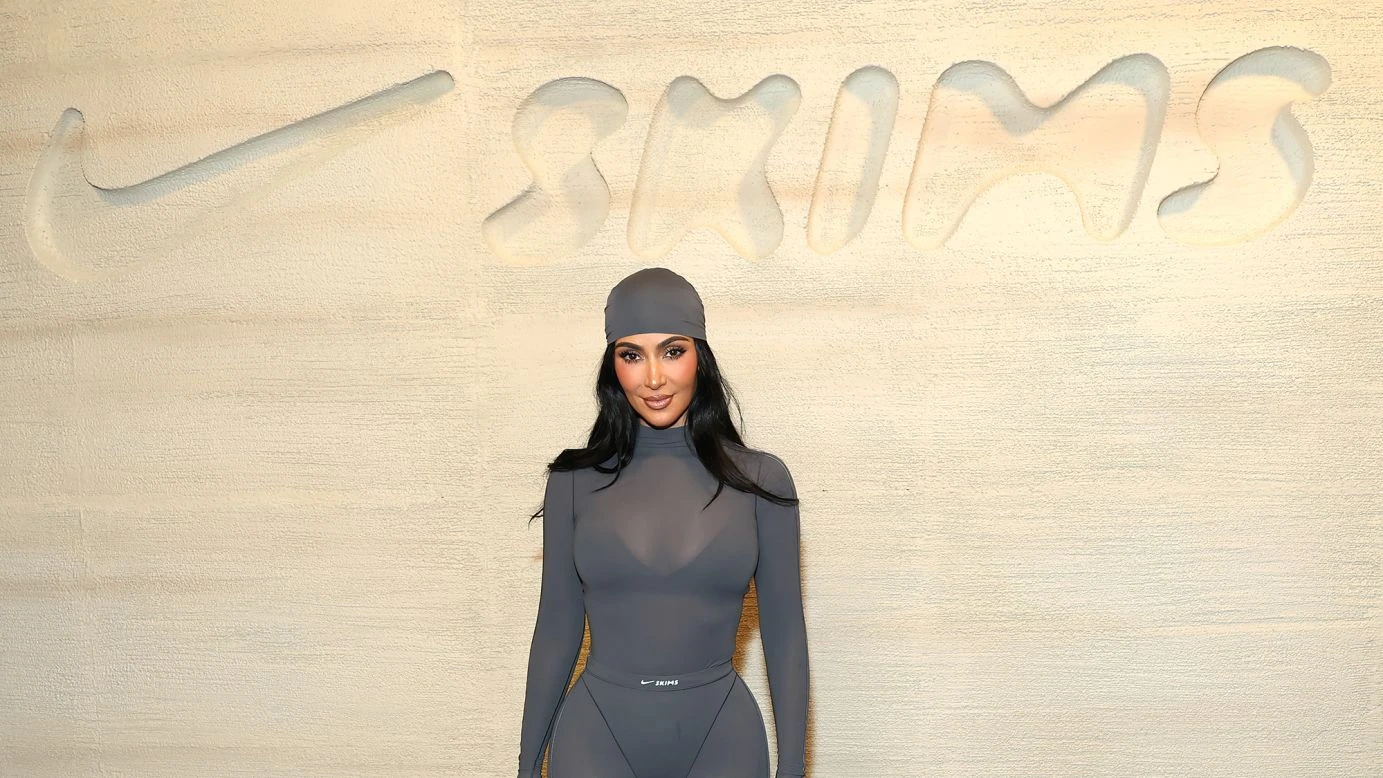
Kim Kardashian at the NikeSKIMS launch event, Nike House of Innovation, New York, September 24, 2025. Photo: Kevin Mazur/Getty Images for SKIMS.
The most useful way to understand SKIMS is to look past the celebrity photograph and into the wardrobe. A garment worn under a dress has to work repeatedly, on an ordinary morning, after the excitement of its advertising has faded. Kim Kardashian can make millions of people notice a product. Building an enduring apparel company requires turning that attention into fit, availability, repeat purchases and a business that survives its own expansion.
SKIMS has become a test of whether celebrity influence can develop into a lasting consumer institution. This analysis separates the company's documented transactions from its forecasts and examines its strategy as of October 25, 2026. Its financing valuation is neither Kardashian's personal wealth nor the amount of money the company has earned.
Who actually founded SKIMS?
SKIMS launched in 2019 with Kim Kardashian and Jens Grede as co-founders. Kardashian supplies the public-facing creative identity; Grede brings the executive and commercial role. The NBA's partnership announcement identifies them as creative director and chief executive respectively, a useful corrective to the idea of a business run by a famous face alone. NBA partnership announcement
Emma Grede also belongs in the founding story. Her official biography at the Fifteen Percent Pledge identifies her as SKIMS' founding partner and Good American's co-founder and CEO. The distinction matters: corporate announcements commonly name Kim and Jens as co-founders, while Emma's biography describes her founding contribution. Omitting her obscures the wider entrepreneurial team; assigning her Jens' CEO role would be equally misleading. Emma Grede's official biography
The division of responsibilities explains the business better than a personality contest over who deserves all the credit. A creative founder can determine the desired look and customer promise, while management turns those decisions into sourcing, merchandising, financing and distribution. Neither function substitutes for the other. A great campaign cannot repair a poor fit, and an efficient warehouse cannot create desire on its own.
Selling a solution, then a wardrobe
The original commercial idea was intimate apparel with a clear use: underwear and shapewear that could sit beneath clothing rather than fight against it. SKIMS subsequently extended its proposition into loungewear, men's essentials and activewear. These are related buying occasions, but they involve different expectations. A customer seeking invisible support for an evening dress is not necessarily shopping for the same fabric, silhouette or performance as someone choosing a workout outfit.
That creates both opportunity and discipline. An underwear purchase can introduce a customer to the brand; a comfortable everyday garment can encourage another visit. Yet adding categories does not automatically create an ecosystem. Each extension must justify its place through quality, design and a sensible relationship to the customer's existing wardrobe. Otherwise, expansion merely increases the number of products competing for attention and inventory space.
What inclusive sizing means in practice
SKIMS' published underwear guide spans XXS to 4X. It also provides international size conversions, which matter when a label travels across borders. This establishes a documented size range for that category, not a guarantee that every style, shade and size is available in every shop at every moment. SKIMS underwear size guide
The commercial significance of inclusion is practical. More sizes and shades can serve customers previously forced to compromise, but they also create more combinations to manufacture and replenish. Inclusion therefore has an operational test: can a shopper find the appropriate product, understand its sizing and buy it again? Campaign diversity and a broad chart are visible promises; consistent availability and fit determine whether those promises hold up.
There is also a tension worth acknowledging without reducing customers to victims or enthusiasts. Shapewear can be a freely chosen styling tool, while its advertising can still reinforce pressure to smooth and sculpt the body. A brand can broaden representation without resolving every anxiety associated with appearance. Claims of empowerment should be assessed alongside the actual product, rather than treated as proof of a universal psychological benefit.
Kardashian's role: more than an endorsement
Nike identifies Kardashian as SKIMS' co-founder and chief creative officer. That is a different position from a celebrity hired for a single campaign: her image, creative direction and reputation are connected to the company over time. It does not establish that she personally designs every garment or makes every operational decision. Nike's partnership announcement
Her visibility gives SKIMS a powerful starting advantage in attracting attention. It can also create concentration risk: controversy around a founder may affect perceptions of the label, even when it has little to do with a garment. The long-term business question is whether people choose SKIMS because it reliably meets a need, including customers who are indifferent to Kardashian's celebrity.
The marketing has increasingly recruited other cultural audiences. Sabrina Carpenter's 2024 campaign provides one documented example, supported by her own interview about the work. A campaign can introduce a label to a musician's audience without establishing how many of those viewers became buyers. Publicity metrics, social reactions and sales are different measurements. Carpenter's campaign interview
Sport turns visibility into distribution
The October 2023 agreement made SKIMS the official underwear partner of the NBA, WNBA and USA Basketball. It followed the launch of SKIMS Mens that month. The connection offered a route beyond the traditional audience for women's shapewear, although a league partnership should not be confused with independently demonstrated product superiority.
NikeSKIMS is a further step: an apparel and footwear proposition built with an established sports company. Its first collection went on sale on September 26, 2025, according to Nike's launch release. The confirmed launch date is more useful than the earlier announcement's provisional spring timetable. NikeSKIMS' first collection
In January 2026, Nike announced the first NikeSKIMS footwear, the Rift. Its Spring 2026 announcement then set out expansion into selected European and Middle Eastern markets, Australia and Korea. This is documented international distribution, not evidence that every country has the full range or that every new market is profitable. Footwear launch Spring 2026 expansion
What is SKIMS worth, and what does it sell?
On November 12, 2025, SKIMS announced a $225 million capital raise valuing the company at $5 billion. Goldman Sachs Alternatives led the round, with participation from funds affiliated with BDT & MSD Partners. The company's legal adviser separately confirmed the financing. Transaction confirmation
The financing announcement said SKIMS expected to exceed $1 billion in net sales in 2025. That was a company forecast when issued. It should not be silently converted into audited annual revenue or described as 2026 sales. This article does not substitute third-party estimates for a complete public set of audited SKIMS accounts. Company financing statement
A valuation prices ownership in a business at a particular transaction. Capital raised is money invested through that transaction. Revenue measures sales over a period, while profit remains after the relevant expenses. Conflating those four quantities can make a strong business sound even larger than the evidence supports. Nor can a founder's personal wealth be calculated by assigning her the entire corporate valuation: ownership percentages, investor rights, other assets and liabilities all matter.
Why a digital brand wants physical stores
Reuters reported 18 owned US stores and two franchise locations in Mexico at the November 2025 financing announcement. Those are dated counts, not a claim about the complete October 2026 network. In August 2026, Wallpaper's reporting on the first standalone UK store documented the London Regent Street flagship and its architectural collaboration with Rafael de Cárdenas. Reuters on the retail strategy London store reporting
Stores can make fabric, shade and fit easier to judge than they are on a phone. They can also introduce the brand to customers who did not encounter its launch online. But physical retail adds leases, staff, stock allocation and the cost of an experience that must remain convincing on a quiet weekday. Online reach is not a substitute for profitable stores; successful stores are not a reason to neglect digital service.
The category ambitions extend beyond clothing. Coty confirmed in March 2025 that it sold its 20% stake in SKKN by Kim to SKIMS. That documents a transaction involving the beauty business, not a disclosed purchase price or proof that beauty will become a particular share of SKIMS' future revenue. Coty's transaction announcement
Competition and the next test
SKIMS competes across overlapping markets: Spanx in shapewear, established underwear labels such as Calvin Klein, lingerie retailers, and activewear businesses including Lululemon. These are competitive reference points, not a ranking or a claim that their financial reporting is directly comparable. Customers can also buy lower-priced alternatives or simply keep the garments they already own. Fashion competition includes the decision not to purchase.
The strategic challenge is to expand without weakening the promise that made the brand distinctive. More shops and partnerships can increase access, but more complexity makes quality control and inventory planning harder. Useful evidence of durable success would include repeat buying, healthy margins, manageable returns and productive stores. The absence of a public, comparable series for those measures is a reason for analytical restraint, not a reason to invent one.
SKIMS belongs in a wider business conversation about how desire becomes infrastructure. McDonald's combines a consumer brand with franchise and property economics, while Coca-Cola connects brand recognition to a global bottling system. SKIMS is much younger, but its central test is recognizable: can the organization keep delivering the experience that the advertising promises, long after the launch has stopped being news?
FAQ
Frequently Asked Questions
What is this PRESDA article about?
Inside SKIMS: Kim Kardashian's role, the Grede founding team, its $5 billion funding valuation, sales forecast, Nike partnership and global retail expansion.
Which category does this story belong to?
This story is part of PRESDA's Business coverage.
Who published this article?
Kim Kardashian: The Business Empire Behind SKIMS was published by PRESDA Editorial on PRESDA.
PRESDA Dispatch
Stay Informed. Stay Aware.
A sharp briefing across AI, gaming, sport, business, world affairs, paparazzi, and lifestyle.