BALI’S 50-FOOT GANESHA SCULPTURE: THE RECORD STORY AND THE CRAFT BEHIND IT
Bali’s Ganesha sculpture has drawn attention for a reported synthetic-rattan record. Explore the craft, cultural context, dates and differing height descriptions.
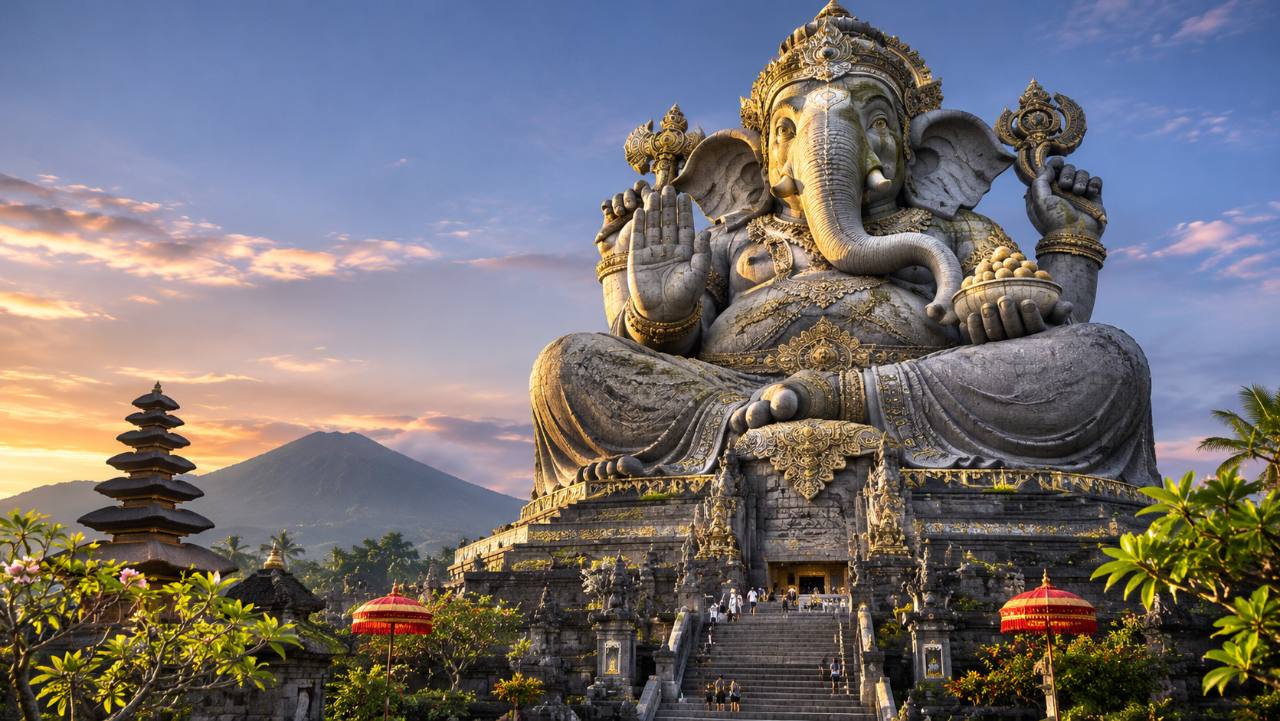
Original editorial illustration supplied for PRESDA, preserved unchanged. Its stone-like monument does not document the actual synthetic-rattan installation, its material or measured proportions.
A monumental Ganesha sculpture at Alas Harum Bali has drawn international attention through reports of a Guinness World Records title for a supported synthetic-rattan sculpture. Recent coverage gives its recorded height as 15.315 metres, a little over 50 feet. The achievement being reported is specific to a material and construction category, not a claim that this is the tallest Ganesha image of any kind in the world. The CSR Journal: reported record category and height
The project is in Tegallalang, in Bali’s Gianyar regency. November coverage has made it newly prominent abroad, but that should not be turned into a claim that Indonesia unveiled it on the day an article appeared. Organiser’s November 20 report dates public unveiling to October 25 and record verification to August 4. Those are reported project milestones, distinct from the date of the international news coverage. Organiser: reported verification and public unveiling dates
| Detail | What the sources establish |
|---|---|
| Location | Tegallalang, Gianyar, Bali |
| Reported record height | 15.315 metres, about 50 feet |
| Reported category | Supported synthetic-rattan sculpture |
| Artisans credited | 126 in the developer’s account |
The craft behind the headline
Alas Harum’s own project announcement, published on April 11, 2026, credits 126 artisans with creating the Ganesha installation. It presents the work alongside the Kailash Fairy Garden as part of the destination’s expansion in cultural and immersive tourism. That primary account makes the scale of the collaborative craft effort an important part of the story, beyond the height alone. Alas Harum Bali: April 11 project announcement and artisans
The same announcement uses the description artificial woven bamboo and gives an 18-metre height. November record coverage instead uses synthetic rattan and 15.315 metres. Those figures and descriptions should not be silently merged. They come from different accounts, and the available material does not establish whether a base, an overall design envelope or a revised measurement explains the difference. Alas Harum Bali: April 11 project announcement and artisans The CSR Journal: reported record category and height
For the record story, 15.315 metres is the figure attributed to the recent reporting. Eighteen metres remains the developer’s earlier project description. An honest account can show both without claiming to have independently surveyed the sculpture or seen a measurement report that has not been supplied. The distinction is particularly important when a precise decimal figure is being used as the basis of a superlative.
Synthetic material is not the same as a stone monument
The reported record category concerns a supported sculpture made with synthetic rattan. Its woven surface and supporting construction are therefore central to the claimed achievement. Describing it as a huge stone carving would change the story. The supplied hero is an editorial illustration with a stone-like appearance, preserved as provided; it is not documentary evidence of the actual installation’s material or proportions. The CSR Journal: reported record category and height
The material description also does not establish environmental performance. A synthetic woven surface should not automatically be called natural bamboo, biodegradable or a certified sustainable product. Those claims would require their own evidence. A craft story can recognise skill and experimentation without turning the choice of material into an unsupported environmental endorsement.
Why Ganesha carries meaning beyond scale
Ganesha is widely recognised by his elephant head, but the image is more than an instantly recognisable silhouette. The Metropolitan Museum of Art’s account of a twelfth-century Chola-period sculpture describes a deity associated with removing obstacles, success and abundance, and explains the practice of making an offering before an important undertaking. This gives the new landmark a religious vocabulary that predates contemporary tourism. The Met: Ganesha’s iconography and religious meaning
That vocabulary is not identical in every place or period. The Met’s seventh-century Cambodian Standing Ganesha provides an early Southeast Asian example and explains that images of the deity could function as principal icons in their own temples. The object is not Balinese and should not be presented as evidence of this project’s direct ancestry. It does, however, illustrate the long regional history of adapting and venerating Ganesha imagery. The Met: early Ganesha worship in Southeast Asia
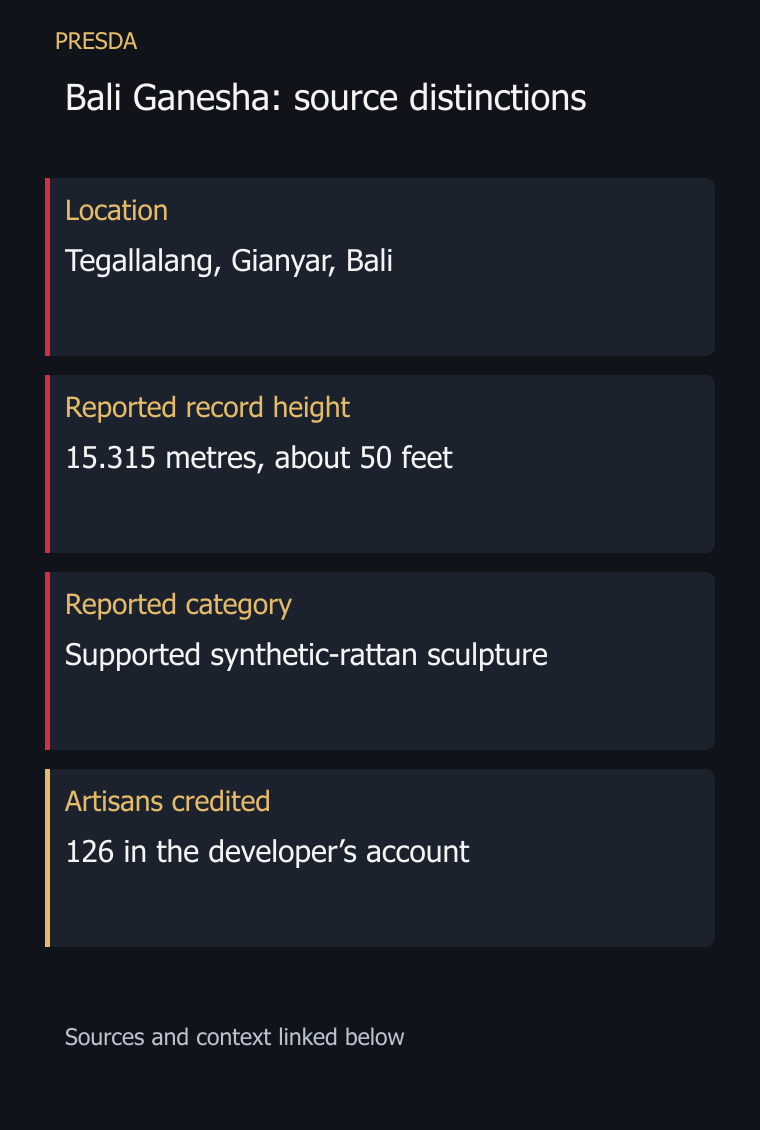
Bali’s Ganesha sculpture: the source distinctions
PRESDA · alasharum.com / thecsrjournal.in / organiser.org / metmuseum.org / whc.unesco.org
For viewers, recognising that history changes the encounter with a large modern sculpture. A familiar divine figure can be presented through new materials and an attraction designed for contemporary visitors, while remaining connected to a living religious tradition. The work can be discussed as art and tourism without reducing its subject to a decorative mascot.
Bali’s culture is also a working landscape
The setting matters as much as the monumental form. UNESCO’s description of Bali’s subak cultural landscape explains the relationship between rice cultivation, water temples and cooperative irrigation. It identifies Tri Hita Karana as a philosophy connecting spiritual life, the human community and nature. That is a useful corrective to seeing the island only as a collection of spectacular photo locations. UNESCO: Bali’s subak cultural landscape
The UNESCO property is a defined heritage landscape, not an award attached to every rice terrace or new attraction on Bali. Nor does its inscription confer UNESCO status on the Ganesha sculpture. Its relevance here is contextual: it helps explain how religious practice, collective work and the environment can be intertwined in Balinese life, rather than existing as separate tourist themes.
This wider context gives the contribution of the artisans additional meaning. Large installations are collaborative objects, even when publicity focuses on a single recognisable figure. Design, fabrication, surface work and installation involve people whose skills shape the final experience. The developer’s credit to 126 artisans offers a concrete starting point for recognising that collective effort. Alas Harum Bali: April 11 project announcement and artisans
A destination story with questions beyond the visitor count
Alas Harum describes its paired developments as a way to combine artistic expression, cultural storytelling and an immersive visitor experience. That is the destination’s stated intention. It does not provide an independently audited figure for extra jobs, visitor spending or the effect of the new sculpture on the surrounding community. Those outcomes should be reported when evidence is available, rather than inferred from the size of the monument. Alas Harum Bali: April 11 project announcement and artisans
Tourism also comes with wider responsibilities. In a 2025 decision about Bali’s World Heritage cultural landscape, UNESCO expressed concern about tourism and associated development, including pressures in the Jatiluwih area. That is a warning about a particular protected landscape and its management; it is not a finding that the Alas Harum sculpture has damaged it. The distinction allows the broader issue to be discussed without accusing a specific project on unrelated evidence. UNESCO: 2025 conservation decision on tourism pressures
The underlying question is how cultural attractions coexist with the everyday systems that make a place distinctive. An increase in visibility can create opportunities for craft and interpretation. It can also encourage an emphasis on spectacular images over context. A serious account should make room for both the attraction and the communities, practices and landscapes around it.
Read the record precisely, then look beyond it
The useful headline is narrower than “the world’s tallest Ganesha.” Current reports describe a supported synthetic-rattan record and identify a 15.315-metre figure. The promoter’s earlier 18-metre description is a separate source statement, not a reason to invent a new certified measurement. Keeping the category and attribution visible preserves the meaning of the news. The CSR Journal: reported record category and height Organiser: reported verification and public unveiling dates
PRESDA’s report on Makkah Clock Tower’s museum and observation-deck records shows why the exact object and category matter in another setting. In Bali, the record coverage opens a larger story about craft, a widely venerated deity and the presentation of cultural identity to modern audiences. Those dimensions remain interesting after the superlative has been read carefully.
FAQ
Frequently Asked Questions
Is this the world’s tallest Ganesha statue overall?
The reported Guinness category is the tallest supported synthetic-rattan sculpture. It should not be expanded into a claim covering all Ganesha statues and materials.
Why do sources give 15.315 metres and 18 metres?
Recent record coverage gives 15.315 metres; Alas Harum’s April project announcement gives 18 metres. The reviewed sources do not establish the reason for that difference, so the article does not invent one.
Was the sculpture newly unveiled on November 21?
November 20–21 is the period of recent international coverage. Organiser reports an October 25 public unveiling and August 4 verification; the developer had already announced the project in April.
Does the supplied hero show the actual rattan sculpture?
It is a supplied editorial illustration with a stone-like appearance. It is not authenticated documentary photography of the installation or evidence of its material and measured height.
PRESDA Dispatch
Stay Informed. Stay Aware.
A sharp briefing across AI, gaming, sport, business, world affairs, paparazzi, and lifestyle.