TÜRKİYE ANNOUNCES OVER $26 BILLION IN COP31 DEALS AND INVESTMENT PLANS
Türkiye reports over $26 billion in COP31 deals and investment plans. Examine the China agreement, EBRD financing intentions and what remains to be delivered.
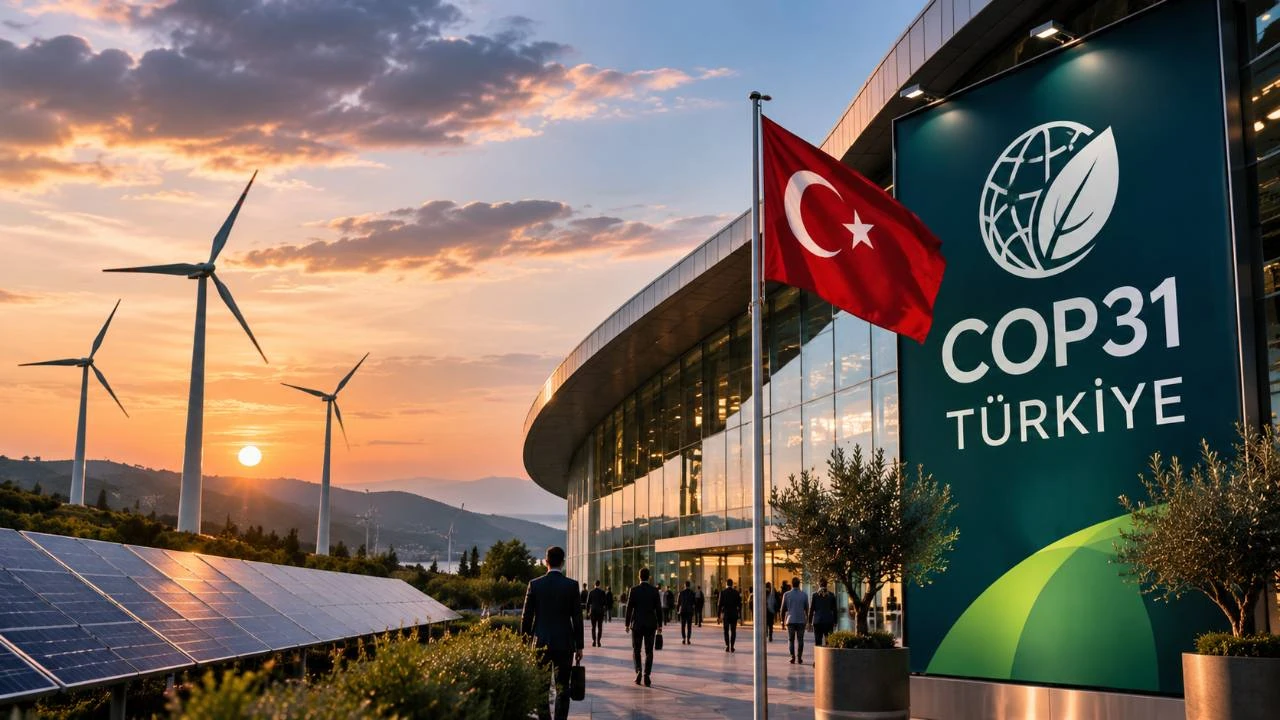
Supplied editorial illustration of a conference setting and renewable energy. Not verified COP31 venue photography or evidence of completed projects.
Antalya has offered Türkiye something more immediately countable than a global climate accord: a pipeline of energy and financing announcements. But the headline figure, more than $26 billion, describes deals and investment plans at different stages. It does not establish that this sum has arrived in the country or that every proposed project has reached a final investment decision.
Reuters reported the aggregate on November 20, 2026. The UN climate conference was scheduled for November 9–20 at Antalya’s EXPO Center. This report examines the investment announcements available on November 20, rather than presenting them as a final verdict on the negotiations. UNFCCC: COP31 conference information Reuters: aggregate investment announcement, November 20
| Announcement | What the figure represents |
|---|---|
| About $15 billion | Preliminary China cooperation framework |
| $6 billion over five years | EBRD investment intention under REACT |
| $5.1 billion | Reported development-bank financing agreements |
| $300 billion by 2040 | REACT mobilisation ambition, separate from COP31 total |
What is included in the $26 billion headline?
The presidency’s first-week account, reported by DHA on November 16, highlighted approximately $15 billion in planned cooperation with China, an EBRD intention to invest $6 billion over five years, and $5.1 billion in development-bank financing agreements. These are the reported components behind the rounded headline. Their legal status, timing and delivery mechanisms differ. DHA: COP31 presidency’s first-week investment report
Those figures should not become a fictional single cheque. A cooperation memorandum can define a prospective project pipeline; a bank’s multi-year investment intention sets a direction; a financing agreement concerns specified lending or support. Published summaries do not provide a consolidated project ledger demonstrating how every dollar will be deployed or excluding all potential overlaps.
China: a preliminary framework for renewable energy
The UNFCCC’s electrification delivery package records a preliminary Türkiye–China agreement envisaging around $15 billion for 7 gigawatts of solar and wind capacity, alongside storage and 4 gigawatts of electricity transmission infrastructure. A gigawatt measures power capacity, not the electricity actually produced over a year. UNFCCC: electrification delivery package
That distinction matters commercially. Installed capacity alone cannot tell readers the future annual output, project earnings or reduction in imported fuels. Those outcomes depend on technology, operating conditions, connection dates and how the wider system uses the power. No generation forecast should be manufactured by treating a capacity number as an energy total.
What the EBRD actually announced
The European Bank for Reconstruction and Development says it plans to invest $6 billion over the next five years in projects under Türkiye’s Renewable Energy Acceleration and Clean Transition platform, REACT. The platform’s wider ambition is to mobilise $300 billion by 2040. That long-term mobilisation objective is separate from the bank’s five-year intention and from the COP31 aggregate. EBRD: planned $6 billion for REACT over five years
REACT links generation with grids, storage, system flexibility, manufacturing and electrification. This breadth explains why climate investment cannot be assessed solely by counting wind turbines or solar panels. Electricity must be transmitted when and where it is needed, and greater variable generation creates additional requirements for network management and flexibility.
The EBRD announcement is evidence of an institutional investment plan. It does not identify $6 billion as already disbursed. Nor should the bank’s historical cumulative investment in Türkiye, expressed elsewhere in euros, be confused with this new dollar-denominated plan. Currency, time period and financial instrument all belong beside the number.
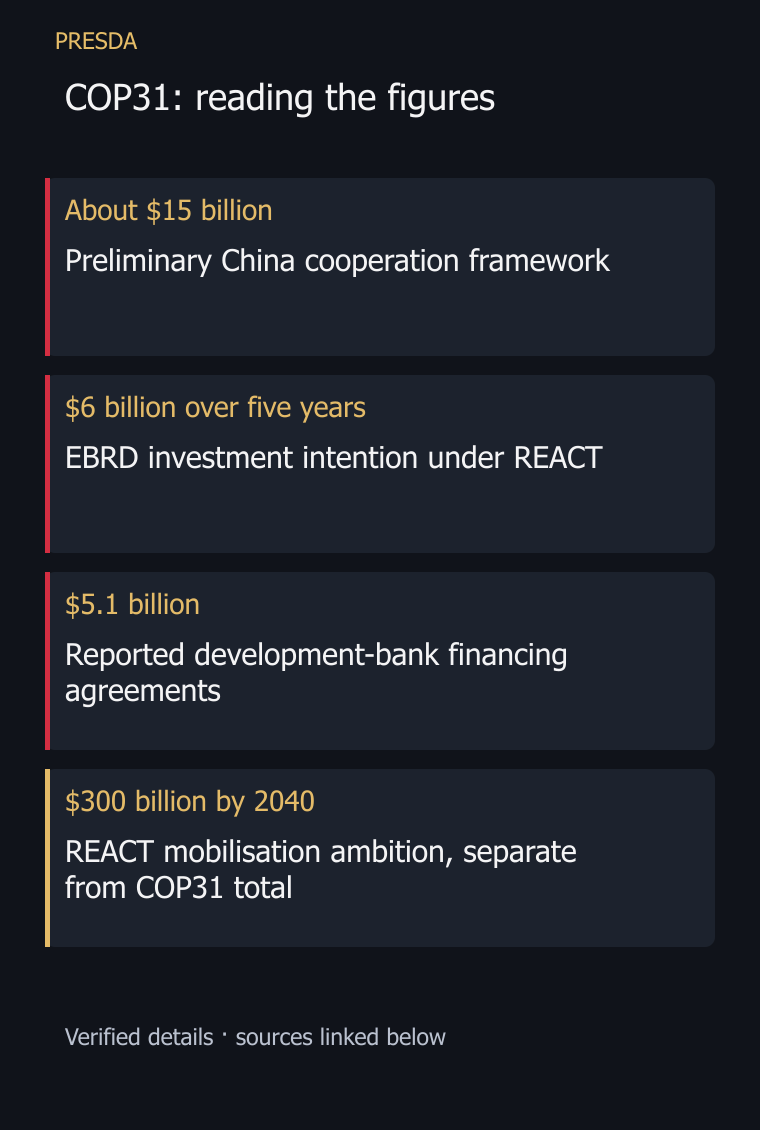
COP31 investment figures: different commitments and time horizons. Sources: COP31 presidency/DHA and EBRD.
Development-bank agreements are another category
Reporting on November 12 identified $5.1 billion in agreements with four development banks and described a wider package ranging from signed loans to preliminary studies and investment targets. The economic significance lies in the underlying instruments, not simply the size of the combined headline. Hürriyet Daily News: November 12 energy and financing agreements
For any individual project, the useful questions are concrete: who borrows or invests, what is financed, what conditions must be met, and when can construction or procurement begin? A signed financing agreement can be a substantial milestone while still preceding drawdown, physical works and operational capacity. These stages should remain separate in subsequent reporting.
There is also a difference between financing and total project cost. A bank may support part of a larger investment, while private capital or other lenders fund the remainder. Without project-level documentation, it would be misleading to assume that every financing announcement represents wholly additional infrastructure or that all figures can safely be summed again.
Why the announcements matter for Türkiye
The reported package brings industrial policy into the climate story. Generation is one part of the proposition; equipment production, networks and the ability to electrify economic activity are others. Hürriyet Daily News reported that the China memorandum also addressed domestic manufacturing and technology transfer. Whether these ambitions create durable local capabilities will depend on implementation. Hürriyet Daily News: November 12 energy and financing agreements
For businesses, that shifts attention from a summit’s ceremony to the chain of work that follows: engineering, equipment orders, grid connections, construction and operation. Announced expenditure is a potential opportunity, not a verified order book for any unnamed company. This article does not assign jobs, revenues or supplier contracts that have not been published.
The broader energy-security context is also important. Reliable domestic electricity and robust infrastructure can affect industrial resilience, but no single memorandum proves energy independence. PRESDA’s account of energy and shipping pressures around the Strait of Hormuz explains why the relationship between supply, infrastructure and geopolitical exposure remains economically consequential.
Investment news is not a negotiated climate settlement
Host-country commercial announcements and a multilateral COP agreement answer different questions. The former concern projects, institutions and prospective finance. The latter requires decisions by parties to the climate process. A large investment pipeline cannot by itself establish consensus on emissions, fossil fuels or international finance obligations.
Readers should therefore resist a simple substitution: financial announcements do not settle the assessment of COP31’s diplomatic outcome. Conversely, disagreement in the negotiating rooms does not automatically erase the potential significance of a signed financing instrument. Each claim needs its own evidence, responsible actors and timetable.
The next test is delivery
The strongest follow-up reporting will move from aggregate promises to named projects and dated milestones. Final investment decisions, procurement, bank disbursement, construction and commissioning offer progressively clearer evidence of implementation. Until those records emerge, the accurate description remains more than $26 billion in reported agreements and investment plans.
The distinction is not semantic caution for its own sake. A pipeline can influence confidence and policy before it becomes productive infrastructure, but its value will ultimately be measured by what is financed, built and operated. Türkiye’s COP31 announcements establish an ambitious starting point. They do not yet constitute a completed balance sheet of the energy transition.
FAQ
Frequently Asked Questions
Has Türkiye already received more than $26 billion?
No. The reported total combines agreements and investment plans with different timetables and conditions. It is not a verified total of cash already received or projects completed.
What is the China agreement about?
The preliminary framework envisages roughly $15 billion for solar, wind, storage and transmission. The UNFCCC records 7 GW of solar and wind and 4 GW of transmission infrastructure.
Is the EBRD’s $6 billion already invested?
The EBRD describes an intention to invest over five years under REACT. That wording does not establish that the entire amount has been disbursed.
Does this mean COP31 reached a final global agreement?
No. Host-country investment announcements and negotiated international climate decisions are separate processes. This article assesses investment reporting available on November 20, 2026.
PRESDA Dispatch
Stay Informed. Stay Aware.
A sharp briefing across AI, gaming, sport, business, world affairs, paparazzi, and lifestyle.