IRAN KEEPS HORMUZ CLOSED UNTIL ITS CONDITIONS ARE MET
Tehran ties reopening to its demands under a June understanding. The dispute concerns a narrow passage with worldwide energy consequences, while mediation continues.
Iran's parliament speaker Mohammad Baqer Ghalibaf said on October 4 that the Strait of Hormuz would not reopen until seven Iranian conditions associated with a June interim understanding with the United States were fulfilled. Reuters reported the remarks, citing Nournews. The statement sets out Tehran's position, not an agreed timetable for restoring normal navigation. Reuters via The Times of Israel: Ghalibaf's statement, October 4, 2026
Ghalibaf referred to the Islamabad Memorandum of Understanding and said Washington had recently conveyed proposals through a mediator. He rejected what he characterized as delaying tactics and unilateral demands. His warning came after Iran received a US response to its diplomatic proposal. Reuters via The Times of Israel: Ghalibaf's statement, October 4, 2026
WHAT CONDITIONS HAS IRAN DESCRIBED?
The October 4 report refers to seven conditions without reproducing a complete numbered text. In an August 18 Reuters report, Ghalibaf identified lifting the US blockade of Iranian ports, lifting oil sanctions, releasing frozen Iranian assets and ending threats and military operations on all fronts. These are previously stated demands, not a newly verified seven-point list or proof that Washington accepts Iran's interpretation. Reuters via Investing.com: interim-deal conditions, August 18, 2026
The distinction matters: a statement about what one side requires is not an agreement about what each side will do, in what order or under whose verification. The present article does not infer a reopening date from the existence of negotiations.
DOES CLOSED MEAN NO SHIP CAN PASS?
Iran's language should not be read as a verified count of zero transits. On September 24, Reuters reported a US official's claim that about 60 commercial vessels had passed through the strait the previous day, about 40 coordinating with the US military for protection. Reuters explicitly said it could not independently verify the figures. That earlier claim is neither a current traffic count nor proof of safe, unrestricted navigation. Reuters via Arab News: US official's shipping figures, September 24, 2026
The distinction between limited passage and normal commercial access is essential. Shipowners need confidence that a voyage can be completed safely, not simply evidence that another vessel passed on a different day. On September 16, the International Maritime Organization urged an end to attacks on merchant shipping and emphasized the human cost to crews. IMO: attacks on merchant ships and seafarers, September 16, 2026
WHY HORMUZ MATTERS TO THE WORLD ECONOMY
Between Iran and Oman, Hormuz connects the Persian Gulf to the Gulf of Oman and, beyond it, the Arabian Sea. For many Gulf energy exports it is the maritime exit to world markets. The US Energy Information Administration estimates that in 2024 it carried about 20 million barrels of oil a day, equivalent to roughly 20% of global petroleum-liquids consumption. EIA: Hormuz geography and 2024 energy flows, June 16, 2025
The same EIA assessment puts the route's share at more than a quarter of global seaborne oil trade in 2024 and early 2025, and around a fifth of global LNG trade in 2024, primarily from Qatar. These measures have different denominators. They are pre-war benchmarks explaining exposure, not estimates of today's throughput. EIA: Hormuz geography and 2024 energy flows, June 16, 2025
Saudi and Emirati pipelines can bypass the strait for some oil, but most volumes historically using Hormuz have no alternative exit. Sailing around Africa cannot solve the initial problem of a tanker unable to leave the Persian Gulf. Our explainer on who controls the world's oil provides the wider production and trade context. EIA: Hormuz geography and 2024 energy flows, June 16, 2025
QATAR'S MEDIATION AND REGIONAL SECURITY
Qatar's foreign ministry said on September 29 that meetings and messages between Washington and Tehran were continuing, including exchanges around the UN General Assembly in New York. Spokesperson Majed Al Ansari reaffirmed support for Pakistani mediation and described efforts to bridge the parties' positions. This confirms diplomatic activity, not a completed settlement. Qatar Ministry of Foreign Affairs: mediation briefing, September 29, 2026
Qatar also condemned attacks on regional infrastructure, energy facilities and vessels, and called for a security framework protecting neighboring states. In an August 27 account of talks with Iran, the ministry described discussions of a temporary joint shipping corridor and a mine-clearance project. Those were proposed arrangements; the announcement did not establish that either was operational. Qatar Ministry of Foreign Affairs: mediation briefing, September 29, 2026 Qatar Ministry of Foreign Affairs: Iran talks and proposed shipping corridor, August 27, 2026
These dated statements should not be presented as fresh responses to Ghalibaf's October 4 remarks. The sources cited here do not establish a new collective Gulf response or a direct US response to that specific statement.
OIL PRICES, INSURANCE AND SHIPPING COSTS
Disruption reaches markets through more than the price of crude. The EIA reported that Middle East-to-Asia rates for very large crude carriers reached their highest level since its series began in November 2005 during March 2026. It linked the pressure to physical attack risks and expensive war-risk insurance. This is a documented historical comparison, not a quotation of today's freight or insurance price. EIA: Middle East tanker rates and war-risk insurance, March 26, 2026
PRESDA analysis: prolonged uncertainty can make cargo scheduling and insurance harder, increase financing and transport costs, and force buyers to seek other suppliers. LNG disruption can affect electricity and industrial fuel markets as well as shipping. The scale depends on actual deliveries, inventories, alternative supply and the duration of restrictions. There is no reliable basis here for a precise oil-price forecast.
WHAT WOULD SIGNAL A REAL REOPENING?
The decisive developments would be agreed terms, credible safety arrangements and sustained evidence of commercial passage. A diplomatic announcement alone would not demonstrate all three. Conversely, selected ship movements would not settle the political dispute. Iran's warning matters globally because the route concentrates energy trade, but its economic consequences must be assessed against actual flows rather than rhetoric alone.
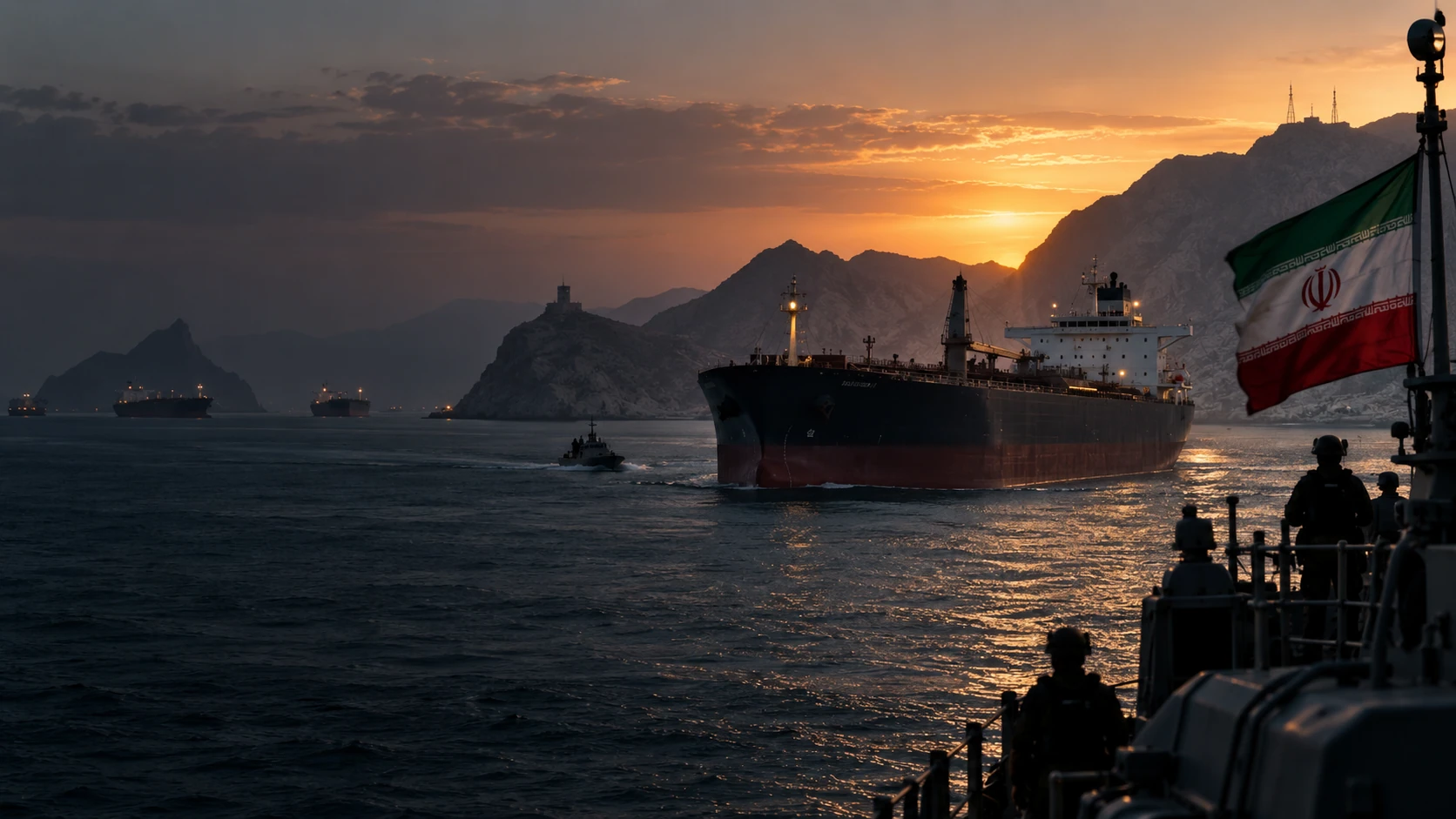
Editorial note: the hero is an AI-generated editorial illustration, not a photograph documenting a specific tanker movement or military operation. Reporting checked on October 5, 2026; dated statistics retain their original reference periods.
FAQ
Frequently Asked Questions
What did Iran say on October 4?
Ghalibaf said Hormuz would not reopen until seven Iranian conditions linked to the June understanding were met, according to Reuters citing Nournews.
Is every ship prevented from passing?
The statement does not establish zero traffic. Reuters previously reported unverified US figures for some transits; limited passage is not the same as safe, normal navigation.
Why is Hormuz important for energy?
EIA estimates for 2024 put oil flows at about 20 million barrels a day and the strait's share of global LNG trade at around one fifth. These are historical benchmarks, not current flows.
Is Qatar mediating?
Yes. Qatar's foreign ministry confirmed ongoing meetings and message exchanges on September 29, 2026. It did not announce a completed agreement.
PRESDA Dispatch
Stay Informed. Stay Aware.
A sharp briefing across AI, gaming, sport, business, world affairs, paparazzi, and lifestyle.
Related