THE BATTLE OF VERTIÈRES: HOW HAITI DEFEATED NAPOLEON'S ARMY
How Dessalines’s army defeated Rochambeau at Vertières, why Napoleon’s expedition failed and how victory led to Haitian independence.
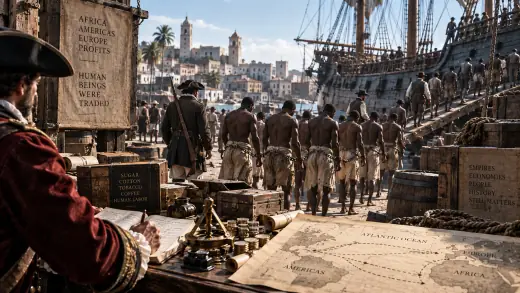
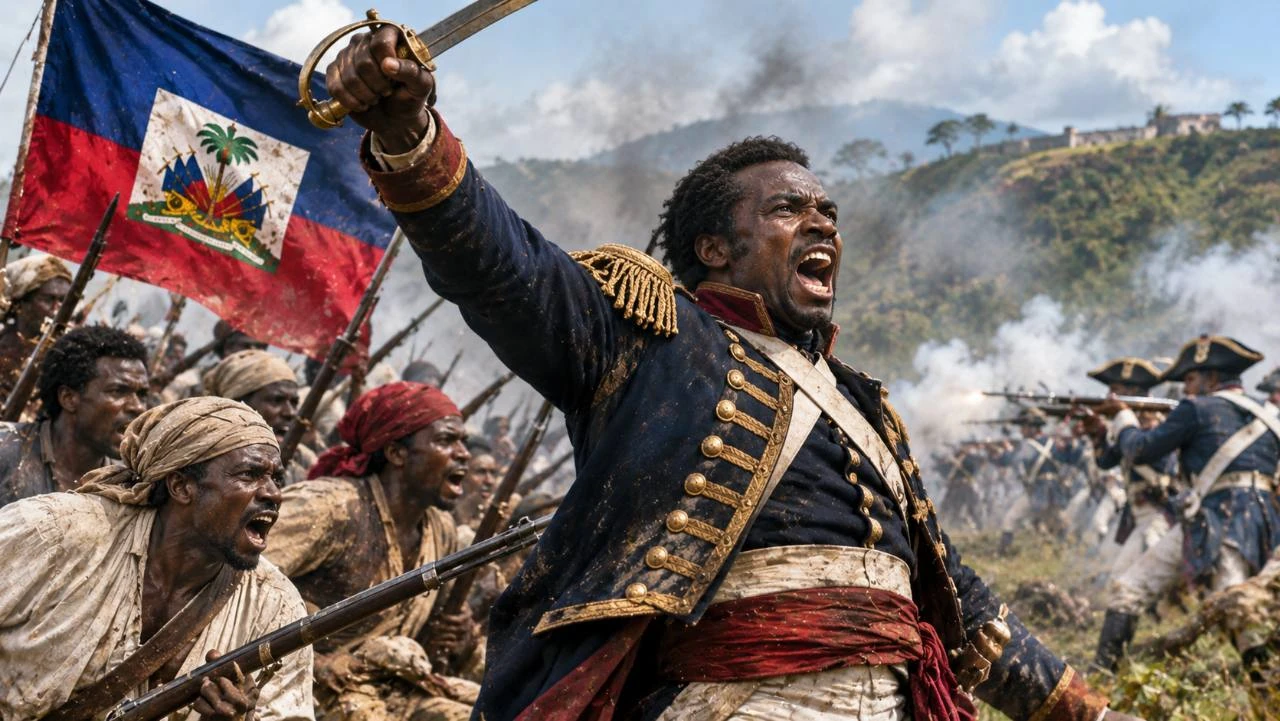
Editorial illustration supplied for PRESDA.
On November 18, 1803, the army led by Jean-Jacques Dessalines defeated French forces at Vertières, near Cap-Français, today Cap-Haïtien. The victory brought Napoleon Bonaparte’s expedition to its decisive end and opened the way to Haiti’s declaration of independence on January 1, 1804. Napoleon did not fight at Vertières himself. His commander in the colony was Donatien de Rochambeau. The battle was the culmination of a revolution in which enslaved people fought to make freedom irreversible. Bibliothèque nationale de France: Dessalines and independence Bibliothèque nationale de France: Napoleon’s failed expedition
What was at stake in Saint-Domingue?
| Date | Event |
|---|---|
| 1791 | Major uprising begins in Saint-Domingue |
| 1802 | Leclerc’s expedition arrives; Louverture is deported |
| November 18–19, 1803 | Victory at Vertières and French capitulation |
| January 1, 1804 | Haitian independence declared |
The western part of Hispaniola was the French colony of Saint-Domingue. Its sugar and coffee economy depended on the forced labour of enslaved Africans and their descendants. Wealth generated for plantation owners and Atlantic commerce rested on coercion and extreme inequality. The uprising that began in 1791 challenged that system. The French Revolution’s language of rights reached a colony where legal status, racial hierarchy and property claims made the meaning of freedom fiercely contested. US Office of the Historian: Haitian Revolution
The conflict developed into a struggle involving rival colonial groups, revolutionary armies and foreign powers. People changed alliances in circumstances where emancipation could be promised, restricted or threatened. This complexity matters when describing the army that later won independence. It was formed through years of war and political negotiation. Formerly enslaved fighters gained military experience and built organisations capable of confronting a large European expedition. Their victory had deep roots before the final campaign. Bibliothèque nationale de France: Dessalines and independence US Office of the Historian: Haitian Revolution
Why did Napoleon send an expedition?
France abolished slavery in its colonies in 1794, but Napoleon sought to restore metropolitan control and the plantation economy. In 1802 he sent an expedition under Charles Leclerc, his brother-in-law, to Saint-Domingue. The return of French military power raised a fundamental question: would emancipation survive reconquest? The restoration of slavery in Guadeloupe made that fear concrete. Developments elsewhere in the Caribbean therefore shaped decisions made by people defending their freedom in Saint-Domingue. Bibliothèque nationale de France: Napoleon’s failed expedition
Where was Toussaint Louverture?
Toussaint Louverture had become the central leader of the preceding revolutionary period. Following the fighting and negotiations of 1802, he was arrested and deported to France. He died imprisoned at the Château de Joux on April 7, 1803, months before Vertières. The château’s memorial history documents that imprisonment. Louverture’s earlier leadership was essential to the revolution, but attributing command of the November battle to him would erase the chronology and the roles of those who fought it. Château de Joux: Toussaint Louverture’s imprisonment
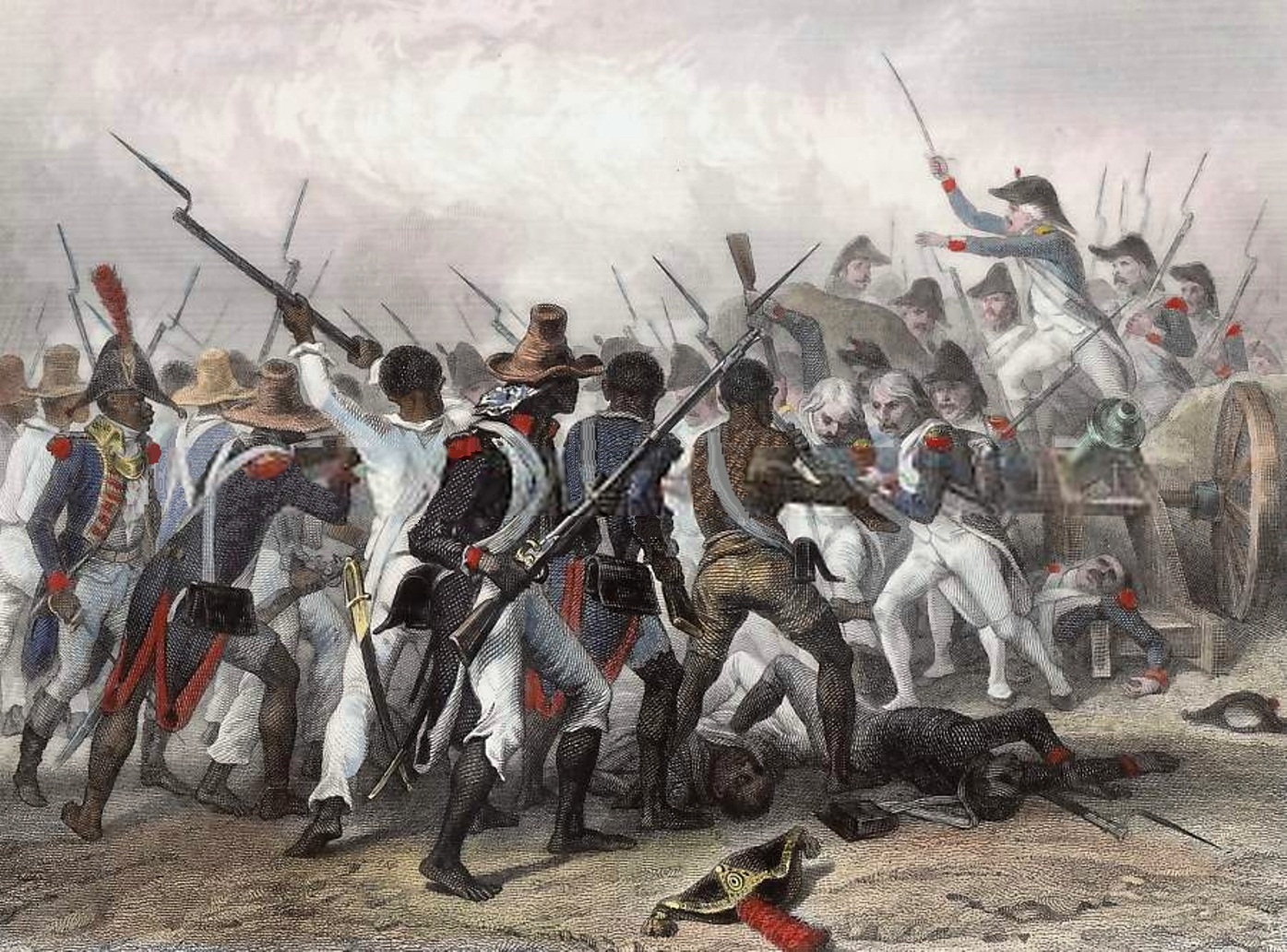
An 1839 engraving after Auguste Raffet depicting the fighting at Crête-à-Pierrot in March 1802. It illustrates the earlier campaign, not the November 1803 Battle of Vertières.
Auguste Raffet, engraving by Hébert, published 1839 / Wikimedia Commons · Public domain
How did Dessalines unite the resistance?
Dessalines emerged from slavery and years of revolutionary warfare to lead the independence army. His relationship with French forces and other revolutionary leaders changed during the conflict. By late 1802, officers and soldiers of colour were joining renewed resistance alongside rebellious cultivators. The alliance brought together groups whose interests had not always coincided. Its strength depended on turning the defence of emancipation into a shared military and political project. Unity was achieved through conflict as well as agreement. Bibliothèque nationale de France: Dessalines and independence Bibliothèque nationale de France: Napoleon’s failed expedition
Accounts centred entirely on commanders can obscure the work that sustained the army. Campaigns required movement, supplies, communication and the ability to hold territory while attacking garrisons. Communities and fighters carried the struggle across a landscape that the expedition could not fully control. The independence army’s achievements should be understood at that scale. Vertières was one concentrated moment within a much wider collapse of colonial authority, made possible by persistent resistance over time.
Why was the French expedition weakening?
Combat and disease both took a heavy toll. Yellow fever devastated the expeditionary forces, killing Leclerc in November 1802. Rochambeau succeeded him and continued a brutal campaign. Meanwhile, the resumption of war between Britain and France in 1803 disrupted French reinforcement and supply. British ships blockaded major ports while Dessalines’s army controlled much of the interior and besieged French positions. These pressures reinforced one another, reducing the expedition’s ability to recover from losses. Bibliothèque nationale de France: Napoleon’s failed expedition
Disease explains part of the expedition’s failure, but treating it as the entire explanation removes the decisions and military action of the revolutionaries. An army weakened by illness still had to be confronted, isolated and defeated. Equally, a battle account that ignores disease and the blockade leaves out conditions that shaped the campaign. The outcome arose from the interaction of resistance, leadership, logistics, imperial policy and the environment in which the war was fought. Bibliothèque nationale de France: Napoleon’s failed expedition US Office of the Historian: Haitian Revolution
What happened at Vertières?
Vertières lay near the French stronghold of Cap-Français. On November 18, the independence army’s victory forced the final reckoning for Rochambeau’s position. The Bibliothèque nationale de France’s historical account dates the battle to that day and capitulation to November 19. The French evacuation followed. These linked events ended the expedition’s attempt to re-establish effective control over the western colony. The military victory and the later declaration of independence were successive stages of the same transformation. Bibliothèque nationale de France: Dessalines and independence
The battle is remembered through heroic narratives, images and national ceremony. Those forms of memory express its importance, but individual speeches and cinematic scenes need their own documentary support. This article does not invent dialogue or present an illustrative fighter as a verified portrait of a commander. Nor does it assign a precise casualty total unsupported by the cited records. The securely documented result is momentous enough: the expedition had been defeated and withdrawal could no longer be avoided.
How did victory become independence?
On January 1, 1804, Dessalines declared Haiti independent. The new state emerged from a revolution that had destroyed slavery and defeated an effort to restore colonial control. The declaration transformed a military outcome into a claim to sovereign political existence. It also challenged a wider Atlantic order in which slavery and colonial commerce remained deeply entrenched. PRESDA’s history of slavery places that achievement within the institutions against which the revolutionaries had fought. Bibliothèque nationale de France: Dessalines and independence US Office of the Historian: Haitian Revolution
Independence did not end violence or secure immediate international acceptance. Dessalines ordered killings of much of the remaining French population in 1804, a part of the aftermath that a serious history must acknowledge. France recognised Haiti only in 1825 under an imposed indemnity arrangement. The United States waited until 1862. Military liberation and diplomatic recognition therefore followed very different timetables, while the financial demands imposed on Haiti burdened the new country’s future. Bibliothèque nationale de France: Dessalines and independence US Office of the Historian: Haitian Revolution French National Archives: Haiti’s imposed indemnity
Did Haiti’s revolution affect the wider world?
The failure of Napoleon’s Caribbean project contributed to his decision to sell Louisiana to the United States in 1803. The Bibliothèque nationale de France explains how Saint-Domingue’s reconquest and the projected role of Louisiana were connected. The purchase preceded Vertières, so the November battle cannot have directly caused an agreement already made earlier that year. The connection concerns the expedition’s broader failure and Napoleon’s changing imperial strategy. Chronology keeps the influence clear. Bibliothèque nationale de France: Napoleon’s failed expedition
Why November 18 still matters
Haiti commemorates Vertières as a victory for freedom, dignity and national existence. An embassy address marking its anniversary explicitly connects the battle with the ancestors’ struggle to live as free people. Remembering that meaning alongside the difficult aftermath preserves the historical achievement without simplifying what followed. For the imperial system challenged by the revolution, see PRESDA’s history of the French empire. Vertières belongs in both Haitian national history and the history of the Atlantic world. Haitian Embassy: commemoration of Vertières
FAQ
Frequently Asked Questions
Did Napoleon personally fight at Vertières?
No. The French force was part of the expedition he had sent to Saint-Domingue, but Donatien de Rochambeau commanded there at the end of the campaign. “Napoleon’s army” identifies the expedition’s political authority rather than his physical presence on the battlefield.
Who led the victorious army?
Jean-Jacques Dessalines led the independence army. The victory followed a long conflict involving many commanders, soldiers and communities. Toussaint Louverture had led the earlier revolutionary phase but died imprisoned in France before the battle.
When did the battle and independence occur?
The battle took place on November 18, 1803. The BnF account dates French capitulation to November 19. Haiti’s declaration of independence followed on January 1, 1804, distinguishing the military victory from the formal proclamation.
Was yellow fever the sole reason France lost?
No. Disease devastated the expedition, while armed resistance, the unification of revolutionary forces, siege warfare and the British naval blockade also shaped the outcome. Treating any single factor as sufficient misses how these pressures combined.
Did Vertières cause the Louisiana Purchase?
The purchase occurred earlier in 1803. The broader failure of the Saint-Domingue expedition contributed to Napoleon’s decision, but the November battle came afterward. The relationship is between the wider colonial campaign and changing imperial plans.
PRESDA Dispatch
Stay Informed. Stay Aware.
A sharp briefing across AI, gaming, sport, business, world affairs, paparazzi, and lifestyle.