FRENCH EMPIRE: HOW FRANCE BUILT AND LOST A GLOBAL EMPIRE
From Napoleon’s European conquests to colonial Africa, Indochina and the Pacific, discover how France expanded its power, confronted resistance and lost an empire.
The French Empire has two connected but distinct histories. Napoleon's First French Empire dominated much of continental Europe between 1804 and 1814, with a brief return in 1815. France's colonial empire developed over several centuries across the Americas, Africa, Asia and the Pacific. Its largest phase came after Napoleon, and its dissolution unfolded through different independence struggles rather than one final battle.
An imperial map makes power look deceptively simple. One color spreads across borders, oceans and islands. On the ground, that color could mean an occupied European kingdom, a Caribbean plantation worked by enslaved people, an Algerian settlement or a Vietnamese village paying colonial taxes. Each required different institutions, and each produced different forms of resistance.
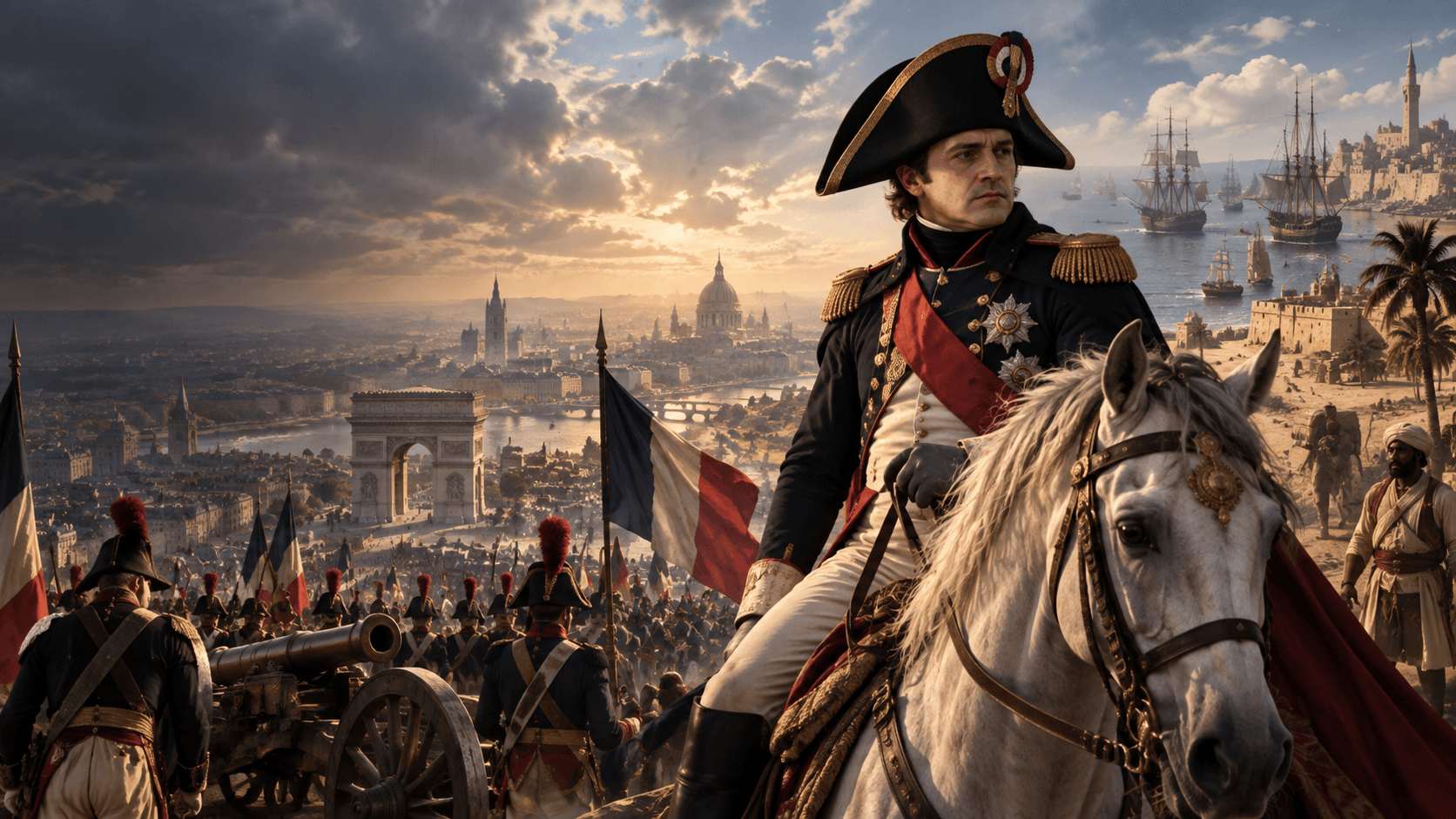
This history begins with the revolutionary crisis that made Napoleon possible, then follows the overseas expansion that outlived him. The supplied opening illustration combines Napoleon, Paris and maritime imagery as an imaginative editorial scene, not a reconstruction of a particular event.
WHICH FRENCH EMPIRE ARE WE TALKING ABOUT?
The First French Empire was Napoleon I's imperial regime, proclaimed in 1804. The Second French Empire was the later regime of Napoleon III, from 1852 to 1870. Neither label is interchangeable with the French colonial empire: overseas possessions existed under kings, emperors and republics.
Historians also distinguish an earlier colonial empire, centered especially on Atlantic possessions, from a later phase associated with the conquest of Algeria and expansion across Africa and Asia. These are useful period labels, not evidence that every colony was acquired or lost at the same moment. Larousse's historical overview traces that uneven geography. Larousse: French colonial empire
HOW DID NAPOLEON BUILD HIS EMPIRE?
Napoleon rose through the armies of the French Revolution. The destruction of the old political order opened opportunities, while war made successful generals increasingly important. His Italian campaigns brought prestige; the Egyptian expedition showed how military ambition could reach beyond Europe without producing a durable settlement.
In the coup of November 1799, Napoleon helped overthrow the Directory and became First Consul. He presented concentrated authority as an answer to instability. The movement from revolutionary republic to personal rule was gradual in its institutions, but unmistakable in its direction. PRESDA's history of France and the French Revolution supplies the wider domestic background. Fondation Napoléon: Consulate and First Empire timeline
Proclamation, coronation and authority
The Empire was legally proclaimed on May 18, 1804. Napoleon's coronation at Notre-Dame on December 2 was a separate event that gave the new regime its unforgettable ceremony. Confusing the two dates turns political construction into a single theatrical moment. Fondation Napoléon: Proclamation of the Empire
The coronation employed religious ritual, dynastic symbolism and carefully organized public spectacle. Its setting joined the authority of the new ruler to older forms of monarchy, even while Napoleon claimed to preserve important achievements of the Revolution. The resulting regime could be modernizing and authoritarian at the same time. Fondation Napoléon: The coronation of Napoleon I
Law and government were also instruments of power
The Civil Code of 1804 consolidated rules concerning property, contracts and civil status. It helped carry parts of the revolutionary legal settlement beyond France and had an influence that survived military defeat. That legacy matters, but it was not a complete charter of universal freedom. Fondation Napoléon: The Civil Code, principles and legacy
Married women remained legally subordinate within a strongly patriarchal family order. Meanwhile, political power rested increasingly with the emperor. Legal standardization, equality in some domains and restrictions in others belonged to the same system. Describing Napoleon simply as either the savior or destroyer of the Revolution misses those distinctions. Fondation Napoléon: Women under the First Empire
NAPOLEON'S GREATEST VICTORIES AND MAJOR DEFEATS
Napoleon's armies combined experienced leadership, mass mobilization, rapid movement and concentrated force. Corps containing infantry, cavalry and artillery could operate separately and come together for battle. The system depended on commanders, soldiers, horses, supplies and roads, not on the emperor's intelligence alone.
Austerlitz on December 2, 1805 brought a decisive victory over Austrian and Russian forces. Jena and Auerstedt on October 14, 1806 shattered Prussian resistance, with Marshal Davout responsible for the victory at Auerstedt. Friedland in 1807 and Wagram in 1809 helped impose further settlements. These campaigns established dominance, but they did not remove the possibility of new coalitions. Musée de l’Armée: Napoleon the Strategist, battles and chronology
Victory could redraw boundaries or replace a ruler without securing lasting consent. France annexed some territories and exercised influence through dependent states and allied rulers elsewhere. This was a hierarchy of unequal relationships rather than one uniformly governed country. Military success repeatedly created obligations that demanded more soldiers and resources.
At Trafalgar on October 21, 1805, Nelson's fleet defeated the combined French and Spanish fleet. Napoleon did not personally command this naval battle, but the defeat demonstrated the limits of continental military power at sea. Austerlitz could change Europe's diplomatic balance without removing Britain's maritime strength. Royal Museums Greenwich: Battle of Trafalgar
THE CONTINENTAL SYSTEM AND THE WAR IN SPAIN
The Continental System sought to weaken Britain by restricting British trade with continental Europe. Napoleon tried to use control over ports and governments to accomplish what France could not reliably impose at sea. The Berlin Decree of 1806 was central to this economic campaign. Fondation Napoléon: Napoleon and economic warfare
The blockade also harmed merchants and consumers within Napoleon's sphere. Smuggling, selective enforcement and reluctant allies undermined it. An attempt to exert economic pressure therefore produced pressure for further political and military intervention. The empire's commercial strategy and territorial ambitions became increasingly difficult to separate.
In 1808 Napoleon displaced the Spanish Bourbons and installed his brother Joseph. Popular resistance and the intervention of British and Portuguese forces turned Spain into a prolonged war. Guerrilla attacks complicated French control, but regular armies and major battles remained essential; resistance was not a single spontaneous method of fighting. National Army Museum: The Peninsular War
Occupation meant requisitions, destruction, reprisals and danger for civilians. French battlefield victories did not solve the political problem of an imposed monarchy. Spain demonstrated that occupying capitals and defeating armies were insufficient when legitimacy and local cooperation remained insecure.
WHY DID NAPOLEON INVADE RUSSIA?
Napoleon invaded Russia in 1812 to force a deteriorating ally back into his European system. Conflict over the Continental System was crucial, but disputes over Poland and the balance of power also mattered. The invasion was an attempt to compel a political settlement, not merely a march undertaken because Napoleon wanted more land. Fondation Napoléon: The Franco-Russian rupture of 1812
The Grande Armée crossed the Niemen in June. Russian withdrawals denied Napoleon the quick decisive result he sought. Long marches, inadequate supply, illness and losses of horses weakened the invasion before the worst winter weather. Borodino in September was exceptionally bloody, but the Russian army survived. Occupying Moscow did not make Tsar Alexander I negotiate. Fondation Napoléon: From the Niemen to Moscow
The retreat compounded an existing catastrophe. Hunger, exhaustion, cold and Russian attacks interacted; no single cause explains the destruction. The familiar claim that winter alone defeated Napoleon removes the logistical failures and Russian decisions that had already undermined his campaign. Fondation Napoléon: The Russian retreat
For the Russian perspective and the state Napoleon confronted, see PRESDA's Russian Empire history. The campaign was a struggle between imperial systems, with soldiers and civilians across many nationalities bearing the consequences.
WATERLOO AND THE FALL OF NAPOLEON
Defeat at Leipzig in October 1813 accelerated the collapse of Napoleon's European position. Allied armies entered France, and he abdicated in 1814 before going to Elba. His return in 1815 restored his rule briefly, but it also restored the coalition determined to remove him.
At Waterloo on June 18, 1815, Wellington's multinational army held against French attacks while Blücher's Prussians entered the battle. It was a coalition victory, not Britain fighting alone. Napoleon abdicated again and was ultimately exiled to Saint Helena. National Army Museum: Battle of Waterloo
Waterloo ended Napoleon's return, but the weakness of his position extended beyond the battlefield. His opponents retained resources and armies with which to continue the war. Tactical genius could not indefinitely overcome an unfavorable coalition, worn-down military resources and the political consequences of repeated conquest.
BEFORE THE LATER EMPIRE: THE CARIBBEAN AND HAITI
France's overseas empire had begun long before Napoleon. North American settlements and Caribbean plantation colonies connected it to Atlantic trade and the trafficking of enslaved Africans. Saint-Domingue, the French colony that became Haiti, illustrates why colonial wealth must be examined alongside the coercion that produced it.
The Haitian Revolution began in 1791. Enslaved people and free people of color fought through shifting alliances and foreign interventions to destroy slavery and colonial rule. Independence in 1804 was their achievement, not a freedom granted by a defeated European government. Slavery and Remembrance: The Haitian Revolution
Napoleon's 1802 expedition sought to reassert French control in Saint-Domingue. The threat of renewed enslavement helped drive resistance, and the French attempt failed. His Caribbean policy exposes the sharp limits of imperial claims to carry revolutionary liberty overseas. Slavery and Remembrance: Haiti and Saint-Domingue
Guadeloupe and Martinique remained important French possessions through later political changes. Slavery's final legal abolition in the French colonies came in 1848. Abolition was fundamental, but it did not automatically remove plantation hierarchies or ensure equal power for emancipated people.
HOW FRANCE BUILT ITS LATER COLONIAL EMPIRE
The invasion of Algeria in 1830 opened a major new phase. Expansion continued under changing regimes, including Napoleon III and the Third Republic. Military commanders, commercial interests, missionaries and politicians did not always share one coherent plan. The Cambridge history French Colonialism emphasizes repeated reinventions of imperial purpose rather than an uninterrupted national blueprint. Cambridge University Press: Reinventions of Empire in the Nineteenth Century
The later empire included colonies, protectorates and, after the First World War, mandates. These statuses mattered. A protectorate might preserve a local sovereign while placing decisive power in French hands. A mandate had an international legal framework. Neither arrangement guaranteed political equality or freedom from coercion.
France established protectorates in Tunisia in 1881 and Morocco in 1912. In West and Equatorial Africa, conquests and treaties were followed by federated colonial administrations. After the First World War, France also received mandates in Syria and Lebanon and over parts of former German Africa. These additions belonged to the colonial empire, not Napoleon's European state.
FRENCH RULE IN AFRICA: CONQUEST, LAND AND CITIZENSHIP
Taking Algiers in 1830 did not mean that Algeria was instantly conquered. The French military archive treats the occupation as the beginning of a much longer process. Resistance, campaigning and settlement transformed the relationship between land, state authority and local society. Service historique de la Défense: The conquest of Algeria
European settlement and the transfer of land changed rural livelihoods. Peasants could become laborers on land now controlled by others, move to towns or seek work abroad. The social history examined in Andrea Rapini's study of Bourdieu's Algerian research shows why colonialism cannot be understood only through governors and battles. Andrea Rapini: Colonialism, labor and power in Algeria
The indigénat was a regime of administrative sanctions imposed on colonial subjects. Gregory Mann's research on French West Africa shows how changing legal statuses and coercive powers contradicted imperial claims about the rule of law. Calling an empire republican did not make citizenship equal throughout its territories. Gregory Mann: What Was the Indigénat?
North and West Africa already contained complex political, linguistic and commercial worlds. PRESDA's histories of the Amazigh peoples and the Mali Empire place colonial conquest within those longer histories. French occupation did not mark the beginning of African statecraft or exchange.
Resistance was part of the conquest itself
In Algeria, Emir Abd el-Kader organized resistance before his surrender in 1847 and subsequent imprisonment in France. His defeat did not establish that conquest had been accepted by the population. The history of military resistance and the later history of independence movements belong to different periods of a continuing struggle over authority. Mucem: Abd el-Kader, historical exhibition dossier
Samori Touré built a powerful West African state and resisted French expansion through warfare and negotiation before his capture in 1898. His history also involved conflict with neighboring populations. Recognizing resistance does not require turning its leaders into uncomplicated heroes or treating African societies as a single united bloc. Larousse: Samori Touré
Resistance extended beyond organized armies. Avoiding recruitment, moving away from demands for labor, petitioning officials and organizing politically could all challenge colonial authority. Cooperation, too, could be tactical and constrained. A person dealing with an administrator was not necessarily consenting to the system that made that encounter unavoidable.
FRENCH RULE IN INDOCHINA
French Indochina brought together territories corresponding to Vietnam, Cambodia and Laos under unequal arrangements of colonial rule. The conquest unfolded during the nineteenth century, followed by administrative consolidation. The label describes a French political construction, not one pre-existing nation or culture. French Ministry of the Armed Forces: French presence in Indochina
Rice exports, rubber plantations, finance and transport linked the region to international markets. French firms were powerful, but Chinese merchants and local producers also remained essential. Research on colonial conglomerates shows a political economy assembled through business networks and government privileges rather than a simple transaction between Paris and a passive colony. Modern Asian Studies: Colonial conglomerates in French Indochina
Fiscal policy could make the colonial state dependent on activities it claimed to regulate. The opium monopoly supplied revenue within an oppressive tax system. Its importance was institutional, connecting consumption, state budgets and commercial intermediaries. That history complicates descriptions of empire as merely a program of schools and railways. Modern Asian Studies: Opium and rule in Vietnam
THE COLONIAL ECONOMY AND ITS HUMAN COSTS
Colonial infrastructure changed transport and production, but its purpose, financing and labor conditions must be examined. Roads could move crops and connect settlements while also moving soldiers and facilitating extraction. Asking who benefited, who paid and who decided is more informative than counting completed projects.
Forced labor supplied public works in parts of the empire. Martin Thomas's study of colonial policing describes how labor requisition and enforcement were integral to colonial government. An official regulation could authorize coercion rather than protect the person subjected to it. Martin Thomas: Colonial policing and labor regulation
After slavery, contracted labor also connected distant colonial territories. The Musée de l'histoire de l'immigration describes the expansion of engagisme and recruitment from Asia. A wage or contract did not by itself eliminate compulsion, unequal bargaining power or restrictions on movement. Musée de l’histoire de l’immigration: Imperialism and contracted labor
Imperial officials often invoked assimilation or a civilizing mission. In practice, schooling, legal rights and access to office were uneven. Colonial law created exceptions for Indigenous populations that would have been incompatible with the universal principles claimed in metropolitan political language. Olivier Le Cour Grandmaison: The Exception and the Rule in French Colonial Law
THE PACIFIC WAS PART OF THIS HISTORY TOO
France took possession of New Caledonia in 1853. Surviving acts of possession, preserved in the archives, record the process by which French authority was asserted. Such documents establish what colonial officials claimed; they should not be read as proof that all Indigenous communities freely accepted permanent subordination. Government of New Caledonia: The archival acts of possession
In Tahiti, a French protectorate was imposed in 1842, followed by annexation of territories under the Tahitian crown in 1880. The island groups later gathered under French Polynesia had their own histories and societies. Placing them on an imperial map does not make them interchangeable with Caribbean plantation colonies or Algeria. French Ministry for Overseas Territories: History of French Polynesia
THE WORLD WARS: EMPIRE DEFENDS FRANCE
The First World War drew soldiers and workers from France's colonies into a global conflict. Recruitment mixed voluntary service with coercion and compulsory systems. African troops fought in Europe while their communities faced demands for manpower and resources. Military service did not reliably deliver the equality some recruits or political leaders hoped it would bring. International Encyclopedia of the First World War: African colonial military participation
The name tirailleurs sénégalais can mislead: these troops were recruited more widely than Senegal. Remembering colonial participation requires seeing soldiers as individuals within unequal institutions, rather than either anonymous imperial manpower or a single group with identical motives.
In the Second World War, France's defeat in 1940 divided the empire between competing authorities. Chad rallied to Free France under Governor Félix Éboué on August 26, 1940, helping give de Gaulle's movement a territorial base. African territories and troops were central to French resistance and recovery, not a peripheral addition to a purely European story. Ordre de la Libération: Félix Éboué
In Indochina, Japanese military domination disrupted French authority. The end of the war did not restore the prewar political world: independence movements had gained organization and ambition. Attempts to rebuild empire now confronted both local resistance and a transformed international environment.
WHY DID THE FRENCH COLONIAL EMPIRE COLLAPSE?
Decolonization resulted from organized resistance, demands for political rights, the costs of warfare and changes in international legitimacy. The Second World War weakened European powers, while the Cold War created new pressures and opportunities. Colonial subjects were political actors who forced choices, not spectators waiting for France to withdraw. University of Luxembourg, CVCE: Decolonization and its geopolitical context
Different territories followed different paths. Independence might come through negotiation, war or a combination of political mobilization and pressure. Repression of the 1947 uprising in Madagascar demonstrates that postwar reform and violent coercion could coexist. In 2025, France and Madagascar announced a joint historical commission concerning 1947 and decolonization-era atrocities, underscoring the continuing work of documenting that history. Élysée: Joint historical work on Madagascar and 1947
Vietnam: military defeat and the Geneva settlement
The First Indochina War, fought from 1946 to 1954, pitted French efforts to retain power against the Viet Minh and its struggle for independence. The fall of the French-held position at Dien Bien Phu on May 7, 1954 was a decisive blow. It did not mean that every French force vanished immediately, but it profoundly changed the prospects for continuing the war. US Office of the Historian: Dien Bien Phu and French Indochina
The Geneva settlement addressed the end of hostilities in Vietnam, Laos and Cambodia. Its July 1954 final declaration explicitly treated Vietnam's military demarcation line as provisional, not a permanent political boundary. Later war should not be projected backward as the settlement's agreed intention. Primary document: Geneva Final Declaration on Indochina, July 21, 1954
Algeria: why withdrawal became a crisis for France
The Algerian War began in 1954. Algeria's settler population and its incorporation into France's administrative system made independence especially divisive within French politics. The conflict involved the FLN's armed struggle, French counterinsurgency and violence against civilians. Military control could not settle the underlying question of sovereignty.
Torture and disappearance were part of French repression. The French presidency's 2018 statement on Maurice Audin acknowledged that his death had been made possible by an officially instituted system of arrest and detention. This is not merely an accusation found in later political rhetoric; state acknowledgment forms part of the documentary record. Élysée: Statement on Maurice Audin and the system of detention
The Évian agreements of March 1962 opened the way to independence that year. They did not instantly end violence. European settlers departed in large numbers, and many harkis, Algerians who had served alongside France, faced abandonment and reprisals. A negotiated endpoint to colonial sovereignty did not make its human consequences orderly. Chemins de mémoire: The end of the Algerian War in 1962
Independence beyond the two great colonial wars
Morocco and Tunisia achieved independence in 1956. Guinea rejected the French Community in the 1958 referendum and proclaimed independence on October 2. A contemporary French administrative note records the resulting rupture in relations, illustrating that even constitutional choices could generate confrontation. CVCE and French overseas archives: Guinea in 1958
In 1960, many former French territories in sub-Saharan Africa became independent. Their leaders debated sovereignty, federation and continued ties with France; independence did not emerge from one identical national movement. PRESDA's history of Morocco follows one of these distinct paths. CVCE: African emancipation and the French Community debates
MYTH VS REALITY: THE FRENCH EMPIRE
“Napoleon built the entire French colonial empire”
No. Overseas expansion preceded him and continued long after his fall. The largest later colonial acquisitions belonged to different governments, including republican ones. Napoleon's European empire and colonial France overlap historically but are not the same institution.
“Winter alone defeated Napoleon in Russia”
Cold worsened the retreat, but illness, hunger, supply failures, combat and Russian strategy had already weakened the invading army. Weather was part of the explanation, not a substitute for it.
“Waterloo was a victory by Britain alone”
Wellington commanded a multinational force, and Blücher's Prussians played a decisive role. The victory belongs to a coalition.
“Republican ideals guaranteed equality in the colonies”
Colonial subjects faced unequal status and coercive institutions. The contradiction between proclaimed universal rights and colonial government is central to the history, not an inconvenient exception to it.
“Infrastructure cancels out exploitation”
Buildings and transport networks had real effects, but they cannot erase forced labor, dispossession or political exclusion. Historical assessment requires examining access, costs and authority rather than treating unlike experiences as entries in a simple balance sheet.
“The whole empire ended on one date”
Different territories gained independence at different times, and France retains overseas territories with varied constitutional statuses. Neither 1815 nor 1962 is a universal endpoint for every part of this history.
THE EMPIRE'S MODERN LEGACY
French remains a language of public life in many societies shaped by empire, but people use and transform it for their own purposes. Migration, family histories, literature and political debate connect France to former colonies without reducing those countries to extensions of Paris. Colonial history also shapes arguments about citizenship, archives and historical responsibility.
France's present overseas territories must be described through their particular institutions and populations. The overseas ministry lists places including Guadeloupe, Martinique, French Guiana, New Caledonia and French Polynesia; they do not all have identical status or political preferences. French Ministry for Overseas Territories: Territories of overseas France
Questions of self-determination remain active. French Polynesia appears on the United Nations list of Non-Self-Governing Territories, having been reinscribed in 2013. That international framework is distinct from France's domestic constitutional description. Acknowledging the distinction avoids pretending that decolonization is either universally finished or unchanged everywhere. United Nations: French Polynesia and decolonization
The French imperial story is therefore more than a rise-and-fall portrait of Napoleon. It is a history of institutions that spread influence, people who served or endured them, and movements that challenged the right of distant rulers to decide their futures. Its military and cultural achievements become more intelligible when read alongside the unequal power and human costs that sustained them.
FAQ
Frequently Asked Questions
What was the French Empire?
The term can refer to Napoleon’s First French Empire or to France’s overseas colonial possessions. The First Empire ruled from 1804 to 1814 and briefly in 1815. The colonial empire developed over centuries under several political regimes.
When did Napoleon become emperor?
Napoleon’s empire was proclaimed on May 18, 1804. His coronation at Notre-Dame in Paris took place on December 2, 1804.
Why did Napoleon invade Russia?
Napoleon invaded in 1812 to force Russia back into his European system. Disputes over the Continental System, Poland and the balance of power contributed to the breakdown of their alliance.
Who defeated Napoleon at Waterloo?
Wellington’s multinational army and Blücher’s Prussian army defeated Napoleon at Waterloo on June 18, 1815. It was a coalition victory, not Britain fighting alone.
Was Napoleon’s empire the same as the French colonial empire?
No. Napoleon’s main imperial system was European. France held overseas colonies before his rise and expanded extensively in Africa, Asia and the Pacific after his fall.
Why did France lose Indochina?
Sustained Vietnamese resistance, the cost of the First Indochina War and the defeat at Dien Bien Phu in 1954 undermined French power. The Geneva settlement provided for ending hostilities in Vietnam, Laos and Cambodia.
When did Algeria become independent?
Algeria became independent in 1962 after the war that began in 1954 and the Évian agreements of March 1962. Violence and displacement continued during the transition.
Does France still have overseas territories?
Yes. France retains overseas territories with different constitutional arrangements, including Guadeloupe, Martinique, French Guiana, New Caledonia and French Polynesia. Their political status and debates over self-determination must be considered individually.
PRESDA Dispatch
Stay Informed. Stay Aware.
A sharp briefing across AI, gaming, sport, business, world affairs, paparazzi, and lifestyle.