The Bee Colony: A World of Order and Intelligence
Inside a honeybee colony: queens, workers, waggle dances, honey, pollination and environmental threats, explained through scientific research.
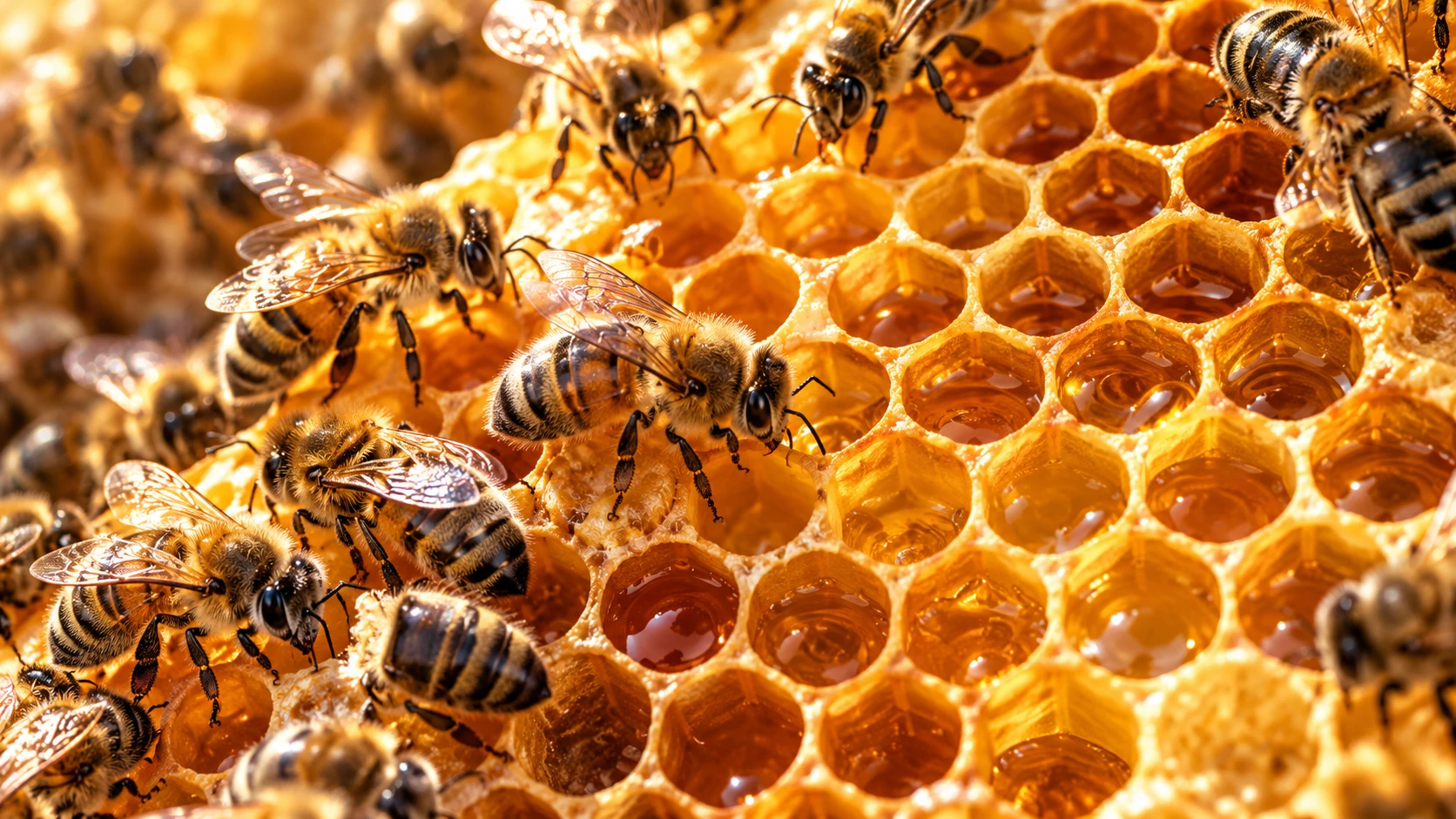
Hero: PRESDA AI-generated scientific illustration of bees and honeycomb, not an authentic macro photograph.
At the entrance to a honeybee nest, the traffic looks almost impossibly organized. Foragers arrive with pollen packed against their hind legs. Others leave to search for flowers, while inside, workers feed larvae, shape wax and regulate the nursery’s temperature. No bee sees the entire operation. No central authority assigns every journey. Yet together, the insects maintain a living system capable of feeding itself, defending its home and founding another colony.
This is the remarkable world of the western honeybee, Apis mellifera. Its intelligence is both individual and collective: bees learn, communicate and respond to one another, allowing useful patterns to emerge from thousands of small interactions. Understanding that achievement requires looking beyond the familiar image of a queen ruling obedient subjects. It also means remembering that honeybees represent only one part of the much larger, astonishingly varied world of bees.
Before the hive: an evolutionary partnership
Bees evolved from wasp ancestors, with a fundamental dietary change: pollen and nectar became central resources for provisioning their young. Flowering plants offered food; visiting insects could carry pollen between flowers. Across immense spans of time, these exchanges helped shape the diversity of both groups. A 2023 analysis combining genomic information, fossils and geographic distributions placed the origins of bees around 120 million years ago, with an ancestral range in western Gondwana. That reconstruction is a scientific inference, not a directly observed birthplace. Evolutionary history of bees
The result was not a single way of living. Many bee species are solitary: a female builds and provisions her own nest rather than joining a permanent workforce. Bumblebees have social colonies with a different seasonal rhythm from honeybees. Stingless bees offer further variations on cooperative life. The honey-filled comb and large perennial colony described here belong specifically to honeybee biology. Treating every bee as a miniature honeybee obscures the different nesting sites, flowers and conservation measures that other species need. Smithsonian Libraries: The Solitary Bees
A colony, not a royal court
A thriving honeybee colony can contain tens of thousands of workers, a queen and, seasonally, male drones. Their numbers change with climate, food supply and the colony’s condition. The nest is simultaneously a nursery, food store and shelter. Scientists sometimes call the colony a superorganism because reproduction and survival depend on coordinated functions distributed among its members. That comparison is useful, but it does not mean that the colony possesses a single mind.
The queen is principally its reproductive female. Workers perform most of the activities that keep the society alive. Chemical signals, touch, movement and local conditions influence what happens next. A worker encountering hungry larvae or a change in temperature can respond without receiving an order from the queen. Colony organization is therefore better understood as a network of feedback than as a monarchy. Its apparent order comes from continuous adjustment, not from a master plan held by one insect. Penn State: beekeeping biology and management
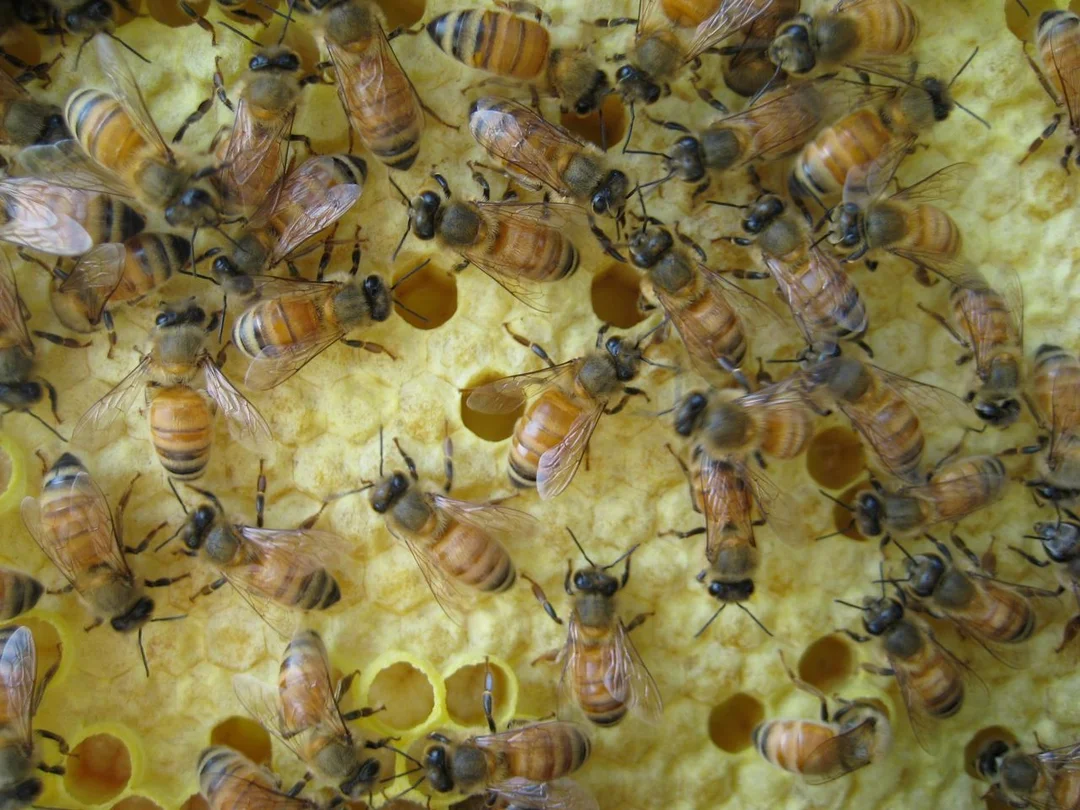
Honeybee workers on brood comb. The wax structure supports the colony’s nursery as well as food storage. Photograph by A. Szalanski (Aszalan), uploaded in 2008.
A. Szalanski (Aszalan) · Original photograph
WebP conversion and responsive resizing by PRESDA. Full composition retained; image derivatives remain under the stated ShareAlike license.
License: CC BY-SA 3.0How a queen becomes a queen
Queens and workers are female bees, but their developmental paths diverge while they are larvae. Nutrition is central: larvae raised as queens receive a sustained, abundant glandular diet in specialized queen cells. This affects growth and reproductive development through interacting physiological and molecular processes. The popular explanation that a single magical ingredient simply switches a worker into royalty misses that complexity. Development depends on the timing, amount and composition of feeding as well as biological responses within the larva. Queen development
A young queen typically mates with several drones during flights, storing sperm that can later fertilize eggs. She can remain reproductively active for years, although longevity and performance vary. Her pheromones help regulate colony behavior and reproductive organization, but workers also assess and sometimes replace her. Queen replacement can follow declining performance or loss of the existing queen. The continuity of the colony matters more than the permanence of any individual. Honeybee genetics
Workers: a flexible lifetime of tasks
Workers clean cells, tend brood, process food, build comb, guard the entrance and forage. Age is associated with changing responsibilities: younger adults commonly work inside the nest, while older workers often collect resources outside. But this is not a rigid career ladder. Colony needs can accelerate or reverse behavioral transitions. A shortage of foragers or nurses changes the social conditions experienced by the remaining bees, helping redirect their activity.
Such flexibility is essential because the outside world does not provide a steady workload. Flowering peaks may briefly make nectar abundant; rain can abruptly interrupt collection. A colony must balance the immediate demands of its larvae against the risks of sending bees into the landscape. Workers are usually reproductively inactive, but describing them as absolutely incapable of laying eggs is inaccurate. Under some conditions, particularly queenlessness, workers can lay unfertilized eggs. Cooperation includes mechanisms that limit reproductive conflict, rather than eliminating its evolutionary possibility. Penn State: colony life cycle
Drones and the genetics of reproduction
Drones are male honeybees. Their central reproductive role is to mate with queens from other colonies, helping move genes through the wider population. They do not collect pollen or nectar like workers, and they have no sting. Their large eyes are suited to locating queens during aerial mating. A drone that successfully mates dies afterward. In temperate conditions, colonies commonly reduce their drone population when resources decline, including expelling males before winter.
Honeybees have a reproductive system called haplodiploidy. Normally, fertilized eggs develop into females and unfertilized eggs into males. This is a helpful introduction, not a complete account of sex determination: the complementary sex-determination system can also produce diploid males under certain genetic combinations. Relatedness has influenced the evolution of cooperation, but genetics alone is not a complete explanation of social life. Ecology, parental care and the advantages of coordinated nesting also matter. For the broader principles, see PRESDA’s guide to DNA and inheritance. Honeybee genetics basics
Swarming: when one society becomes two
A colony reproduces at another level when it swarms. The old queen departs with a substantial group of workers, leaving behind brood, food and developing queens. The departing bees may gather temporarily on a branch while scouts search for a suitable cavity. This is different from an individual queen producing eggs: the colony itself is dividing into potential new societies. Success requires enough workers, resources and shelter to survive the transition.
Swarming also reveals the limits of apparently seamless organization. Queens must emerge and establish themselves, weather can interfere with mating, and a new nest must be found. Beekeepers manage swarming partly because it reduces the workforce remaining in a hive. In an unmanaged colony, however, it is a reproductive process, not a malfunction. Understanding that distinction separates the bees’ biological interests from the practical objectives of honey production. Penn State: queen cells and swarming
The waggle dance: directions written in movement
A returning forager can communicate the direction and distance of a profitable food source through a waggle dance. On a vertical comb, the angle of the waggle run relative to upward encodes direction relative to the Sun. Its duration conveys information related to distance. Followers combine these signals with other cues, including odors. The dance does not transmit a human-style map or guarantee that every recruit will find the same flower. Smithsonian: the waggle dance
Remarkably, experience helps refine this inherited communication system. A 2023 experiment found that bees deprived of opportunities to follow experienced dancers before their first dances made more directional and distance-signaling errors. Some difficulties improved with practice, while distance errors persisted. The finding does not mean bees learn language as children do. It shows that social learning contributes to a behavior often imagined as entirely preprogrammed. Evolution supplies a framework that experience can calibrate. Social learning of the waggle dance
Decisions without a commander
When a swarm needs a home, scouts inspect candidate nest sites and recruit others through dances. Better sites can attract more sustained recruitment, while competing signals and independent inspections influence the outcome. Researchers have also documented inhibitory stop signals directed toward dancers advertising other sites. These interactions help prevent the decision process from remaining divided indefinitely. Agreement emerges through changes in activity across the group, rather than through a queen announcing a choice. Stop signals and collective decisions
This is collective intelligence in a precise sense: interactions among individuals can solve a problem that none could solve alone with the same information. Calling the process democratic can be an illuminating metaphor, but bees do not debate principles or cast conscious ballots. Nor is every collective decision perfect. The scientific interest lies in how distributed information, recruitment and inhibition produce workable outcomes despite uncertainty. Similar questions arise in studies of nervous systems, although a bee colony is not literally a brain.
Honey: sunlight stored for leaner days
Honey begins mainly as floral nectar, collected into a specialized crop and brought back to the nest. Bees transfer and process the liquid, adding enzymes that modify its sugars. Water loss concentrates the mixture, with ventilation and spreading of nectar helping evaporation. Mature honey is stored in wax cells that workers can cap. It is primarily an energy reserve, allowing the colony to bridge periods when fresh nectar is scarce. USDA: honey chemistry
Its composition varies with floral sources and processing. Concentrated sugars, acidity and other properties inhibit many microorganisms, but honey is not sterile or universally incapable of spoiling. Pollen supplies additional nutritional components, including protein and lipids, that honey alone cannot provide. The nest therefore stores complementary resources rather than one perfect food. Harvesting honey also involves a biological tradeoff: bees require sufficient reserves for their own survival. Their stores exist first as part of colony nutrition, not as surplus created for humans. USDA: anatomy and biology of the honeybee
Wax architecture, including its imperfections
Worker bees produce wax from glands on the underside of the abdomen and manipulate it into comb. Closely packed cells provide space for brood and food while sharing walls. The familiar hexagonal pattern offers an economical arrangement, but real comb is more varied than a perfect diagram. Workers must connect growing sections, accommodate obstacles and transition between cell sizes. Building is a continuing response to the geometry already present.
A 2021 study of natural construction showed how bees use intermediate cell sizes, irregular shapes and gradual changes in orientation when joining mismatched combs. Their achievement is not diminished by the presence of nonhexagonal cells. Those departures reveal adaptability: a colony can produce a coherent structure without every worker having access to a blueprint. Architecture arises from local work, the properties of wax and responses to neighboring construction. Imperfect comb and architectural ability
A nursery with climate control
Developing brood needs a relatively stable thermal environment. Workers generate heat through muscular activity and alter their distribution within the nest. When cooling is needed, ventilation and water evaporation can help. The brood area is commonly maintained around the mid-thirties Celsius, with conditions varying across the nest and with circumstances. It is misleading to imagine every corner of a hive remaining at exactly one temperature throughout the year.
In cold conditions, bees cluster and use stored energy to maintain suitable conditions. In heat, access to water and the nest’s physical properties become important. Research shows that density changes and individual heat production contribute to this social thermoregulation. Temperature control is therefore another distributed task, linking physiology to collective behavior. It also exposes a vulnerability: a shortage of food, water or healthy workers can compromise the system that protects the next generation. Colony thermal homeostasis
Pollination reaches far beyond honey
When a bee visits flowers, pollen can adhere to its body and reach another flower’s receptive structures. This can support fertilization and seed production. The outcome depends on the plant and the visitor: some flowers require particular handling, and not every visit is equally effective. Honeybees are important agricultural pollinators because colonies can be managed and transported. Their usefulness does not make them interchangeable with every wild pollinator. USDA: insects and pollinators
Wild bees, flies, butterflies, moths, beetles and other animals contribute to pollination in different settings. Many major staple crops are wind-pollinated or do not rely on animal pollination for the parts people harvest. Claims that all food would vanish without honeybees are therefore wrong. The real stakes are substantial enough: pollinators support crop quality and production, wild plant reproduction and ecological relationships that sustain landscapes. Protecting that diversity requires more than increasing the number of managed hives.
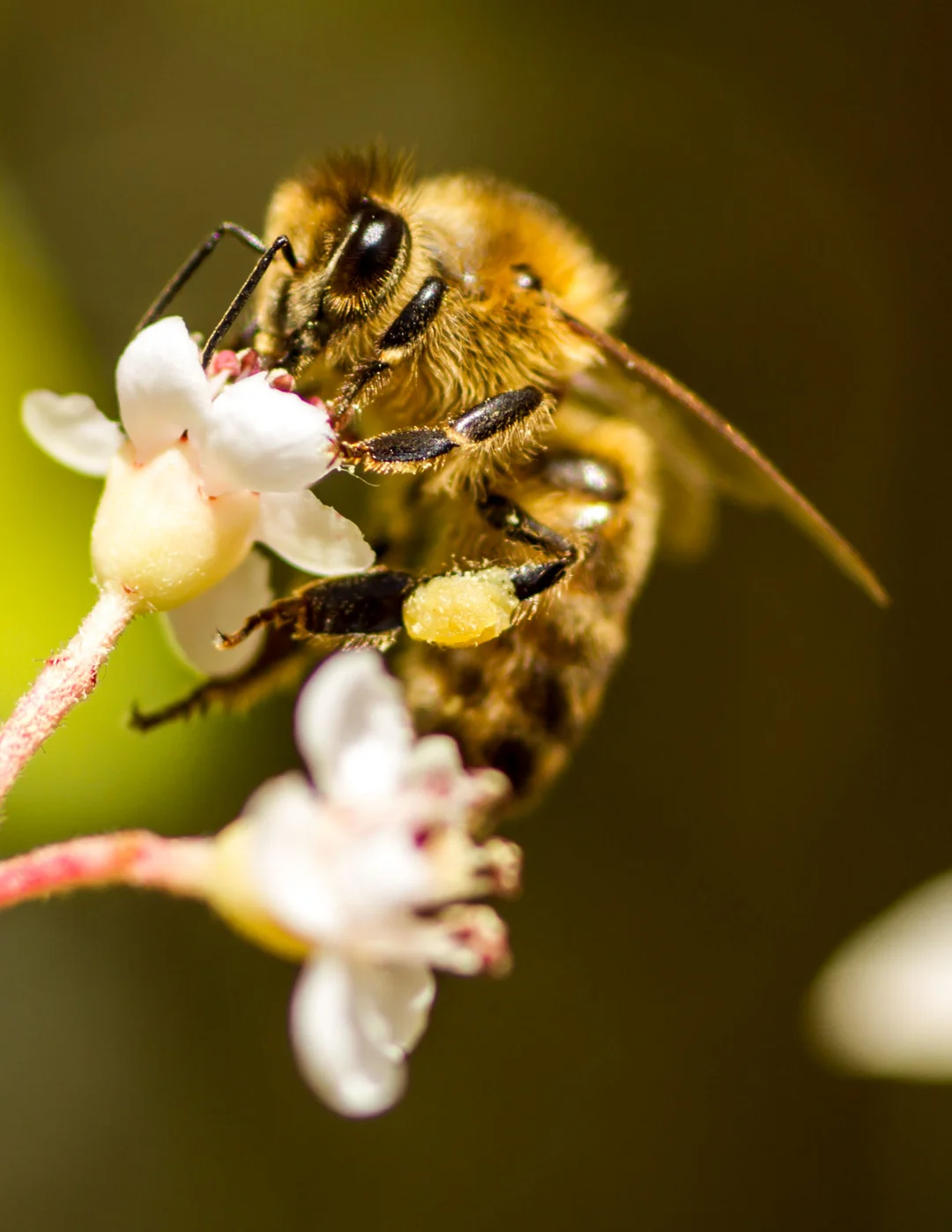
A honeybee visiting a flower with collected pollen on a hind leg. Photograph by Michael Palmer, 8 June 2014.
Michael Palmer / photorasa.com · Original photograph
WebP conversion and responsive resizing by PRESDA. Full composition retained; image derivatives remain under the stated ShareAlike license.
License: CC BY-SA 4.0Parasites, pathogens and overlapping pressures
For western honeybee colonies, Varroa destructor is a major threat. This parasitic mite damages bees and is associated with the transmission and amplification of viruses, including deformed wing virus. Research overturned a familiar description of Varroa as simply a blood-feeder: it feeds primarily on fat body tissue, which is important for metabolism, nutrient storage and immune function. That finding changed the biological understanding of the damage it causes. Varroa feeding research
Threats do not operate independently. USDA research has examined how Varroa and viral infection can increase susceptibility to insecticides. Exposure depends on the chemical, dose, timing and route, while colony condition changes the outcome. Habitat loss can reduce food availability; weather extremes can interrupt foraging. A credible account resists selecting one universal explanation for every loss. Managed colony mortality, declining wild-bee populations and the specific syndrome called colony collapse disorder are related concerns, but they are not synonymous measurements. USDA: interacting stressors
Protecting bees means protecting relationships
Conservation must account for the entire season, not just a spectacular spring bloom. A landscape needs accessible flowers at different times, suitable nesting places and reduced exposure to harmful pressures. Climate change can alter flowering and activity, with consequences that vary among species and locations. Drought, heat and shifts in seasonal timing can create difficulties even where flowers and bees remain present. Regional research is essential because there is no single worldwide calendar of risk. USDA: pollinators and climate change
For managed colonies, good husbandry includes monitoring pests, maintaining nutrition and using appropriate, evidence-based controls. For wild bees, preserving habitat and nesting resources is often more relevant than installing a honeybee hive. These goals can coexist, but they should not be confused. The most useful question is not simply how many bees a place contains. It is whether that place sustains the different species and ecological interactions on which a resilient pollination system depends. USDA: pollinator research
Finding the way home
A forager’s journey is not simply a response to instructions received inside the hive. Bees also learn about the landscape through their own experience. Navigation involves sensory information, remembered visual features and directional cues. Experiments examining familiar-place recognition show how the surrounding panorama can contribute to locating a destination. A flowering patch therefore becomes part of an individual’s learned world, not merely a coordinate supplied by another bee. Recognition of familiar places
This distinction matters when interpreting intelligence. A small nervous system can support specialized, effective learning without operating like a human navigator. Researchers separate the observable performance, such as returning to a familiar location, from competing explanations of the information used. Testing those explanations requires changing cues and measuring responses. The bee’s success is fascinating on its own terms; it does not need an invented inner monologue to become an extraordinary biological achievement.
Hygiene as a collective defense
Living close together creates opportunities for cooperation, but also for infection. Among the colony’s defenses is hygienic behavior: workers can detect problematic brood, open sealed cells and remove their contents. Removing diseased or parasitized individuals can limit some threats before they spread further. The behavior varies between colonies and with the condition of the brood, making it an important subject for research and selective breeding. Research on brood and hygienic behavior
This defense is not a universal cure, and different assays do not necessarily measure identical forms of resistance. A colony that removes experimentally killed brood efficiently may still require management against parasites. The broader lesson is that health depends partly on behavior outside an individual’s body. The colony’s social environment can alter exposure and protection, alongside the immune and physiological responses of each bee. Cooperation has consequences at the level of disease as well as food gathering.
The smaller community inside the bee
Honeybees also host gut microorganisms. Experiments have investigated how newly emerged workers acquire their characteristic bacterial communities through the hive environment and interactions associated with colony life. This creates another layer of biological organization: a society of insects contains microbial communities within its members. Research on acquisition routes shows why the environment surrounding a young bee matters alongside its own development. Acquisition of the honeybee gut microbiota
These findings should not be turned into unsupported promises that any commercial microbial supplement will improve every hive. Effects depend on the organisms involved, conditions and evidence from suitable experiments. The microbiome is a field of investigation, not a shortcut around nutrition or parasite control. PRESDA’s feature on bacteria explores the broader distinction between beneficial microbes and pathogens. Inside a bee as elsewhere, understanding biology begins by identifying the specific relationship rather than labeling every microorganism helpful or harmful.
What the colony still has to teach us
Modern cameras and computational tracking let researchers follow behavior across much larger portions of a colony than earlier observation methods allowed. A 2021 study demonstrated markerless tracking on natural comb, opening opportunities to examine movement and interactions without individually attaching labels to every bee. Such tools produce detailed records of behavior, not direct access to experience or intention. Scientists still need careful experiments to establish why a pattern occurs. Whole-colony tracking
Questions remain about how individuals integrate signals, how learning changes with age and context, and how colonies remain stable under combinations of stress. The boundaries of insect cognition are also an active research area. Sophisticated learning does not by itself settle questions about subjective experience. PRESDA’s human brain feature explores why intelligence and consciousness should not be treated as interchangeable concepts. The colony offers a different lesson: complicated organization need not depend on one complicated controller.
The hive’s order is never finished. It is renewed whenever a worker tends a larva, a scout communicates a discovery or a group adjusts to changing conditions. Its achievement lies in the relationship between individual abilities and collective survival. Seen clearly, the bee colony is neither a flawless machine nor a miniature human kingdom. It is an evolving biological society, impressive precisely because its coordination grows from living organisms responding to one another and to an uncertain world.
FAQ
Frequently Asked Questions
What is this PRESDA article about?
Inside a honeybee colony: queens, workers, waggle dances, honey, pollination and environmental threats, explained through scientific research.
Which category does this story belong to?
This story is part of PRESDA's Science coverage.
Who published this article?
The Bee Colony: A World of Order and Intelligence was published by PRESDA Editorial on PRESDA.
PRESDA Dispatch
Stay Informed. Stay Aware.
A sharp briefing across AI, gaming, sport, business, world affairs, paparazzi, and lifestyle.