PINOCCHIO: 200 YEARS SINCE THE BIRTH OF ITS CREATOR
Born on November 24, 1826, Carlo Collodi created Pinocchio decades later. Explore the author, the original story and the 2026 bicentenary.
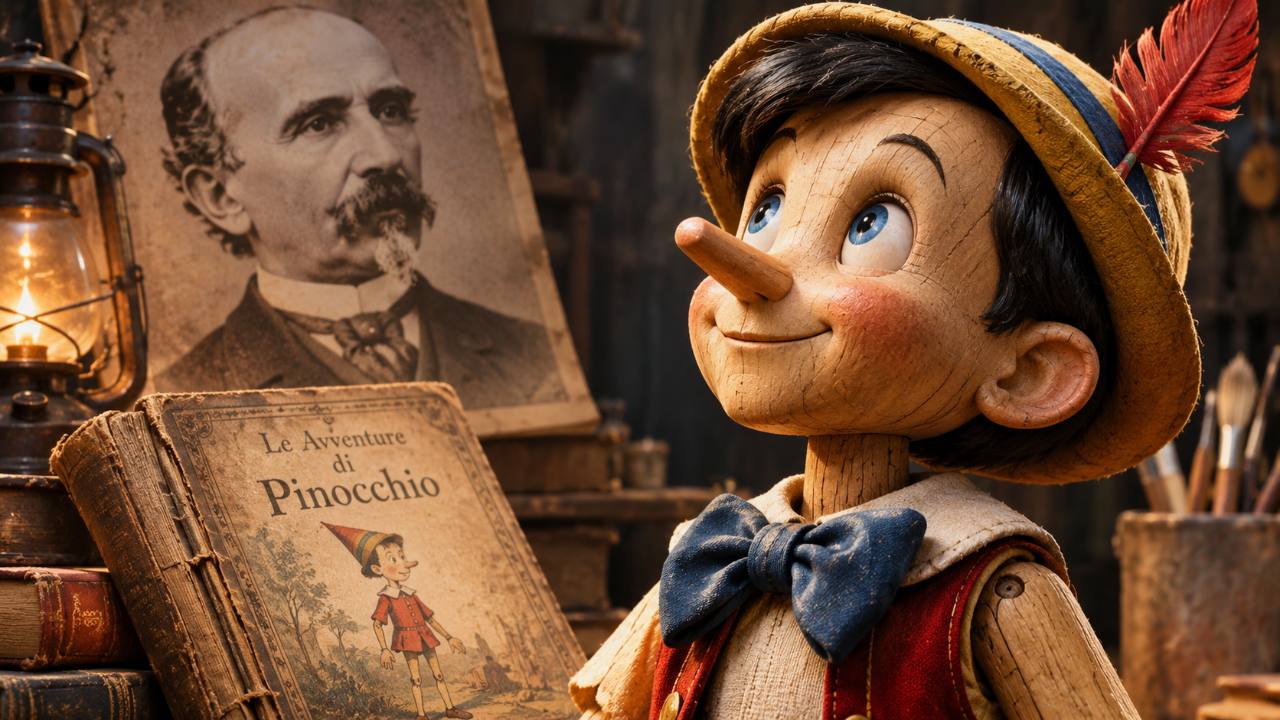
Supplied modern editorial illustration, preserved unchanged. The puppet, book and portrait form a composite; the book is not presented as an authenticated first edition.
November 24, 2026 marks 200 years since the birth of Carlo Lorenzini, better known as Carlo Collodi, the creator of Pinocchio. It is the author’s bicentenary, not the puppet’s: the story first appeared in installments in 1881 and became a book in 1883. The difference opens a richer anniversary than the familiar image of a growing nose. Treccani: Carlo Lorenzini, life and literary work Treccani: Pinocchio’s serialization and reception Italian Ministry of Culture, November 24, 2026: bicentenary exhibition announcement
Collodi’s wooden child has become so recognizable that the writer can almost disappear behind him. Returning to the original restores a journalist, satirist and participant in Italian political life, and a story in which hunger, exploitation, affection and education are as important as telling the truth.
The Florentine behind the pen name
Carlo Lorenzini was born in Florence on November 24, 1826. His literary surname came from Collodi, the Tuscan village associated with his mother’s family. The Carlo Collodi Foundation explains that he spent part of his childhood there with maternal relatives and returned as an adult. The pseudonym therefore connected a metropolitan writer to a particular family landscape. Italian Ministry of Culture, November 24, 2026: bicentenary exhibition announcement Carlo Collodi Foundation: the author and the village of Collodi
Before the puppet, there was a long working life with newspapers and books. Treccani records his involvement with the satirical Il Lampione and theatrical Lo Scaramuccia, along with other journalism. He also participated in the first and second Italian wars of independence. Children’s literature was an important part of his career, not its entire starting point. Treccani: Carlo Lorenzini, life and literary work
That background offers a useful reading perspective. An author accustomed to observing adult pretension could write a children’s story in which authority is not automatically wise. Pinocchio makes foolish choices, but the world around him contains cheats and absurd institutions as well as patient guides. The humor does not disappear simply because the intended audience includes children.
A writer in a changing Italy
Collodi’s lifetime spanned the political movement toward Italian unification and the years after it. His educational writing belonged to a society debating how children should learn and how a common national language should circulate. Treccani places his books for young readers alongside his journalism and translations, rather than separating them into unrelated careers. Treccani: Carlo Lorenzini, life and literary work
When Pinocchio actually appeared
The first installment, titled Storia di un burattino, appeared in the Giornale per i bambini on July 7, 1881. The story’s serialized form matters: readers encountered episodes and interruptions before they could hold the complete narrative in one volume. The 1883 book, Le avventure di Pinocchio: storia di un burattino, included illustrations by Enrico Mazzanti. Treccani: Pinocchio’s serialization and reception
A story that changed while it was being told
The initial sequence reached a disturbing apparent end with the puppet hanging from a tree. Treccani describes readers’ anger and pressure for the story to continue. The eventual narrative carried Pinocchio through further reversals to his transformation into a boy. The work’s history is therefore not simply that of a finished moral lesson delivered unchanged to an obedient readership. Treccani: Pinocchio’s serialization and reception
Serialization helps explain the story’s restless energy. A new encounter can overturn the previous promise of safety; a character who seems to offer an easy solution can lead to another disaster. For a reader today, the pattern can be understood as repeated tests of judgment, rather than a smooth march from one approved lesson to the next.
More than a lesson about lying
The growing nose is unforgettable, but it is not an adequate summary of the book. The original text repeatedly returns to food, money, work, schooling and the cost of trust. Its chapter sequence takes Pinocchio from a hungry search for an egg to the sale of his schoolbook, fraudulent promises of wealth and punishment after being robbed. Carlo Collodi: original Italian text, digitized edition on Wikisource
Geppetto and the price of care
Geppetto sells his coat to buy an alphabet book for the puppet. Pinocchio then sells that book to enter a puppet theater. The contrast is concrete: one character sacrifices a necessity to provide an education, while the other exchanges that opportunity for an immediate attraction. The scene makes care visible as a material cost, not merely an instruction to behave. Carlo Collodi: original Italian text, digitized edition on Wikisource
Hunger gives those choices weight. Food is not just a comic prop in a world of magic; needing it exposes the puppet to dependence and temptation. Reading those episodes alongside the book’s fantastical transformations helps explain why the story can feel unsettling even when its surface is playful. This is literary interpretation grounded in the narrative, not a claim about a documented childhood episode in Collodi’s life.
A dangerous world for an inexperienced child
The Fox and the Cat offer a shortcut to riches. Elsewhere, entertainment becomes exploitation, and Pinocchio’s body itself can become something to be bought and sold. These episodes allow adults and children to read the same story differently: one may follow the adventure while another notices the economic arrangements and abuses underneath it. Carlo Collodi: original Italian text, digitized edition on Wikisource
The puppet’s mistakes do not make every adult blameless. Collodi’s satire is sharper when responsibility is distributed across an environment of manipulators, inconsistent justice and precarious livelihoods. Reducing the book to “do not lie” loses its uncomfortable question about how a child learns discernment in a world that is not reliably honest.
Key dates
| Date | Milestone |
|---|---|
| 24 November 1826 | Carlo Lorenzini born in Florence |
| 7 July 1881 | Pinocchio begins as a newspaper serial |
| 1883 | The completed story appears in book form |
| 24 November 2026 | The author’s bicentenary |
The chronology separates the author’s birth, the first serial installment and the completed book. None of the latter events took place in 1826. The bicentenary is an opportunity to reconnect the famous character with the person whose birthday is actually being commemorated. Treccani: Carlo Lorenzini, life and literary work Treccani: Pinocchio’s serialization and reception Italian Ministry of Culture, November 24, 2026: bicentenary exhibition announcement
The original and the adaptations
The Library of Congress identifies Disney’s 1940 Pinocchio as the studio’s second animated feature, adapted from Collodi’s novel. Its enormous cultural presence is one reason many people know the screen version before the book. An adaptation can be a major creative work without functioning as a verbatim account of its source. Library of Congress: Pinocchio and the 1940 film adaptation
Readers can compare the original Italian text with digitized historical translations. The Library of Congress, for example, catalogs an English edition published in 1917. That is evidence of the story’s international circulation, not a first edition of the Italian novel. Identifying the language, publisher and date of an edition is more informative than describing every old-looking book as an original. Library of Congress: digitized 1917 English edition
Claims about precisely how many languages have received Pinocchio also require care. Counts change depending on whether dialects, abridgments and new translations are included. Treccani describes it as one of the most translated Italian books; that well-supported formulation is preferable to an unsourced worldwide ranking or a total detached from a catalog and date. Treccani: Carlo Lorenzini, life and literary work
How Italy is marking the bicentenary
Poste Italiane announced a commemorative stamp on November 24, 2026. The Ministry of Culture’s Centre for Books and Reading also published an announcement of a project involving the Società Dante Alighieri, Gabinetto Vieusseux and the Carlo Collodi Foundation. It lists an exhibition opening event for November 25 and public access from November 26, 2026 to February 3, 2027 in Rome. These are announced dates, not events this article claims already to have attended. Poste Italiane, November 24, 2026: commemorative stamp Italian Ministry of Culture, November 24, 2026: bicentenary exhibition announcement
The exhibition’s focus on Collodi’s language and wider career is appropriate. A bicentenary can restore the author’s journalism, educational work and literary voice rather than merely repeat the puppet’s most marketable image. Commemoration becomes useful when it gives readers a reason to return to the text.
PRESDA’s account of Dostoevsky’s life and writing explores another case in which an author’s public image can overshadow the complexity of the work. The subjects are different, but both reward reading beyond a single famous phrase or symbol.
Why the wooden child still matters
Pinocchio endures partly because becoming human is not treated as a matter of appearance alone. The story asks what it means to learn, to recognize another person’s sacrifice and to act with responsibility. Its fantasy makes those questions memorable without removing the discomfort of failure, vulnerability and loss.
On Collodi’s 200th birthday, the most revealing return is therefore to a book that is stranger and more searching than its shorthand reputation. The nose remains a brilliant image. The writer behind it left a much larger world for readers to discover.
FAQ
Frequently Asked Questions
Is Pinocchio 200 years old in 2026?
No. The bicentenary marks Carlo Collodi’s birth in 1826. Pinocchio first appeared in 1881, and the complete book followed in 1883.
What was Carlo Collodi’s real name?
Carlo Lorenzini. Collodi was his pen name, taken from the Tuscan village connected with his mother’s family and his childhood.
Is the novel the same as the Disney film?
No. The 1940 animated film is an adaptation. The original serialized story and book have their own narrative, tone and publication history.
Does the supplied image show an authenticated first edition?
No. It is a modern editorial composite of a puppet, book and portrait. The original image is preserved, but its caption does not authenticate the pictured book as a first edition.
PRESDA Dispatch
Stay Informed. Stay Aware.
A sharp briefing across AI, gaming, sport, business, world affairs, paparazzi, and lifestyle.