THE CULTURE OF TATTOOS: FROM ANCIENT RITUALS TO MODERN ART
Across millennia, tattooing has marked bodies with stories of belonging, devotion, memory and style. Its meanings have never been universal, and its history is still being uncovered.
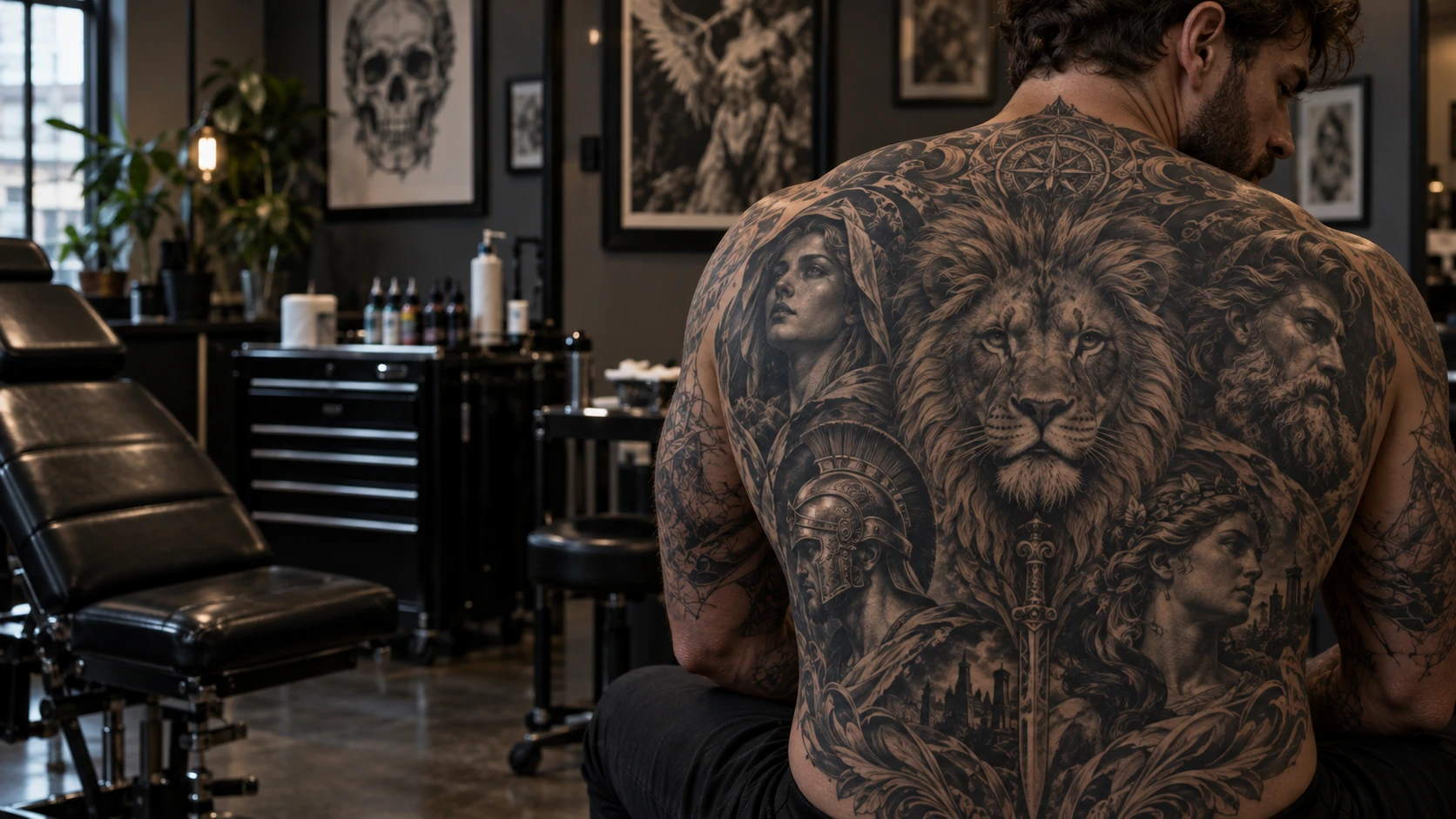
AI-generated editorial illustration of a tattooed man in a modern studio, not a documentary photograph.
A body can become an archive. A line may remember a person who died, a passage into adulthood, a promise, a place, or simply an image someone wants to carry. The needle makes a permanent mark, but the meaning is never fixed by the pigment alone. It belongs to the person, the community, the artist, and the time in which it is read.
Tattooing is among humanity's oldest surviving forms of body art, yet its beginnings remain beyond the reach of history. Archaeology preserves skin only in exceptional conditions, so the oldest tattoo we can identify is not necessarily the first tattoo ever made. Across the world, tattoo traditions have served very different purposes, and no single story can contain them all.
The oldest marks are not the beginning
In 1991, hikers found the naturally preserved body of a man in the Ötztal Alps, near the border of Austria and Italy. Radiocarbon dating places his death around 3300 BCE. His skin bears 61 tattoos, mostly groups of short lines and crosses, making him one of the earliest securely documented tattooed people. In 2018, infrared imaging revealed figurative tattoos on two Predynastic Egyptian mummies from Gebelein, dated to 3351–3017 BCE. Their date range overlaps broadly with Ötzi's. The Egyptian marks are the oldest known figurative tattoos, not proof of the first tattooing anywhere. A 2015 reassessment had already corrected earlier dating of a Chinchorro mummy. The record changes as old collections are re-examined, and the first tattoo remains beyond archaeological reach. Smithsonian overview · Archaeological reassessment · Gebelein study
The Iceman's marks cluster near joints and the lower back. Researchers have proposed therapeutic or ritual functions, partly because some align with areas affected by degenerative conditions. That is an interpretation, not a diagnosis or proof of purpose. The body gives evidence of placement and technique; it does not preserve the explanation Ötzi or his community would have given.
Other evidence widens the map, and new imaging is changing what researchers can see. A 2025 PNAS study used multispectral imaging to survey 1,048 mummified remains from three sites in Sudan, dating from about 350 BCE to 1400 CE. Researchers documented tattoos on 27 people at two sites, including children. The designs and possible meanings require care: a proposed link between some marks and Christian identity is an interpretation, not a settled explanation. Another PNAS team used laser-stimulated fluorescence to reveal intricate details in tattoos on Chancay mummies from coastal Peru, showing how non-destructive imaging can recover patterns hidden to ordinary light. Such work expands the record, but does not make every ancient mark legible or explain its purpose. Nubian study, PNAS · Chancay study, PNAS
Polynesia: names, lineages and living practice
The English word tattoo entered European languages through Pacific encounters, often linked to the Tahitian word tatau. But Polynesia is not a single culture and its practices are not interchangeable. In Samoa, tatau names a customary practice with its own history, vocabulary and obligations. Museum scholarship stresses that Samoan tattooing has changed through colonialism, Christianity, migration and contemporary cultural exchange, rather than remaining frozen in an imagined ancient past. Smithsonian, *Tatau: A Cultural History of Samoan Tattooing*
In Aotearoa New Zealand, Māori tā moko is a distinct art and practice. Te Papa describes designs as a complex visual language connected with artistic excellence, identity and role; particular meanings can be personal and context-dependent. Traditional tools called uhi applied pigment, while some forms of facial moko also involved cutting grooves into the skin. Colonization and Christian influence disrupted practice, and Māori artists and communities have since renewed it. Calling every Pacific pattern a generic tribal tattoo erases the knowledge and authority behind specific traditions. Te Papa: Tāmoko
Japan, North Africa and many other histories
Japanese tattooing is often condensed into the word irezumi, but terminology, technique and social meaning have shifted over centuries. Edo-period prints and popular culture helped shape large decorative compositions; tattooing has also been associated with punishment, laboring identities and organized crime, associations that can obscure the diversity of people who wear it. The history is not a straight line from a timeless tradition to today's studio. Pitt Rivers Museum: Japanese irezumi
Among Amazigh communities of North Africa, tattooing has appeared alongside related geometric vocabularies in textiles, pottery, jewelry and other arts. The Peabody Museum's work on Amazigh aesthetics documents body marking as part of a broad visual world. Motifs and meanings vary across region, generation and person; a symbol should not be assigned one universal translation without community-specific evidence. Colonial rule, religious change, urbanization and changing ideas of beauty have also shaped whether the marks are continued, concealed or reconsidered. Harvard Peabody Museum: Imazighen
From ancient Egypt and Nubia to Indigenous North America, the Andes and Siberia, tattoos have marked social roles, spiritual protection, achievement, mourning and belonging in particular places and periods. These examples are not proof that every tattooed person shared one motive. The same visual act can mean something different across borders, and a design's significance may be known only to the wearer and their community.
What a tattoo can say about a self
In contemporary studios, clients often describe tattoos as reminders, memorials, declarations of identity or decisions about how their bodies look. These explanations can coexist. A memorial may also be beautiful; a decorative image can carry a private story. Social science has studied body modification as a way people negotiate identity and social perception, but small or specific samples cannot tell us why all tattooed people choose ink. University of Liège study on identity and stigma
The language of rebellion is part of modern tattoo history, especially where visible ink once conflicted with expectations of respectability, gender or professional conduct. Sailors, soldiers, artists and subcultures helped make tattoos legible as signs of affiliation or defiance in different settings. Today, workplaces and public attitudes vary. Wider visibility has not erased stigma, and a tattoo that is celebrated in one context may still affect how someone is judged in another. Research on college students, for example, found attitudes shaped partly by assumptions about risk and pain, but those results describe a population and period, not a universal public opinion. Social Science Journal study
A tattoo also changes the encounter between a person and the people looking at them. Some wearers choose a visible design to invite recognition; others place ink where clothing can cover it, keeping control over when the story is shared. The same person may feel differently about visibility at work, at home or among friends. That choice is not evidence of shame or secrecy. It shows how a mark can be both personal and social, carrying one meaning for its wearer and attracting another from an observer. Research into stigma therefore needs to ask who is looking, in what setting and under which norms, rather than treating a tattoo as a reliable clue to character. This matters in everyday life: clothing, family expectations, workplace rules and local histories shape whether ink is displayed or covered. A choice made for personal reasons can therefore become part of a wider negotiation about privacy, belonging and professional identity. None of those readings can be inferred from the image alone.
Celebrity tattoos and social platforms have made tattoo imagery widely visible, while fashion photography and luxury campaigns have moved between embracing and styling body art. Visibility can expand creative possibilities, but it can also detach designs from their histories or turn living traditions into temporary aesthetics. A public figure's choice does not make a practice universal or settle questions of cultural ownership.
From hand tools to contemporary studios
Tattooing techniques have always depended on tools, materials and local expertise. Hand tapping, combs and puncturing tools remain meaningful in some cultural practices; electric machines became central to many modern commercial studios. Artists work across styles including fine line, blackwork, realism, traditional flash, lettering and Japanese-inspired large compositions. These labels describe broad conventions, not rigid categories. The artist's skill lies in adapting a design to skin, scale, movement and the client's intent.
Modern tattooing also depends on infection control. Needles pierce the skin, so contaminated equipment or ink can introduce bacteria and other hazards. The US Food and Drug Administration has documented infections and allergic reactions linked to tattoo inks, including products contaminated before use. A clean-looking studio is not a guarantee of safety; clients should look for locally licensed practitioners who use sterile, single-use needles and follow applicable hygiene rules. Regulations differ by place, and the FDA does not approve tattoo inks for injection into the skin. FDA: Think Before You Ink
Allergy can appear immediately or years later. Persistent redness, swelling, bumps or other concerning reactions warrant medical assessment. Tattoo pigments can also complicate some medical imaging, so people should tell clinicians about tattoos when relevant. This is not a reason to panic: it is a reminder that decorative pigment is placed inside living tissue, and its long-term effects are not fully understood.
Laser removal can break pigment into smaller particles that the body clears over time, but removal is not a guaranteed reset. Multiple treatments may be needed, some colors respond differently, and scarring or incomplete removal can occur. The FDA says the short- and long-term consequences of pigment breakdown after laser treatment remain uncertain. Before getting tattooed, it is sensible to treat permanence as real, even when removal is technically possible. FDA safety guidance
Appreciation, appropriation and who gets to wear a design
Cultural exchange has always shaped tattoo history, but exchange does not make every borrowing equal. A motif can be sacred, genealogical, restricted, or linked to a community's authority and experience of colonization. Copying a recognizable form without understanding it can strip away context, while members of that culture may face discrimination for wearing the same marks. There is no single checklist that resolves every case. Research the design, listen to people from the source community, ask whether it is appropriate to wear, and choose an artist with cultural knowledge when a tradition is involved.
Respect also means not treating cultures as museums. Traditions change, communities disagree, and artists debate what can be shared. Māori tā moko, Samoan tatau and Amazigh tattoo histories each have their own living contexts. A respectful conversation makes room for those differences rather than flattening them into an aesthetic trend.
A permanent mark, an evolving meaning
Tattooing has outlasted empires, religious change, criminalization and fashion cycles, not because it has meant one thing everywhere, but because skin is intimate and visible at once. It can hold a memory close or announce belonging to strangers. It can be chosen freely, inherited through a living custom, or read by others in ways its wearer never intended.
The modern tattoo studio is not the end point of an ancient story. It is another place where people negotiate beauty, pain, identity and community. The oldest marks tell us that humans have long altered their bodies with intention. What those marks meant remains partly beyond reach. That uncertainty is not a failure of history; it is an invitation to approach every tattoo, and every person who wears one, with more curiosity than assumption.
Sources and further reading
Smithsonian: Ötzi and early tattoo evidence; D. Deter-Wolf et al., archaeological reassessment; Friedman et al., Gebelein tattoos; Austin et al., Nubian tattoo traditions, PNAS; Kaye et al., Chancay tattoos, PNAS; Smithsonian: Samoan tatau history; Te Papa: Māori tā moko; Oxford Pitt Rivers Museum: Japanese irezumi; Harvard Peabody Museum: Amazigh aesthetics; FDA: tattoo safety and removal; Mormont, identity and tattoo stigma.
For more culture and identity reporting, explore PRESDA LIFESTYLE and our feature on the psychology of brands.
FAQ
Frequently Asked Questions
What is the oldest known tattoo?
The oldest known direct evidence on preserved human skin is associated with Ötzi the Iceman, who died around 3300 BCE and had 61 tattoos. That is the oldest surviving evidence identified so far, not proof that he was the first person ever tattooed.
What did ancient tattoos mean?
Meanings differed by person, community and period. Proposed roles include identity, social position, ritual, healing or protection, but archaeology rarely preserves a definitive explanation for a particular mark.
Are tattoos safe?
Tattooing carries risks including infection and allergic reaction, especially when ink or equipment is contaminated. A licensed professional using sterile, single-use equipment and following local hygiene rules can reduce avoidable risks, but cannot remove every possible complication.
Can tattoos be completely removed?
Laser removal can fade or remove some tattoos, but it may require multiple sessions and can leave pigment behind or cause scarring. Outcomes vary by ink, skin and treatment, so complete removal is not guaranteed.
When does a tattoo become cultural appropriation?
There is no universal rule. Concerns are stronger when a design is sacred, restricted or tied to a community that has faced discrimination for the same practice. Researching its source and listening to that community are important steps.
PRESDA Dispatch
Stay Informed. Stay Aware.
A sharp briefing across AI, gaming, sport, business, world affairs, paparazzi, and lifestyle.