THE DANCING PLAGUE OF 1518: WHEN STRASBOURG COULDN'T STOP DANCING
What happened in Strasbourg in 1518? Examine the records, disputed death tolls and competing explanations behind the famous dancing plague.
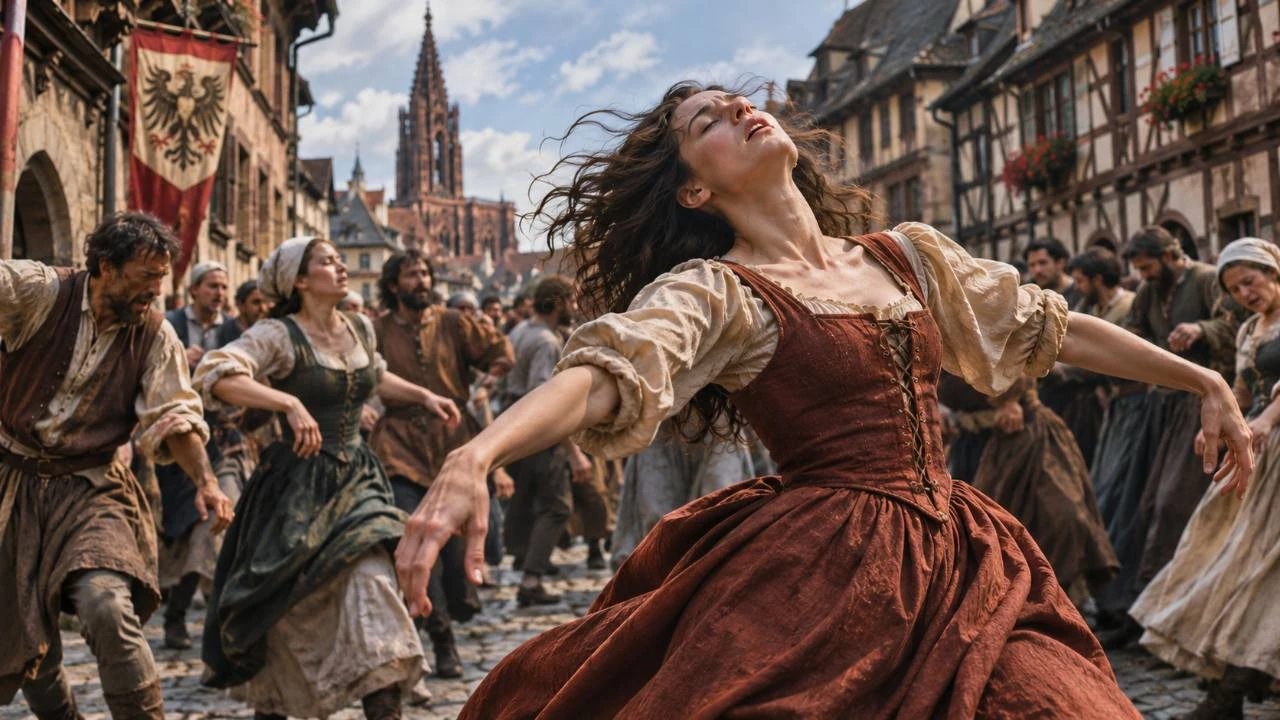
Editorial historical reconstruction, not a contemporary record of 1518. People, clothing and movements are interpretive. Editorial image supplied for PRESDA. Original creator and reuse licence not provided.
It is an unforgettable image: a street full of people moving as if the music could never end. But the dancing plague of 1518 is not a surviving film, a measured clinical outbreak or a scene we can reconstruct minute by minute. It is a historical problem assembled from records and retellings. The strange part is real enough to investigate; the familiar dramatic version needs to be taken apart.
What the historical record supports
An official Strasbourg education page accompanying the city museum’s exhibition describes people dancing in the streets in July 1518 and an episode extending over several weeks. That supports a historical disturbance, not the literal claim that an entire city danced continuously. Our headline is shorthand for the episode’s hold on Strasbourg. Individuals, intervals and changing responses matter more than imagining one uninterrupted performance. Académie de Strasbourg, museum exhibition introduction
The woman often called Frau Troffea belongs to a more complicated trail of narration. ARTE’s historical investigation explains that Paracelsus offered his account after the event, rather than as a modern observer interviewing a first patient. Repeating a name does not turn every attached anecdote into contemporary evidence. The same caution applies to vividly described conversations, private motives and scenes that later storytellers make sound directly witnessed. ARTE, investigation into Strasbourg 1518
Did people really dance themselves to death?
Fatalities are among the episode’s most contested elements. Popular accounts turn uncertain figures into a daily death counter, but we do not have an agreed, independently verified toll to publish. The responsible conclusion is narrower: exhaustion and suffering are central to the historical narrative, while precise mortality claims remain disputed. Neither dismissing the entire episode as fiction nor presenting a sensational casualty figure resolves that gap in the evidence.
Competing explanations, no confirmed diagnosis
A historical review published in Public Health in 1997 surveyed proposed causes of dancing mania, from poisoning to social adversity, and concluded that its exact aetiology remained unclear. It discussed a combination of cultural background and difficult social circumstances rather than a single established cause. This is a retrospective interpretation, not a laboratory result from 1518. Describing a hypothesis carefully makes it useful without pretending that the historical patients have been diagnosed. Donaldson, Cavanagh and Rankin, Public Health (1997)
Ergot poisoning and socially transmitted trance therefore belong on a list of debated explanations, not in a final verdict. A dramatic label can hide very different questions: what moved an individual body, why an episode spread, how onlookers interpreted it and how authorities responded. No single attractive mechanism automatically answers all four. The surviving record also cannot tell us the participants’ experience with the precision of a modern clinical assessment.
Why the story still matters
Strasbourg’s unsettling story asks how a community gives meaning to distress it cannot readily explain. Its fascination survives the removal of invented dialogue, exact death totals and confident retrospective diagnoses. Indeed, it becomes more human. The supplied hero is a reconstruction, not evidence of clothing, gestures or named participants. Looking closely at the uncertainty is not an anticlimax: it is the difference between sharing a compelling historical question and recycling a legend as settled fact.
Related reading: Why a beat makes the body move.
FAQ
Frequently Asked Questions
Was the 1518 dancing plague a real historical episode?
Historical material records a dancing disturbance in Strasbourg. That does not verify every dramatic detail in later accounts.
How many people died?
There is no agreed, independently verified death toll. Exact casualty claims should not be presented as settled.
Was ergot poisoning definitely responsible?
No. Poisoning and social or cultural explanations remain debated hypotheses, not a confirmed diagnosis.
PRESDA Dispatch
Stay Informed. Stay Aware.
A sharp briefing across AI, gaming, sport, business, world affairs, paparazzi, and lifestyle.