
D. B. COOPER: THE HIJACKER WHO VANISHED WITH $200,000
The verified story of D. B. Cooper’s 1971 hijacking, the ransom money recovered in 1980 and why his identity and survival remain unresolved.
Supplied dramatic editorial illustration, not an authenticated portrait of the unidentified hijacker, an archival scene or proof that he survived. The FBI-style sketch is illustrative.
The man remembered as D. B. Cooper left behind a ransom demand, physical evidence and a lasting gap in the historical record. On November 24, 1971, he hijacked a flight in the Pacific Northwest, obtained $200,000 and disappeared after leaving the aircraft by parachute. His identity and ultimate fate remain unresolved in the FBI’s official case history. FBI: official case history
Even the familiar name requires a correction. He bought his ticket as Dan Cooper. The FBI explains that the initials D. B. arose from press confusion involving a different man who was questioned and was not the hijacker. A mistaken name became the permanent label for an unidentified person.
| Date | What is established |
|---|---|
| November 24, 1971 | Hijacking and $200,000 ransom; ticket used the name Dan Cooper |
| 1980 | $5,800 in bills matched to ransom serial numbers |
| December 2007 | FBI discusses tie evidence and investigative assessments |
| July 12, 2016 | FBI announces resource redirection effective July 8 |
An ordinary ticket began an extraordinary crime
The FBI preserves the plane ticket as an artifact. Its accompanying record places the purchase in Portland, Oregon, for a one-way Northwest Orient flight to Seattle on November 24. It is a concrete starting point: a surviving document tied to a transaction, rather than a later theory about who the passenger really was. FBI: preserved Dan Cooper plane ticket
The distinction between an alias and a confirmed identity is central. Dan Cooper was the name used to travel; it does not establish a legal name or biography. Likewise, the familiar composite sketches are representations based on witness information, not photographs identifying a known individual. The supplied hero is a dramatic editorial illustration, not an authenticated portrait.
The threat and the ransom
During the flight, the man gave a flight attendant a note claiming he had a bomb. The FBI describes wires and red sticks visible in his briefcase. His demands were four parachutes and $200,000 in twenty-dollar bills. The record supports a threat and a displayed object, not a forensic conclusion here that an explosive device was functional. FBI: preserved Dan Cooper plane ticket
The distinction matters because dramatic retellings often transform a witness account into a fully established technical fact. The people aboard had to respond to an immediate threat. Later readers should preserve what was observed without filling the gaps with an imagined mechanism, motive or professional background.
In Seattle, the hijacker released 36 passengers in exchange for the money and parachutes. Several crew members remained aboard for a second departure. The pilots later landed safely after the man had gone. This was a coercive event affecting passengers and workers, not a harmless performance created for a future legend. FBI: official case history
Disappearance is not proof of a successful escape
The FBI places the jump a little after 8 p.m., somewhere between Seattle and Reno. The lack of a definitive ending is the central mystery. It is not evidence that he reached safety, spent the entire ransom or lived under another identity for decades. Each of those propositions would require evidence beyond his disappearance. FBI: preserved Dan Cooper plane ticket
The popular image of a perfectly executed escape can therefore be misleading. A person can vanish from investigators’ view without surviving. Conversely, the danger of an event does not by itself prove death. The historical record leaves both the identity question and the survival question unresolved.
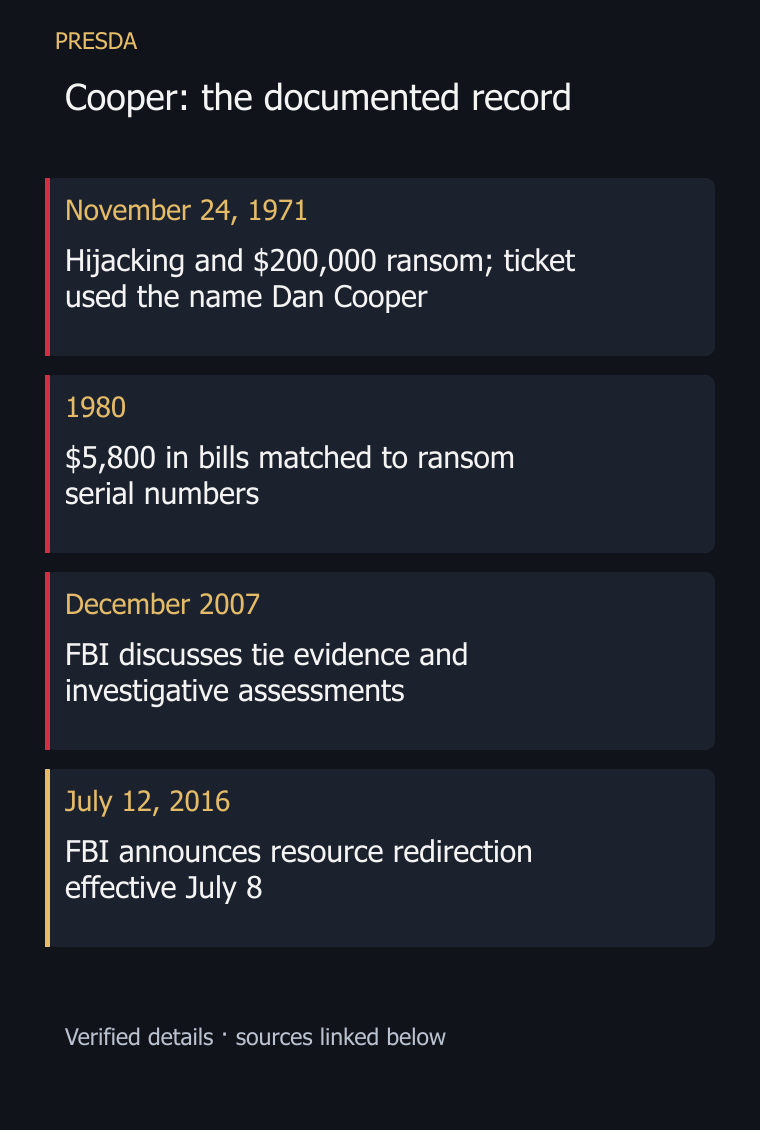
D. B. Cooper: documented events and investigative limits. Sources: FBI case history and dated statements.
A small portion of the money resurfaced
In 1980, a child found deteriorating twenty-dollar bills totalling $5,800. Their serial numbers matched the ransom money, according to the FBI. The discovery established that part of the cash had resurfaced. It did not identify the hijacker or provide a complete explanation of how the money reached the discovery site. FBI: official case history
That is why the find is so important and so limited at the same time. Physical evidence can establish one connection while leaving the larger sequence uncertain. The recovered bills tie the discovery to the ransom; a theory about transport, loss or burial still needs its own supporting evidence.
This article keeps the sums in their historical context. The demand was $200,000 in 1971, while $5,800 was the documented recovered portion. It does not present an unverified modern inflation equivalent or imply that the remaining money has been traced into an identified person’s fortune.
The investigation produced evidence, not a final identity
The inquiry was known as NORJAK, for Northwest Hijacking. The FBI’s case history says investigators had considered more than 800 suspects by the fifth anniversary. A large number of leads demonstrates the scale of the search, not that any one of the people examined was guilty. FBI: official case history
In a December 2007 account, the bureau discussed a DNA sample obtained from the tie left behind and the use of witness descriptions to assess proposed identities. It also presented investigators’ doubts about the hijacker’s parachuting expertise and survival. These were dated investigative assessments, not a newly solved identification or certainty about his fate. FBI: December 2007 account of evidence and investigative theories
The tie and sketches illustrate different kinds of evidence. A physical object can be examined; a description can guide comparison; neither automatically produces a name. The strongest account is one that distinguishes those functions instead of treating every new examination as the moment the case must finally be solved.
What the FBI changed in 2016
The bureau’s July 12, 2016 announcement said resources had been redirected on July 8 toward other investigative priorities. It described a 45-year investigation and said that tips and technological work had not produced the proof needed for a definitive identification. The announcement did not declare that a particular suspect had been established as Cooper. FBI: July 12, 2016 investigation update
It also said that specific physical evidence relating to the parachutes or stolen money could still be brought to the FBI. That is more precise than either claiming an unchanged full-time investigation continues or saying the institution could never consider relevant evidence again.
The date helps readers interpret older sources. A 2007 story discussing renewed investigative work belongs to that moment. It does not override the later 2016 resource decision. Historical research requires sequencing the documents, not combining every archived statement into one supposedly current investigative status.
Why the mystery keeps generating certainty without proof
An unresolved event invites a satisfying ending. A compelling resemblance, a family story or unexplained wealth can seem persuasive when connected to a famous crime. But plausibility is not identification. The FBI’s 2016 statement emphasised the difference between tips and the evidence required to prove culpability.
The same discipline applies to images. A striking face beside an FBI-style sketch can create an impression of certainty that the record does not support. The supplied illustration is labelled accordingly. It should help introduce the story without being mistaken for a photograph of the unidentified offender.
PRESDA’s examination of the Bermuda Triangle’s stories and evidence explores a related problem: the gap between an intriguing account and what can actually be demonstrated. Cooper’s case remains a specific crime with specific evidence, rather than a licence to turn every possible explanation into a fact.
The ending remains unwritten
The established outline is powerful enough: a 1971 hijacking, a ransom, a nighttime disappearance, a partial recovery of money and decades of investigation without a definitive identity. None of those facts requires inventing the man’s motives or choosing a favourite suspect as the solution.
The enduring mystery is not proof that Cooper was a criminal genius or that every official account is concealing an answer. It is a limit in the record. Respecting that limit preserves both the seriousness of the crime and the genuine uncertainty that has kept the story alive for more than half a century.
FAQ
Frequently Asked Questions
Was D. B. Cooper the hijacker’s real name?
His confirmed legal identity remains unknown. The ticket used Dan Cooper; the FBI attributes the familiar D. B. initials to press confusion.
Was all the $200,000 recovered?
No. The FBI documents $5,800 in deteriorating bills discovered in 1980 whose serial numbers matched the ransom. This article does not establish recovery of the remainder.
Did he survive the jump?
His ultimate fate remains unresolved. Investigators described reasons to doubt survival, but disappearance alone proves neither survival nor death.
Did the FBI solve or simply close the case in 2016?
The July 2016 statement announced redirection of resources, not a definitive identity. It left room for specific physical evidence concerning the money or parachutes.
PRESDA Dispatch
Stay Informed. Stay Aware.
A sharp briefing across AI, gaming, sport, business, world affairs, paparazzi, and lifestyle.