THE ESSEX: THE WHALE THAT SANK A SHIP
The Essex sank after a sperm whale struck in 1820. Follow the crew’s survival, the evidence and the disaster’s transformation into Moby-Dick.
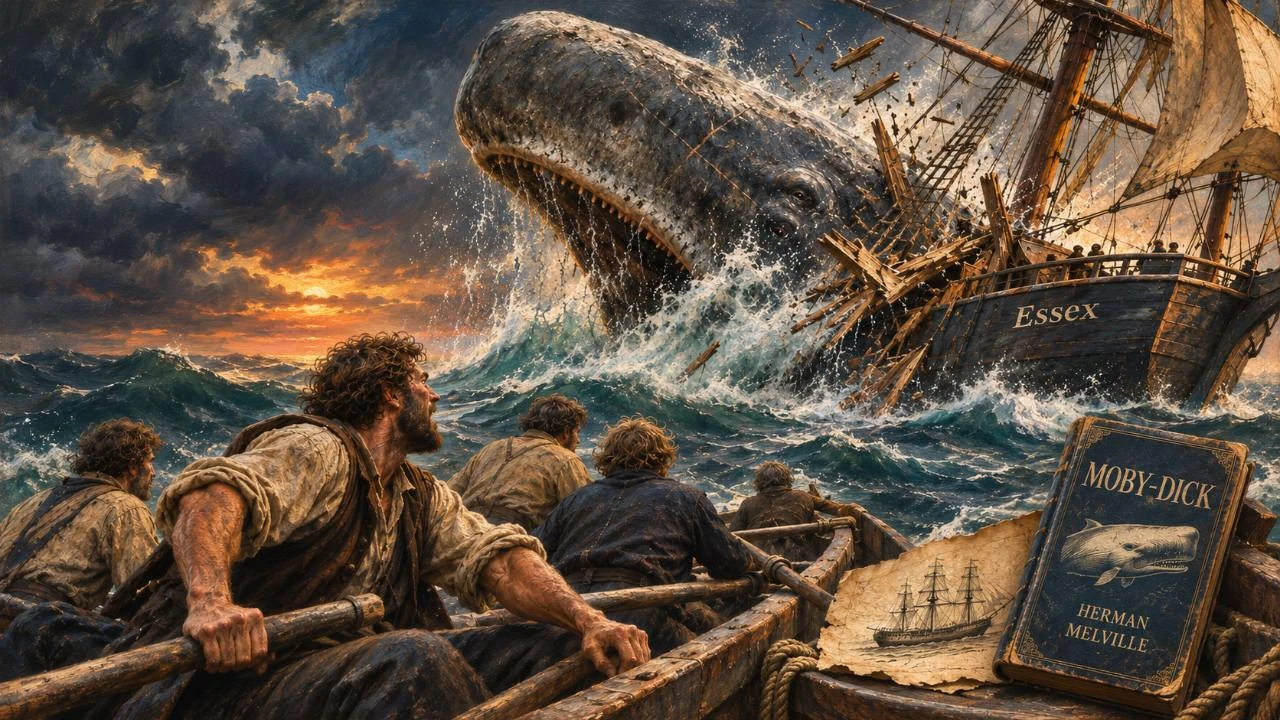
Supplied dramatic editorial illustration, not an archival record. The whale’s appearance and literary objects are artistic devices; Moby-Dick was published in 1851, after the 1820 sinking.
On November 20, 1820, a sperm whale struck the Essex in the Pacific Ocean and turned a commercial whaling voyage into a struggle to stay alive. Twenty men escaped in three small boats. Only eight ultimately survived. The disaster helped inspire Moby-Dick, but its most harrowing events happened after the whale and the ship had disappeared from the survivors’ view. Owen Chase: 1821 firsthand narrative, University of Nebraska edition
The distinction matters. Herman Melville’s novel makes pursuit of a whale the organising force of a fictional voyage. The Essex story is also about navigation, hunger, leadership and decisions made with incomplete knowledge. A collision that lasted minutes produced an ordeal measured in months.
| Stage | What happened |
|---|---|
| August 1819 | The Essex sailed from Nantucket under George Pollard Jr. |
| November 20, 1820 | A sperm whale struck the ship; twenty men escaped in three boats. |
| 1821 | Separate rescues ultimately saved eight of the twenty men. |
| 1851 | Moby-Dick appeared, transforming one influence into fiction. |
A ship built around the whale trade
The Essex had sailed from Nantucket in August 1819 under Captain George Pollard Jr., with Owen Chase as first mate. It belonged to a maritime economy in which distant voyages and the killing and processing of whales were ordinary commercial work. The men who would become castaways had gone to sea as hunters, not passengers. Owen Chase: full public-domain narrative
Whaling exposed a crew to danger before any extraordinary attack. Men left the relative security of a ship in open boats to approach large animals at close quarters. Damage to a boat could strand or injure its occupants, while the main vessel carried the supplies and equipment that made a prolonged voyage possible. Losing that vessel meant losing the centre of their working world.
What happened on November 20?
Chase’s published account describes two blows from a large sperm whale. The second left the ship fatally damaged. The men salvaged what they could and prepared the whaleboats for a passage that none had intended to undertake in such small craft. Owen Chase: full public-domain narrative
Evidence is stronger than an invented motive
We cannot interview the animal or establish its intention. Chase’s description gives evidence of what a survivor believed he saw, not proof that the whale acted from revenge. Dramatic illustrations and later films can make the encounter easier to picture, but they cannot settle its motive or supply a reliable measurement of the whale.
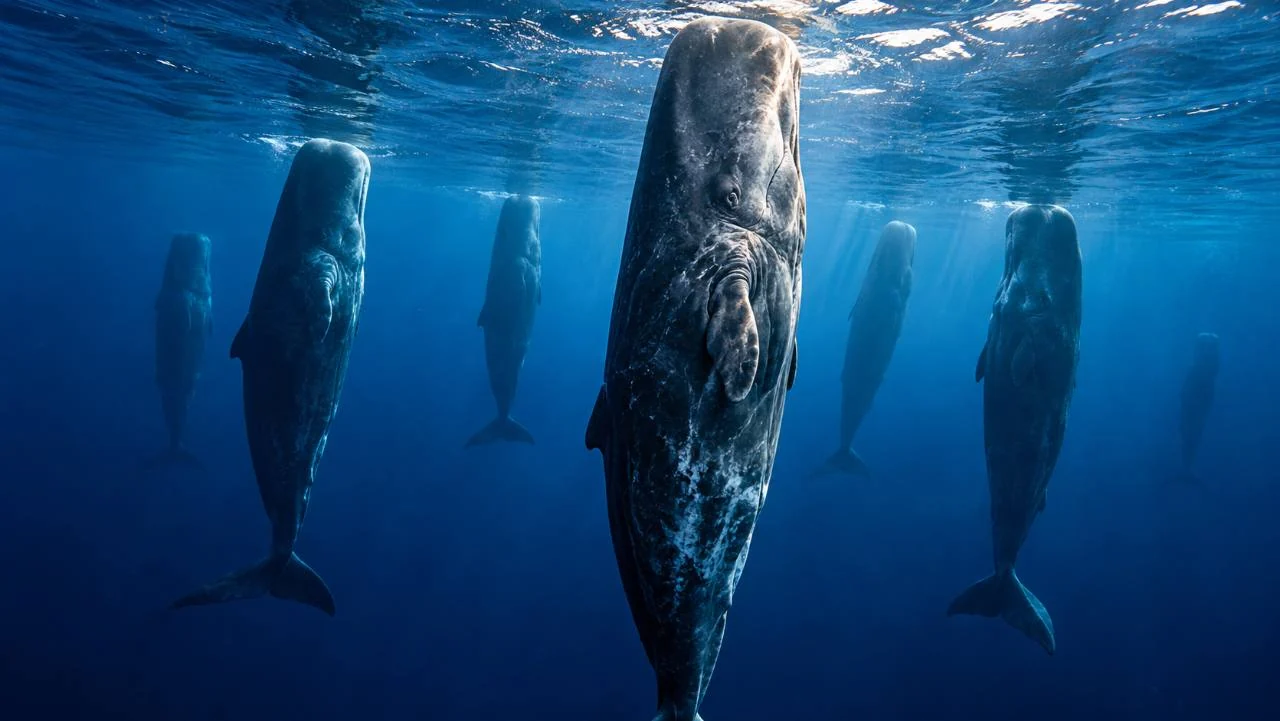
The biological background is worth separating from the legend. PRESDA’s feature on why sperm whales sleep vertically considers the animals on their own terms. The Essex account instead records a particular encounter through the experience of people whose livelihood depended on hunting them.
Why the crew headed east
After the sinking, the men had to choose a route across an immense ocean. Chase’s narrative records their discussion of islands to the west and fears about the inhabitants. The eventual plan aimed toward South America. Those fears belong to the sailors’ worldview; they are not evidence that the island communities they imagined were actually a danger. Owen Chase: full public-domain narrative
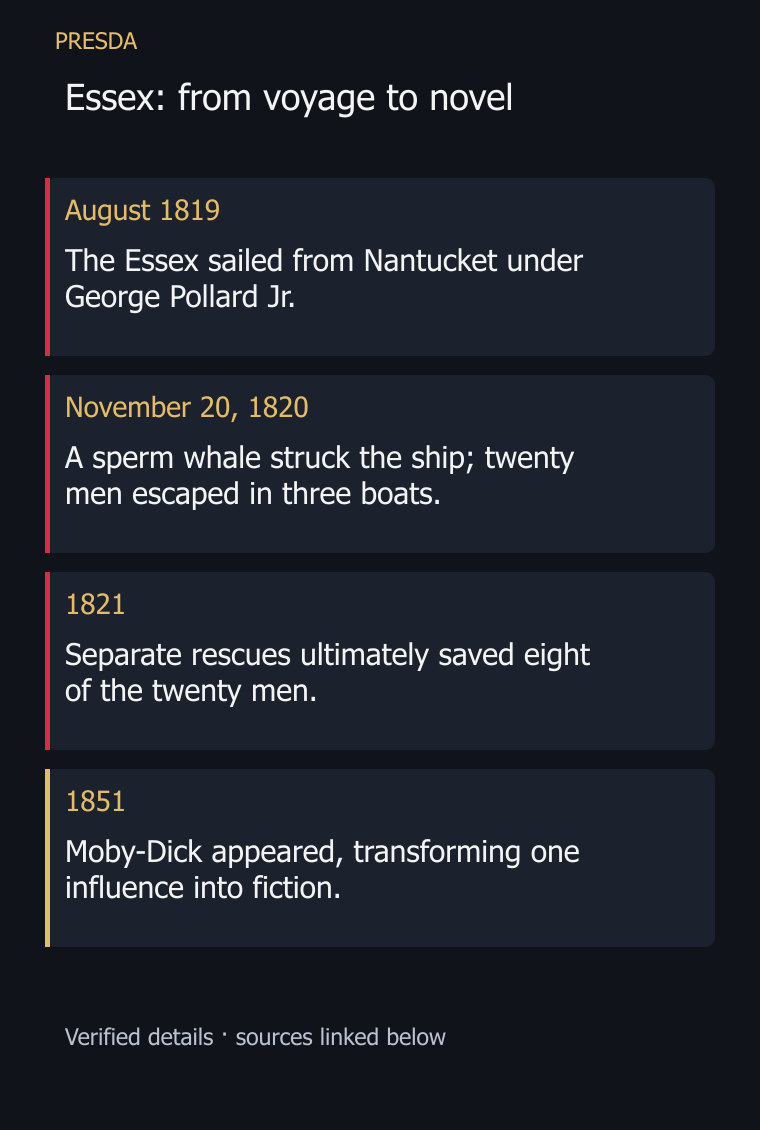
The Essex: four stages. Sources: Chase’s 1821 narrative and the institutional accounts cited below. Dates describe distinct events, not a single rescue.
The choice exchanged one set of uncertainties for another. A known continental destination could feel more reassuring than an unfamiliar island, yet reaching it required surviving an exceptionally long passage. Winds, the boats’ condition, navigational judgment and limited provisions would all influence the outcome. A destination on a chart was not the same thing as a reachable refuge.
Land did not end the emergency
The survivors reached an island now identified as Henderson, where they found some food and water but no dependable solution for the whole party. Three men remained while the others went back to sea. The boats later became separated, and the ordeal developed into several different survival stories rather than one continuous voyage together. Owen Chase: 1821 firsthand narrative, University of Nebraska edition Owen Chase: full public-domain narrative
Henderson complicates the familiar image of castaways waiting helplessly for land. Land could offer relief without the resources needed to sustain everyone. Staying and leaving both carried risks, and different members of the same exhausted crew made different choices. The three who stayed were eventually rescued, forming part of the final total of eight survivors.
Starvation and the people behind the horror
As supplies failed, men died and survivors resorted to eating the bodies of deceased companions. Chase’s narrative describes this directly. Accounts of the wider disaster also record the drawing of lots and the killing of a crew member in Pollard’s boat. These events should be reported plainly, without turning the dead into spectacle. Owen Chase: full public-domain narrative Linda Hall Library: Pollard, Chase and the Essex
The boats’ separation limits what any one witness could describe firsthand. Chase could testify to his own group’s experience; other parts of the story reached him through survivors. Keeping that distinction visible does not diminish the disaster. It makes clear how historians assemble it from accounts written by people who had endured extreme suffering.
Rescue came in separate episodes
Five men were recovered from two boats in February 1821; the third boat was never found. The three men left on the island were rescued separately. Eight survived out of twenty, while twelve did not return. There was no single rescue scene bringing the entire original crew together at sea. Owen Chase: 1821 firsthand narrative, University of Nebraska edition
The arithmetic is stark, but it cannot express the whole experience. Survival depended on more than endurance alone: the position of a passing vessel, separation in darkness or weather and the resources left in a boat could change a person’s chances. Later retellings risk presenting chance as though it were simply a reward for resolve.
How the Essex became part of Moby-Dick
Chase’s narrative appeared in 1821, providing an early published record of the encounter and its aftermath. Melville knew the account, and the disaster became one influence on Moby-Dick, published in 1851. The Linda Hall Library traces this relationship through the book and the people associated with it. Linda Hall Library: Pollard, Chase and the Essex
That does not make the novel a transcript. The Pequod, Captain Ahab and Melville’s literary whale belong to a work of fiction. The Essex gives the novel a real-world precedent for a whale destroying a ship, while the novel transforms that possibility into a larger exploration of obsession, knowledge and power.
Reading a survival story without simplifying it
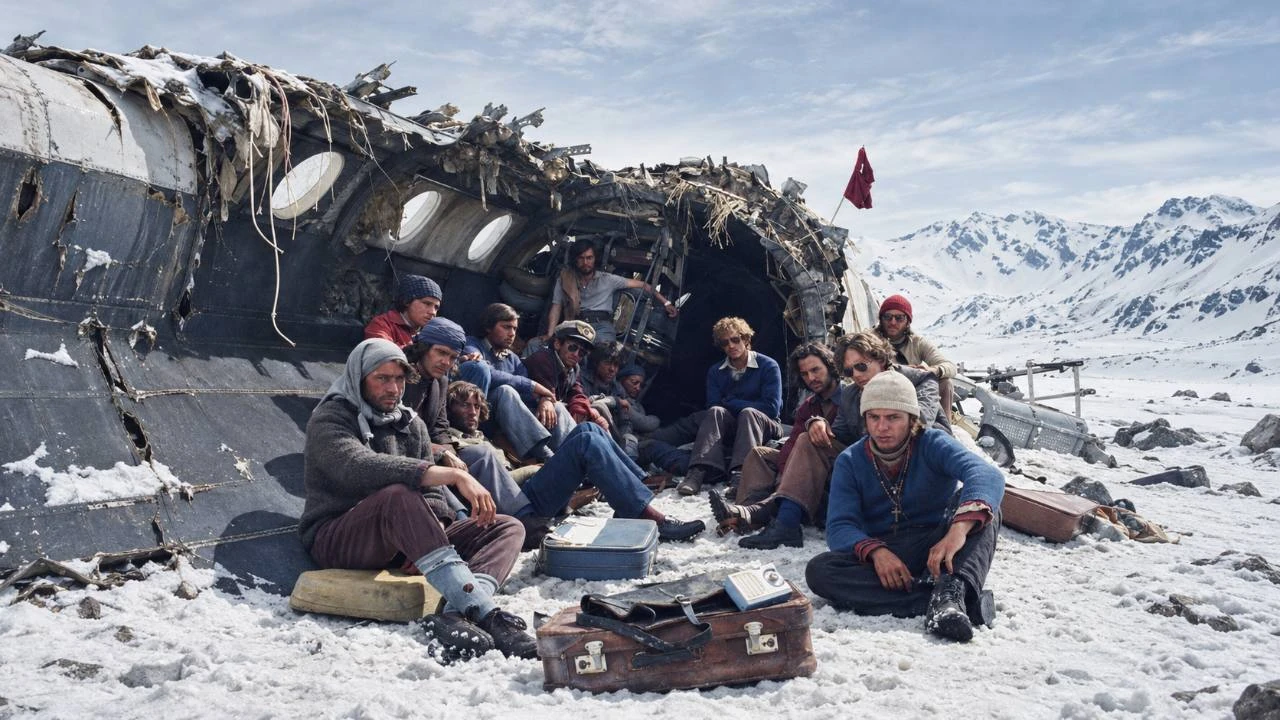
The Essex remains compelling because the attack is only the beginning. What follows forces questions about command, fear, cooperation and the way people calculate danger under pressure. PRESDA’s account of the 72-day Andes survival explores another disaster in which collective decisions and the treatment of the dead became inseparable from staying alive.
Neither story needs an invented speech or a perfectly knowable villain. For the Essex, the soundest starting point is the surviving testimony, read with attention to who witnessed what. A whale sank the ship; what followed was a human catastrophe whose complexity outlasted the wreck.
FAQ
Frequently Asked Questions
Did a whale really sink the Essex?
Yes. Survivor Owen Chase’s account describes a sperm whale striking the vessel on November 20, 1820.
How many people survived?
Eight of the twenty men ultimately survived: five recovered from two boats and three rescued from the island where they had remained.
Was Moby-Dick based on the Essex?
The disaster and Chase’s published account were influences on Melville’s novel. Its characters and narrative are fictional, not a direct reconstruction.
Do historians know why the whale attacked?
No motive can be established with certainty. Survivor descriptions do not prove a story of deliberate revenge.
PRESDA Dispatch
Stay Informed. Stay Aware.
A sharp briefing across AI, gaming, sport, business, world affairs, paparazzi, and lifestyle.