WHY DO SPERM WHALES SLEEP STANDING VERTICALLY?
Sperm whales rest in vertical drift dives. Explore the sleep evidence and 2026 research showing how bubbles help them control buoyancy beneath the surface.
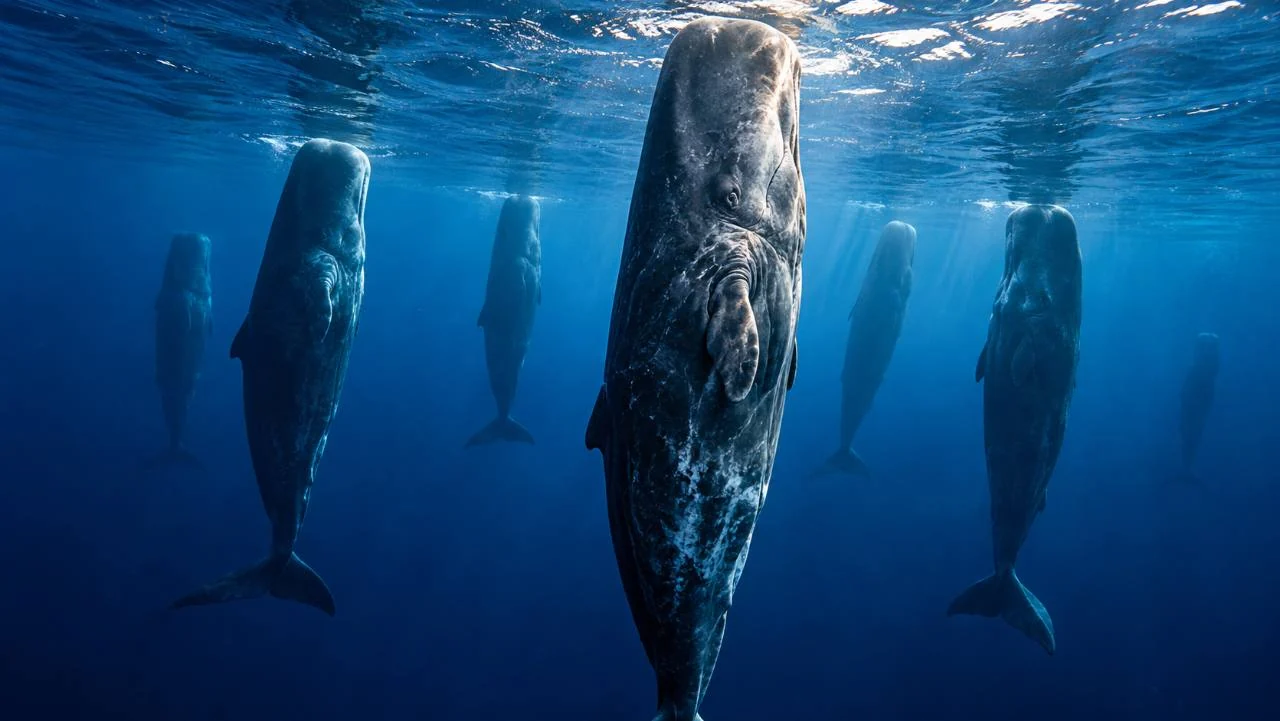
Editorial illustration of vertical rest, not a research photograph. Resting sperm whales can also orient head-down; this scene does not show a measured sleep state. Editorial image supplied for PRESDA. Original creator and reuse licence not provided.
To a human swimmer, a group of motionless whales arranged like columns looks almost unreal. For sperm whales, shallow vertical drifting is a documented form of rest associated with sleep. Remaining below the waves may provide a quieter place to rest without a deep descent. Recent research adds a practical detail: bubbles help the animals manage buoyancy while suspended.
What did scientists actually observe?
A 2008 Current Biology study used suction-cup tags to record passive, shallow drift dives in vertical postures. A group also responded unusually little to a passing vessel until contact occurred. Posture, inactivity and reduced responsiveness together supported a sleep interpretation. The tags did not record brain waves, so the observations were not a direct measurement of sleep stages. Miller et al., Current Biology (2008)
The original project tagged 59 whales and recorded 562 hours. Drift-resting occupied 7.1% of tag time. That often-repeated percentage describes the recordings, not a proven daily sleep allowance for every sperm whale. Other kinds of rest or sleep could be missed by a definition based on this distinctive behaviour. University of St Andrews, original research account (2008)
How bubbles help a resting whale stay submerged
In 2026, researchers modelled resting dives from 10 of 42 tagged sperm whales in Norway, focusing on animals that mainly rested head-down. All the resting individuals analysed released bubbles. Matching simulations to depth profiles supported the idea that gas release counteracts increasing buoyancy as a slowly rising whale’s onboard gas expands. Freymond, Burslem and Miller, Journal of Experimental Biology (2026)
Think of buoyancy as a balance, rather than a fixed “float” setting. A small upward drift reduces water pressure; gas can expand and make further rising easier. Releasing some gas can oppose that feedback. The mechanism helps explain how a whale maintains a resting position, without claiming that every detail of why vertical rest evolved has been settled.
The researchers also inferred that resting dives begin with less diving gas than deep foraging dives. Their university’s account presents this as fine control of buoyancy near the surface. The study does not exclude additional roles for bubble release, including the movement of metabolic gases from tissues into the lungs. One behaviour can have more than one physiological consequence. University of St Andrews, buoyancy research release (July 2026)
Do they sleep with half a brain awake?
Some captive toothed whales show one-sided brain sleep, but that finding cannot simply be copied onto every wild sperm-whale photograph. The vertical posture does not reveal which brain regions are asleep or whether the animal is dreaming. The sound conclusion is narrower: a characteristic resting behaviour is well documented, while its precise brain state needs a different kind of evidence.
Stillness deserves space
A 2022 study found altered movement during non-foraging periods when sperm whales were exposed to whale-watching vessels, consistent with disrupted rest. A motionless group should therefore not be treated as an invitation to approach. The discovery is best appreciated through careful observation. The supplied hero is an illustration, not evidence that researchers photographed this exact arrangement. Oliveira et al., Frontiers in Marine Science (2022)
Related reading: The real hidden world beneath Antarctic ice.
FAQ
Frequently Asked Questions
Why do sperm whales rest vertically?
They perform shallow passive drift dives associated with sleep. Resting below the waves may reduce disturbance, while buoyancy control helps them remain submerged. The full evolutionary explanation remains open.
Must they always rest head-up?
No. Vertical resting can include head-down postures. The 2026 buoyancy analysis focused on whales that mainly rested head-down.
Does 7.1% mean their total daily sleep is known?
No. It is the proportion of tag time occupied by the distinctive drift-resting behaviour in the original study, not a complete measurement of all sleep.
PRESDA Dispatch
Stay Informed. Stay Aware.
A sharp briefing across AI, gaming, sport, business, world affairs, paparazzi, and lifestyle.