THE GLASS OCTOPUS: THE ALMOST INVISIBLE CREATURE OF THE DEEP
Discover Vitreledonella richardi, the transparent glass octopus, what research footage reveals and how an AI illustration differs from documented anatomy.
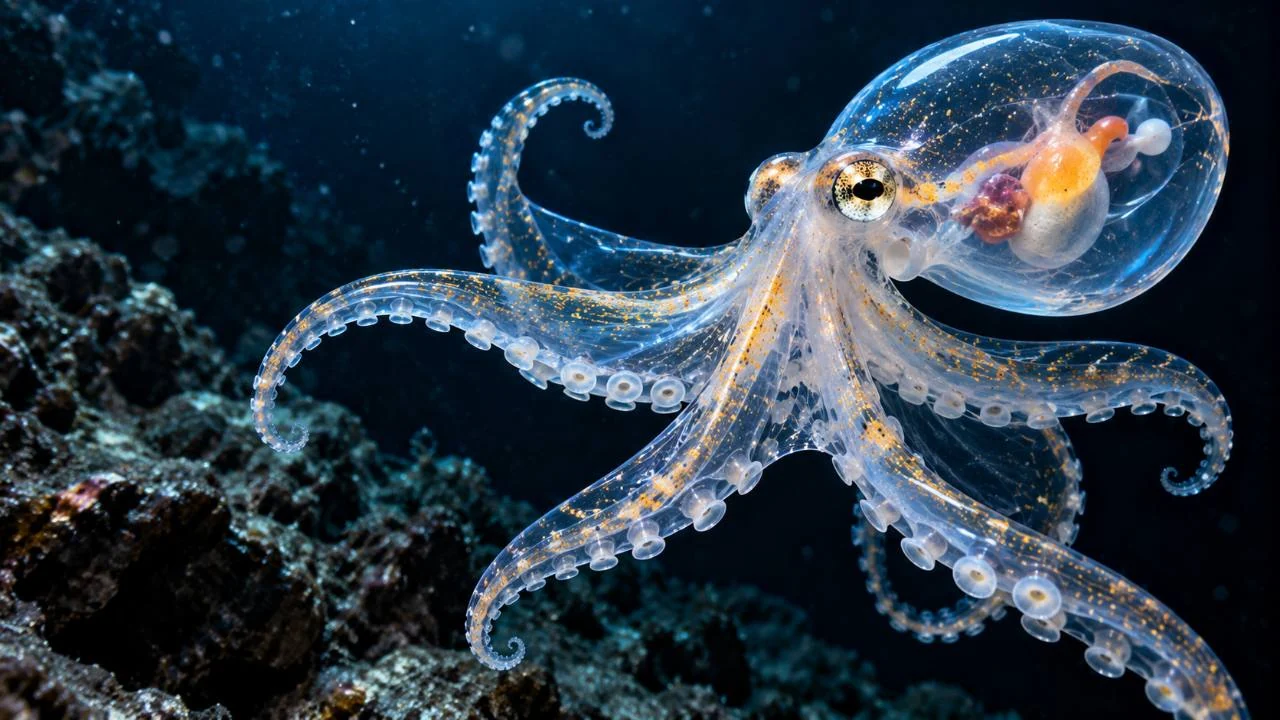
Artistic depiction, not research footage or a diagnostic species portrait. The seabed and luminous-looking details do not establish habitat or bioluminescence. AI-generated editorial illustration supplied for PRESDA
Imagine watching an animal whose outline almost disappears into the water around it. The glass octopus, Vitreledonella richardi, makes that experience possible. Much of its body is transparent, while conspicuous internal structures remain visible. It is a real ocean animal, but the spectacular image above is an AI illustration, not the photograph that established its existence.
A body that lets light through
The Schmidt Ocean Institute describes the glass octopus as almost completely transparent, with the optic nerve, eyeballs and digestive tract standing out. Transparency reduces the contrast of much of the body against its surroundings. That makes sense as camouflage in open water, where there is little solid scenery to hide behind. It does not make an animal optically invisible: lighting, viewing angle and opaque organs still matter. Schmidt Ocean Institute, Phoenix Islands expedition findings (2021)
Calling it a glass octopus describes an appearance, not a material. Its tissues are living tissues, not glass. Nor does transparency mean that every organ has vanished. The visible eyes and digestive system are part of the reason the animal is so striking: an observer can see a functioning body while much of its outer shape is difficult to follow.
What the 2021 expedition actually recorded
During a 2021 expedition to the Phoenix Islands region of the Pacific, researchers aboard R/V Falkor recorded two glass octopuses. A field log places the first encounter at 680 metres. These were valuable observations of an elusive animal, not the announcement of a species newly discovered in 2026. The distinction matters: a rare encounter can expand knowledge without being a new taxonomic discovery. Schmidt Ocean Institute, expedition field log (19 July 2021)
A remotely operated vehicle gives researchers a way to observe an animal in the water column rather than relying solely on collected remains. Video can document posture, movement and the surroundings at an encounter. Two sightings, however, cannot establish a population size, a complete diet or a full life history. The footage is evidence with a defined scope, not a substitute for every other kind of research.
An illustration is not a species identification
The approved hero imagines a transparent octopus beside a rocky seabed, with dramatic round eyes and luminous-looking details. Those artistic choices should not be read as a diagnostic portrait of Vitreledonella richardi. The documented animal is pelagic, associated with the water column. The image does not demonstrate reef-dwelling behaviour or bioluminescence, and it cannot be used to verify the shape of a particular research specimen.
The value of watching carefully
The glass octopus is compelling without adding impossible powers or invented discoveries. Its transparency, the difficulty of observing it and the images returned by deep-sea exploration already tell an extraordinary story. Each carefully documented encounter adds a small, testable piece to a much larger picture of life in the ocean.
Related reading: Why sperm whales sleep vertically.
FAQ
Frequently Asked Questions
Is the glass octopus completely invisible?
No. Much of its body is transparent, but eyes, the optic nerve and digestive structures remain visible.
Was it a new species discovered in 2021?
No. The expedition recorded rare observations of an already known species, including an encounter at 680 metres.
Is the hero authentic research footage?
No. It is an AI editorial illustration. The seabed setting and luminous-looking details are artistic, not documented behaviours.
PRESDA Dispatch
Stay Informed. Stay Aware.
A sharp briefing across AI, gaming, sport, business, world affairs, paparazzi, and lifestyle.