THE HIDDEN WORLD BENEATH ANTARCTICA’S ICE
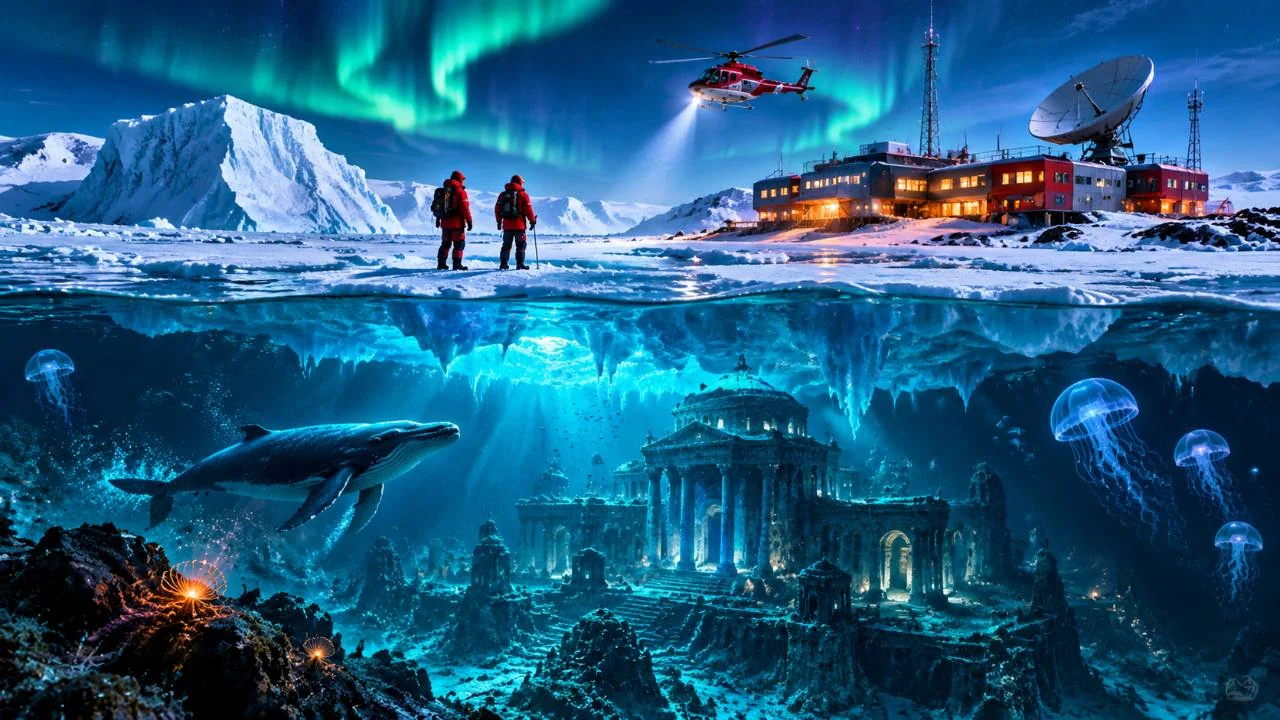
Explore Antarctica’s real subglacial lakes, microbial life and ice-shelf ecosystems. The hero’s underwater ruins are explicitly fictional AI artwork.
Conceptual AI cutaway. The underwater ruins are fictional, not a real discovery. This is not a scientific reconstruction or a map of subglacial habitats. AI-generated editorial illustration supplied for PRESDA. Original creator and reuse licence not provided.
The ruins in this article’s hero image are fictional AI artwork. They do not depict a discovered city, archaeological site or scientific reconstruction. The cutaway combines imagined elements and is not a map of Antarctic habitats. The real hidden world is remarkable enough: rock landscapes, liquid water, microbial ecosystems and ocean life beneath floating ice.
There is no single ocean beneath the continent
Two environments must be kept separate. Subglacial lakes lie beneath ice resting on the continent. Ice shelves are floating extensions of land ice, with seawater beneath them. A marine animal found under a shelf is therefore not evidence of whales swimming inside a sealed lake beneath kilometres of grounded ice. NSIDC, the science of ice shelves
This distinction changes the questions scientists ask. A continental lake raises questions about water beneath an ice sheet and the organisms it supports. A floating shelf raises questions about exchanges with the ocean, food supplies and melting from below. Both are concealed by ice, but their plumbing and ecological possibilities differ.
Mapping a landscape nobody can walk across
Published in 2025, Bedmap3 combines decades of surveys to improve the map of the bed beneath Antarctica. Radar and other geophysical observations reveal the shape of concealed terrain. This is a reconstruction from measurements, with uneven coverage and uncertainty, not a photograph of an empty chamber under the ice. British Antarctic Survey, Bedmap3 (2025)
A hidden landscape is not an undiscovered civilisation. Maps show the physical setting in which ice moves and water collects. Their value lies in making that system measurable: where the bed rises, where basins lie and where important gaps in observation remain. The less visible a place is, the more carefully evidence and imagination must be separated.
The life beneath grounded ice is microbial evidence
A landmark Nature paper in 2014 reported a microbial ecosystem in subglacial Lake Whillans, sampled through roughly 800 metres of ice. Researchers found bacteria and archaea in this dark environment, with evidence for chemical-energy-based production. The discovery demonstrated life in the sampled lake; it did not establish identical ecosystems in every Antarctic lake. Christner et al., Nature (2014)
Microbes may lack the spectacle of the fictional temple in our illustration, but they pose a deeper scientific challenge. How is a habitable environment sustained without local sunlight? Which reactions provide usable energy? Those questions turn an apparently sealed landscape into a testable study of the limits of life, without needing to invent large animals or lost architecture.
Under floating shelves, a different living world
Beneath the Ekström Ice Shelf, samples collected through boreholes in 2018 revealed diverse marine invertebrates, reported in 2021. More recently, a 2025 expedition explored seafloor exposed after iceberg A-84 calved from the George VI Ice Shelf, observing established communities including corals and sponges. These are ocean ecosystems, not archaeological discoveries or newly created life. British Antarctic Survey, ecosystem after iceberg calving (2025)
The Ekström findings also illustrate why access matters: drilling through ice can reveal animals beyond the reach of ordinary ship surveys. Such observations broaden the known habitat without making every unobserved cavity equivalent. A sample is evidence from a location, and its wider meaning has to be tested. British Antarctic Survey, life beneath Ekström (2021)
Why this hidden geography matters above the ice
Floating shelves help restrain the grounded ice behind them. Losing that support can allow land ice to flow faster into the ocean, contributing to sea-level rise. The shelf is already afloat, so its disappearance is not equivalent to adding the same volume of land ice to the sea. Understanding the hidden interface is therefore part of understanding Antarctica’s future. NSIDC, why ice shelves matter
Related reading: Rare natural phenomena that seem impossible.
FAQ
Frequently Asked Questions
Have underwater ruins been discovered beneath Antarctica?
The ruins in this article are fictional AI artwork, not evidence of a real discovery. The scientific sources cited here document natural environments and life.
Is there life beneath Antarctic ice?
Yes. Microbes have been sampled from Lake Whillans, and marine animals observed beneath floating shelves. These are different environments.
Does a melting floating shelf directly add its whole volume to sea level?
No. It is already afloat. A major concern is the loss of support that can accelerate grounded ice flowing into the sea.
PRESDA Dispatch
Stay Informed. Stay Aware.
A sharp briefing across AI, gaming, sport, business, world affairs, paparazzi, and lifestyle.