BLOOD FALLS: THE MYSTERY OF ANTARCTICA'S RED ICE
Discover why Blood Falls is red, how salty water moves through Taylor Glacier and what new microbial evidence suggests about its ancient origins.
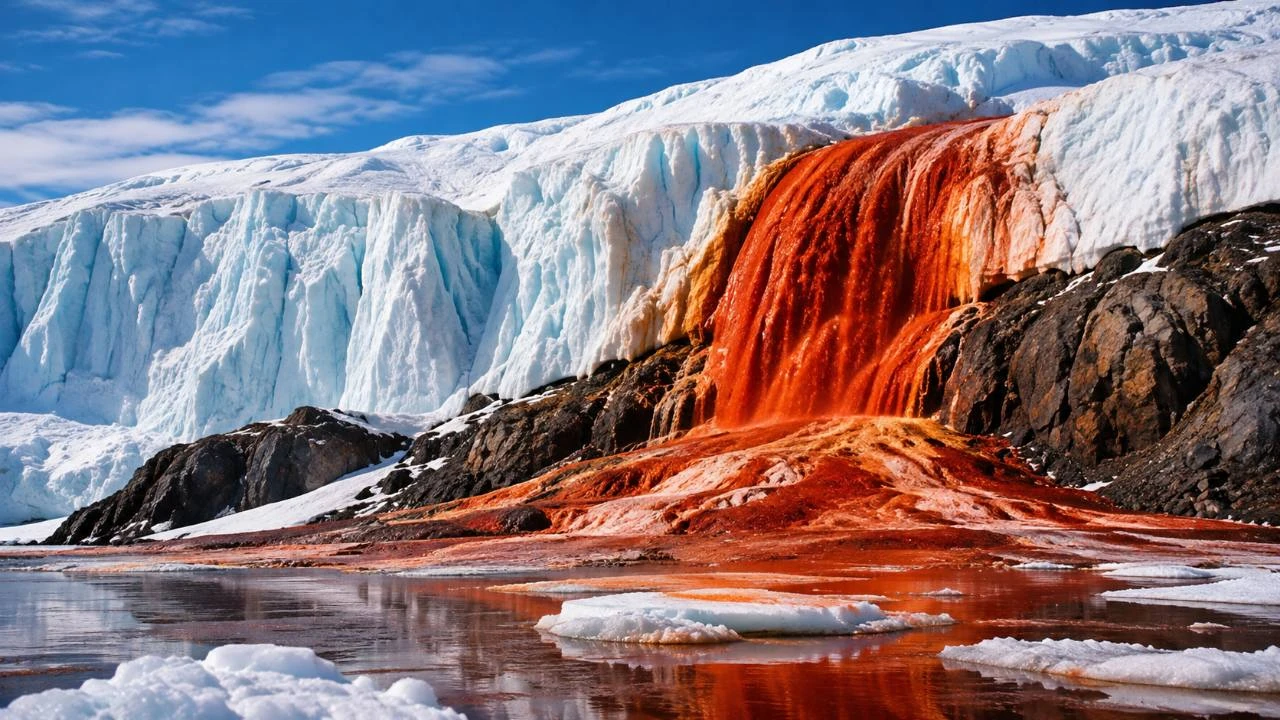
Editorial depiction, not an authenticated field photograph. Colour intensity, scale and discharge volume are illustrative, not measurements. Editorial image supplied for PRESDA. Original creator and reuse licence not provided.
The name invites the wrong explanation. Blood Falls is not a wound in Antarctica, and its red colour is not evidence of blood beneath the ice. At Taylor Glacier, salty, iron-bearing water emerges into a landscape that seems designed to keep water frozen. The scientific puzzle is therefore richer than the photograph: colour, liquid flow and the history of a hidden ecosystem are related questions, but they are not the same question.
Where the red water emerges
NASA’s astrobiology account locates the feature at Taylor Glacier in the McMurdo Dry Valleys and describes episodic discharges of hypersaline, iron-rich brine. Episodic matters: this is not necessarily a broad, uninterrupted waterfall. A dramatic illustration can convey the contrast between red water and white ice while giving a misleading impression of its everyday scale or flow. Our supplied image is editorial, not a measurement or an authenticated field photograph. NASA Astrobiology, brine beneath Taylor Glacier
The chemistry behind the colour
In 2023, Johns Hopkins reported that electron microscopy revealed abundant tiny iron-rich nanospheres in sampled surface material. Their oxidation helps explain the red appearance. The particles were not simply the crystalline minerals researchers might have expected to identify. This detail matters because an instrument suited to one kind of structure can overlook another. A familiar answer, iron reacting after exposure, becomes more informative when scientists can investigate the material carrying it. Johns Hopkins University, nanosphere research (2023)
How liquid moves through a cold glacier
A 2017 team used radio-echo sounding to trace the brine’s passage within the ice. The University of Alaska Fairbanks explained that salt lowers water’s freezing temperature, while freezing itself releases heat into neighbouring ice. Together, these processes help make liquid movement possible in conditions that would freeze fresher water. This is a particular glacial plumbing system, not proof that Antarctic glaciers are warm inside or that every red discharge has the same origin. University of Alaska Fairbanks, radar investigation (2017)
New clues from microorganisms
The story continued in 2026. A Nature Geoscience study led by Angela Zoumplis found molecular evidence for a relict marine community in the brine-fed system. Nature Portfolio’s summary says the findings support a seawater origin and make modern wind transport alone an unlikely explanation for the marine signal. They do not supply an exact date when the water became isolated. Stronger evidence for an origin is different from a complete chronology. Nature Portfolio, 2026 marine-community findings
There is a useful hierarchy here: the red material can be examined, pathways can be mapped, and the past can be inferred from several kinds of evidence. Those methods answer different questions and carry different limits. Calling everything an unsolved mystery ignores real progress; calling everything solved goes too far. Blood Falls is compelling precisely because a visible surface feature provides access to questions about an environment that remains difficult to sample.
That is also why the image deserves careful reading. Its intense colour communicates a question, but its apparent waterfall volume cannot establish a discharge rate, and the scene cannot demonstrate a new discovery. The scientific story is about evidence collected over time, not the literal appearance of an illustration. The red ice rewards curiosity most when we separate what we can see, what instruments reveal and what researchers are still trying to reconstruct.
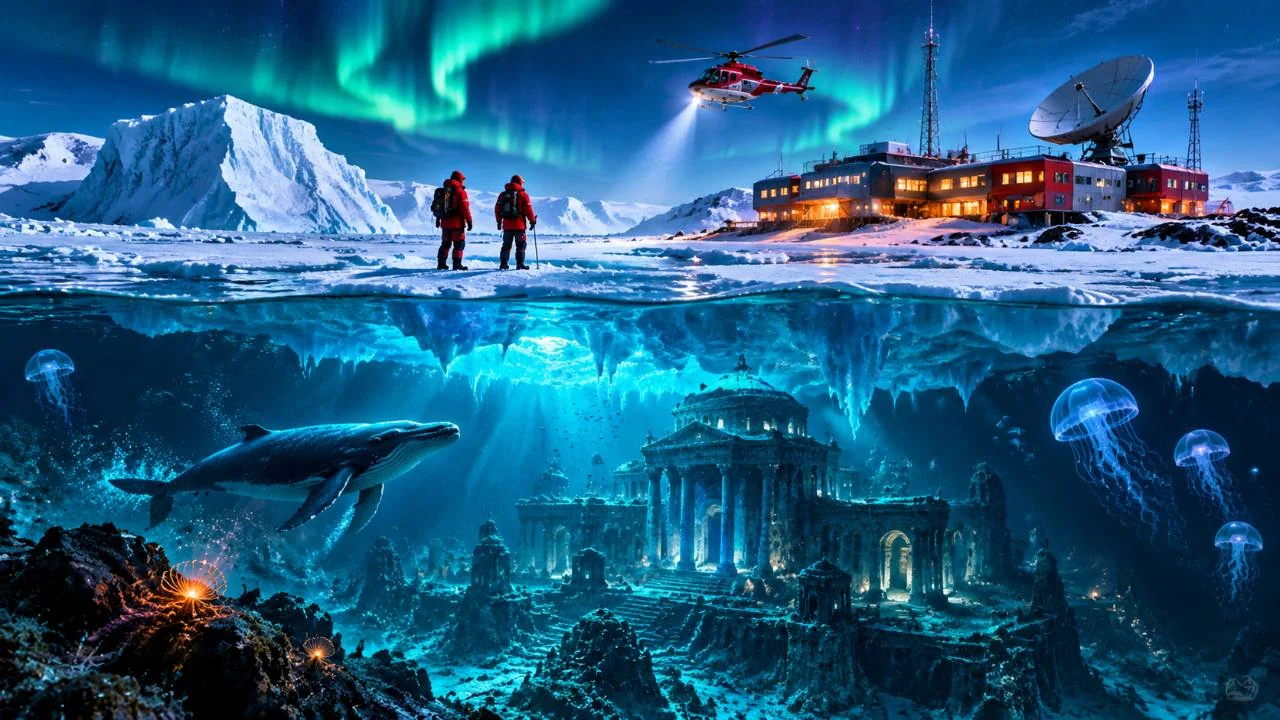
Related reading: The hidden world beneath Antarctica’s ice.
FAQ
Frequently Asked Questions
Why is Blood Falls red?
Iron-rich material in the discharged brine oxidizes after exposure. Research has identified tiny iron-rich nanospheres that help explain the colour.
Why does the salty water not simply freeze?
Salt lowers the freezing temperature, and heat released during freezing helps sustain liquid movement through this particular glacial system.
Has the water’s history been completely solved?
No. New microbial evidence supports a marine origin, but the precise timing and evolution of isolation still need investigation.
PRESDA Dispatch
Stay Informed. Stay Aware.
A sharp briefing across AI, gaming, sport, business, world affairs, paparazzi, and lifestyle.