GEORGE WEAH: FROM BALLON D’OR TO LIBERIA’S PRESIDENCY
George Weah’s journey from the 1995 Ballon d’Or to Liberia’s presidency, his electoral setbacks and the peaceful transfer of power in January 2024.
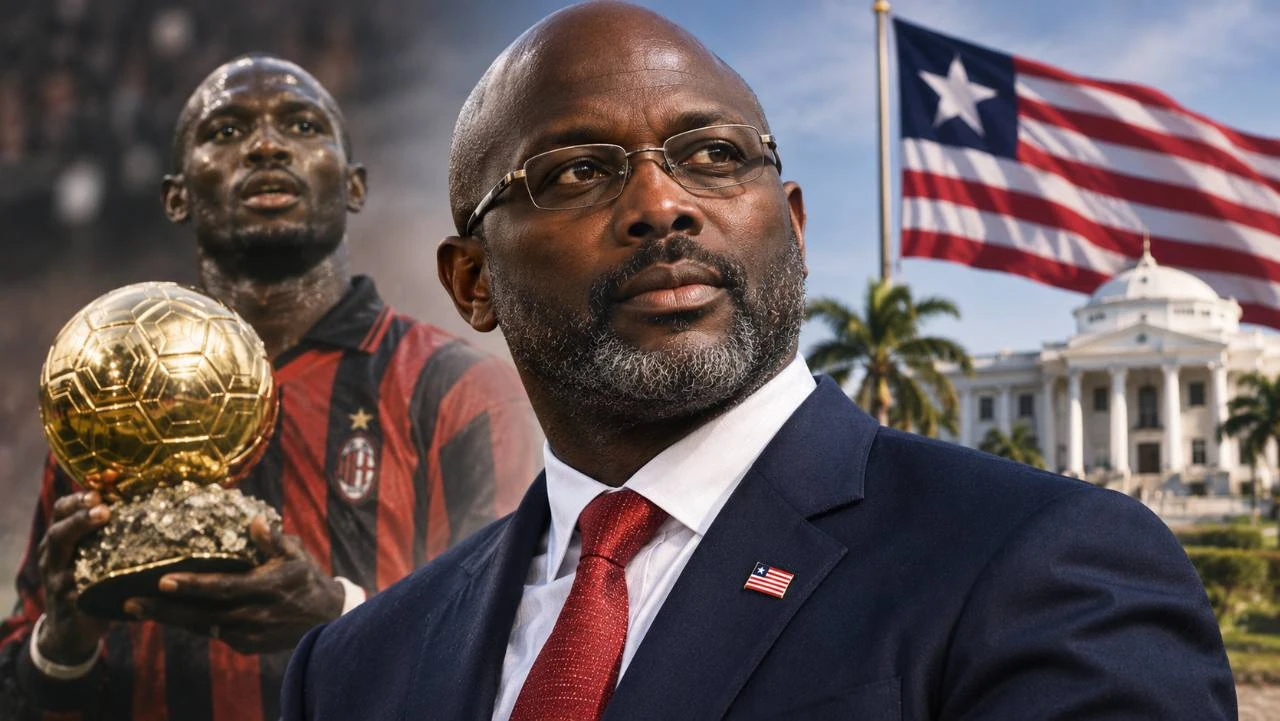
Supplied editorial composite of George Weah as footballer and political leader, not a single historical photograph. His presidency ended in January 2024.
George Weah’s journey contains two different kinds of public recognition. In 1995, a football jury placed him at the top of its profession. More than two decades later, Liberian voters entrusted him with the presidency. The connection made him a globally distinctive figure, but the two roles were never interchangeable: sporting greatness could create recognition without answering the demands of government.
Weah served as Liberia’s president from January 22, 2018, until the transfer of power on January 22, 2024. He is a former president, not the incumbent. His story includes electoral defeat, a Senate seat, victory and ultimately a peaceful concession after losing the 2023 election. Executive Mansion: archived Weah biography, frozen historical material AP Archive: January 22, 2018 inauguration OHCHR: Liberia’s 2023 elections and January 2024 transition
| Date | Milestone |
|---|---|
| 1995 | Wins the Ballon d’Or as a Liberian international |
| 2005 | Loses the presidential runoff to Ellen Johnson Sirleaf |
| January 22, 2018 | Sworn in as Liberia’s president |
| January 22, 2024 | Boakai’s inauguration completes the transfer of power |
The 1995 award was a historical breakthrough
The Ballon d’Or’s official ranking lists Weah as its 1995 winner, representing Liberia and the clubs Paris Saint-Germain and AC Milan. Jürgen Klinsmann finished second and Jari Litmanen third. The record places his achievement in a specific season of international football rather than reducing it to a retrospective political symbol. Ballon d’Or: official 1995 ranking
The rules matter. As contemporary reporting in Le Monde explained, 1995 was the first year the award admitted players at European clubs regardless of nationality. Previously restricted to European players, it now recognised a Liberian international. Weah became the first African international to receive the honour after that eligibility change. Le Monde: contemporary December 1995 report and eligibility change
That context does not diminish his achievement; it explains the barrier that had existed. African players could already perform at elite European clubs, but the award’s earlier rules had excluded them on nationality grounds. Weah’s victory combined exceptional individual recognition with a change in who could be considered for football’s most celebrated individual prize.
A career connecting Liberia and European football
His club path included Monaco, Paris Saint-Germain and AC Milan, followed by other stops in Europe and the United Arab Emirates. FIFA’s interview with Weah reflects on a career that reached the summit of individual recognition without a World Cup appearance. Club success and the opportunities available to a national team were different measures. FIFA: interview with George Weah
For a player from Liberia, international visibility also carried a wider significance. A national team competes through institutions, resources and a pool of eligible players; it cannot simply reproduce the strength of one star’s club. The contrast helps explain why Weah’s achievements were both personally exceptional and symbolically important beyond the teams that employed him.
The image of a footballer representing a country abroad later became part of his political appeal. But public identification should not be mistaken for a guaranteed political mandate. To become president, he still had to enter elections, build a political organisation and face voters who could choose someone else.
The road to office included losing
Weah did not move directly from a trophy ceremony to the presidency. The archived Executive Mansion biography records his defeat by Ellen Johnson Sirleaf in the 2005 presidential runoff and his election to represent Montserrado County in the Senate in 2014. That page is frozen historical material, not a current officeholder directory. Executive Mansion: archived Weah biography, frozen historical material
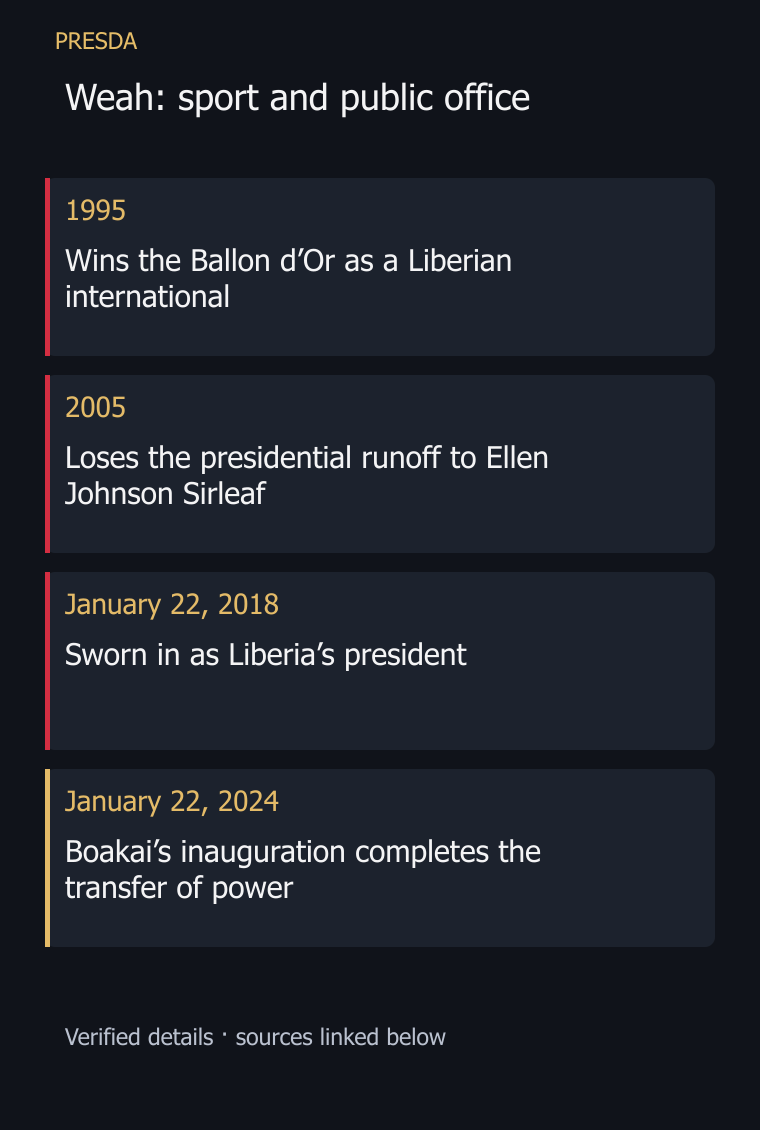
George Weah: football recognition and political chronology. Sources: Ballon d’Or, Executive Mansion and OHCHR.
The sequence complicates the easy claim that celebrity alone carried him into power. Recognition may help a candidate become known, but an electoral career also involves setbacks and the gradual accumulation of political experience. His eventual victory came after an earlier loss and a period in the legislature, not as an immediate reward for sporting fame.
In December 2017, he defeated Joseph Boakai in the presidential runoff. AP’s inauguration reporting records his swearing-in on January 22, 2018, succeeding Ellen Johnson Sirleaf. The handover was significant for a country rebuilding its institutions after civil wars that had ended in 2003. AP Archive: January 22, 2018 inauguration OHCHR: Liberia’s 2023 elections and January 2024 transition
A presidency has a different scorecard
A football match produces a relatively clear result. Government has overlapping responsibilities: public services, spending choices, employment conditions, rights and accountability. Those outcomes cannot be inferred from a player’s medals, popularity or personal story. A president’s achievements and failures require evidence about the administration itself.
That is why the transition should not be written as an uninterrupted sporting triumph. A compelling biography can recognise the extraordinary route to office while preserving the distinction between electoral symbolism and governing performance. Citizens are not simply supporters of a team; they can demand results, challenge decisions and replace an administration.
The 2023 election tested the institution
The United Nations human rights office records a presidential runoff on November 14, 2023, in which Boakai defeated the incumbent Weah. It also records Weah’s concession on November 17, before the formal announcement of final results, and the creation of a joint transition team on November 22. OHCHR: Liberia’s 2023 elections and January 2024 transition
These dates supply a more precise ending to his presidency than the vague statement that he left politics. Losing an election, accepting its outcome and organising a transfer are distinct events. They show the operation of a political process rather than the disappearance of a public figure from national life.
The OHCHR report describes the peaceful transition while also documenting human-rights concerns during the electoral period, including threats to expression and assembly and barriers to participation. It should not be read as a blanket endorsement of every aspect of the administration or campaign. Nor does it justify assigning every documented violation personally to Weah.
January 2024 completed the transfer
Boakai’s inauguration on January 22, 2024, concluded the transition. That is the relevant endpoint for Weah’s term. An older biography that still calls him president must be read as an archive, while a present-day article needs to use former president. The difference is fundamental to an accurate historical profile. OHCHR: Liberia’s 2023 elections and January 2024 transition
The concession remains an important part of the story because accepting defeat is itself a test of political institutions. It does not settle every debate about the six years in office. It does establish that the narrative should include a transfer to a successful opponent, rather than leaving readers with the misleading impression of an ongoing presidency.
Sporting fame and public responsibility
Weah’s path offers a different comparison with the post-playing careers explored in PRESDA’s Gareth Bale profile. A commercial venture and a presidency both place a familiar athlete in a new role, but elected office carries obligations to an entire population, including people who never supported the candidate.
The comparison is useful precisely because the roles differ. A sporting identity can create access, trust or attention, but those advantages do not substitute for the operating requirements of the new institution. In government, the right to criticise and the possibility of electoral replacement are central, not inconvenient distractions from a celebrity’s story.
A life understood through both victories and limits
The lasting outline is remarkable: the first African international to win the Ballon d’Or, an unsuccessful presidential candidate, a senator, a president and a defeated incumbent who conceded. Each stage adds something that the simple phrase from footballer to president leaves out.
Weah’s history is most compelling when neither half is allowed to swallow the other. The football achievement belongs to the sport’s record. The presidency belongs to Liberia’s political history and must be assessed through institutions, rights and results. His trajectory connects those worlds while reminding readers that excellence in one does not automatically resolve the demands of the other.
FAQ
Frequently Asked Questions
When did George Weah win the Ballon d’Or?
He won in 1995, the first year the award admitted players at European clubs regardless of nationality. The official ranking identifies PSG and AC Milan as his clubs that year.
Is Weah still president of Liberia?
No. He served from January 22, 2018, until the transfer to Joseph Boakai on January 22, 2024.
Did he become president on his first attempt?
No. He lost the 2005 presidential runoff, later won a Senate seat in 2014 and won the presidency in the 2017 election.
What happened after the 2023 election?
Boakai won the November 14 runoff. OHCHR records Weah’s November 17 concession, a joint transition team and the January 2024 handover.
PRESDA Dispatch
Stay Informed. Stay Aware.
A sharp briefing across AI, gaming, sport, business, world affairs, paparazzi, and lifestyle.