THE FIRST ATM: HOW A MACHINE CHANGED BANKING FOREVER
Barclays opened its Enfield cash dispenser on 27 June 1967. Early rivals and shared networks explain how cash machines changed everyday banking.
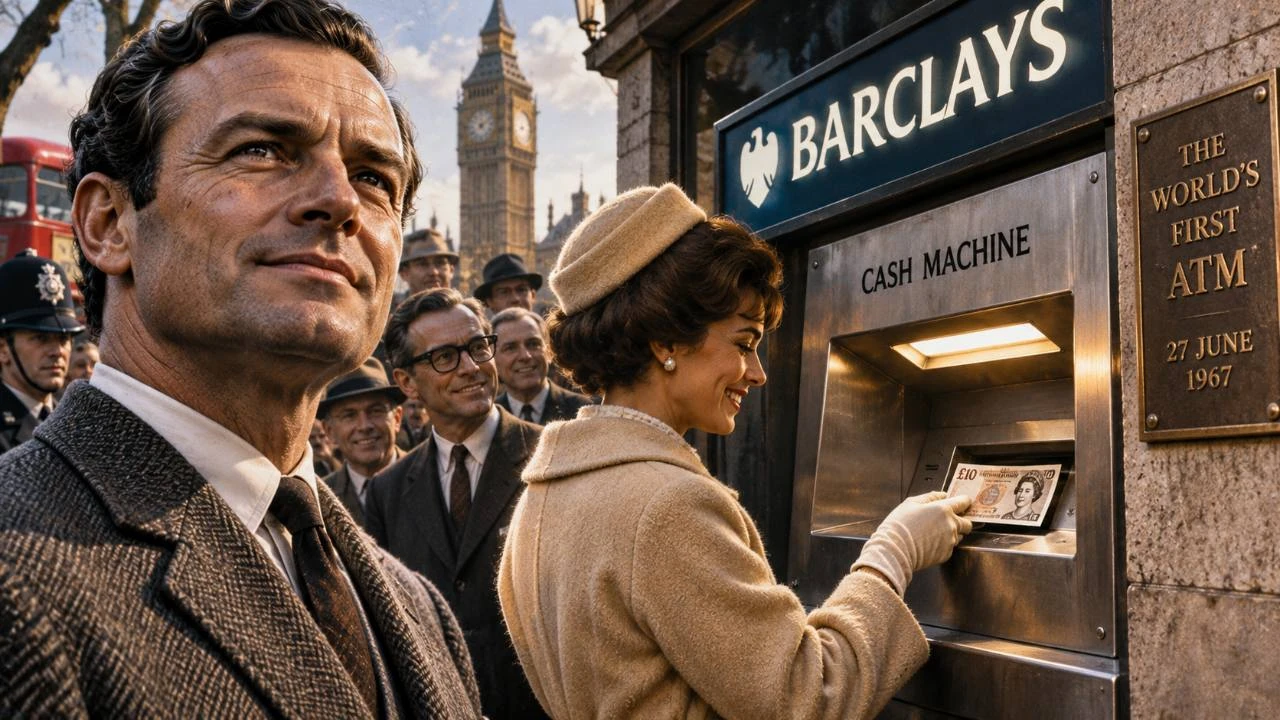
AI-generated historical illustration. The street and machine are imagined. The documented launch was in Enfield, away from the Westminster skyline depicted here.
On 27 June 1967, the British actor Reg Varney demonstrated a new way to get cash at a Barclays branch in Enfield, north London. A machine built into the bank dispensed notes to the customer outside. Historic England identifies it as the first installation of its kind at a bank. The business innovation was easy to grasp: a cash withdrawal could be detached from the hours when a teller was available. Historic England: the Enfield branch and launch
How the first cash dispenser worked
The De La Rue system associated with John Shepherd-Barron used specially issued paper instruments. A customer needed to obtain them beforehand and could exchange one at the machine for a fixed amount of cash. The device automated a defined transaction. Modern bank cards, live account checks and the freedom to use another bank’s machine depended on further systems that had yet to be built. IEEE-ISTO: early cash dispensers and ATM networks
Who invented the ATM?
Enfield gives historians a well documented opening, but the modern ATM has several origins. Bernardo Bátiz-Lazo found that independent teams introduced cash dispensers in different countries within a short period. Britain’s Chubb system also differed from De La Rue’s. Sweden’s Metior machine was shown to the press in Uppsala on 6 July 1967. Depending on whether a history tracks cash dispensing, card authentication or live network access, a different milestone comes into focus. Thodenius, Bátiz-Lazo and Karlsson: the Swedish ATM
The network changed the business
A machine outside one branch extended that branch’s service. A network made the service available away from the branch that held the account. To make that leap, banks had to agree on how to route requests, recognize customers and settle transactions across institutions. A shared switch could pass a withdrawal request between banks. Each compatible terminal added places where customers could get cash, giving banks a reason to cooperate even as they competed for deposits. Bátiz-Lazo: the evolution of British ATM networks
Adoption took time. Early cards preserved by the Bank of England show banks trying out different systems, while Bátiz-Lazo’s research describes limited public familiarity in the first years. Enfield matters because it made a new relationship between banking and time visible. The lasting transformation came when a routine withdrawal no longer depended on a particular counter, employee or branch. Bank of England Museum: early ATM cards
From a branch machine to a banking channel
A shared cash network also changed what a bank needed to own. Customers could benefit from terminals they had never seen before, and an institution could extend service without building a staffed office at every location. Banks still had to decide how to share costs and who would handle a failed transaction. Bátiz-Lazo’s research describes the move from proprietary networks to interoperability in Britain, a change that depended as much on agreements between institutions as on the machines themselves. Bátiz-Lazo: the evolution of British ATM networks
Related reading · The Rothschild banking dynasty · The first text message
FAQ
Frequently Asked Questions
Where and when was the first Barclays cash dispenser opened?
At Barclays in Enfield, north London, on 27 June 1967.
Did the Enfield machine take ordinary bank cards?
It used specially issued paper instruments. Bank cards and shared networks came through separate developments.
Who demonstrated the machine?
British actor Reg Varney took part in the opening demonstration.
PRESDA Dispatch
Stay Informed. Stay Aware.
A sharp briefing across AI, gaming, sport, business, world affairs, paparazzi, and lifestyle.