THE FOURTH CRUSADE: WHEN CRUSADERS ATTACKED CHRISTIAN ZARA
In November 1202 crusaders attacked Christian Zara, now Zadar. Explore Venice’s role, papal opposition and the disputed November 24 chronology.
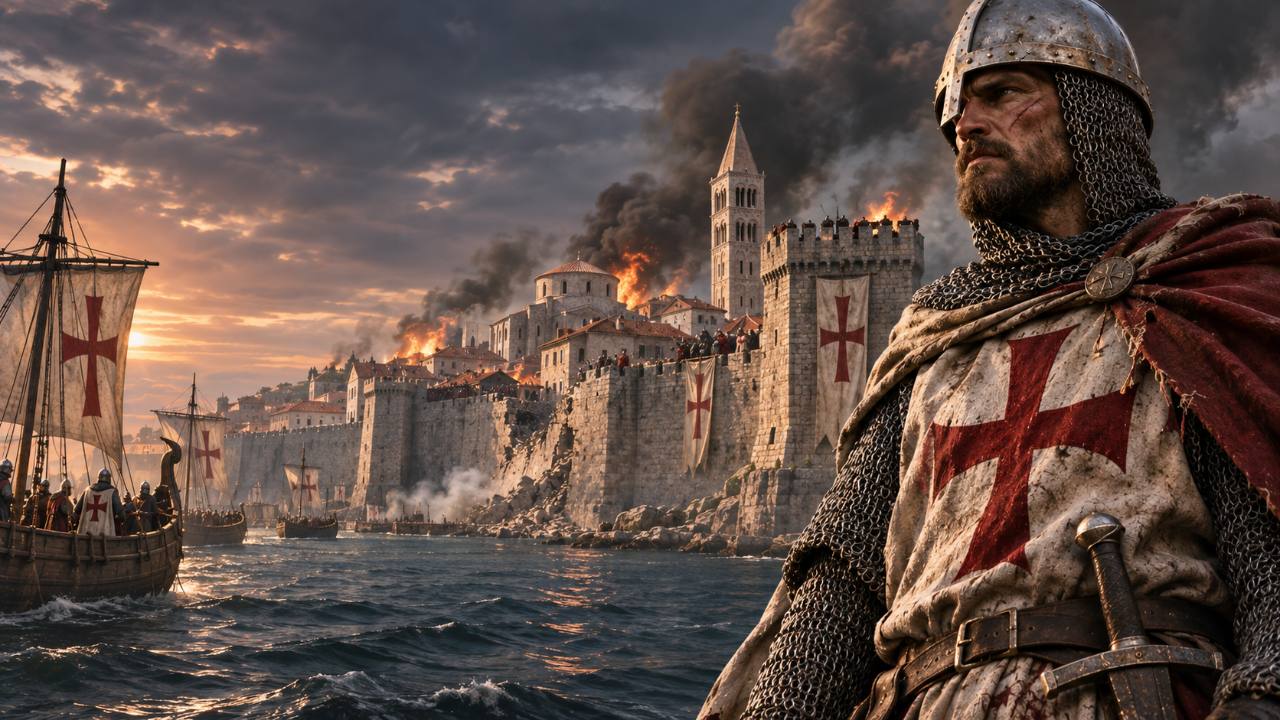
Supplied modern editorial reconstruction, preserved unchanged. The knight, ships and burning city are illustrative, not a medieval eyewitness image or an authenticated reconstruction of Zadar’s buildings.
In November 1202, crusaders and Venetians besieged and seized Zara, today Zadar in Croatia, a Christian city on the Adriatic. November 24 is a traditional date for its capture or occupation, but the chronology is disputed: scholarly studies also identify November 18 as the surrender date. The anniversary must preserve that uncertainty while explaining an attack that redirected the Fourth Crusade. Stjepan Antoljak: source-critical study of Zadar’s capture and destruction Ivan Božilov, 2009: Zadar and the Fourth Crusade, including disputed dates David Nicolle: The Fourth Crusade 1202–04, publisher’s chronology
The central contradiction is clear even where the dates are not. An expedition organized in the name of a Christian holy war turned its force against a Catholic community. Understanding how that happened requires following transport contracts, Venetian ambitions and arguments within the crusading army, rather than assuming a single religious identity guaranteed common political interests.
Why an expedition for the East attacked an Adriatic city
The Fourth Crusade set out in 1202 with Egypt as its intended target, according to the Metropolitan Museum’s historical account. The plan was connected to the struggle for the Holy Land, not originally a campaign to conquer Zadar. The city became a target through the expedition’s relationship with Venice, which supplied the fleet and had its own interests on the Adriatic coast. Metropolitan Museum of Art: the Fourth Crusade and its diversion
Geoffrey of Villehardouin, a participant in the crusade and one of its negotiators, describes a transport agreement based on a force larger than the number that eventually assembled. The crusaders could not meet the full payment. Doge Enrico Dandolo offered a way to postpone the outstanding obligation: help Venice recover Zara. That bargain translated a logistical and financial crisis into a military commitment against another city. Geoffrey of Villehardouin: participant’s chronicle, Fordham sourcebook edition
Debt explains the bargain, not its innocence
The contract created pressure, but pressure was not the same thing as inevitability. The account itself preserves opposition and departures. Leaders faced a choice about whether keeping the army and fleet together justified changing the immediate target. Describing the debt explains why the proposal was powerful; it does not turn the resulting attack into a morally neutral accounting adjustment.
For Venice, Zara was not simply a convenient stop on a map. It was a contested Adriatic city linked to the Hungarian-Croatian crown and resistant to Venetian control. The Croatian Encyclopedia situates the assault within that longer struggle, identifying 1202 as a particularly destructive attack on the city. Crusading manpower gave a regional maritime rivalry a much larger military instrument. Croatian Encyclopedia: Zadar’s history and the destruction of 1202
A Christian city and a divided army
Villehardouin reports that some participants objected to the attack and that the abbot of Vaux-de-Cernay invoked papal opposition. Simon de Montfort was among those who refused to support the operation. These objections matter because they show that the target’s Christian status was recognized at the time, not a contradiction noticed only by modern historians. Geoffrey of Villehardouin: participant’s chronicle, Fordham sourcebook edition
The disagreement also cautions against describing “the crusaders” as if every person made the same decision. The army was a coalition held together by vows, leaders, transport arrangements and expectations. Some participants accepted the diversion, some opposed it and some later left. A common cross did not erase competing judgments about what the expedition was permitted to do.
What the contemporary narrative reveals
The chronicle describes the fleet arriving on the eve of St Martin’s Day, November 10, and a camp established the following day. Negotiations with the inhabitants, opposition within the army and preparations for an assault followed. It records pressure against the fortifications by land and sea before the city sought terms. These details establish a siege, not a peaceful transfer that later acquired a violent reputation. Geoffrey of Villehardouin: participant’s chronicle, Fordham sourcebook edition
Villehardouin was close to the leadership whose decisions he described. That access makes his account valuable, but also makes its explanations interested rather than detached. His emphasis on keeping the army together needs to be read alongside the choices and suffering that such unity imposed on the people of Zara.
Why November 24 needs a careful explanation
A modern chronology by historian David Nicolle gives November 24 for capitulation and sack. Other scholarly work draws a distinction between the city’s surrender and the entry or occupation that followed. The date is therefore a legitimate anniversary connection, but not an uncontested timestamp that can be repeated without qualification. David Nicolle: The Fourth Crusade 1202–04, publisher’s chronology Stjepan Antoljak: source-critical study of Zadar’s capture and destruction
Surrender and occupation may be different stages
Stjepan Antoljak’s source-critical study compares accounts that do not agree. It places surrender on November 18 in a reconstruction of Villehardouin’s sequence, while connecting November 24, St Chrysogonus’s feast day, with other accounts and entry into the conquered city. Ivan Božilov’s 2009 study likewise uses November 18 and discusses the alternative dating. This article follows the disagreement openly rather than pretending all sources say the same thing. Stjepan Antoljak: source-critical study of Zadar’s capture and destruction Ivan Božilov, 2009: Zadar and the Fourth Crusade, including disputed dates
The difference does not reverse the result of the campaign. It changes the precision with which an anniversary can be stated. “Associated with November 24” is sounder than claiming that every stage of the assault, surrender and occupation happened on that day. Medieval events often survive through sequences and feast-day references rather than a single agreed modern chronology.
The sack and its human consequences
Zara suffered destruction, plunder and the displacement of its population. The Croatian Encyclopedia describes the city as devastated in the attack. The scholarly literature compares differing accounts of damage to walls, houses and the city’s occupation. Their combined evidence supports severe consequences without requiring an invented casualty total. Croatian Encyclopedia: Zadar’s history and the destruction of 1202 Stjepan Antoljak: source-critical study of Zadar’s capture and destruction
That absence of a secure number is not a reason to minimize the violence. Damage to a port city affected shelter, trade, property and the capacity of inhabitants to return to ordinary life. The story cannot be reduced to a successful siege from the attackers’ perspective while the community inside the walls becomes merely a logistical obstacle.
Papal condemnation did not dissolve the army
Innocent III’s opposition is central to understanding the episode. Villehardouin’s account describes the crusaders seeking absolution after the capture of Zara, and the pope’s willingness to absolve them under conditions. It distinguishes their position from that of the Venetians. The sequence shows a serious breach followed by attempts to preserve the crusade, not an uncomplicated papal authorization of the original attack. Geoffrey of Villehardouin: participant’s chronicle, Fordham sourcebook edition
Authority had to operate through a coalition
The pope could condemn conduct and impose ecclesiastical penalties, but the army’s practical choices still depended on leaders, ships, supplies and alliances. Zara exposed the gap between an expedition’s proclaimed religious purpose and the mechanisms governing its movement. That gap became a defining problem as the campaign continued.
The winter at Zara was not a quiet pause before the original plan resumed. Villehardouin records conflict between allies and continued debate over the expedition. Božilov examines the winter as a period of preparation and negotiation. The army that left the Adriatic had already demonstrated that a change of target could be accepted by enough participants to carry the whole enterprise in a new direction. Geoffrey of Villehardouin: participant’s chronicle, Fordham sourcebook edition Ivan Božilov, 2009: Zadar and the Fourth Crusade, including disputed dates
Key dates
| Date | Event |
|---|---|
| 1201 | Crusading leaders arrange transport with Venice |
| 10–11 November 1202 | Fleet arrives and the siege begins |
| November 1202 | 18 November surrender in some studies; 24 November capture or occupation in others |
| 1204 | The expedition sacks Constantinople |
The timeline separates the transport bargain, the disputed November sequence and the later attack on Constantinople. The last event belongs to 1204, not to the siege of Zara itself. Keeping those stages distinct prevents a two-year campaign from collapsing into a single episode. Geoffrey of Villehardouin: participant’s chronicle, Fordham sourcebook edition Stjepan Antoljak: source-critical study of Zadar’s capture and destruction Metropolitan Museum of Art: the Fourth Crusade and its diversion
From Zara to Constantinople, without assuming inevitability
In 1204 the crusaders sacked Constantinople and established a Latin Empire there. The Metropolitan Museum describes the Byzantine dynastic dispute and promised payment that helped redirect the expedition. Zara was an important precedent for diversion and a place where the coalition’s future was negotiated, but it was not proof that every later decision had already become unavoidable. Metropolitan Museum of Art: the Fourth Crusade and its diversion
The consequences of the 1204 conquest were much wider than the earlier Adriatic siege. Byzantine rule fragmented, populations were displaced and competing successor states emerged. Constantinople returned to Byzantine rule in 1261. That longer aftermath explains why Zara is often read as an early turning point in a campaign whose eventual target was another Christian capital. Metropolitan Museum of Art: Byzantium and the Latin occupation
PRESDA’s history of the Byzantine Empire follows that wider imperial story. The capture of 1204 should also remain distinct from the Ottoman conquest of Constantinople in 1453, a different event involving different powers and circumstances.
What Zara changes about the history of crusading
The siege demonstrates why religious slogans alone cannot explain a campaign’s behavior. Commercial arrangements, maritime power and decisions inside a coalition shaped where violence was directed. The participants’ own objections show that the contradiction was visible, and that alternatives existed even when the dominant leadership rejected them.
Remembering Zara on November 24 is therefore most useful when the date leads to a more precise history, not a simplified spectacle. The evidence leaves room for disagreement over the day of surrender. It leaves much less doubt that a Christian city paid heavily for the bargain that kept the Fourth Crusade moving.
FAQ
Frequently Asked Questions
Were Zara and Zadar different cities?
No. Zara is the historical Italian name used in many accounts for present-day Zadar on Croatia’s Adriatic coast.
Did Zara definitely surrender on November 24, 1202?
The date is disputed. Some chronologies give November 24 for capture and sack; studies of the sources also place surrender on November 18 and distinguish it from later entry or occupation.
Did the pope approve the attack on a Christian city?
No. Papal opposition and the subsequent effort to obtain absolution are part of the contemporary account. The later handling of participants should not be confused with advance approval of the assault.
Was this the sack of Constantinople?
No. Zara was attacked in November 1202. Constantinople was sacked in 1204 during the later course of the Fourth Crusade.
PRESDA Dispatch
Stay Informed. Stay Aware.
A sharp briefing across AI, gaming, sport, business, world affairs, paparazzi, and lifestyle.