THE GHOST ARMY: THE FAKE SOLDIERS WHO FOOLED THE NAZIS
Real soldiers, inflatable tanks and false radio traffic: how the Ghost Army misled German forces in World War II and earned belated recognition.
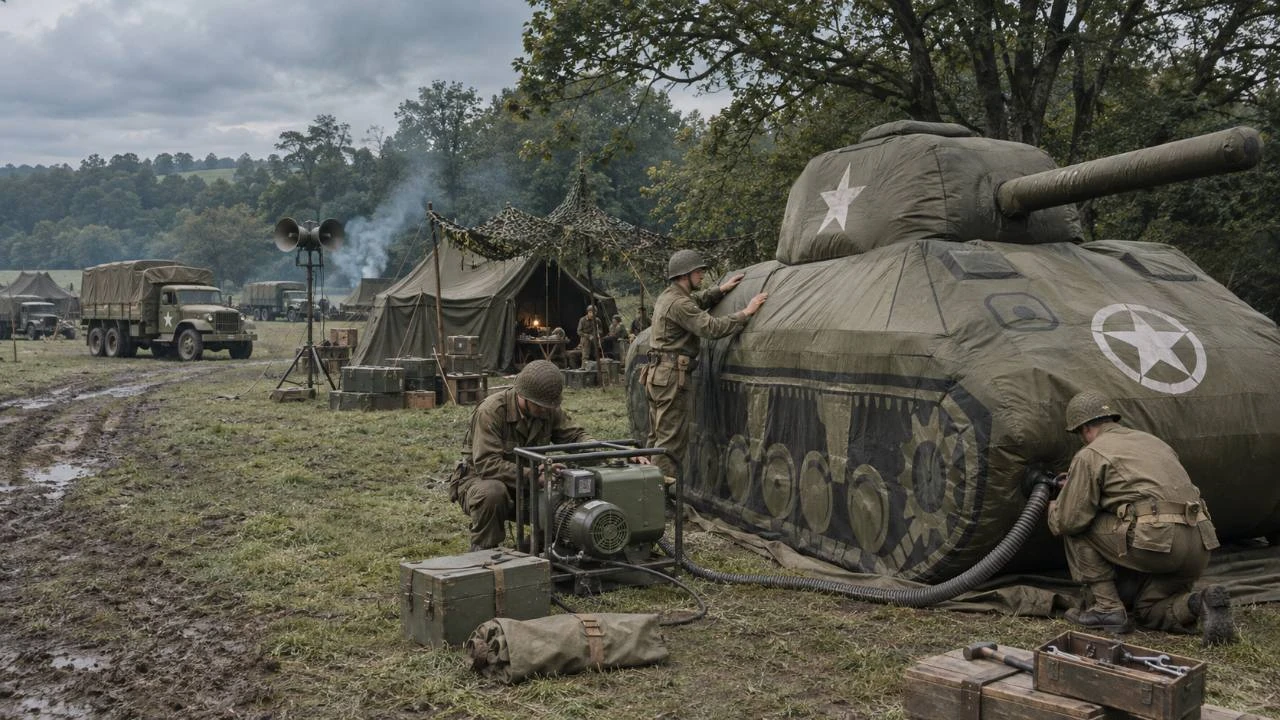
Historical reconstruction supplied for PRESDA. It illustrates inflatable decoys and sound equipment, not a verified photograph of a named Ghost Army mission. Editorial image supplied for PRESDA.
The Ghost Army’s soldiers were real. The armies they appeared to command were often illusions. During World War II, American deception units combined inflatable equipment, invented radio traffic, recorded sounds and carefully staged behaviour to mislead German forces. The nickname can suggest supernatural warfare; the actual story is about trained people manipulating evidence. Their task was to make an enemy observer reach a convincing conclusion about troops who were somewhere else.
Who belonged to the Ghost Army?
The 23rd Headquarters Special Troops was activated at Camp Forrest, Tennessee, on January 20, 1944, under Colonel Harry Reeder. Its approximately 1,100 men brought together visual camouflage, radio deception, sonic deception and security. The Ghost Army Legacy Project preserves unit histories and veterans’ records. Those records show a specialised organisation, not a collection of actors improvising without military planning. Each performance had to match a specific operational need. Ghost Army Legacy Project: unit history and records
The U.S. Army describes a force whose unusual methods helped conceal the movements of conventional American troops. That distinction is important. A deception unit did not replace the formations actually fighting and supplying the campaign. It created misleading signs around them. Its value depended on coordination with commanders who knew which genuine movement needed protection and which false movement the enemy might believe. U.S. Army: the 23rd Headquarters Special Troops
Three ways to make an absent army seem present
The eye: tanks without armour
Inflatable vehicles supplied recognisable shapes, but a shape alone was insufficient. The National Gallery of Art explains the importance of shadows, tracks and other small signs that made equipment seem used and heavy. The artists’ skill lay in anticipating how a hurried observer would read a scene at a distance. Perfect realism at arm’s length was less useful than the right combination of clues from an aircraft or observation post. National Gallery of Art: the Ghost Army’s artists
The ear and the radio: a matching story
Sound specialists projected recordings of military activity, while radio operators generated communications for units they were impersonating. Different channels had to reinforce one another. A supposed concentration of vehicles was more credible if an observer also heard activity and intercepted plausible messages. Personnel could add false unit insignia and staged conversations. The dummy equipment was therefore one element of a coordinated information environment, not a magic trick that worked on its own. National WWII Museum: canvas and camouflage
Operation Viersen and the limits of the legend
During Operation Viersen in March 1945, the unit staged an apparent Rhine crossing away from the real assault area. Inflatable equipment, a false headquarters and repeated sound activity helped direct German attention toward the decoy. This is a concrete example of the method’s purpose: alter the enemy’s interpretation of where a threat was developing. It should not be inflated into a claim that rubber tanks alone won the war. National Gallery of Art: the Ghost Army’s artists
Nor should every Allied deception be folded into the Ghost Army’s biography. Operation Fortitude, associated with misleading Germany about the invasion of France, was a broader strategic effort. The 23rd’s mobile battlefield work belongs within that larger history, but the names are not interchangeable. Similar caution applies to claims about lives saved. Such estimates describe an outcome that never happened and cannot be counted like names on a unit roster.
A real risk behind the false front
The 23rd included a combat-engineer security component because a convincing display could attract real danger. Decoys did not protect their operators by becoming harmless. The historical unit had to work close enough to the campaign to be believable, then move and repeat the performance in changing circumstances. The separate 3133rd Signal Service Company Special, which operated in Italy, also belongs to the wider Ghost Army story; it should not be confused with the 23rd’s sonic component. Ghost Army Legacy Project: unit history and records
Recognition after secrecy
The 2022 Ghost Army Congressional Gold Medal Act authorised collective recognition of the 23rd Headquarters Special Troops and the 3133rd Signal Service Company Special. The medal was presented in March 2024. This was recognition of wartime service, not the discovery of an imaginary unit. Veterans’ records, military documentation and museum collections make the central story verifiable even where sweeping claims about its overall impact require qualification. U.S. Congress: Ghost Army Congressional Gold Medal Act
The most enduring idea is that military intelligence depends on interpretation. A camera records a shape, a radio intercept captures a message, and a commander decides what they mean together. The Ghost Army worked in the space between those steps. Its achievement was to turn painting, engineering, listening and acting into a coordinated effort to make the wrong conclusion appear reasonable.
Why a believable deception needs restraint
A staged army could fail by offering too little evidence, but it could also fail by offering the wrong evidence. A spectacular display might attract attention without fitting what the enemy already knew about roads, units or timing. Effective deception therefore required a plausible relationship between the false scene and the real campaign. Its purpose was not to make every observer believe anything. It was to influence a particular judgement at a moment when that judgement could affect military decisions.
Further reading: The real intelligence work behind the ninja legends.
Related reading: How photography changed the way people see the world.
FAQ
Frequently Asked Questions
Were the Ghost Army soldiers fake?
No. They were real U.S. servicemen who created false impressions of larger formations using decoys, sound, radio and impersonation.
Was the Ghost Army the same as Operation Fortitude?
No. Fortitude was a broader strategic deception effort. The 23rd Headquarters Special Troops specialised in mobile battlefield deception.
When did the Ghost Army receive the Congressional Gold Medal?
The award was authorised by law in 2022 and presented in March 2024, honouring the 23rd and the separate 3133rd unit.
PRESDA Dispatch
Stay Informed. Stay Aware.
A sharp briefing across AI, gaming, sport, business, world affairs, paparazzi, and lifestyle.