GUATEMALA UNVEILS ANCIENT MAYA STUCCO HEADS FROM EL MIRADOR
Guatemala presented restored Maya stucco heads on November 18, 2026. Explore their Late Classic origins, excavation history and conservation.
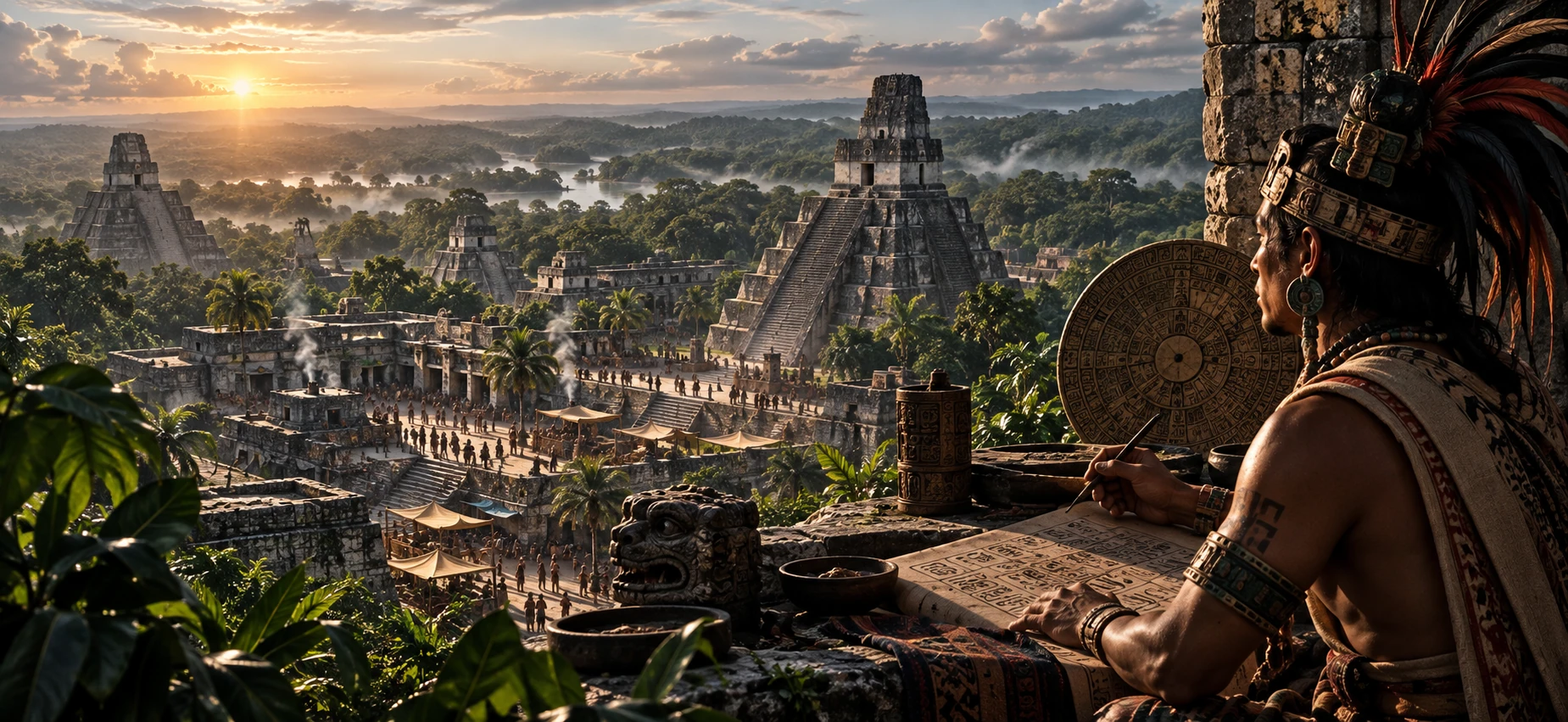
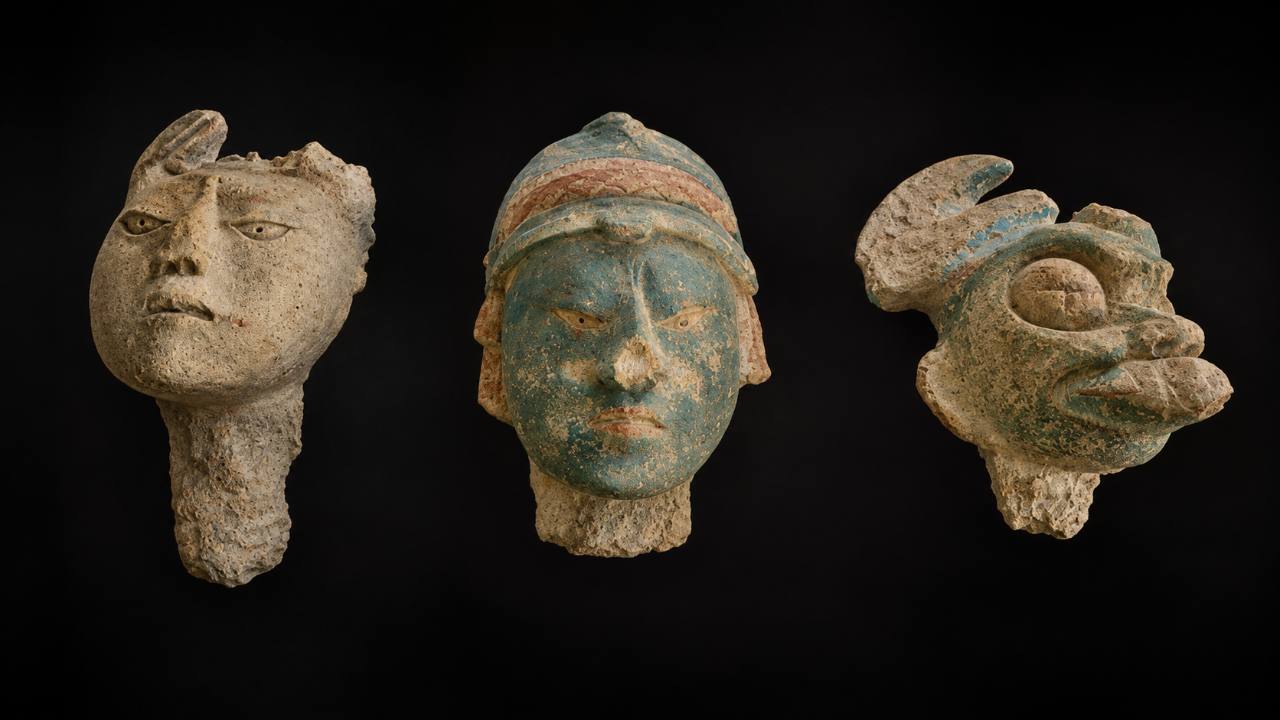
Original editorial visual supplied for PRESDA, preserved unchanged. It is not authenticated photography of the November 18, 2026 presentation.
The faces seem unexpectedly immediate: pursed mouths, carefully shaped eyes, traces of color and features that refuse to settle into a single expression. Guatemala’s latest presentation of Maya stucco heads from El Mirador has brought that artistry back into public view. The event, held on November 18, 2026, concerns an archaeological collection recovered and conserved over years, not a cache all unearthed this month. The sculptures also belong to a later chapter of El Mirador’s history than the enormous Preclassic monuments for which the ancient city is best known. AGN: November 2026 El Mirador research presentationMauricio, Hansen and Guenter: Casa del Coral excavation report, 2016
Their significance lies in the connection between objects and place. These are not simply isolated portraits attractive enough for a museum case. Excavation records connect heads and other modeled fragments to Casa del Coral, a group of buildings east of the La Danta complex in northern Guatemala’s Petén region. The evidence offers a way to examine how Maya communities represented authority, ancestors and supernatural beings through architectural decoration. It also makes the restoration laboratory part of the historical investigation. Mauricio, Hansen and Guenter: Casa del Coral excavation report, 2016
| Date or period | What it establishes |
|---|---|
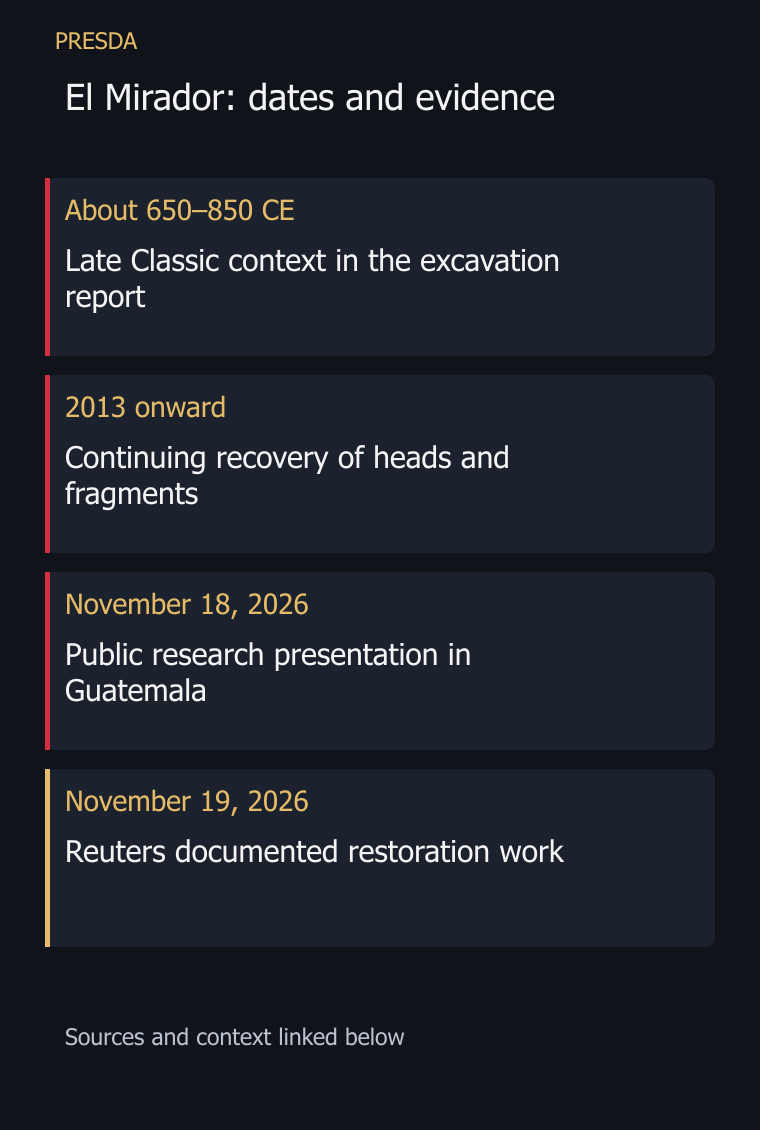
| About 650–850 CE | Late Classic context in the excavation report |
| 2013 onward | Continuing recovery of heads and fragments |
| November 18, 2026 | Public research presentation in Guatemala |
| November 19, 2026 | Reuters documented restoration work |
What Guatemala actually presented in November
INGUAT, Guatemala’s tourism institute, and the Mirador Basin archaeological project organized the presentation known as Los rostros del Mirador. The government’s Diario de Centro América reported on the November 18 conference, while Reuters documented restored pieces and conservators working in Guatemala City on November 19. Those dates describe the public presentation and subsequent reporting. They should not be mistaken for the day every head was excavated or the opening of a newly announced permanent exhibition. Diario de Centro América: November 18 presentation and restorationReuters via CNA: restored heads and November 19 laboratory reporting
The scale requires similar care. Archaeologist Douglas Mauricio Martínez told La Hora that work since 2013 had recovered between 42 and 43 sculptures, counting complete examples and fragments. A rounded description of about 40 pieces captures the scale; calling them 43 complete, newly discovered heads would not. Some recovered examples have reached Guatemala’s National Museum of Archaeology and Ethnology, while others remain under restoration. The changing total reflects continuing fieldwork and conservation rather than a single sealed deposit suddenly revealed. La Hora: collection accumulated since 2013 and interpretive context
Casa del Coral and the importance of archaeological context
A published excavation report by Douglas Mauricio, Richard Hansen and Stanley Guenter provides an essential historical anchor. Presented at Guatemala’s 2015 archaeological symposium and published in 2016, it discusses modeled stucco sculptures associated with Casa del Coral and dates their context to the Late Classic, approximately 650–850 CE. That earlier research demonstrates that the assemblage was already being studied well before the current news cycle. November’s presentation is a new opportunity to understand a continuing project. Mauricio, Hansen and Guenter: Casa del Coral excavation report, 2016
A face is not automatically an identified ruler
The excavators interpreted the sculpture as part of a mythological scene involving deities and ancestors associated with the ruling class. Recent accounts also discuss authority and prominent individuals. These ideas need not reduce every head to a named historical person. An expression can suggest age, character or supernatural attributes, but the identity of a particular figure depends on its context and supporting evidence. A compelling resemblance to a modern character is not an archaeological identification. Mauricio, Hansen and Guenter: Casa del Coral excavation report, 2016Reuters via CNA: restored heads and November 19 laboratory reporting
How Maya artists built expression in stucco
Stucco offered a sculptural language distinct from cutting a face into a stone block. The form was modeled, allowing artisans to build projecting features, work around the eyes and mouth and establish the head’s relationship to a larger composition. Surviving pigments are therefore part of the evidence, not incidental decoration. They remind viewers that much ancient architecture and sculpture looked different when color and surface treatments remained intact. The supplied hero presents three sculpted heads, but is not authenticated as a photograph of the November event. Mauricio, Hansen and Guenter: Casa del Coral excavation report, 2016
Conservator Lilian Vega de Zea described a collaborative production process in Reuters’ reporting, involving the preparation of pigments, the mixing of stucco and the modeling of the head. Her account directs attention away from a solitary anonymous genius and toward organized craft. The result depended on materials, skilled hands and shared visual conventions. Faces were made to communicate within a society that understood their setting, even when that original visual vocabulary is only partly recoverable today. Reuters via CNA: restored heads and November 19 laboratory reporting
The El Mirador heads: dates and evidence
PRESDA · agn.gt / mesoweb.com / channelnewsasia.com / dca.gob.gt / lahora.gt / maya.nmai.si.edu
Conservation is part of the discovery
Restoration begins with a difficult distinction: what survives, what can be securely joined and what remains uncertain. Diario de Centro América reported Vega’s description of heads arriving in disaggregated condition and of some restorations taking as long as a year. That timescale explains why a field discovery may become public news much later. A recognizable face can emerge only after patient work on fragments that initially look disconnected. Diario de Centro América: November 18 presentation and restoration
Why a beautiful surface cannot tell the whole story
A restored object is easier to read, but the excavation record remains indispensable. Fragment locations, associated material and the building’s construction help reconstruct the circumstances in which the sculpture was used and eventually displaced. Documentation allows later researchers to revisit an interpretation rather than rely on appearance alone. In the Casa del Coral report, architectural observations and associated ceramics form part of the argument for the Late Classic context. The face and its recorded surroundings belong in the same historical account. Mauricio, Hansen and Guenter: Casa del Coral excavation report, 2016
El Mirador had more than one historical life
El Mirador’s famous monumental landscape is associated with the Preclassic Maya world, but the heads complicate a simple story of an early city that rose and vanished forever. The Casa del Coral evidence instead illuminates later occupation and artistic production. Archaeological sites can contain buildings, repairs, deposits and reused spaces from different periods. The most imposing monument does not automatically provide the date for every object recovered nearby. Keeping those phases separate changes how the wider city is understood. AGN: November 2026 El Mirador research presentationMauricio, Hansen and Guenter: Casa del Coral excavation report, 2016
This is also why the terminology in broad presentation headlines can mislead. A conference discussing the Mirador Basin’s Preclassic settlements may include objects from a later phase. The age assigned to the heads should follow their specific archaeological context. Reuters describes the displayed sculptures as dating to the seventh and eighth centuries; the earlier Casa del Coral publication gives a broader Late Classic range. Both place this sculptural tradition centuries after the city’s celebrated early monumental development. Reuters via CNA: restored heads and November 19 laboratory reportingMauricio, Hansen and Guenter: Casa del Coral excavation report, 2016
What landscape technology adds, and what it cannot answer
The government’s presentation situated the sculptures within wider research on the Mirador Basin, including LiDAR mapping of ancient settlement and infrastructure. LiDAR uses laser measurements to help reconstruct land surfaces and detect patterns beneath vegetation. It can reveal relationships between buildings and routes that are difficult to recognize from ground level. It does not itself identify a deity, determine the age of a pigment or replace excavation and conservation. Landscape mapping and object analysis answer complementary questions. AGN: November 2026 El Mirador research presentation
The larger story is one of continuing knowledge rather than a civilization reduced to mysterious ruins. The Smithsonian’s Living Maya Time project foregrounds contemporary Maya voices and enduring, changing traditions. Ancient sculpture belongs within that longer human history. For more context on the cities, calendars and political worlds behind these objects, read PRESDA’s history of Maya civilization. El Mirador’s restored faces matter because they make a particular historical world more legible while leaving room for evidence that has yet to be understood. Smithsonian National Museum of the American Indian: Living Maya Time
FAQ
Frequently Asked Questions
Were all the Maya heads discovered in November 2026?
No. The November presentation described a collection accumulated through years of research and restoration, with recoveries reported since 2013.
Where did the sculptures come from?
They are associated with Casa del Coral at El Mirador in Guatemala’s Petén region, east of the La Danta complex.
How old are the heads?
The published Casa del Coral report places the sculptural context in the Late Classic, approximately 650–850 CE. Recent Reuters reporting describes displayed examples as seventh- and eighth-century works.
Are the heads stone carvings?
The reported sculptures are modeled stucco with surviving pigments. Their archaeological context and restoration records are essential to interpreting them.
PRESDA Dispatch
Stay Informed. Stay Aware.
A sharp briefing across AI, gaming, sport, business, world affairs, paparazzi, and lifestyle.