THE FIRST FREE HUMAN BALLOON FLIGHT: 25 MINUTES ABOVE PARIS
Pilâtre de Rozier and the Marquis d’Arlandes flew above Paris for about 25 minutes in 1783. Explore the pioneers, balloon and authentic archival prints.
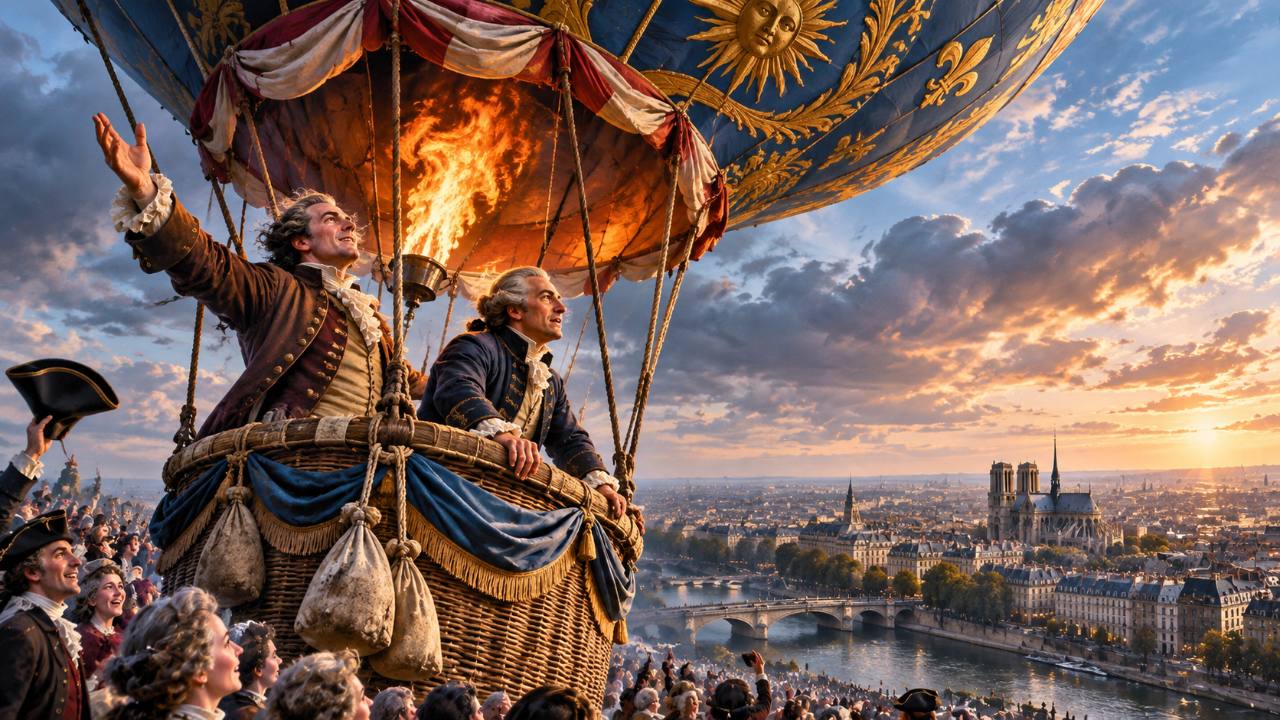
Modern editorial reconstruction supplied for PRESDA, preserved unchanged. It is not an authentic image from 1783. Period archival prints appear below.
For about 25 minutes on November 21, 1783, two people traveled above Paris without a rope connecting them to the ground. Jean-François Pilâtre de Rozier and François Laurent, Marquis d’Arlandes, rose from the grounds of the Château de la Muette in a Montgolfier hot-air balloon. Their flight covered roughly nine kilometers before they landed near the Butte-aux-Cailles, beyond the city’s ramparts. Museum of Flight: November 21 flight, route and duration
This was the first documented free, untethered human balloon flight. That wording identifies a specific achievement. It does not confuse an ascent tied to the ground with an independent journey, or a balloon lifted by heated air with a powered aircraft. Within those limits, a brief passage across Paris changed what human beings could demonstrably do. Library of Congress: The Dream of Flight exhibitionGuinness World Records: first untethered crewed balloon flight
| Question | Verified answer |
|---|---|
| Date | November 21, 1783 |
| Aeronauts | Jean-François Pilâtre de Rozier and the Marquis d’Arlandes |
| Aircraft | A Montgolfier hot-air balloon, untethered |
| Journey | About 25 minutes and nine kilometers above Paris |
The inventors and the people who actually flew
Joseph-Michel and Jacques-Étienne Montgolfier developed the practical hot-air balloon. Their names became attached to the machine, the montgolfière, but the two men aboard the November 21 flight were Pilâtre de Rozier, a scientific lecturer and experimenter, and d’Arlandes, a military officer. Inventing the vehicle and volunteering to occupy it were related but separate roles. Museum of Flight: November 21 flight, route and durationSmithsonian: eighteenth-century ballooning context
That distinction prevents a common compression of the story into an image of “the Montgolfier brothers flying over Paris.” Their invention enabled the journey; other men carried out the celebrated first free human flight. A history attentive to roles gives credit to both the makers and the aeronauts, while leaving room for the testing and public demonstrations that made the attempt possible.
Why paper makers entered the history of flight
The Smithsonian’s account places the Montgolfiers’ public demonstration at Annonay on June 4, 1783. It was part of a succession of experiments that moved rapidly from proving lift to considering living passengers. The breakthrough was practical: an envelope containing heated air could rise, remain aloft for a time and carry a load. It gave an old human ambition a repeatable mechanism. Smithsonian: eighteenth-century ballooning context
The principle does not require wings. Heated air is less dense than the cooler surrounding atmosphere, so a sufficiently large volume can provide buoyant lift. But explaining why an envelope rises is not the same as making it safe. The structure, heat source, passenger support and landing all become part of the engineering problem as soon as people leave the ground.
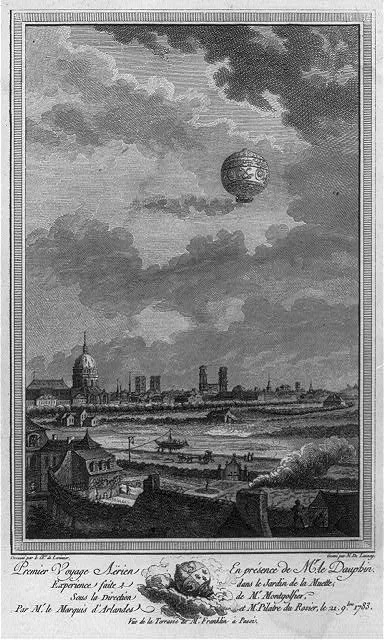
Period engraving, dated 1783, cataloged as the first human balloon ascension above Paris. A historical illustration, not a photograph or a modern reconstruction.
Library of Congress, Prints and Photographs Division, LCCN 2005684858 · Public domain: 1783 engraving
Versailles was a different flight
On September 19, 1783, a Montgolfier balloon carried a sheep, a duck and a rooster from Versailles before the royal court. The Château de Versailles’s history records that animal experiment as a major step toward human flight. It was not the 25-minute journey over Paris, and its date should not be transferred to the later achievement. Château de Versailles: September 19, 1783 animal flight
The distinction also matters when looking at images. A period engraving of the balloon above the palace can be authentic evidence of how the Versailles demonstration was represented, while still being the wrong illustration for a caption claiming to show the November departure from La Muette. Dates, places and the identity of the passengers have to travel with the picture. Library of Congress: Versailles print, LCCN 2002721989
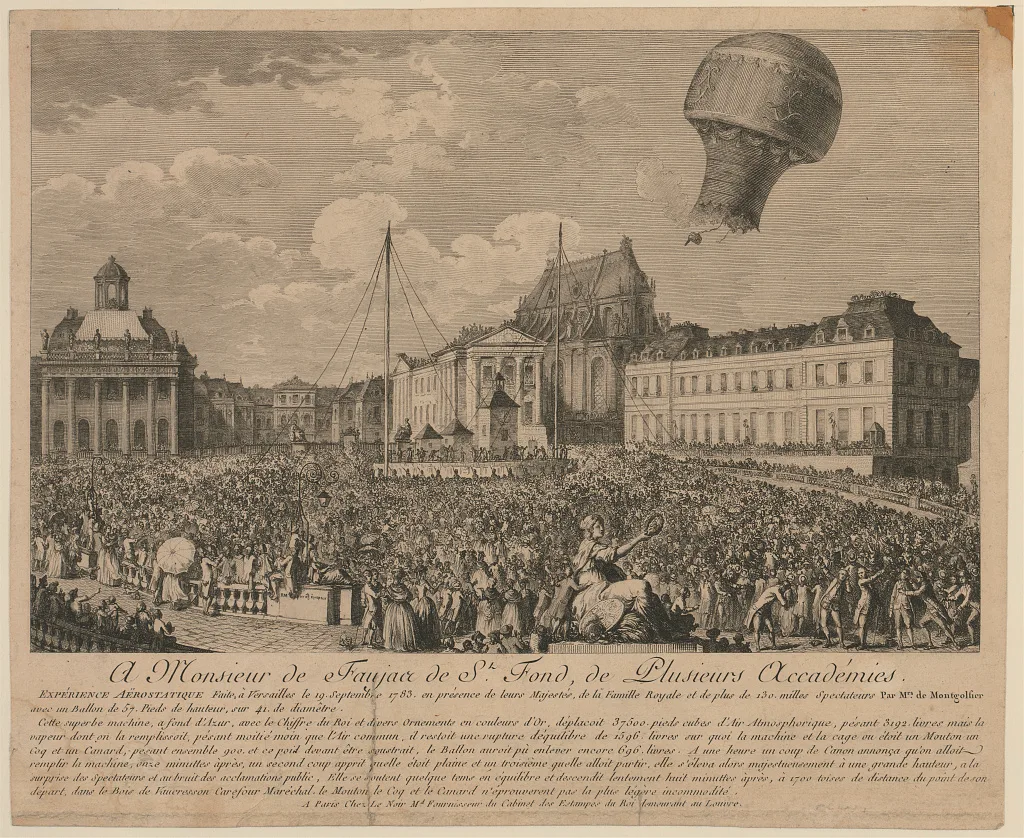
Period print depicting the September 19, 1783 demonstration at Versailles. The passengers were animals; this was not the November 21 human flight. The print’s caption is part of the historical object, not an independently verified crowd count.
Library of Congress, Prints and Photographs Division, LCCN 2002721989 · Public domain: eighteenth-century print
Tethered ascents supplied another essential stage. A rope could keep an ascending balloon within reach and allow an experimenter to experience the machine without committing to a journey on the wind. The November flight crossed that threshold: the people aboard could regulate aspects of their ascent, but they could no longer rely on a tether to bring them back to the launch site. Museum of Flight: November 21 flight, route and duration
Twenty-five minutes over an eighteenth-century city
The Museum of Flight describes a journey from La Muette in western Paris to the Butte-aux-Cailles, a distance of about nine kilometers. It gives an altitude of approximately 910 meters. These figures are historical estimates, not the output of a modern GPS recorder. The duration of about 25 minutes is also the figure used in the Library of Congress’s account. Museum of Flight: November 21 flight, route and durationLibrary of Congress: The Dream of Flight exhibition
The route is part of what made the demonstration important. This was not simply a vertical ascent followed by a return to the same patch of ground. The balloon carried its passengers across a recognizable urban landscape and beyond the ramparts. The city below became both a measure of distance and an audience for an event that no previous generation had seen in that form.
Freedom from a tether did not mean freedom from the wind
A hot-air balloon is not an airplane with an engine and steering surfaces. Its horizontal journey depends on the air through which it moves. Changing lift can affect altitude, but it does not supply the kind of direct directional control associated with later powered aviation. “Free flight” therefore describes the absence of restraint by a ground tether, rather than complete command over a route.
That limitation makes the accomplishment more interesting, not less. The aeronauts accepted that leaving the ground meant entering an environment they could influence only partly. A successful landing mattered as much as takeoff. The event demonstrated that people could travel through the air and return alive, while leaving the larger questions of navigation, endurance and operational safety unresolved.
What authentic engravings contribute
The Library of Congress holds a 1783 engraving cataloged as the first human balloon ascension, depicting Pilâtre de Rozier and d’Arlandes above Paris. Its small balloon is set against a broad cityscape. Unlike a cinematic reconstruction, it conveys how an eighteenth-century printmaker framed the novelty in relation to the familiar city below. It remains a representation, not a photographic record. Library of Congress: 1783 engraving of the human flight, LCCN 2005684858
The Versailles print, also held by the Library of Congress, adds the context of public display and royal attention. Its crowded foreground and palace setting belong to the September experiment. Presented beside the November engraving, it helps explain the progression from an animal demonstration to human free flight without pretending that the images record the same occasion. Library of Congress: Versailles print, LCCN 2002721989
The supplied hero at the top of this article is a modern editorial reconstruction and is identified as such. It is preserved exactly as supplied. The archival engravings are separate supporting materials with catalog links and dates, so readers can distinguish a dramatic modern interpretation from historical objects that can be examined in a library collection.
A breakthrough without a simple ending
The first free flight did not complete the problem of aviation. Balloons established a workable form of human flight, while steering and sustained travel remained challenges. The Library of Congress’s exhibition follows later experiments and records Pilâtre de Rozier’s death with Pierre Romain during an attempted Channel crossing in 1785. Success in Paris had not removed the dangers of further experimentation. Library of Congress: The Dream of Flight exhibition
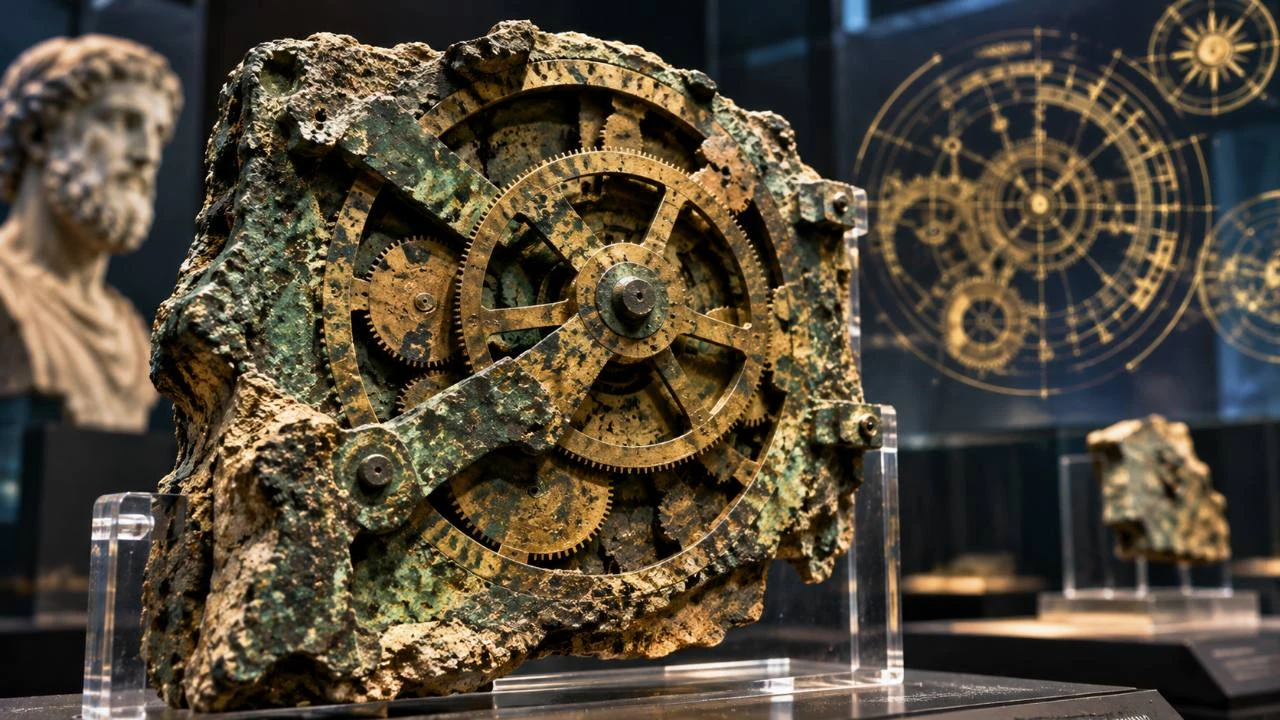
That combination of achievement and unfinished work appears elsewhere in the history of invention. PRESDA’s feature on the Antikythera mechanism examines a different machine whose significance depends on understanding what it actually did. In both stories, precise description is more revealing than assigning a sweeping modern label to an earlier technology.
The November 21 flight endures because its scale was human enough to grasp: two passengers, one balloon, a city crossed in less than half an hour. Its historical importance does not require imaginary dialogue or an invented view from the basket. The documented journey is striking on its own, a moment when an experiment became a means of carrying people into a new environment.
FAQ
Frequently Asked Questions
Who made the first free human balloon flight?
Jean-François Pilâtre de Rozier and François Laurent, Marquis d’Arlandes, flew in a Montgolfier hot-air balloon on November 21, 1783.
How long did the Paris flight last?
About 25 minutes. The Museum of Flight describes a distance of roughly nine kilometers from La Muette to the Butte-aux-Cailles.
Did the Montgolfier brothers fly in the balloon?
They developed the balloon, but Pilâtre de Rozier and d’Arlandes were the passengers on the first free human flight.
Are the illustrations photographs of the event?
No. The supporting archival images are period engravings. The supplied hero is a modern editorial reconstruction, clearly distinguished from historical evidence.
PRESDA Dispatch
Stay Informed. Stay Aware.
A sharp briefing across AI, gaming, sport, business, world affairs, paparazzi, and lifestyle.