THE ANTIKYTHERA MECHANISM: THE WORLD’S FIRST ANALOG COMPUTER
Discover the Antikythera mechanism’s gears, astronomical predictions and surviving fragments, with clear distinctions between evidence and reconstruction.
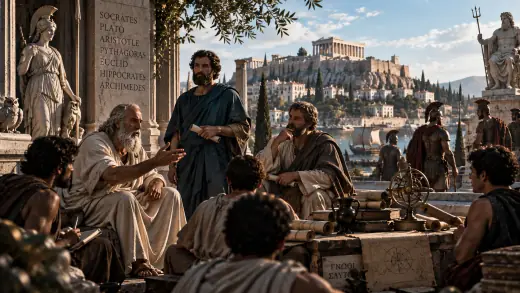
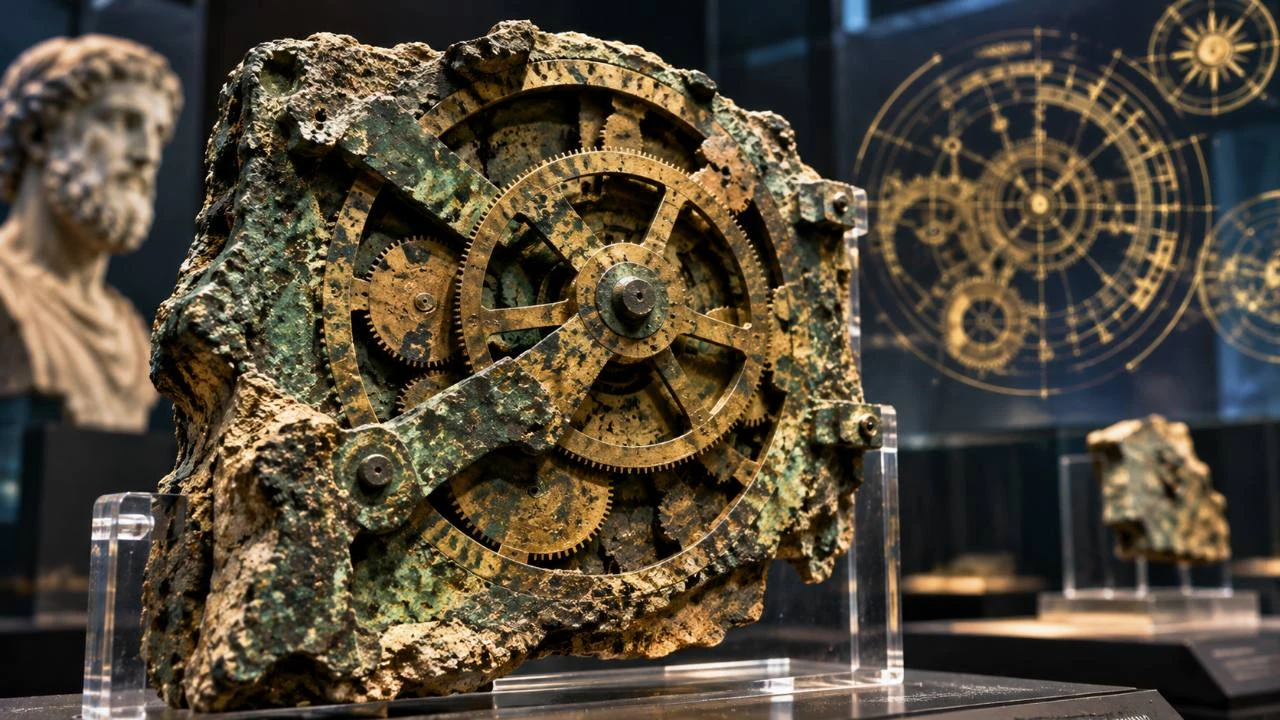
Supplied editorial illustration inspired by the Antikythera mechanism. Not verified museum photography or a reconstruction establishing the exact ancient arrangement.
The Antikythera mechanism is the oldest known surviving geared astronomical calculator, often called the world’s first analog computer. Built in the ancient Greek world more than two thousand years ago, it represented celestial cycles through the movement of bronze gears. Its significance lies in that mechanical achievement, not in a claim that it was an electronic computer mysteriously misplaced in antiquity. Greek Ministry of Culture: mechanism catalogue
Today the remains are kept at the National Archaeological Museum in Athens. What looks at first like a damaged mass of metal contains evidence of a sophisticated relationship between observation, mathematics and craftsmanship. Reading it has required archaeologists, historians of astronomy, imaging specialists and engineers to work on the same object.
| Evidence | What it establishes |
|---|---|
| Probably 150–100 BCE | The Ministry’s catalogue date for the instrument. |
| 82 fragments; 30 surviving gears | The preserved remains, not a complete original parts list. |
| 1900–1902 | Wreck discovery, salvage and recognition were separate stages. |
| 2021 cosmos model | A proposed reconstruction of missing front-display mechanics. |
What was the mechanism designed to do?
The Greek Ministry of Culture describes an instrument that calculated the movement of the Sun and Moon, probably also the five planets known in antiquity, and predicted astronomical phenomena including eclipses. Calendar functions and the timing of Pan-Hellenic celebrations also formed part of its scope. It connected the sky with systems for organising human time. Greek Ministry of Culture: mechanism catalogue
The word “computer” is useful when it means a device that carries out calculations. It becomes misleading if it suggests a screen, electricity or software. The mechanism encoded relationships in the sizes and arrangement of its gears. Turn the input, and connected parts moved in proportions chosen to represent astronomical cycles.
How gears can perform a calculation
Two meshing gears do more than transmit motion: their tooth counts determine how far one turns in relation to the other. Combining several such relationships allows a machine to represent a longer or more complicated cycle. A pointer can then translate the resulting rotation into a readable position on a dial.
This is analog computation because physical motion stands for a changing quantity. The user is working with a mechanical representation, rather than entering a modern computer program. The achievement was to make a difficult body of astronomical knowledge operable through an instrument small enough to be portable.
A discovery in three stages
Sponge divers found the wreck off Antikythera in 1900. Recovery of its antiquities followed in 1900–1901, while recognition of the unusual geared object came in 1902. These are different moments: discovering the shipwreck, bringing material ashore and understanding that one corroded object contained a machine. Antikythera Mechanism Research Project: discovery chronology
The sequence helps explain why discoveries do not always happen in a single dramatic instant. An object may be recovered before its importance is recognised. The mechanism’s story moved from underwater salvage to museum examination and then into a research programme that has continued for generations.
How old is it, and how much survives?
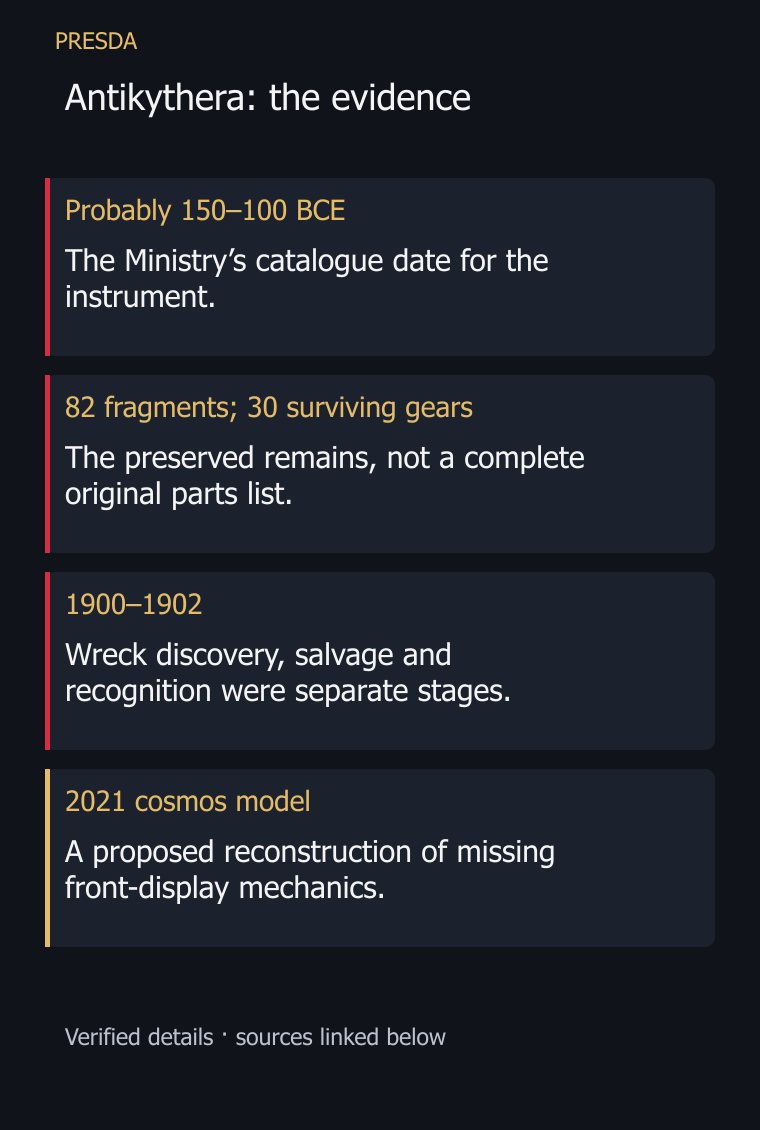
Antikythera: evidence and interpretation. Sources: Greek Ministry of Culture, research-project chronology and UCL. Approximate dating is not a known manufacturing year.
The Ministry’s catalogue gives a probable date of 150–100 BCE. Exact dating remains a scholarly question, and a date associated with a calculated astronomical cycle is not automatically the year when a craftsperson manufactured the object. The wreck and the instrument also need not have the same date of origin. Greek Ministry of Culture: mechanism catalogue
Researchers work with 82 catalogued fragments and 30 surviving bronze gears. Those figures describe the remains, not a complete inventory of every component originally installed. UCL’s account estimates that only about a third of the mechanism survives, making any reconstruction an exercise in fitting evidence to missing space as well as to metal that can still be examined. UCL: the 2021 cosmos reconstruction
An instruction manual written on metal
Greek inscriptions are part of the evidence. Some concern astronomical and calendar calculations; others explain the instrument’s use. They make the fragments more than an arrangement of anonymous cogs. Text can indicate a function that the surviving mechanical parts alone would not fully reveal. Greek Ministry of Culture: mechanism catalogue
The inscriptions also place the object in a human technical culture. Someone had to understand the relationships well enough to design the gearing, someone had to manufacture and assemble it, and a user had to read its displays. The mechanism is evidence for those connected skills, even when the names of the individuals are unknown.
Seeing through corrosion
Research in 2005 used three-dimensional X-ray imaging and surface imaging to obtain information that ordinary inspection could not provide. Hidden inscriptions and internal mechanical details helped researchers explain eclipse prediction and the Moon’s variable motion. Imaging made the object newly readable without requiring every corroded layer to be physically separated. UCL: the 2021 cosmos reconstruction
That is an important difference between observing a fragment and guessing a complete machine. An X-ray can constrain where a gear or inscription actually is. A model must then account for those constraints, rather than simply build an attractive device that produces the desired result by some unrelated method.
What the 2021 reconstruction contributed
In 2021, the UCL team published a proposed model for the front cosmos display in Scientific Reports. The work combined physical evidence and inscriptions with a reconstruction of how the Sun, Moon and planets could be displayed. The paper is a major attempt to solve the missing front gearing, not the discovery of an intact ancient instrument. Freeth and colleagues: A Model of the Cosmos, Scientific Reports
The team discussed long planetary cycles recorded in inscriptions, including 462 years for Venus and 442 for Saturn. These concern patterns in how planets appear from Earth, including apparent reversals against the stars. They should not be confused with a modern measurement of how long either planet takes to orbit the Sun. UCL: the 2021 cosmos reconstruction
A model is an argument that can be tested
UCL described manufacturing the proposed arrangement with ancient techniques as a further challenge. A successful theoretical layout and a demonstrated historical manufacturing process answer related but different questions. Researchers must consider the available space, materials, precision and assembly as well as the mathematics.
The result is not uncertainty about everything. The surviving evidence firmly establishes an elaborate astronomical machine. The caution concerns how all of its missing parts were arranged and made. Acknowledging that boundary is more informative than presenting every polished replica as a photograph of the original design.
Why its historical importance is so large
The mechanism brings together fields that are often taught separately: astronomy, mathematical modelling and the working of metal. It shows that ancient technical achievement could include the construction of an operating model, not only a written description or a diagram. Complexity here is something that had to fit, mesh and move.
PRESDA’s account of ancient Greek civilisation provides the wider historical setting. The mechanism also belongs to a longer history of mathematical knowledge crossing cultures, rather than a story in which one isolated inventor produced modern science from nothing. UCL notes the importance of earlier Babylonian astronomy in the intellectual background. UCL: the 2021 cosmos reconstruction
What “the first computer” should mean
No surviving label can prove that this was the first such machine ever constructed. The careful description is the oldest known surviving example of its extraordinary kind. Absence of another preserved mechanism does not establish that there were no predecessors, related instruments or workshops making similar devices.
For another route through the history of calculation, PRESDA’s feature on al-Khwarizmi and algebra follows mathematical ideas rather than bronze gearing. The Antikythera mechanism’s distinctive power is to let us see thought embodied in matter: a model of celestial time that could be set in motion by a human hand.
FAQ
Frequently Asked Questions
Was the mechanism really a computer?
It was an analog mechanical calculator. Gears represented astronomical relationships; it had no electronics or modern software.
Where is the original?
The surviving fragments are kept at the National Archaeological Museum in Athens.
Who built it?
The maker is not securely identified. Specific attributions should be presented as hypotheses, not established biography.
Is the whole mechanism reconstructed with certainty?
No. Functions are strongly supported, but missing components and the complete front gearing remain subjects of reconstruction and testing.
PRESDA Dispatch
Stay Informed. Stay Aware.
A sharp briefing across AI, gaming, sport, business, world affairs, paparazzi, and lifestyle.