Japan's Capsule Hotels: Sleeping in the Smallest Spaces
Explore Japan's capsule hotels, from Osaka's 1979 pioneer to Narita and Haneda. Published prices, privacy, accessibility and booking trade-offs explained.
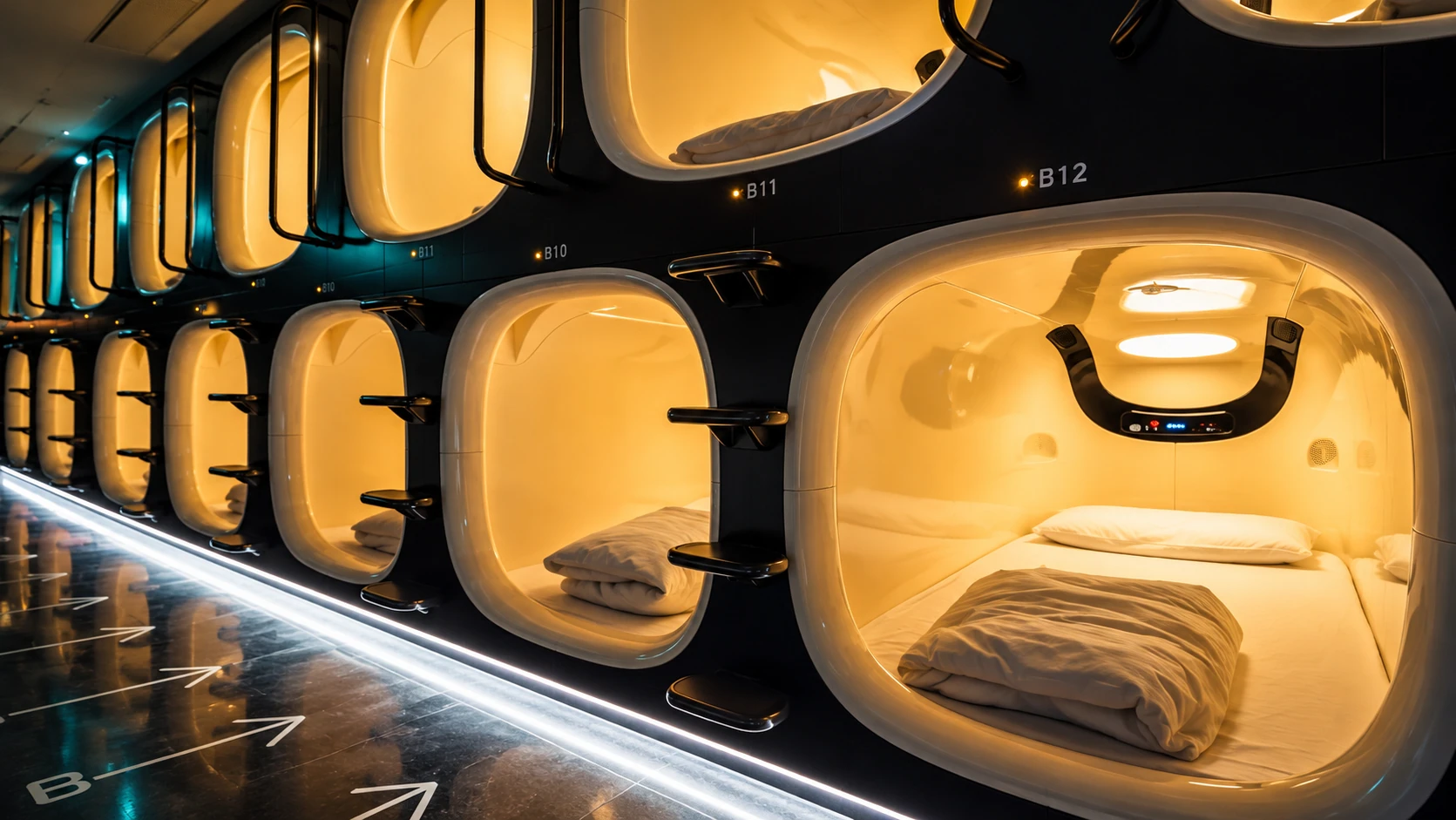
PRESDA AI-generated concept illustration. This imagined interior is not a photograph of Capsule Inn Osaka, Nine Hours, First Cabin or another identified property. Actual layouts and dimensions vary.
A capsule hotel sells a small place to sleep within a much larger shared environment. The bed is personal; the corridor, bathrooms and much of the daily routine are communal. That distinction explains both the appeal and the compromise. Japan's capsules can make an overnight stop practical and memorable, but the right choice depends less on how futuristic the photographs look than on noise, access, luggage and the rules of the particular property.
This guide uses official tourism, airport and operator information checked on October 25, 2026. The prices below are published examples, not a quotation for a selected travel date or a promise of availability. The supplied hero is an AI-generated concept illustration. It does not identify a bookable hotel, and its spacious-looking corridor should not be used to estimate the dimensions of a real sleeping compartment.
How did capsule hotels begin?
Japan's national tourism organization dates the first capsule hotel to 1979 in Osaka's Umeda district. It describes a practical early clientele: businesspeople who needed somewhere affordable after missing the last train. The idea was to separate the minimum private space needed for sleep from facilities that could be shared. It was an accommodation model shaped by urban travel patterns, not evidence that every Japanese traveler preferred tiny rooms. Japan National Tourism Organization's capsule guide
Capsule Inn Osaka's own facility guide credits architect Kisho Kurokawa with its 1979 sleeping capsule. Its standard model is listed as 190 centimetres deep, 95 centimetres wide and 75 centimetres high; the deluxe model is larger. Those measurements make the distinction concrete: a traditional capsule is somewhere to lie down, not a small room in which to stand and unpack. Architectural novelty should never replace checking whether the space fits your body. Capsule Inn Osaka's facility guide
The cultural interest lies in how the arrangement organizes shared life. Quiet becomes part of the product because a neighbor's telephone call can defeat the purpose of a good mattress. The format asks guests to coordinate sleeping, washing, dressing and storing possessions across several spaces. It can feel efficient and reassuring to one traveler and inconvenient to another. Neither reaction is a verdict on Japanese culture as a whole.
What is private, and what is shared?
Do not assume a capsule has the privacy of a hotel room. First Cabin's official FAQ says its ordinary cabins have curtain entrances that cannot be locked, shared washing and toilet facilities, and lockable valuables boxes. It identifies premium-class accommodation as an exception to the locking rule. Policies differ by room category, so a photograph of one category does not establish the facilities of another. First Cabin's guest FAQ
The practical consequence is that visual privacy and acoustic privacy are different purchases. A screen may block a view without blocking conversations or alarms. Before reserving, check the sleeping-area policy on calls, food and luggage, and whether there is a lounge where you can work or speak. Travelers who need a confidential video meeting, uninterrupted daytime sleep or a room shared with a partner should compare a conventional hotel on those terms.
Capsule Inn Osaka: history with measurable trade-offs
The original operator's current English site describes a men-only facility in central Osaka, five to ten minutes on foot from Osaka or Umeda stations. It also publishes restrictions on photography, outside food and drinks, and tattoos or body art. These are property rules, not a universal capsule-hotel code. Check them before paying, especially if a bathing restriction would make the stay unsuitable. Capsule Inn Osaka's official visitor information
Its published tariff lists a standard capsule from ¥4,400, a superior capsule from ¥4,600 and a deluxe capsule from ¥5,000. New deluxe and premium categories start at ¥6,000 and ¥6,500 respectively. The tariff gives check-in from 15:00 and check-out at 10:00, with an extension charge of ¥150 per 30 minutes up to noon. These are advertised starting prices checked on October 25, not a live reservation or a guarantee that every date offers the lowest category. Operator's room-rate sheet
This is a useful place to compare dimensions against price rather than treating every capsule as interchangeable. A taller compartment may matter more than a decorative finish; a lower berth may matter more than a television. Confirm the available category, whether a berth preference can be honored, the bathing arrangements and the complete payable amount. Historic significance is a reason to be interested, not a substitute for a suitable night's sleep.
Nine Hours Narita: a transit option with an important boundary
Narita Airport lists Nine Hours before security, on the basement level associated with Terminal 2. Its published rates are ¥1,500 for the first hour of day use and ¥500 for each additional hour. Shower-only access is ¥1,000 for up to one hour; overnight and day-use guests have showers included. These airport-listed charges include tax. Overnight prices are inquiry-based on the airport page, so they should not be inferred from the hourly tariff. Narita Airport's official capsule-hotel listing
The airport service operator explains that the hotel is landside: international connecting passengers must complete immigration and customs and enter Japan to use it. It also describes separate men's and women's entrances to locker and capsule areas, with towels, toothbrushes, slippers and indoor wear included for overnight guests. This is not an airside sleeping pod accessible to every passenger without entry formalities. Greenport Agency's Nine Hours information
For an early departure, work backward from your airline's check-in and security requirements. A bed near one terminal does not remove the time needed to reach another. Check the route, operating hours of any transfer and your ability to enter Japan before committing. The value of an airport capsule is the usable rest it creates between those obligations, not simply the distance shown on a map.
First Cabin Haneda: more cabin than sleeping tube
First Cabin Haneda Terminal 1 lists first-class and business-class cabins at the airport's first-floor arrivals level. The operator gives standard check-in and check-out as 14:00 and 10:00, while noting that plans may differ. Tokyo's official tourism guide describes the airline-cabin design and both short and longer stays. This is a real property, but the article does not quote a nightly rate without a dated booking result. First Cabin Haneda's property page and Tokyo's official guide
The example shows why the word capsule covers different products. A larger cabin can improve usable space without becoming a fully private conventional room. Read the specific category's floor plan and entrance arrangements, then confirm luggage storage, bathroom access and who can stay. An airport location also makes the correct terminal essential: Narita and Haneda are different airports, and First Cabin's Terminal 1 is not a generic location beside every international departure gate.
Technology should solve a problem you actually have
Capsule Inn Osaka's rate sheet lists lighting, power outlets, USB ports and Wi-Fi among its amenities. Those are useful details for a traveler arriving with a phone and an alarm to set. They do not establish that every capsule hotel has the same equipment. Ask about sockets, charging access, ventilation and controls in the exact category being booked, especially when older and newer compartments coexist in one building.
Treat more ambitious claims about sleep technology with the same care. If an operator offers monitoring or a sleep report, ask what it measures, whether participation is optional, how personal data are handled and whether the result has a medical purpose. A sensor score is not automatically a diagnosis. For most guests, a comfortable temperature, quiet surroundings and enough time in bed are more immediate booking considerations than a futuristic control panel.
Safety, accessibility and who the format suits
Assess access before the price. Can you climb into an upper berth, turn comfortably inside it and reach the toilets at night? Does the property have an accessible route and an accommodation category that meets your needs? Request specific answers rather than assuming that a lift to the floor makes the sleeping compartment accessible. A capsule can be a poor fit for someone who finds enclosed spaces distressing, even when the building itself is easy to enter.
On arrival, locate the exit route, keep it clear and identify how to contact staff. Use the designated lockable storage for valuables and check how oversized bags are handled. Confirm the property's age rules and gender arrangements before booking. A family, couple or transgender traveler may need more detailed information than a generic booking filter supplies. These are practical questions for the operator, not reasons to assume every capsule hotel follows identical policies.
What does a night actually involve?
A sensible routine is to finish noisy tasks before entering the sleeping area: organize tomorrow's clothing, charge devices and separate what you need from a large suitcase. Keep calls in permitted common spaces and minimize repeated alarms. Bring items that help you sleep, but confirm what the property already supplies before buying extras. This is planning advice based on the shared-space format, not a claim that PRESDA has personally tested the listed hotels.
For a first stay, one night can be a more useful experiment than committing an entire holiday. The attraction is not necessarily luxury or the lowest possible price. It may be a convenient pause between trains, a place to shower after a flight or an opportunity to experience a particular design. A favorable experience comes from matching the property to that purpose, rather than expecting a capsule to perform every function of a private room.
How to compare the total cost
Calculate the whole stop: the quoted accommodation, any local tax or optional service, transfers, luggage storage and the value of usable sleeping time. A low rate far from the next departure may be less useful than a higher rate nearby. Equally, two individually priced capsules may not offer the same value as one conventional twin room. Check cancellation conditions and late-arrival procedures as carefully as the headline rate.
Keep prices in yen until you compare them using an exchange rate appropriate to your payment date. Published minimums and booking-engine quotes answer different questions: the former show an advertised entry point, while the latter depend on a specific date and category. This guide establishes real locations and documented examples; it does not claim rooms are available for an unspecified trip. Make the final comparison on the operator's current booking page.
Small spaces, deliberate choices
Japan's capsule hotels are most interesting when understood as a design decision about what to share and what to keep personal. The format can make limited urban space useful, but comfort still depends on people, rules and the specific bed. For a very different example of accommodation built around a distinctive sleeping environment, see our guide to real underwater hotels and ocean suites. In both cases, the practical details matter more than the fantasy image.
FAQ
Frequently Asked Questions
What is this PRESDA article about?
Explore Japan's capsule hotels, from Osaka's 1979 pioneer to Narita and Haneda. Published prices, privacy, accessibility and booking trade-offs explained.
Which category does this story belong to?
This story is part of PRESDA's Travel coverage.
Who published this article?
Japan's Capsule Hotels: Sleeping in the Smallest Spaces was published by PRESDA Editorial on PRESDA.
PRESDA Dispatch
Stay Informed. Stay Aware.
A sharp briefing across AI, gaming, sport, business, world affairs, paparazzi, and lifestyle.