LALIBELA: ETHIOPIA'S CHURCHES CARVED FROM SOLID ROCK
Explore Lalibela’s eleven UNESCO-listed churches, the cross-shaped Biete Ghiorgis, the archaeology of the carving and the site’s living pilgrimage.
Editorial illustration supplied for PRESDA.
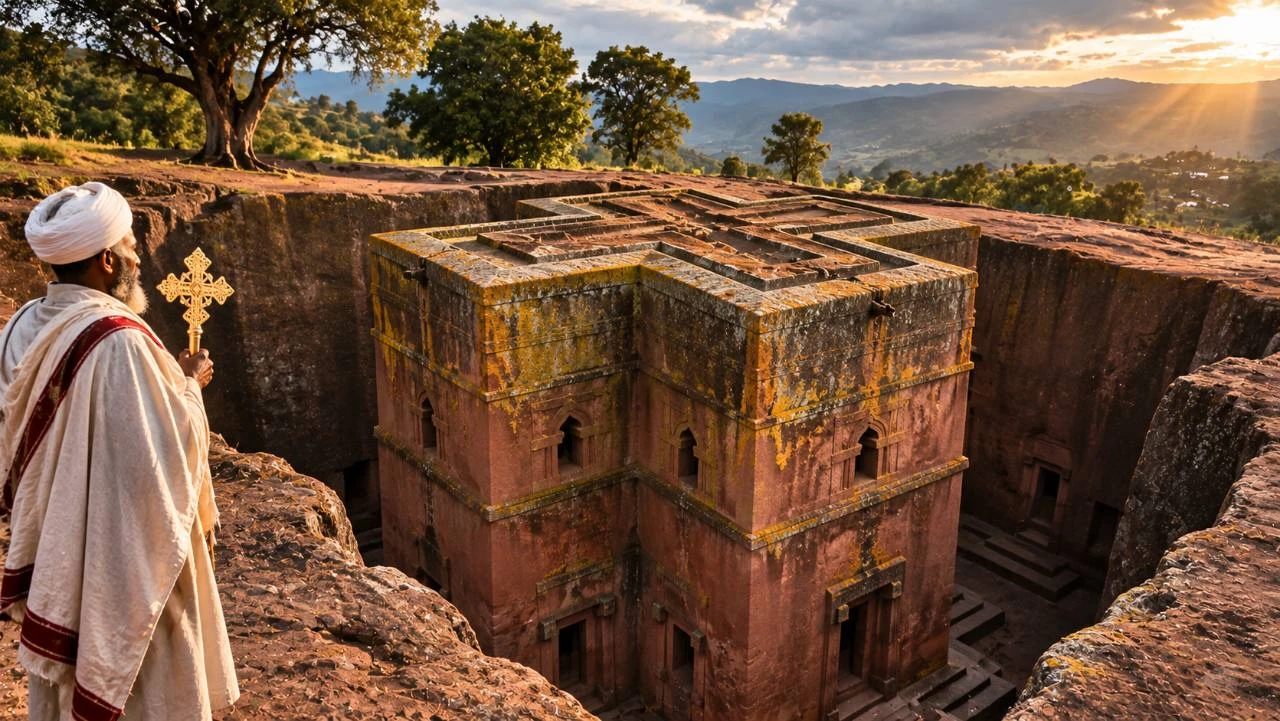
At Biete Ghiorgis in Lalibela, the cross on the roof is visible before the building’s walls. The church stands in a deep cut below the surrounding ground. Instead of assembling its main structure from blocks, the makers removed rock to leave a building in place. Its silhouette makes the idea easy to grasp. It is one of eleven medieval churches in the UNESCO World Heritage property, however, and the complex includes spaces that relate to the bedrock in different ways. Lalibela is also a centre of worship and pilgrimage. Architecture and religious life meet in the same places. UNESCO World Heritage listing UNESCO advisory mission on Lalibela Metropolitan Museum of Art essay
Where Lalibela is and why it is called a New Jerusalem
| Feature | What it tells us |
|---|---|
| Eleven listed churches | The scope of the UNESCO property |
| Biete Ghiorgis | A cross-shaped church standing in an excavated enclosure |
| Rock cuts and crossings | Clues to the sequence of construction and change |
| Drainage and worship | The site remains both a conservation project and a sacred place |
Lalibela is in the Ethiopian highlands. UNESCO describes a medieval complex associated with King Lalibela and the idea of a New Jerusalem. The name expresses a religious geography. It does not mean the churches are replicas of eleven buildings in Jerusalem. Paths, groups of churches and names create relationships between places within the site. The town’s earlier name, Roha, appears in the advisory mission’s historical account. Both names are useful for finding references to different periods. UNESCO World Heritage listing UNESCO advisory mission on Lalibela Metropolitan Museum of Art essay
Why there are eleven churches in the World Heritage listing
The eleven figure refers to the churches in the UNESCO property. The listing describes two main groups and the separate Biete Ghiorgis. The advisory mission notes that the original nomination focused on particular precincts amid other sacred spaces carved in the surrounding rock. That helps explain why a visitor encounters more than a list of eleven isolated objects. The surrounding routes and smaller sacred areas form part of the experience and are treated in heritage documentation. UNESCO World Heritage listing UNESCO advisory mission on Lalibela
How do you make a building by removing rock?
At a monolithic church, a trench can define an exterior and leave the intended mass in place. People then carve and hollow parts of the remaining block. Openings, pillars and interior spaces have to be planned in relation to what can remain structurally sound. A rock-cut building is shaped by subtraction. That affects the sequence because the removal of material changes how later work can proceed, and the workers cannot assume they can put original rock back. UNESCO describes features such as trenches, tunnels and drainage that developed as part of this landscape. UNESCO World Heritage listing Metropolitan Museum of Art essay Antiquity research on Lalibela’s rock-cut stratigraphy
Not every church has the same relationship to the rock
A freestanding monolithic form appears detached from the surrounding rock on its sides, while other spaces remain partly engaged with the mass around them. From one photograph, it is easy to mistake the best-known shape for a model followed everywhere. As a visitor moves between sites, it becomes possible to compare excavated spaces with details that evoke built architecture, such as doors, windows and carved columns. A historian can ask which parts of the design were made to imitate a form and which respond to practical constraints of the stone. UNESCO World Heritage listing Metropolitan Museum of Art essay Antiquity research on Lalibela’s rock-cut stratigraphy
What Biete Ghiorgis shows especially clearly
Biete Ghiorgis, the House of Saint George, stands apart from the principal clusters. Its cross-shaped plan is especially legible from above. The depth of the cut is part of that effect. A photograph from the rim gives a clear view of the roof, while movement through access routes reveals how the church is reached. A photograph can identify the plan and the rock around it without revealing the whole approach or the importance of the interior to worshippers. The church is a useful introduction to the site precisely because it leads to those other questions. UNESCO World Heritage listing UNESCO advisory mission on Lalibela Metropolitan Museum of Art essay
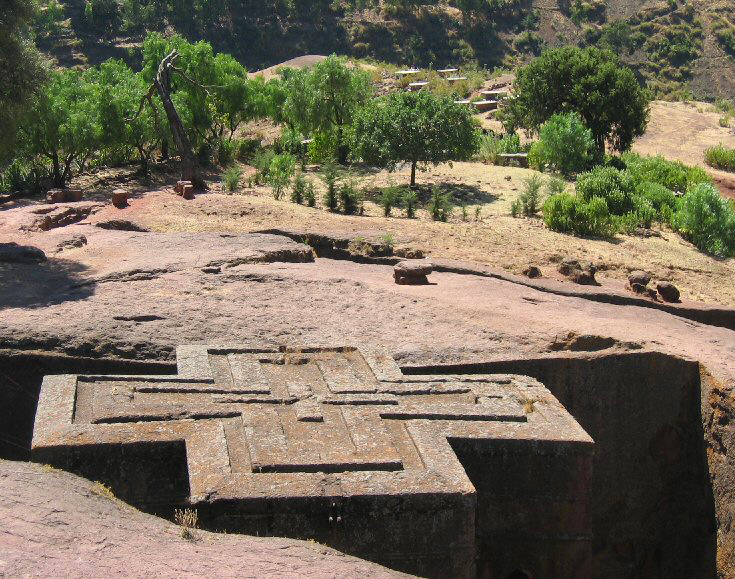
The cross-shaped roof of Biete Ghiorgis viewed from above its excavated enclosure in Lalibela.
How archaeologists establish a sequence
The site is traditionally associated with King Lalibela, who ruled around the turn of the thirteenth century. Research published in Antiquity uses relationships between rock cuts to examine the sequence of changes. If one cut interrupts another, the relationship can establish relative order. It may not provide the precise year in which either was made. Later work can remove clues to an earlier use. The Metropolitan Museum’s discussion notes changes of use and later phases. The traditional attribution, the order of particular cuts and a date for a particular building are related claims that need different evidence. UNESCO advisory mission on Lalibela Metropolitan Museum of Art essay Antiquity research on Lalibela’s rock-cut stratigraphy
Why Lalibela remains a living place
UNESCO records a resident religious community and pilgrimage for major feasts of the Ethiopian Christian calendar. The churches are sacred spaces in Ethiopian Orthodox Tewahedo practice. Their use continues to shape how visitors encounter them. The meaning of the passages or an interior can be different for someone attending worship than for someone studying masonry. A photograph preserves the view that the camera saw. The people using the place preserve relationships, knowledge and practices that the photograph cannot capture alone. For an explanation of how feast dates are read in a different calendar, see PRESDA’s guide to Ethiopia’s thirteen months. UNESCO World Heritage listing UNESCO advisory mission on Lalibela
What conservation has to preserve
Treating the buildings as part of an excavated landscape changes what needs attention. Drainage is important because water runs through and around the cuts. UNESCO documents that some drains accumulated material and that seismic activity has disrupted parts of the system. A repair also has to account for the water that may reach a neighbouring space. The choices cannot be assessed purely by how much of a church is visible in a photograph. Protection has to address the rock, the setting and continued use by people who worship there. UNESCO World Heritage listing UNESCO advisory mission on Lalibela
What a good description of the churches can establish
The count of eleven is the count in the listing. The association with King Lalibela tells us about the site’s history and tradition, and relationships between cuts can help establish phases. The roof of Biete Ghiorgis lets even a distant viewer recognise a design, while the larger record puts it within a community and an evolving site. The more precise the claim, the more important it is to describe which place, which source and which period supports it. Those details preserve the complexity of Lalibela without making the visitor wait to understand what makes the churches extraordinary. UNESCO World Heritage listing UNESCO advisory mission on Lalibela Metropolitan Museum of Art essay Antiquity research on Lalibela’s rock-cut stratigraphy
Reading the site from above and below
The cross of Biete Ghiorgis is most legible from ground level above its trench. A person approaching the doorway sees the walls and the passage before seeing the outline of the roof. The two vantage points convey different facts about the same building. They also explain why site conservation has to consider the rock around each church. Water flowing down a slope can collect in the spaces cut around a structure, and repairs that change drainage or circulation can affect other parts of the complex. UNESCO World Heritage listing UNESCO advisory mission on Lalibela
Archaeological recording adds a third viewpoint. At an intersection, a later cut may remove part of an earlier surface. Such evidence can establish an order of work even without giving either phase a calendar date. A sequence inferred this way can coexist with a religious account about the significance of the church. Metropolitan Museum of Art essay Antiquity research on Lalibela’s rock-cut stratigraphy
FAQ
Frequently Asked Questions
How many churches are included at Lalibela?
Eleven medieval rock-hewn churches are described in the UNESCO property.
Which church has a cross-shaped roof?
Biete Ghiorgis, the House of Saint George.
Are the churches still used?
Yes. Lalibela remains a place of Ethiopian Orthodox Tewahedo worship and pilgrimage.
PRESDA Dispatch
Stay Informed. Stay Aware.
A sharp briefing across AI, gaming, sport, business, world affairs, paparazzi, and lifestyle.