A NEW WILD CAT SPECIES DISCOVERED AFTER MORE THAN A CENTURY
Genomes reveal Leopardus tilcayo in Bolivia’s Yungas forests. Learn what makes it a new species and why “first in a century” needs careful explanation.
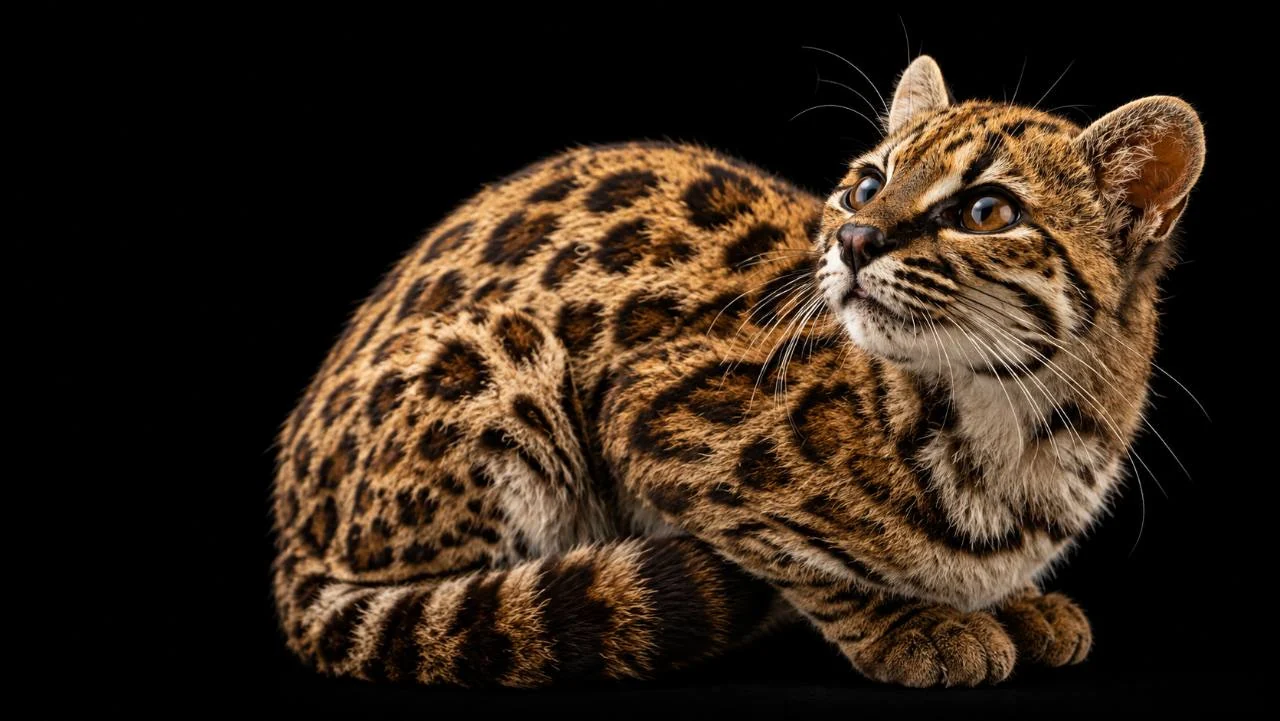
Editorial depiction of a spotted wild cat, not an authenticated photograph or diagnostic identification of Leopardus tilcayo. Editorial image supplied for PRESDA. Original creator and reuse licence not provided.
A small spotted cat can be easy to overlook in a family famous for lions and tigers. In Bolivia, the overlooked animal helped expose a gap in the scientific map of South American cats. Researchers have described Leopardus tilcayo, a distinct lineage from the Yungas forests. The discovery is a recognition of an existing wild animal, not the sudden appearance of a new one.
How DNA revealed the tilcayo
The Current Biology study compared whole genomes from 38 cats, including eight museum specimens. It resolved five species within the tiger-cat complex and described L. tilcayo from Bolivia. Museum DNA was especially useful for checking historical identities, making the research a combination of present-day sampling and a fresh reading of old collections. Lescroart et al., Current Biology (2026)
That approach matters because similar coats can conceal different evolutionary histories. A photograph may suggest that a cat deserves closer study, but it cannot by itself establish a species. Genome-wide comparisons test whether the proposed animal belongs to an independently evolving lineage, rather than relying on one striking marking or an unusually small individual.
A discovery that also recognises local knowledge
The National Geographic Society, which supported participating explorer Paola Nogales-Ascarrunz, identifies the cat with Bolivia’s Yungas cloud forest and documents the sanctuary animal that helped draw scientific attention. Its scientific name retains “tilcayo”, a locally used name. Being new to formal taxonomy does not mean being unknown to the people who share an animal’s habitat. National Geographic Society, discovery account (September 2026)
The discovery team’s university describes the finding as the first formal description of a newly named living cat species in more than a century. The qualification matters. Scientists have revised other cat classifications during that period, including restoring older names or separating previously grouped populations. The century claim should not be read as a century without any changes to cat taxonomy. PUCRS, research team announcement (18 September 2026)
Five lineages do not mean five brand-new discoveries
The study supports four previously proposed species alongside the newly described tilcayo, and also recognises a Peruvian subspecies of L. tigrinus. Those are different taxonomic outcomes. Counting every supported lineage as a newly discovered species would exaggerate the result. The achievement is a clearer family tree and a distinct name for an animal that did not fit it.
Why a name matters for conservation
Recognising a species changes the unit that conservation must assess. A population once treated as part of a widespread cat may need its own survey of distribution, habitat and threats. Genomes alone do not supply a current population count. The next questions concern where tilcayos live, how connected those populations are and which pressures they face.
The supplied hero is an editorial depiction of a spotted wild cat, not an authenticated photograph of the study animal or a diagnostic identification guide. Appearance alone was precisely the problem the research had to overcome. For a different feline story, explore cats and human history, which concerns domestication rather than the naming of a wild species.
Related reading: How cats and humans began their shared history.
FAQ
Frequently Asked Questions
What is the new wild cat called?
Leopardus tilcayo, a newly described tiger-cat species from Bolivia’s Yungas forests.
Does “new species” mean it evolved in 2026?
No. The animal already existed. The 2026 research formally distinguished and named its evolutionary lineage.
Were five completely new cat species discovered?
No. The study supports five tiger-cat species in total, including four previously proposed species and the newly described tilcayo.
PRESDA Dispatch
Stay Informed. Stay Aware.
A sharp briefing across AI, gaming, sport, business, world affairs, paparazzi, and lifestyle.