MIKHAIL TAL: THE MAGICIAN OF RIGA WHO CHANGED CHESS
On Mikhail Tal’s 90th birth anniversary, explore his Riga roots, 1960 world title, daring sacrifices and enduring influence on chess.
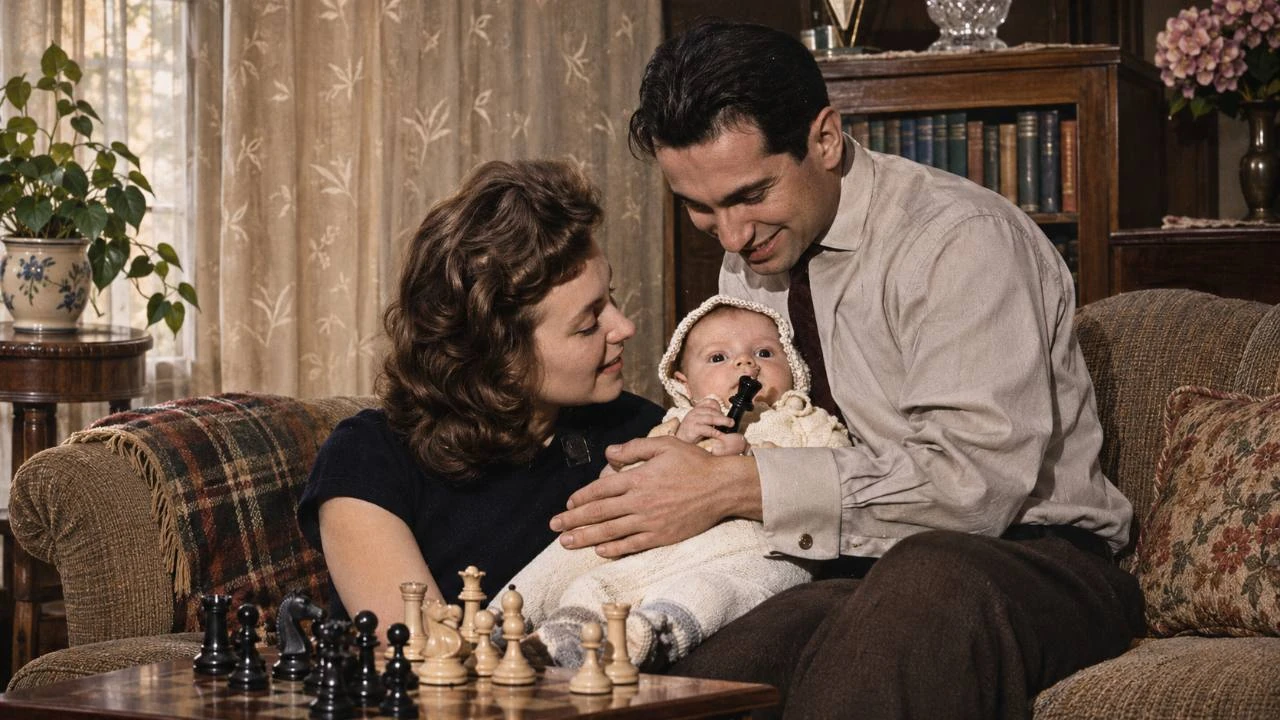
Approved editorial image supplied for PRESDA, used illustratively to evoke a family scene associated with Mikhail Tal. The photographer, date and identities of the other people have not been independently authenticated. It is not presented as documentary evidence of a particular family occasion.
On November 9, 2026, Mikhail Tal’s birth lies exactly 90 years in the past. His games still feel startlingly alive. Born in Riga on November 9, 1936, the future eighth world chess champion became famous for positions in which a material advantage offered little comfort. He made opponents defend against possibilities they could not easily calculate. The nickname Magician of Riga describes that experience, not a supernatural explanation for his results. European Chess Union: Mikhail Tal biography, March 2025 magazine, page 25
From Riga’s chess rooms to the Soviet elite
Tal’s development was not simply the sudden arrival of an inexplicable genius. Training mattered. Grandmaster Julio Becerra’s biographical account identifies Alexander Koblents as his tutor from 1949 and traces the young player’s progress through Latvian and Soviet competition. Tal won the Latvian championship in 1953 and the Soviet championship in 1957, then won the Soviet title again in 1958. His creativity grew within demanding competitive structures, not outside them. GM Julio Becerra: Tal’s early career
1960: the challenger who unsettled Botvinnik
Victory in the 1959 Candidates tournament in Yugoslavia earned Tal a match against Mikhail Botvinnik. In Moscow in 1960, he won 12½–8½ and became world champion at 23. He was the youngest holder of the title at that time, not the youngest for all subsequent history. The result matters as much as the spectacle: Tal’s imaginative approach survived the examination of a championship match against an exceptionally accomplished opponent. FIDE Open Chess Museum: Mikhail Tal
What a Tal sacrifice actually offers
A sacrifice gives up material for something else: time, open lines, exposed kings, dangerous pawns or an initiative that prevents the opponent from settling. A forcing combination may lead to a result that can be calculated. A speculative sacrifice can instead offer lasting compensation whose value is harder to prove. Tal was celebrated for navigating that uncertainty. Counting pieces was never enough to explain the position, but calculation and judgement remained essential.
Game six, Moscow 1960: the knight on f4
The signature example came in game six of the Botvinnik match. With Black, Tal played 21...Nf4, offering a knight and inviting complications rather than immediate material recovery. Botvinnik accepted, and Tal eventually won. The enduring interest lies in the defensive problems created after the offer. It is more revealing to ask what the defender had to find than to call the move inexplicable magic or an automatic forced win. Sam Copeland: Botvinnik–Tal, game six, 1960
Modern analysis can uncover defensive resources that were extraordinarily difficult to locate over the board. Matthew Sadler and Steve Giddins revisit this classic with computer assistance, illustrating why an engine’s evaluation and a human player’s practical task are different questions. A later discovery does not erase the historical result. Equally, winning does not prove every move was objectively best. Tal’s artistry becomes more interesting when those distinctions are preserved. Matthew Sadler and Steve Giddins: Re-Engineering the Chess Classics, publisher excerpt
Bled 1965: another knight, another decisive test
Five years later, Tal and Bent Larsen reached the tenth game of their Candidates semifinal level on points. Tal, playing White, offered another knight on move sixteen with Nd5. He won the deciding game and advanced. The two famous sacrifices should not be reduced to one identical trick: the position, opponent and competitive circumstances differed. What connects them is Tal’s willingness to make the struggle concrete and uncomfortable when the stakes were highest. Chess.com: Tal–Larsen, the deciding Candidates game of 1965
A short reign did not mean a short career
Botvinnik regained the classical title in their 1961 rematch. Tal never recaptured that crown, but his competitive importance continued for decades. FIDE’s museum records six Soviet championship titles and victory at the official World Blitz Championship in Saint John in 1988, at 51. The contrast is useful: his world-title reign lasted about a year, while his ability to compete at a formidable level outlasted the youthful image most often attached to him. FIDE Open Chess Museum: Mikhail Tal
Remembering a person, not only a highlight reel
Tal died on June 28, 1992, aged 55. His life belonged to Riga’s culture and the Soviet chess world, as well as to the universal language of recorded games. Remembering him only through spectacular diagrams flattens that history. So does turning every anecdote into an authenticated quotation. An anniversary offers a better opportunity: return to the games, distinguish recollection from documentation and recognise the work behind the apparent improvisation. European Chess Union: Mikhail Tal biography, March 2025 magazine, page 25
Why the Magician of Riga still matters
Tal did not invent attacking chess or abolish its rules. His influence lies in how vividly he demonstrated the value of initiative and the difficulty of making decisions under pressure. For a learner, the lesson is not to sacrifice without thinking. It is to examine activity alongside material, consider the defender’s choices and calculate before trusting a beautiful idea. Ninety years after his birth, that combination of curiosity and discipline remains a powerful invitation to play.
Related reading: Bobby Fischer and another extraordinary chess life.
Related reading: The history of chess, from courts to a global game.
FAQ
Frequently Asked Questions
Why is November 9, 2026 significant for Mikhail Tal?
Tal was born in Riga on November 9, 1936, so November 9, 2026 marks the 90th anniversary of his birth.
When did Tal become world chess champion?
He defeated Mikhail Botvinnik 12½–8½ in Moscow in 1960, becoming the eighth world champion at 23. Botvinnik regained the title in 1961.
Were all of Tal’s sacrifices objectively winning?
No. Some were speculative and created difficult practical problems. A game’s result does not establish that every move was objectively best.
Did Tal win another world title later in life?
He won the official World Blitz Championship in Saint John in 1988, aged 51. That was a different title from the classical crown he held in 1960–61.
PRESDA Dispatch
Stay Informed. Stay Aware.
A sharp briefing across AI, gaming, sport, business, world affairs, paparazzi, and lifestyle.