Nasser Al-Khelaifi: The €70 Million Deal That Changed PSG Forever
How QSI transformed PSG from its 2011 takeover to two European titles: Al-Khelaifi, superstar spending, financial growth and Luis Enrique’s revolution.
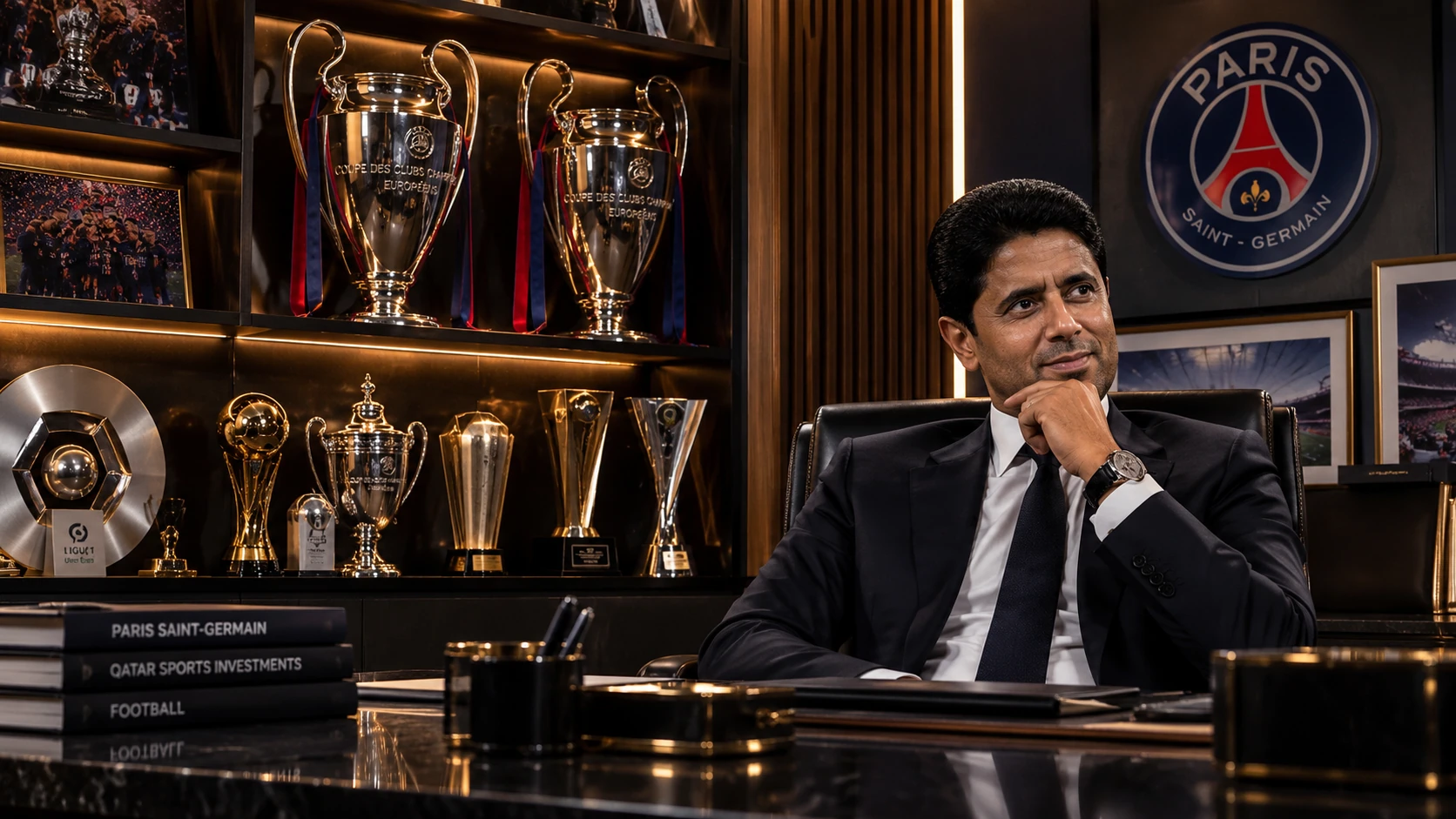
PRESDA AI-generated editorial illustration of Nasser Al-Khelaifi in an imagined PSG office. The trophies and setting are illustrative, not a documentary photograph or verified trophy-room inventory.
Paris Saint-Germain’s transformation is often compressed into a seductive equation: buy a football club for €70 million, fill it with superstars, then watch it become a European giant. The real story is more demanding. It involves an acquisition in stages, years of additional investment, costly disappointments and a gradual change in what the team expected from its most talented players.
By October 2026, PSG had won consecutive Champions League titles. Nasser Al-Khelaifi had become the public face of that transformation, but the ownership distinction matters: Qatar Sports Investments, or QSI, acquired PSG. Al-Khelaifi led the project as chairman and club president; he did not personally purchase the club. The reported €70 million is an entry figure, not the total cost of building modern PSG.
What did the €70 million actually buy?
QSI took a 70% controlling stake in 2011. In March 2012, Reuters reported the purchase of the remaining 30%. These were separate steps toward full ownership, not a single personal transaction by the president. Contemporary reporting establishes the sequence more securely than the familiar headline price establishes a complete acquisition accounting. Reuters: the remaining stake
The €70 million figure has a clear public source: in November 2022, Al-Khelaifi himself cited it when discussing PSG’s appreciation in value, according to AFP. It should therefore be identified as a reported acquisition figure. It excludes subsequent player recruitment, salaries, infrastructure and financing. Treating it as the entire investment would turn a striking opening chapter into a misleading balance sheet. AFP: Al-Khelaifi’s valuation remarks
Paris was an opportunity, not a blank page
PSG already had a history worth defending. Before QSI, the men’s team had won the French championship twice, in 1986 and 1994, eight French Cups and the 1996 European Cup Winners’ Cup. The takeover did not create its supporters, its identity or its connection with Paris. It changed the financial scale on which the institution could compete. PSG: official honours
The commercial opportunity was unusually powerful: a famous capital, a recognisable name and a club capable of representing the city internationally. Yet supporters are not simply customers acquired with an asset. New audiences, higher expectations and global marketing can strengthen a club while creating friction over who its identity serves. That tension runs through the wider psychology of football fandom.
Al-Khelaifi’s leadership and the ownership question
Al-Khelaifi has chaired QSI and presided over PSG since 2011. His responsibilities connect the owner’s long-term ambitions with the daily pressure of elite football. His public prominence makes it easy to conflate chairman, shareholder and club. They are distinct: QSI supplies ownership and strategic backing, while coaches, sporting executives, players and staff turn decisions into sporting performance. QSI: leadership biography
The strongest case for his leadership is continuity of ambition through failure. The strongest criticism is that continuity at the top did not always produce a coherent football structure underneath. These are assessments, not accounting facts. An owner can provide exceptional resources and still make expensive recruitment mistakes; a president can oversee success without being the sole author of a tactical breakthrough. PSG’s story is an institutional achievement with an unusually visible leader.
Neymar, Mbappé and Messi: the superstar experiment
Neymar’s 2017 move from Barcelona, through his €222 million release clause, changed the scale of the transfer market. Mbappé arrived from Monaco that summer on an initial loan with a subsequent permanent transfer reported at €180 million. These headline amounts describe transfer arrangements, not the players’ complete employment costs. Salaries, bonuses, commissions and accounting treatment are separate matters. Reuters: Neymar’s record move Reuters: Mbappé and PSG’s spending
Messi’s arrival in 2021 added another extraordinary name. PSG officially announced a two-year contract with an option for a further year. The attraction was sporting and commercial: exceptional players could win matches while carrying the club into conversations far beyond France. But celebrity is not a defensive system. Assembling spectacular individuals does not automatically solve pressing, balance, injury disruption or the distribution of responsibility. PSG: Messi’s contract announcement
The defeats that money could not prevent
The most brutal illustration came in March 2017. PSG took a 4–0 first-leg lead to Barcelona and lost the return 6–1, going out 6–5 on aggregate. A position of apparent control became one of the competition’s defining collapses. Luis Enrique, later entrusted with PSG’s transformation, was then coaching Barcelona. UEFA: the 2017 reversal
In 2020, Paris reached the final but lost 1–0 to Bayern Munich. That run showed that the project could reach the last match without guaranteeing it could win it. European knockout football exposes weaknesses quickly, while injuries and individual moments can decide close contests. PSG’s disappointments were not evidence that investment was irrelevant. They showed why investment alone cannot explain the outcome. UEFA: Paris and Bayern’s final history
Luis Enrique’s revolution: talent working together
PSG appointed Luis Enrique in July 2023. The later transformation was not simply a rejection of expensive players. It was a reordering of priorities: mobility, collective pressure and the willingness to work within a shared structure. UEFA’s technical analysis of the 2025 final emphasised the movement and positional versatility that unsettled Inter. PSG: appointment UEFA: Paris’s movement
The practical difference is visible when possession changes hands. Pressing works when distances and reactions are coordinated, not when one forward chases alone. Rotating positions can create passing options while asking opponents to make difficult marking decisions. Players still need exceptional technique, but their abilities become mutually reinforcing. PSG’s evolution offers a more persuasive explanation than the claim that individual greatness had somehow stopped mattering. UEFA: pressing and performance
Two European crowns, two different tests
On 31 May 2025 in Munich, PSG beat Inter 5–0 to claim their first Champions League title. Désiré Doué scored twice. It was the largest winning margin in a European Cup or Champions League final. The result provided the breakthrough that domestic success and global visibility had never quite supplied. UEFA: 2025 final
The second title required a different kind of performance. On 30 May 2026 in Budapest, PSG drew 1–1 with Arsenal after extra time and won the shoot-out 4–3. Retaining the trophy demonstrated resilience as well as attacking quality. It supports the description of PSG as Europe’s leading team across those two seasons, not a prediction of permanent supremacy. UEFA: 2026 final
From local club revenue to a global business
PSG reported €837 million in revenue for 2024/25, including €367 million commercial revenue and €175 million matchday revenue. Its release used €99 million as the 2011 baseline. That means turnover grew to more than eight times the earlier figure. These are season-specific financial numbers, not 2026 forecasts or profit. PSG: 2024/25 financial release
Commercial growth reflects the ability to sell partnerships, merchandise and experiences around an internationally recognised team. It also creates dependencies: sponsors value visibility, supporters have finite spending power and a disappointing season can alter the sales narrative. The economics resemble the wider commercial ecosystem around major football events, but a club must sustain relationships throughout the year rather than around one tournament.
What is PSG worth, and is it profitable?
Arctos acquired a minority stake in December 2023. Reuters reported a valuation of about €4 billion, citing the Financial Times; the financial terms were not officially disclosed. QSI retained control. That is a dated transaction valuation, not a verified market price for October 2026, and it is not the same thing as annual revenue. Reuters: Arctos investment
Nor does a high valuation establish profitability. Football Benchmark’s European Champions Report 2026 recorded a €40 million net loss for PSG in 2024/25. Revenue growth and continued losses can coexist. A meaningful investment-return calculation would require the full history of capital contributions, debt, distributions and ownership changes. Dividing a multibillion-euro valuation by €70 million does not provide that answer. Football Benchmark: financial comparison
Financial rules, disputes and the limits of the model
UEFA’s 2022 financial settlement set PSG’s total financial contribution at €65 million, of which €10 million was unconditional and the rest conditional. Calling that an immediately paid €65 million fine would be inaccurate. The historical settlement illustrates the constraints around spending; it does not by itself establish a current breach. UEFA: 2022 settlement
The dispute with Mbappé exposed another cost of the superstar era. Reuters reported a December 2025 labour-court order for roughly €60 million in unpaid salary and bonuses. In February 2026, PSG said it would not appeal the judgment. This was an employment-pay dispute, not a criminal conviction. Beyond individual cases, debate continues over state-backed capital, competitive balance and football’s use as international influence. Sporting success does not make those governance questions disappear. Reuters: court ruling L’Équipe/AFP: no appeal
Developing players rather than only buying them
Academy development gives PSG another way to connect identity with performance. Senny Mayulu progressed into the first team and scored in the 2025 Champions League final. Such pathways matter because the academy can supply players who understand the institution before becoming global names. They also require opportunity: a training system is judged partly by whether its graduates actually play. PSG: Senny Mayulu
Youth recruitment and academy development should not be confused. Buying talented young professionals is different from developing a player through the club’s own youth teams. A sustainable strategy can use both. PSG’s Poissy campus, prepared for the 2023/24 season, represents investment beyond transfer headlines. Facilities cannot guarantee success, but they support the everyday work from which fitness, technique and cohesion emerge. PSG: the campus project
2011 and 2026: what the comparison really shows
Before the takeover, PSG had two French league titles and no Champions League title. By the end of 2025/26, the totals were fourteen and two respectively. The financial comparison uses a different endpoint: the club’s €99 million baseline for 2011 versus €837 million for 2024/25. The ownership sequence also changed, from QSI’s initial controlling stake to full ownership and later a minority partner. Keeping those dates separate prevents an impressive story from becoming an inaccurate one. PSG: the fourteenth league title
The next test is durability. Paris must renew its squad, control costs, create space for young players and sustain revenue within the constraints of its stadium and domestic market. The €70 million headline captures the scale of the opportunity QSI recognised. The years that followed explain the achievement: substantial resources, mistakes, persistence and eventually a team whose collective organisation matched its ambition. Al-Khelaifi’s legacy rests on that complicated transformation, not on the fiction of one man buying success with one cheque.
FAQ
Frequently Asked Questions
What is this PRESDA article about?
How QSI transformed PSG from its 2011 takeover to two European titles: Al-Khelaifi, superstar spending, financial growth and Luis Enrique’s revolution.
Which category does this story belong to?
This story is part of PRESDA's Sport coverage.
Who published this article?
Nasser Al-Khelaifi: The €70 Million Deal That Changed PSG Forever was published by PRESDA Editorial on PRESDA.
PRESDA Dispatch
Stay Informed. Stay Aware.
A sharp briefing across AI, gaming, sport, business, world affairs, paparazzi, and lifestyle.