ORCA FOSSILS PUSH LARGE-PREY HUNTING BACK MORE THAN TWO MILLION YEARS
North Sea fossils dated to 2.6–2.1 million years ago suggest large-prey hunting evolved early in Orcinus. Explore the evidence and its limits.
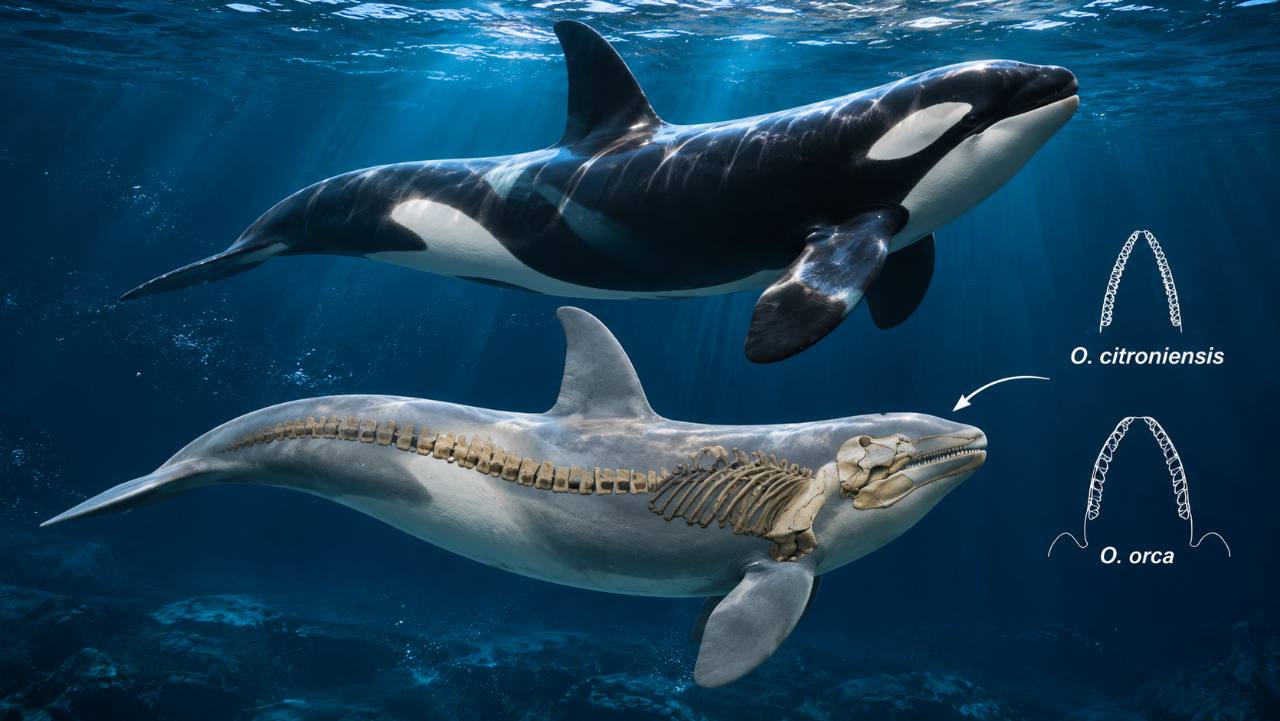
Supplied comparative editorial illustration, preserved unchanged. The correct fossil species name is Orcinus citoniensis; the embedded label contains a spelling error. The North Sea remains in the study are identified as Orcinus sp.
A handful of bones recovered from the southern North Sea has pushed a familiar predator’s history much deeper into the past. A study published in PeerJ on November 10, 2026, describes large ancient members of the orca genus with anatomy suited to tackling substantial prey. Sediment attached to one skull fragment dates that specimen to approximately 2.6–2.1 million years ago. Bakker and colleagues: PeerJ paper, November 10, 2026PubMed: publication record and abstract, DOI 10.7717/peerj.21890
The finding supports a more precise headline than “orcas became super-predators two million years ago.” It provides early evidence of large-prey hunting within the lineage. It does not identify the exact moment the behavior originated, prove that every ancient orca hunted the same animals, or establish that the fragmentary fossils belong to the living species Orcinus orca. Bakker and colleagues: PeerJ paper, November 10, 2026
| Question | Published finding |
|---|---|
| Publication | PeerJ, November 10, 2026; DOI 10.7717/peerj.21890 |
| Material | Five remains: two crania, one mandible fragment and two atlas–axis complexes |
| Dated evidence | One cranial specimen supported as approximately 2.6–2.1 million years old |
| Identification | Orcinus sp.; species unresolved, with large individuals estimated at 7.2–7.7 meters |
What the researchers found
Hidde Bakker and colleagues studied five fossil remains: two incomplete crania, part of a lower jaw and two fused atlas–axis neck complexes. The material was recovered by fishing vessels and is held at the Natural History Museum Rotterdam. Comparisons with living orcas produced estimated lengths of roughly 7.2–7.7 meters for the larger individuals, within the range of very large modern males. Bakker and colleagues: PeerJ paper, November 10, 2026
The specimens are identified as Orcinus sp. The abbreviation means that the genus is assigned but the species remains unresolved. That small qualification carries a large scientific meaning: a fossil can reveal important information about the history of a lineage even when it does not preserve enough anatomy to receive a confident species identification. Bakker and colleagues: PeerJ paper, November 10, 2026
Why the incomplete material still matters
A skull fragment can preserve the shape of a joint, the size of a tooth socket or the proportions of part of the braincase. Those features may be compared with more complete animals. An incomplete fossil is therefore not simply a broken version of an ideal museum skeleton. It can retain a particular piece of evidence that survives careful comparison and measurement.
The strength of the argument depends on which features are present and which conclusions they support. Body length is estimated from relationships among measurements in living animals and from comparisons with three-dimensional models. The estimate is an inference, not a direct measurement of a complete ancient animal from snout to tail.
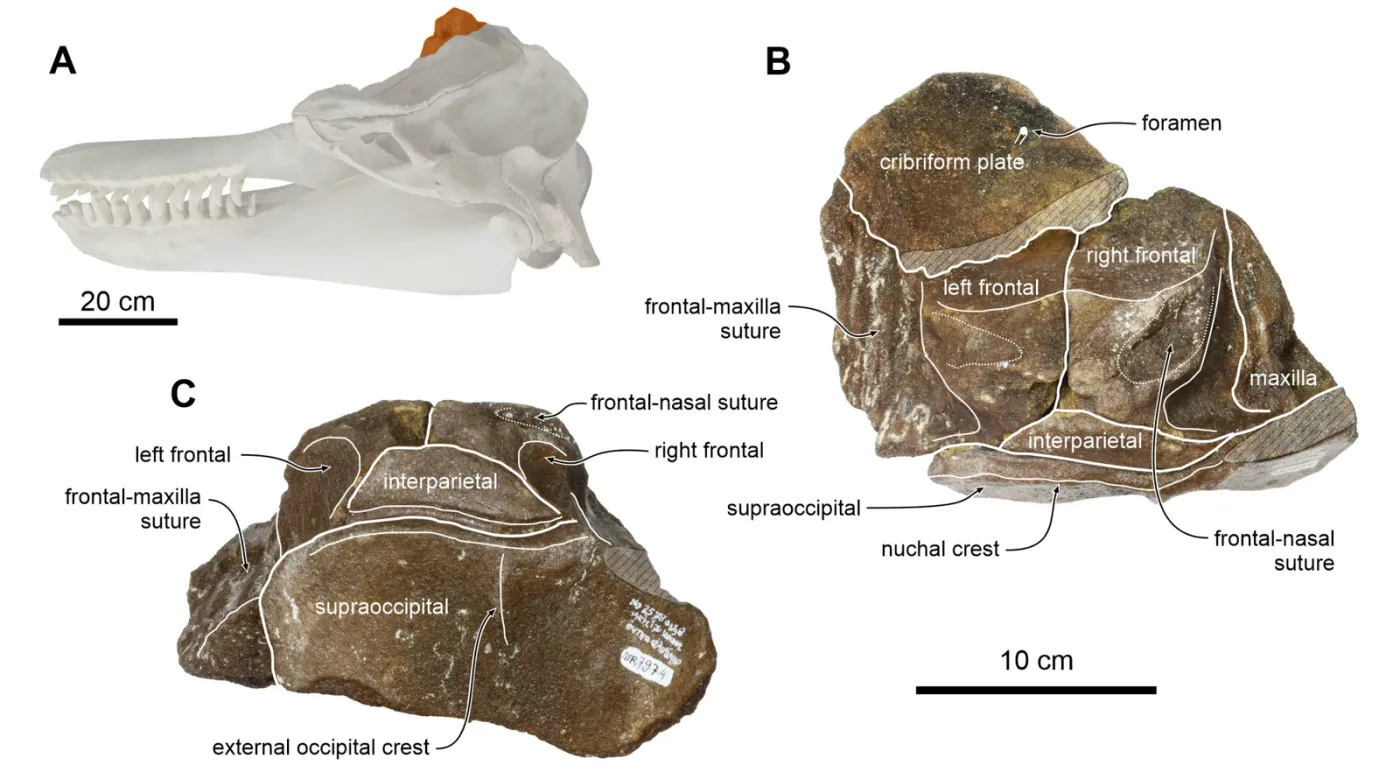
Figure 2 from the study published November 10, 2026: fossil cranial material NMR 07974 and its position relative to a modern skull reference. Orange areas identify the preserved region; this is scientific documentation, not a complete fossil skull.
Bakker et al. (2026), A large orca from the Lower Pleistocene of the Southern North Sea Basin pushes back the origin of macropredatory behavior in the oceanic dolphins (Odontoceti, Delphinidae), PeerJ 14:e21890, DOI: 10.7717/peerj.21890, Figure 2 · CC BY 4.0
How do bones reveal a feeding strategy?
The study describes robust anatomy, including large, deep and separated tooth sockets, alongside features of the skull and neck associated with handling large prey. Together with the size estimates, those characteristics support macroraptorial feeding: seizing and processing relatively large animals. The term describes a functional capability, rather than a fossilized menu documenting every meal. Bakker and colleagues: PeerJ paper, November 10, 2026
A useful analogy is the difference between a tool’s design and a record of its use. Strong jaws and large teeth can make a particular feeding strategy plausible, but reconstructing ecology requires the evidence to be considered together. Researchers ask whether several anatomical features point toward the same interpretation, rather than treating one impressive bone as a complete behavioral biography.
The fossil record is a record of surviving evidence
The oldest known example of a feature sets a minimum age for its existence in the available record. It does not usually mark the precise day, generation or population in which the feature first appeared. Older material may never have fossilized, may have been destroyed or may remain undiscovered. That is why the new date pushes the evidence back without fixing a single evolutionary starting point.
The North Sea material also illustrates a common complication: bones recovered from the seabed do not always come from a neatly excavated rock layer. Their geological setting has to be reconstructed from the information that remains. In this study, microscopic organisms in attached sediment help date one cranial specimen, connecting its anatomy to a period of geological time. Bakker and colleagues: PeerJ paper, November 10, 2026
What the 2.6–2.1 million-year range means
The dated material is assigned to the Gelasian, near the beginning of the Pleistocene. The range is not a claim that the bone’s age is known to the nearest year. It is a geological estimate supported by the sediment’s microscopic fossil content. Preserving that range is more informative than replacing it with an artificially exact “two million years.” PubMed: publication record and abstract, DOI 10.7717/peerj.21890
Different kinds of evidence also answer different evolutionary questions. Fossils can establish the presence of a large-bodied form and particular anatomical adaptations. Genetic studies of living populations can investigate relationships among surviving groups. A comparatively recent split among modern ecotypes does not rule out a much older history for a broad feeding capability in their wider lineage. Bakker and colleagues: PeerJ paper, November 10, 2026
This is the central value of the new work. It brings physical anatomy into a story that can otherwise be dominated by the histories of populations alive today. The two records can be compared without assuming that a date inferred for a modern population is automatically the first appearance of every trait that population possesses.
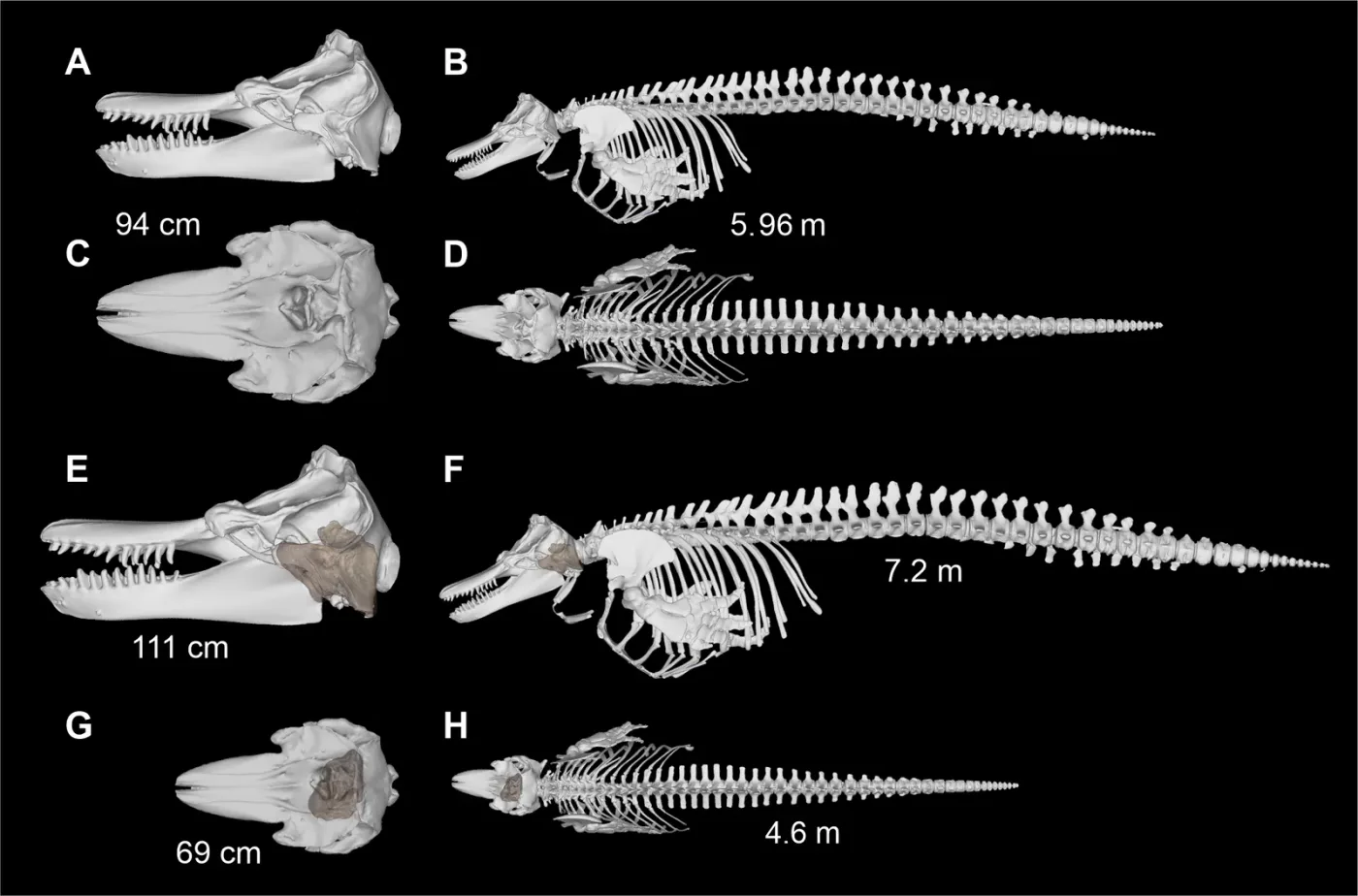
Figure 9 from the November 10, 2026 study compares a 5.96-meter modern reference with fossil-based size reconstructions, including 7.2- and 4.6-meter estimates. The digital models are not complete ancient skeletons recovered together.
Bakker et al. (2026), A large orca from the Lower Pleistocene of the Southern North Sea Basin pushes back the origin of macropredatory behavior in the oceanic dolphins (Odontoceti, Delphinidae), PeerJ 14:e21890, DOI: 10.7717/peerj.21890, Figure 9 · CC BY 4.0
Modern orcas are not one uniform feeding population
NOAA Fisheries describes killer whales as the largest members of the dolphin family and notes substantial differences among populations in diet, behavior and social organization. Some groups specialize in fish; others take marine mammals. Local knowledge and group behavior matter alongside the physical equipment of a large predator. A single species name does not imply an identical way of life everywhere. NOAA Fisheries: killer whale biology and population differences
That diversity helps explain why the fossil result should be framed as evidence of capability and ecological role. An ancient animal with anatomy suited to large prey need not have possessed every hunting tradition observed in a living population. A modern orca’s behavior is shaped by both its body and the social environment in which it learns to use it.
The small extinct relative in the comparison
The study discusses Orcinus citoniensis, a smaller extinct species from Italy’s Pliocene record, estimated at about 3.5 meters and generally interpreted as fish-eating. The new large North Sea material expands the range of forms known within the genus. It does not demonstrate a simple parent-to-descendant sequence between those particular specimens. Bakker and colleagues: PeerJ paper, November 10, 2026
The spelling matters here. The supplied hero contains a different spelling in one of its labels; the name used in the scientific paper is Orcinus citoniensis. The image remains unchanged as supplied and is treated as an editorial illustration. Its reconstruction and jaw diagrams are not substitutes for the specimens and published measurements discussed in the research.
Reading the scientific figures
The first supporting figure shows an actual cranial specimen alongside a modern skull reference, with preserved areas indicated. The second compares fossil fragments with three-dimensional skull and skeleton models. Both are figures from the open-access paper and retain their scientific context and attribution. A colored reference region identifies what is preserved; it does not mean the entire ancient skeleton was recovered. Bakker and colleagues: PeerJ paper, November 10, 2026
These visuals make a useful distinction visible: the fossil material is observed, while the full-body size is reconstructed through comparison. A reader can therefore evaluate why the authors estimate a large animal without mistaking a complete modern reference skeleton for a complete ancient find. The differences between evidence and reconstruction are part of the explanation, not an obstacle to it.
PRESDA’s account of Darwin’s theory of evolution supplies a broader framework for understanding change across generations. This study works at a more specific scale: it asks when a set of anatomical adaptations can first be demonstrated in one marine lineage, using a small but informative fossil sample.
What the discovery changes
The strongest conclusion is that large-bodied, large-prey predation in Orcinus has a substantially deeper fossil history than a recent reading of modern population differences might suggest. The unresolved species identity and limited material remain important. A more complete skull, associated skeleton or better geological context could sharpen the picture or reveal a distinct ancient species. Bakker and colleagues: PeerJ paper, November 10, 2026
The finding is compelling because it gives an ocean predator a more tangible deep past. It replaces an easy evolutionary slogan with bones, comparisons and a dated geological clue. The North Sea fossils do not show every step by which orcas became formidable hunters. They demonstrate that an important part of that history was already established more than two million years ago.
FAQ
Frequently Asked Questions
Did orcas become apex predators exactly two million years ago?
The study provides evidence for large-prey hunting adaptations more than two million years ago. It does not pinpoint the behavior’s exact origin.
Where were the fossils found?
They were recovered from the seabed of the southern North Sea and are held at the Natural History Museum Rotterdam.
Were these animals definitely modern killer whales?
The authors identify them as Orcinus sp. The fragmentary material does not establish whether they were Orcinus orca or a distinct ancient species.
Are the supplied hero and full skeletons actual fossil photographs?
The hero is an editorial illustration. The paper’s supporting figures distinguish preserved fossil fragments from modern reference skulls and skeletons used in reconstruction.
PRESDA Dispatch
Stay Informed. Stay Aware.
A sharp briefing across AI, gaming, sport, business, world affairs, paparazzi, and lifestyle.