WEBB HELPS RECONSTRUCT A GIANT STAR’S MERGER WITH ITS COMPANION
Webb observations helped reconstruct AT 2025abao, a giant star’s merger with a smaller companion. The evidence, dates and scientific limits explained.
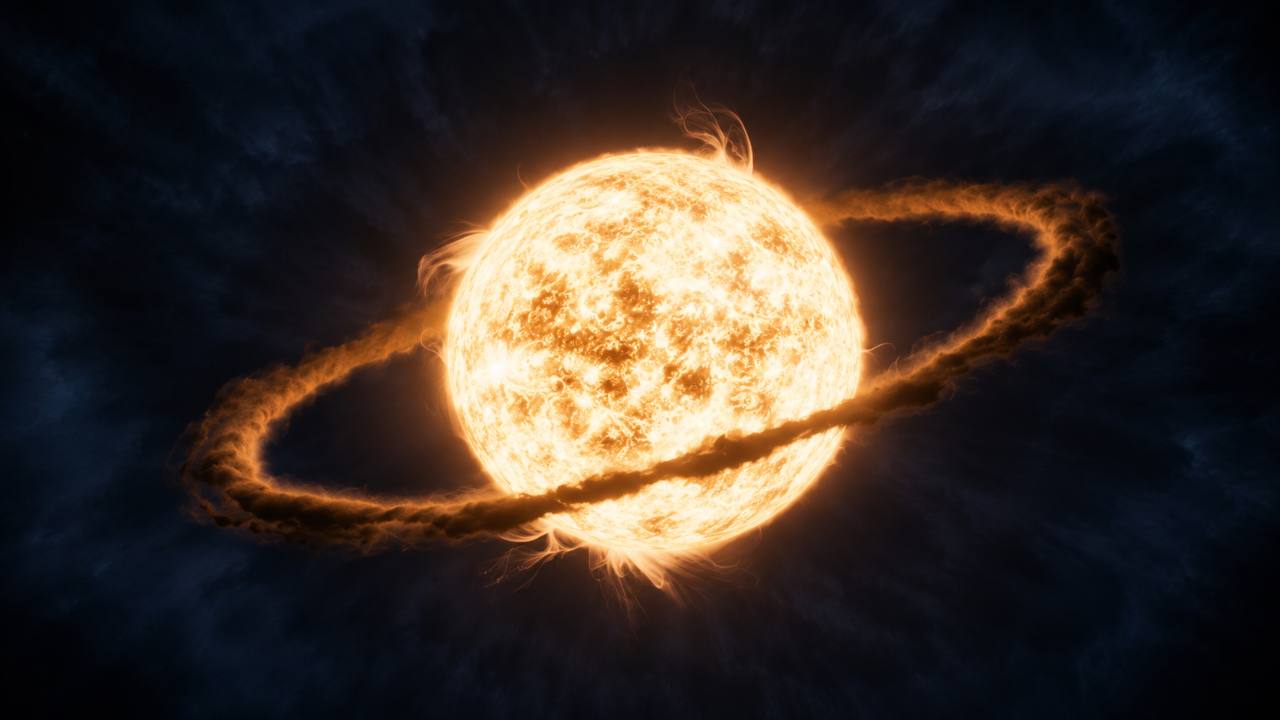
Supplied editorial illustration, preserved unchanged. It is not a Webb observation or a photograph of Bao.
A distant point of light became a rare opportunity to follow a stellar transformation. Astronomers studying AT 2025abao, nicknamed Bao, reconstructed how a giant star engulfed a smaller companion in the Andromeda galaxy. Observations from the James Webb Space Telescope helped connect the dusty aftermath to years of earlier changes recorded by other observatories. NASA announced the research on November 18, 2026. NASA: November 18, 2026 Bao release and image credits
The strongest version of the headline is also the most careful: Webb helped reconstruct a merger. It did not return a close-up photograph of one star swallowing another. The research combines unresolved light, spectra and physical modeling. The study, published in Nature on November 18, interprets those measurements as a companion spiraling through the giant’s envelope and ultimately merging with its core. Karambelkar and colleagues: Nature research paper, November 18, 2026
| Question | Verified answer |
|---|---|
| Object | AT 2025abao, nicknamed Bao, in Andromeda |
| Modeled masses | Approximately 7 and 0.7 solar masses |
| Webb observation | December 24, 2025 |
| Research publication | November 18, 2026, in Nature |
What happened to the two stars?
The Nature team modeled a primary star of approximately seven solar masses and a companion of about 0.7 solar masses. The paper identifies the larger object as an asymptotic giant branch star. NASA’s public explanation describes a puffed-up supergiant. Both descriptions refer here to an evolved, extended star, rather than to a black hole consuming a passing object. NASA: November 18, 2026 Bao release and image creditsKarambelkar and colleagues: Nature research paper, November 18, 2026
According to the reconstruction, the smaller star entered the larger star’s outer layers around 2018. Over roughly seven years, drag progressively reduced its orbit. An eruption late in 2025 marked the dramatic culmination of that interaction. Nature Portfolio’s research summary reports an estimated 0.1–0.2 solar masses of expelled material, while emphasizing the need for further observations to confirm the final merger conclusively. Nature Portfolio: observations and remaining uncertainty
A shared envelope, not an empty orbit
A star is not a solid ball with a hard surface. Its visible boundary is a region from which light escapes, and an evolved giant can have an enormous, relatively diffuse outer envelope. A companion moving through that gas encounters resistance. As its orbit shrinks, orbital energy can be transferred to the surrounding material, changing both the system’s brightness and the movement of its gas.
This process is called common-envelope evolution because the two stellar components can orbit within a shared gaseous envelope. It is central to understanding how a wide binary may become a much closer system. The outcome is not predetermined: some binaries can eject surrounding material and survive as two stars, while others merge. Bao provides evidence for the latter route in this particular case. Karambelkar and colleagues: Nature research paper, November 18, 2026
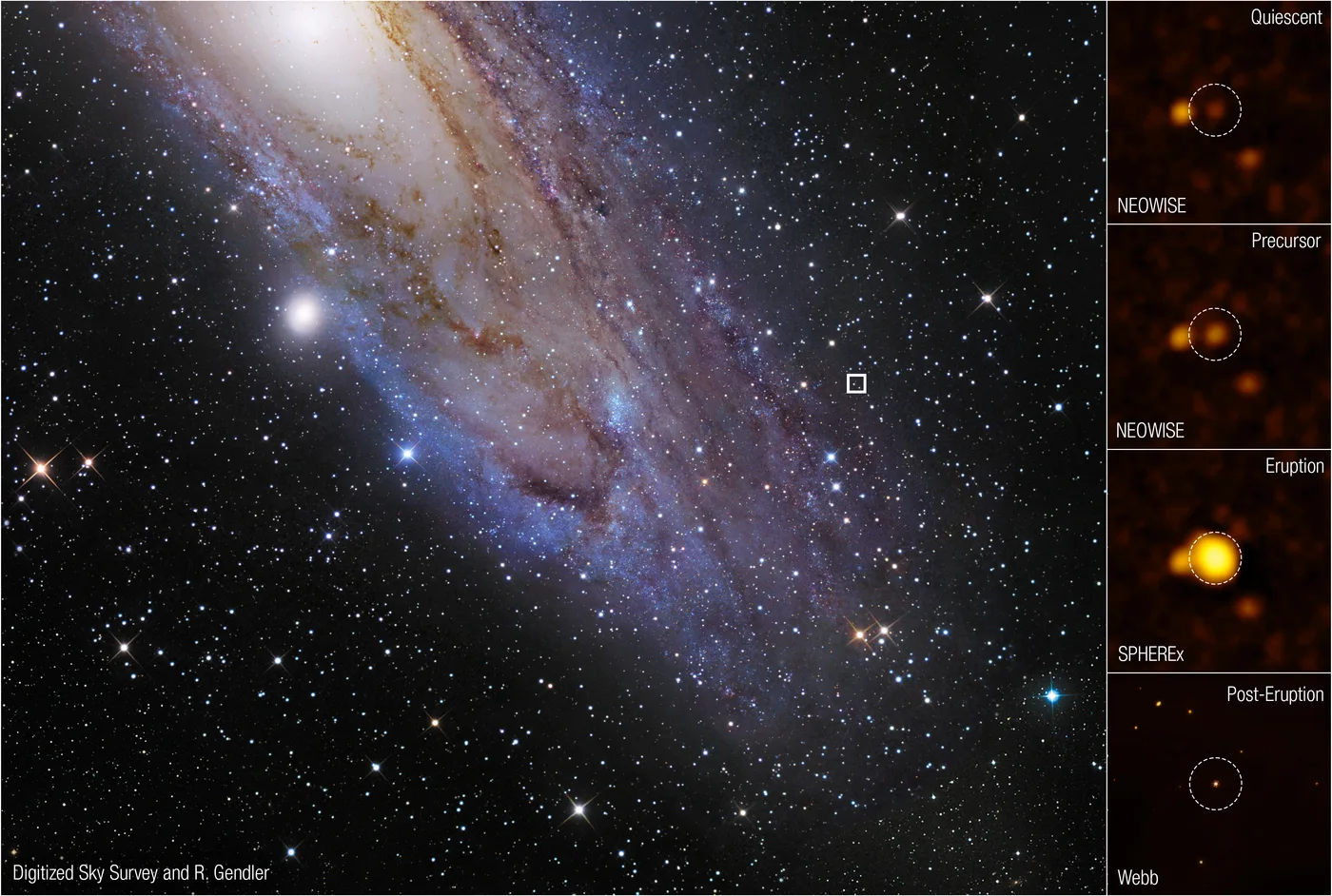
Official observation composite released November 18, 2026: Bao’s position in Andromeda, with NEOWISE, SPHEREx and Webb views of different phases. These are processed observations, not resolved views of two stellar surfaces.
NASA, ESA, CSA, STScI, Viraj Karambelkar (Columbia), Kishalay De (Columbia); processing: Alyssa Pagan (STScI); acknowledgment: DSS, Robert Gendler · NASA media usage guidelines
Why infrared observations mattered
An eruption is only one part of the evidence. Dust around a changing star can hide visible light while radiating in the infrared. Observing several wavelengths lets astronomers ask whether a source has genuinely faded, cooled, become obscured, or redistributed its energy into a different part of the spectrum. A photograph in one band cannot settle all those possibilities.
Webb’s Mid-Infrared Instrument, or MIRI, is designed to study light beyond the wavelengths visible to human eyes. Its imaging and spectroscopy capabilities let researchers examine cooler material and the spectral signatures carried by infrared radiation. Spectroscopy separates light by wavelength, providing more information than a single brightness measurement. That is why instrument choice matters as much as the dramatic appearance of a published image. NASA: how Webb’s Mid-Infrared Instrument works
In Bao’s case, the infrared evidence constrained the dust surrounding the system and helped test the proposed history. A successful model must account for multiple observations together, rather than merely produce a convincing illustration. The dust is not decorative background; it preserves information about material that left the stars and about how energy traveled through their surroundings. Karambelkar and colleagues: Nature research paper, November 18, 2026
A network of telescopes, rather than a solitary discovery
NASA’s release describes evidence from NEOWISE, WINTER, SPHEREx, the Zwicky Transient Facility, Swift and Gemini North alongside Webb. The eruption was detected in October 2025, while Webb observed on December 24, 2025. The observations and the November 2026 publication therefore belong to different stages of the same investigation, not to a newly photographed explosion on the day the news appeared. NASA: November 18, 2026 Bao release and image credits
That distinction is especially useful in astronomy. A discovery date, the date light was recorded and the date a paper was published may all differ. At extragalactic distances, the physical event also predates the light’s arrival at Earth. A responsible account keeps those clocks separate instead of turning the publication date into the moment the stars actually collided.
What the images can and cannot show
The official observation composite places Bao in Andromeda and compares views from different instruments and phases. Its small panels show changes in a distant source, not the resolved outlines of two stars. The colors and processing make scientific information accessible, but they do not transform the object into a nearby scene that a human observer could watch unaided. NASA: November 18, 2026 Bao release and image credits
The accompanying NASA, ESA, CSA and STScI artist’s concept serves a different purpose. It translates the proposed sequence into a spatial picture, showing the shared environment and eruption. Its labels identify it as an illustration. Both visuals are useful when read correctly: one displays measurements in context; the other explains the physical interpretation of those measurements. STScI: the Bao discovery announcement
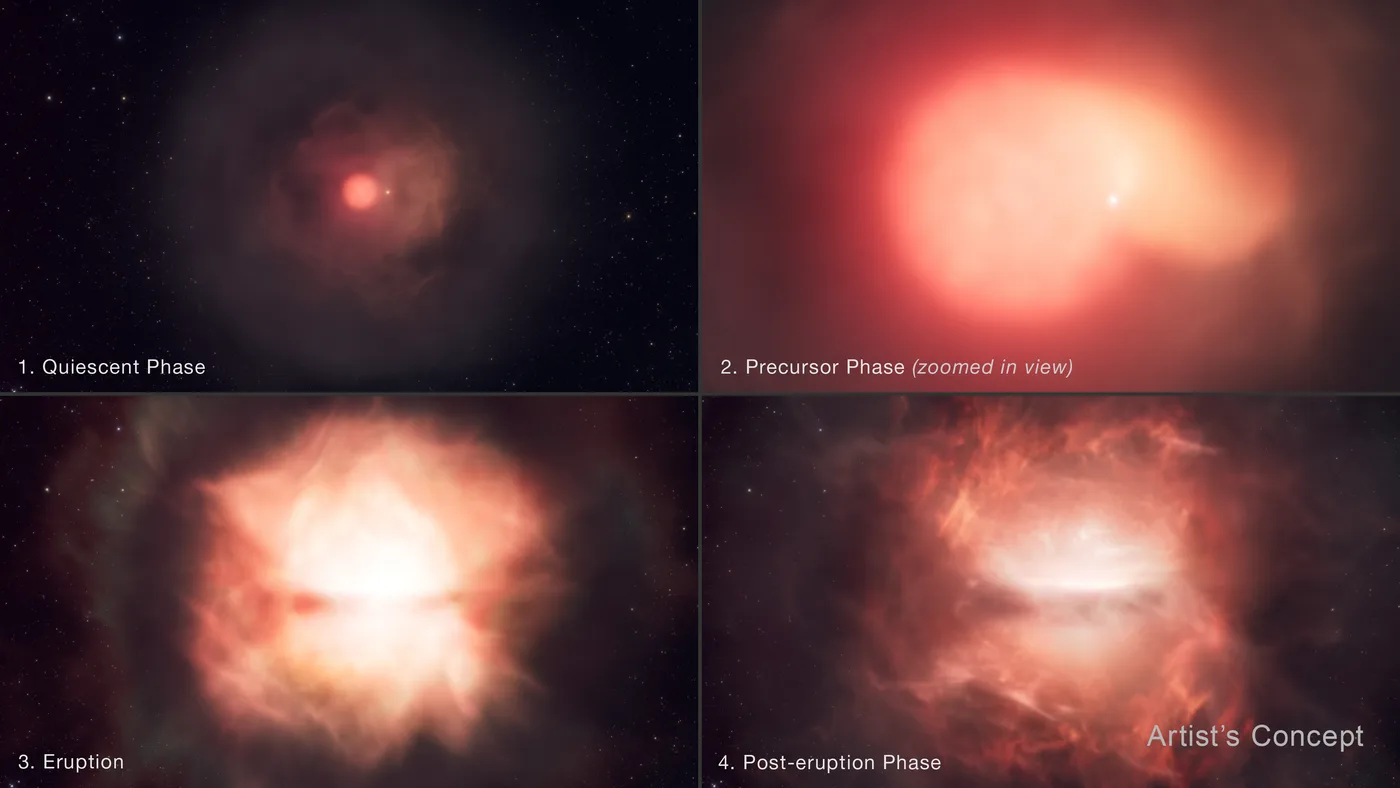
Artist’s concept released November 18, 2026, showing the quiescent system, inspiral, eruption and aftermath. This is a scientific illustration, not telescope photography.
Illustration: NASA, ESA, CSA, STScI, Leah Hustak (STScI); Science: Viraj Karambelkar (Columbia) · NASA media usage guidelines
This article’s supplied hero is likewise an editorial illustration, preserved unchanged. It is not a Webb observation or a literal image of Bao’s stellar surface. Keeping those distinctions visible allows visual storytelling to add understanding without becoming counterfeit evidence. Official image credits and the applicable NASA media guidelines accompany the supporting material. NASA: images and media usage guidelines
Why the result matters beyond one unusual star
Common-envelope evolution is difficult to observe from beginning to end. A short-lived event may be noticed only after its most revealing stage has passed, and older systems often require scientists to infer their past from present-day remnants. Bao’s value lies in connecting an evolving source to an expanding observational record rather than relying solely on a retrospective reconstruction. Karambelkar and colleagues: Nature research paper, November 18, 2026
The paper uses that record to constrain how efficiently orbital energy helps remove a giant’s envelope. This is more than a question of how impressive an eruption looks. If models put too much or too little energy into ejecting gas, they can predict a different outcome for the binary. An observed case helps test those assumptions, even though one system cannot represent the entire population of interacting stars. Karambelkar and colleagues: Nature research paper, November 18, 2026
The broader story of astronomy is often about extracting meaning from limited signals. PRESDA’s exploration of Voyager’s Golden Record examines the reverse challenge: deliberately encoding a message for an unknown observer. Bao illustrates how researchers assemble a physical explanation from light whose source cannot be visited or manipulated.
What remains uncertain
NASA’s announcement presents the merger interpretation confidently; Nature Portfolio explicitly notes that continued observations are needed to confirm its final outcome conclusively. Those statements should be read together. The data strongly support an inspiral and a merger model, while the remnant’s later behavior and the model’s longer-term predictions remain subjects for further investigation. Nature Portfolio: observations and remaining uncertaintySTScI: the Bao discovery announcement
Future monitoring can test whether the surviving source settles as expected, how its surrounding material evolves and whether alternative explanations remain viable. The next observation will not merely add another attractive picture. It can change the constraints on the system’s mass, temperature and energy budget, which are the quantities that make the interpretation scientifically useful.
Bao is therefore a powerful example of evidence accumulating across time, instruments and methods. The discovery is compelling precisely because the story does not stop at a giant star’s apparent appetite. It reaches into the difficult physics of how stars exchange matter, surrender orbital energy and sometimes become one.
FAQ
Frequently Asked Questions
Did Webb photograph a star swallowing another star?
No close-up view resolved the two stars. Webb’s infrared data helped researchers reconstruct the event alongside other observations and modeling.
What is Bao?
Bao is the nickname of AT 2025abao, a transient event in the Andromeda galaxy interpreted as a giant star’s merger with a smaller companion.
When did Webb observe the aftermath?
NASA dates Webb’s observations to December 24, 2025. The study and NASA announcement were published on November 18, 2026.
Is the merger fully settled science?
The observations strongly support the published merger interpretation. Nature Portfolio says further monitoring is needed to confirm the final outcome conclusively and study the remnant.
PRESDA Dispatch
Stay Informed. Stay Aware.
A sharp briefing across AI, gaming, sport, business, world affairs, paparazzi, and lifestyle.