PABLO ESCOBAR: HOW A DRUG EMPIRE MADE ONE MAN RICH ENOUGH TO CHALLENGE A STATE
Cocaine made Pablo Escobar a billionaire. Corruption and terror helped him challenge Colombia’s institutions. Behind the mansions and myths lies a history of political violence, civilian loss and consequences that outlived him.
Pablo Escobar’s story ended on a rooftop in Medellín on December 2, 1993. The man whose money had purchased estates, political access and private armies was dead at 44. For the people who had spent years living through assassinations and explosions, however, there was no equally precise moment when the consequences ended.
His life is often told through its most spectacular objects: the cash, the aircraft, the private zoo, the prison he helped design. Those objects matter because they show what the cocaine economy made possible. But they can also obscure the central question. How did a criminal organization acquire enough power to intimidate public institutions, and what did ordinary Colombians lose while it did so?
The answer involves American demand, Colombian inequality, political corruption, international prohibition and choices made by men who used violence to defend their wealth. Escobar did not invent those conditions. He exploited them, amplified them and eventually became trapped by the war he helped create.
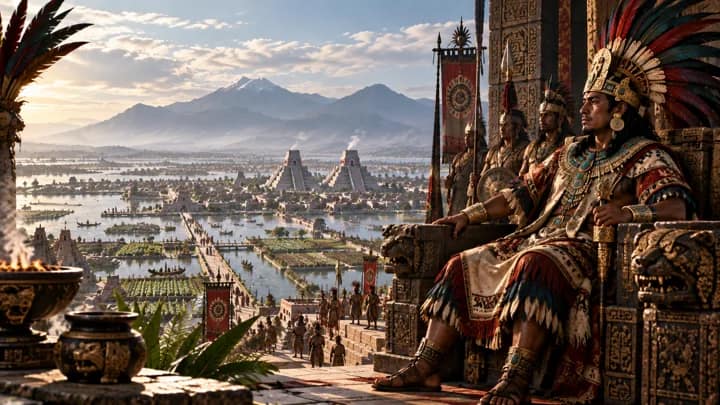
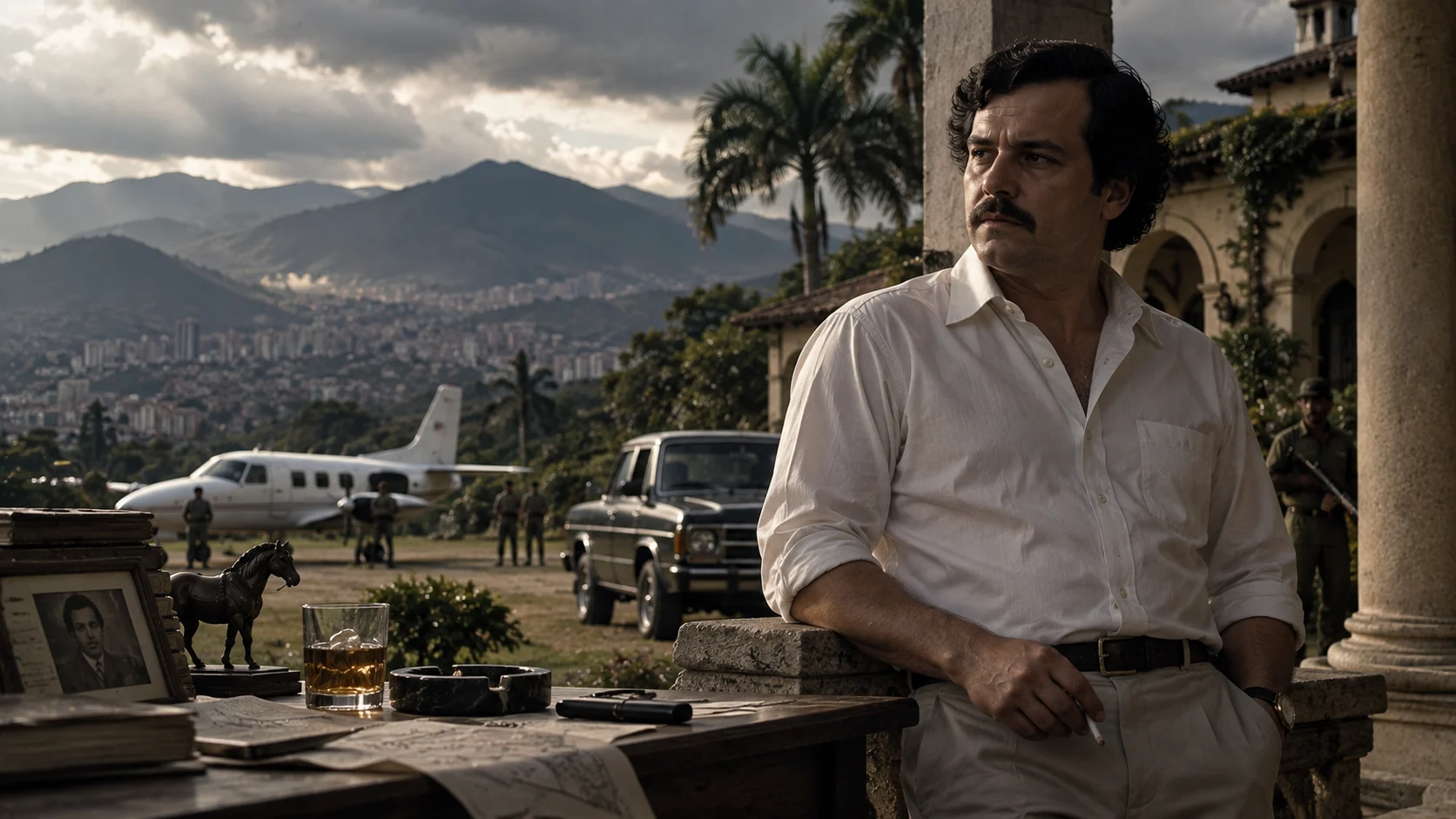
**Image note:** The hero is a cinematic editorial reconstruction supplied for this article. It is not an archival photograph of Escobar, Hacienda Nápoles or a documented gathering.
Before the Empire: A Childhood in Antioquia
Pablo Emilio Escobar Gaviria was born on December 1, 1949, in Rionegro, in the Colombian department of Antioquia. His mother was a schoolteacher and his father a farmer; he grew up in the Medellín metropolitan area, including Envigado. Accounts differ over how poor the family was. The familiar story of an entirely destitute child inevitably driven into crime is more confident than the evidence allows. Biographical chronology and Richard D. Hartley’s biographical overview.
His early criminal activity is also less securely documented than his later career. Retrospective accounts describe theft, car crime and contraband, particularly cigarettes. The celebrated story that he began by stealing gravestones belongs to the category of frequently repeated biographical anecdote, not a necessary foundation for understanding his rise. Colombia’s National Museum places his emergence within an existing world of theft and smuggling, rather than treating cocaine as his first encounter with organized illegality. Historical analysis of narcotics trafficking in Colombia.
The setting mattered. Medellín was changing rapidly, with expanding settlements, unemployment, unequal access to services and institutions unable to protect many residents adequately. The city’s Museo Casa de la Memoria describes the 1980s as an accumulation of these pressures alongside corruption, hired killing and the growth of trafficking. Poverty did not make criminality inevitable. It did create openings in which illicit money could acquire influence far beyond a simple commercial transaction. Medellín in the 1980s.
Cocaine Finds a Vast Market
Cocaine had a history long before Escobar. Historian Paul Gootenberg traces its movement from an earlier legal commodity and small-scale illicit trade in the central Andes to the Colombian trafficking organizations of the late twentieth century. That longer history corrects the idea that one Colombian entrepreneur suddenly invented a global drug business. Cocaine’s Long March North, 1900–2010.
During the 1970s, expanding demand in the United States transformed the scale of the opportunity. Cocaine acquired an expensive, high-status image in some American social settings; the later emergence of crack exposed another devastating dimension of the same drug economy. Demand supplied revenue, while illegality made enforcement of agreements and competition inseparable from coercion. This was an international market whose harms were distributed very unevenly. DEA Museum’s history of coca and cocaine.
Explaining the demand does not excuse the suppliers. Nor does explaining Colombian trafficking make Colombia solely responsible for a business sustained by consumers, intermediaries and financial relationships across borders. Both sides belong in the history.
What Was the Medellín Cartel?
A firmer documentary marker in Escobar’s rise is his 1976 arrest on a cocaine-trafficking allegation alongside his cousin Gustavo Gaviria. El Tiempo’s contemporary chronology records the arrest and the subsequent judicial proceedings. By the early 1980s, the activity had developed far beyond the small-scale contraband associated with his youth. El Tiempo’s career chronology.
The Medellín Cartel was an alliance of powerful trafficking organizations and figures, not simply a company wholly owned by Escobar. The Ochoa family, Carlos Lehder and Gonzalo Rodríguez Gacha were important participants with their own resources and interests. Escobar became its most internationally recognizable figure, but prominence should not be confused with exclusive ownership or absolute command over every associate. DEA’s history of the cartel’s emergence.
The word “cartel” is convenient but can flatten a changing set of partnerships, rivalries and independent operations. It also encourages misleading arithmetic: a claim about the coalition’s share of a market can become a claim about Escobar’s personal income after only a few retellings.
The scale was extraordinary. The precision of many popular statistics is not. Estimates of an illicit market depend on incomplete observations, definitions and time periods. A percentage of American imports is not a percentage of worldwide production; the value of drugs at retail is not the profit of the organization that supplied them. This article therefore does not turn the frequently repeated “80 percent” claim into an exact measure of Escobar’s personal empire.
Wealth Made Visible: Hacienda Nápoles
Hacienda Nápoles, near Puerto Triunfo, became the physical expression of the fortune: an expansive estate associated with exotic animals, lavish buildings and conspicuous consumption. The private zoo made an especially powerful statement. Animals transported across continents suggested that even geography could be rearranged for the owner’s pleasure. Contemporary archival reporting and later accounts document the property’s place in Escobar’s public image. Hacienda Nápoles archival history.
The extravagance was not incidental to power. Visible wealth could attract admiration, signal untouchability and make ordinary limits appear negotiable. It offered an image of arrival: the criminal who possessed what established elites possessed, and then something more.
Yet possession was not security. An estate could display a fortune without making that fortune legal, stable or fully knowable. The same visibility that advertised success also advertised the challenge Escobar posed to public authority.
HOW RICH WAS PABLO ESCOBAR, REALLY?
There is strong evidence that Escobar was extraordinarily wealthy. There is no publicly available, comprehensive audit that establishes his peak personal net worth. The responsible answer begins by separating an estimate made at the time from a later recollection, and both from a story repeated without its original qualifications.
What Forbes Actually Documents
Forbes confirms that Escobar appeared on its billionaires list every year from 1987 through 1993. Its retrospective reproducing the 1987 profile describes net worth above $2 billion and an estimated cumulative cash flow of at least $3 billion. A separate Forbes retrospective summarizes the first estimate as at least $3 billion. Both describe an estimate of about $1 billion by 1993. These differences are a reason to preserve the source’s wording, not merge the figures into one supposedly exact balance sheet. Forbes’s 1987 archival profile and seven years on the list.
Forbes’s inclusion is documented; Forbes’s valuation was an estimate. Neither the list nor the surviving public record warrants presenting the familiar **$30 billion fortune** as an audited fact. Cash flow, lifetime proceeds, organizational revenue and personal net worth answer different questions.
Hundreds of Millions a Week?
Sensational weekly earnings figures often circulate without explaining whose receipts are being counted, at what point in the market, over which period, or before which expenses. Even a credible estimate of cartel turnover would not establish Escobar’s weekly personal profit. Without those distinctions, multiplying a headline number by 52 produces an impressive-looking annual figure rather than reliable economic history.
Rubber Bands and Rats
The rubber-band story has an identifiable source: Roberto Escobar’s memoir, *The Accountant’s Story*, written with David Fisher. Its publisher’s description attributes to Roberto the claim that rubber bands cost $2,500 a month. It also describes his claim that losses to rats and damp sometimes required a 10 percent write-off. Those are an insider’s retrospective assertions, not independently audited expense records. Publisher’s description and bibliographic record.
It is therefore misleading to convert the memoir into a verified annual amount “eaten by rats,” especially by multiplying it against an unrelated estimate of total wealth. The original account includes dampness as well as rodents. Repetition can make a story more familiar without making it more demonstrable.
Burning Money to Keep His Daughter Warm
The claim that Escobar burned $2 million to warm his daughter comes from his son Juan Pablo’s account, reported in 2009. It should be identified as his recollection, including the amount, rather than narrated as an independently established scene. This article does not invent its dialogue, temperature or precise circumstances. El Espectador’s report of the son’s account.
The enduring economic fact is less picturesque: illicit wealth could purchase enormous influence while remaining vulnerable to seizure, theft, betrayal and the cost of defending it. A fortune can be immense without every legend about it being true.
From Community Patron to Political Candidate
Escobar funded housing and football projects in poor Medellín communities. These were not imaginary benefits. A family receiving a home could experience a material improvement that government had failed to provide. Such assistance helped create the benefactor image that he cultivated alongside his growing wealth. Contemporary Forbes reporting recorded both the projects and his political ambitions.
In 1982 he entered national politics as an alternate member of the Chamber of Representatives. “Alternate” matters: he was not president, a presidential election winner or the undisputed ruler of Colombia. Political office offered public standing and an opportunity to recast the source of his influence. El Tiempo’s contemporary career chronology.
That attempt met resistance. Justice Minister Rodrigo Lara Bonilla confronted the influence of trafficking in public life. His assassination on April 30, 1984, became a defining escalation in the confrontation between the traffickers and the Colombian state. The Colombian public broadcasting archive places the murder within the collapse of any comfortable distinction between criminal wealth and political violence. Señal Memoria on Lara Bonilla.
Escobar’s inability to secure lasting respectability did not cause every subsequent crime by itself. But it exposed a limit money could not reliably overcome: some officials, journalists and citizens continued to identify the violence behind the benefactor’s image.
ESCOBAR: ROBIN HOOD OR TERRORIST?
The two labels describe different things. “Robin Hood” describes a reputation cultivated through selective generosity. Terrorism describes the use of violence and fear against civilians and institutions for coercive ends. Building houses does not cancel responsibility for bombings, and documenting those bombings does not require pretending the houses never existed.
Some people admired Escobar because they had received tangible help. Others feared him, opposed him or had lost someone to his organization. Treating an entire poor community as his willing accomplice erases those differences and the constraints under which people lived. A resident’s gratitude for shelter is not a mandate for murder.
His patronage also illustrates the difference between a favor and a right. A public service should not depend on personal loyalty to its provider. Assistance distributed by a violent patron can bind recipients to his reputation even when their need is entirely legitimate. That relationship helps explain the persistence of his image; it does not vindicate it.
“Plata o Plomo”: Corruption Backed by Fear
The phrase “plata o plomo” means, literally, money or lead: bribery backed by the threat of a bullet. It is widely associated with Escobar’s methods. Here it is used as a description of coercion, not as an authenticated transcript of a particular conversation. The reality documented in official histories is the combination of payments, threats and killings used against journalists and public officials. DEA history, 1980–1985.
The pressure extended beyond the person being threatened. It could reach families, colleagues and anyone expected to take the same job next. Every official who refused a bribe was therefore defending more than an individual decision: the possibility that a public institution could continue to function independently.
Los Extraditables: War Against a Legal Process
Extradition meant the possibility of being sent abroad to face prosecution. For Colombian traffickers, prosecution in the United States threatened to remove them from the local relationships on which their influence depended. Los Extraditables became the name associated with the campaign to prevent that outcome.
The conflict was about the state’s authority to enforce law, even when presented in the language of national sovereignty. Threats, kidnappings and attacks made officials and civilians bear the cost of resisting the traffickers’ demands. The extradition of Carlos Lehder in 1987 demonstrated that the danger the traffickers feared was real. DEA history, 1985–1990.
Journalism was another target. Guillermo Cano, director of *El Espectador*, was murdered on December 17, 1986. The newspaper’s account of the judicial record documents the accusation against Escobar as the intellectual author of the crime and the long struggle for accountability. Silencing an editor was an attack on the public’s ability to know who exercised power and how. The Cano case chronology.
Police and judges faced sustained intimidation and lethal attacks. There is no need to invent a single exact “Escobar body count” to describe this campaign. Citywide homicide totals, victims of a particular bombing and killings judicially attributed to an organization are different categories; treating them as interchangeable produces false precision.
The Palace of Justice: What Is Established, What Is Disputed
On November 6, 1985, M-19 guerrillas seized Bogotá’s Palace of Justice. Security forces retook it during an operation extending into the following day. The siege, fire, deaths and disappearances remain among Colombia’s deepest institutional traumas. They cannot responsibly be reduced to a supporting scene in an Escobar biography. National Center for Historical Memory’s account.
The allegation that Escobar financed the assault to obstruct extradition and destroy judicial records is serious and longstanding. The commission established to investigate the Palace events examined contacts between traffickers and M-19 members, threats against magistrates and accounts from figures including John Jairo Velásquez and Carlos Castaño. Its report gave weight to evidence of connections and collaboration. Those accounts do not turn every later claim about a payment, instruction or motive into an uncontested fact. Palace of Justice commission report, discussion of narcotics trafficking.
Former M-19 members disputed the interpretation that the operation was undertaken on the traffickers’ behalf. Colombia’s later Truth Commission documents the political controversy surrounding that explanation and the continuing questions about responsibility. The careful formulation is that alleged Escobar involvement has been investigated and supported by some testimony and investigative conclusions, while the precise financing and purpose remain disputed. It is not sound history to reconstruct a private commissioning scene as if a camera had recorded it. Truth Commission’s Palace of Justice study.
A separate matter is the responsibility of state agents. In its 2014 judgment in *Rodríguez Vera and others v. Colombia*, the Inter-American Court of Human Rights addressed forced disappearances and other grave violations connected to the Palace events. Allegations against Escobar cannot erase those findings or relieve either the guerrillas or state forces of responsibility for their own acts. Inter-American Court case record.
1989: Political Murder and Civilian Catastrophe
Luis Carlos Galán
Presidential candidate Luis Carlos Galán was assassinated at a rally in Soacha on August 18, 1989. His opposition to drug trafficking made his campaign a direct challenge to criminal influence. His death was an attack on voters’ ability to determine Colombia’s future without an armed veto. Historical Memory’s account of the Galán case.
The judicial history matters as much as the familiar photograph of the rally. In 2023, Colombia’s Supreme Court rejected an attempt to reopen former senator Alberto Santofimio’s conviction for co-authorship of the murder. Its explanation addressed the finding that Santofimio had induced Escobar to kill Galán. The case shows why the violence cannot be understood as an isolated criminal operating entirely outside politics. Supreme Court decision summary.
Avianca Flight 203
On November 27, 1989, Avianca Flight 203 was destroyed shortly after leaving Bogotá. All 107 people aboard died. Colombia’s National Center for Historical Memory identifies the bombing as an Escobar attack and records the enduring experience of victims’ families. The aircraft was a civilian space; its passengers were not participants in the traffickers’ confrontation with the government. La guerra tocó el cielo.
The American prosecution of Dandeny Muñoz Mosquera, known as “La Quica,” ended in a conviction in his second trial in 1994. A later Justice Department inspector general review documented serious criticism of aspects of an FBI expert’s testimony and the dispute over Muñoz’s involvement. Those distinctions should remain visible: the occurrence of the bombing, the court outcome and criticism of particular evidence are not the same question. This article gives no technical account of the device. Justice Department inspector general’s Avianca review.
The DAS Bombing
On December 6, 1989, a bombing struck the headquarters of the Administrative Department of Security, or DAS, in Bogotá. The reported death toll was 63. The target included the institution’s director, Miguel Maza Márquez, who survived; civilians and others in and around the building paid the price. El Tiempo’s reporting on the DAS attack.
These attacks made fear a feature of ordinary life. A commute, a workplace or an airline ticket could become the point where a national conflict entered a family’s history. Listing the dates is necessary, but it is not equivalent to measuring the bereavement, disability and lost security that followed.
The State Responds and Rival Criminals Advance
Colombia’s response combined policing, prosecution, international cooperation and attempts to induce surrender. The United States supplied assistance to Colombian authorities, including through the DEA. The relationship expanded during the pursuit of Escobar, but it was Colombian society and institutions that bore the immediate strain of the confrontation. DEA history, 1990–1994.
Meanwhile, the Cali trafficking organization was a rival, not a lawful alternative. Competition weakened any idea of a united criminal front. Opposing Escobar could serve another organization’s commercial interests without representing opposition to trafficking itself. The DEA’s history describes Cali’s growing position as the Medellín organization declined.
This is one reason the conflict resists a simple two-sided picture. Officials sought public order; victims sought safety and justice; rival criminals sought advantage. Their immediate interest in Escobar’s defeat could overlap while their purposes remained fundamentally different.
La Catedral: Surrender Without Effective Control
Escobar surrendered on June 19, 1991, and entered La Catedral in the hills above Envigado. The timing coincided with the constituent assembly’s decision to prohibit extradition of Colombians by birth, incorporated into the new constitution. But Colombia’s constitutional transformation involved far more than Escobar; reducing the entire 1991 charter to a concession to one trafficker misrepresents it. Truth Commission on the constituent assembly and Medellín: Memories of an Urban War.
The extraordinary conditions of confinement made the surrender deeply compromised. Escobar’s selected guards controlled his immediate security, and he retained the ability to direct criminal activity. The DEA Museum describes a prisoner protected from both the government and his rivals by the arrangement. The essential scandal was not simply comfortable furniture or recreation. It was the state’s failure to exercise effective custody. DEA Museum’s account of his imprisonment.
The distinction matters. A prison’s defining function is not that it looks austere; it is that lawful authority, rather than the prisoner, determines what happens inside. At La Catedral, the appearance of confinement concealed a continuing center of power.
The Murders That Broke the Arrangement
The killing of associates Gerardo Moncada and Fernando Galeano inside La Catedral in July 1992 exposed that failure with particular force. Colombia’s Truth Commission identifies those killings as a decisive event in the subsequent alignment of Escobar’s enemies. The government moved to transfer him to conventional custody. During the transfer crisis on the night of July 21–22, he escaped. Truth Commission’s historical narrative.
His escape was not proof that he had defeated the state forever. It destroyed the arrangement that had offered him relative protection, intensified the official pursuit and accelerated the loss of allies. He had regained physical freedom while narrowing the circumstances in which he could safely use it.
The Search Bloc and Los Pepes
The Colombian police Search Bloc, or Bloque de Búsqueda, became central to the renewed manhunt, supported by American assistance. This was a prolonged institutional effort, not a single brilliant detective’s duel with a fugitive. Declassified diplomatic records show the intensity of bilateral cooperation and the political pressure surrounding the search. U.S. diplomatic record on assistance after the escape.
Alongside the official pursuit, Los Pepes, short for *Perseguidos por Pablo Escobar* (people persecuted by Pablo Escobar), attacked his network. The group brought together enemies with criminal and paramilitary interests. Its violence against associates and properties weakened him, but it was extrajudicial violence, not a substitute for prosecution.
Declassified records assembled by the National Security Archive document deeply troubling connections between members of the anti-Escobar task force and Los Pepes. They include diplomatic reporting about evidence of police links to crimes and abuses, as well as intelligence concerns about paramilitary figures. The archive also identifies gaps: the full extent of the relationships, authorization and American knowledge cannot simply be inferred from every allegation. Declassified Los Pepes collection.
Two conclusions can stand together. Escobar’s organization was responsible for enormous harm. Methods used against it require scrutiny of their own. A successful manhunt does not retrospectively legalize everything done in its name, and an enemy of a terrorist is not automatically a defender of civilians.
December 2, 1993: Death on a Medellín Rooftop
Escobar died in Medellín on December 2, 1993, the day after his 44th birthday. The official account describes Colombian police locating him and killing him during an attempted escape across neighboring rooftops. The DEA’s institutional history credits the Colombian National Police, with American support in the broader pursuit.
What is less settled is the identity of the person who fired the fatal shot. Police officer Hugo Aguilar claimed a decisive role. Figures associated with Los Pepes offered competing accounts, while members of Escobar’s family advanced a suicide interpretation. BBC Mundo’s review lays out these conflicting claims; they should not be presented as equally established forensic conclusions. BBC Mundo on the competing accounts.
Colombian biographer Alonso Salazar has also emphasized the uncertainty about the shooter while rejecting the family’s suicide explanation. A responsible account can identify the official narrative and acknowledge the dispute without choosing the most dramatic alternative. Salazar’s assessment.
There is no need for invented final words or a detailed reconstruction of his last thoughts. The historical outcome is clear: the individual at the center of the campaign was dead. The institutions, markets and armed relationships surrounding him survived in altered forms.
After Escobar: An Empire Fragments
The Medellín alliance had already been weakened by arrests, deaths, surrenders and internal conflict before Escobar’s final day. His death ended his personal command; it did not close the cocaine market. Cali’s prominence and the later evolution of trafficking organizations demonstrate the difference between dismantling a particular network and ending the economic system that supported it.
Gootenberg’s historical research traces the subsequent northward shift in trafficking leadership toward Mexico. That development is incompatible with the cinematic ending in which one rooftop victory resolves the entire drug war. Organizations changed, and the geography of power changed with them.
This broader pattern connects with PRESDA’s history of organized crime: personal leadership matters, but criminal markets and political relationships often outlast their most famous participants.
What Happened to His Family?
Escobar’s wife, María Victoria Henao, and their children, Juan Pablo and Manuela, left Colombia and eventually settled in Argentina under new identities. Juan Pablo became known as Sebastián Marroquín and later published accounts of his father. The family’s departure and his public work are documented; his explanations of private family events remain testimony that requires attribution. El País’s account of the family’s exile and publisher’s biography of Marroquín.
Their story should not be written as an uncomplicated inheritance of limitless wealth. Nor should relatives automatically be assigned responsibility for every act committed by Escobar. An individual’s conduct and the evidence about it must remain distinct from a family name.
What Became of Hacienda Nápoles?
The estate passed out of Escobar’s control, experienced neglect and looting, and was partly transformed into a tourist complex. Reporting on its redevelopment describes the difficulty of creating a new use without celebrating the criminal who made it famous. The modern attraction includes wildlife and recreation facilities; its existence does not settle every question about the wider estate’s land or historical meaning. El Tiempo on the transformation and the present-day park.
The Hippos: An Ecological Legacy Still Unfolding
The hippopotamuses associated with Escobar’s private zoo became a free-ranging, reproducing population in the Magdalena basin. Their story is often presented as an absurd footnote to his extravagance. For nearby communities and conservation scientists, it is a continuing environmental problem.
A 2020 study found that hippos were carrying nutrients and organic matter from land into Colombian waters, with measurable effects on aquatic ecosystems. This is a mechanism familiar from their African habitats, but an introduced population acts within a different ecological setting. Researchers have also examined rapid population growth and the difficulty and cost of controlling it. Ecosystem study and population and management research.
Colombia designated the hippo an invasive species in 2022. Official management has considered measures including sterilization, relocation and euthanasia, with legal, welfare and implementation disputes continuing. A 2026 ministry statement addressed court proceedings concerning management, and a separate announcement described discussions about potential translocation to India. A proposal is not a completed transfer; a population estimate from an earlier year is not a current census. Invasive-species designation, 2026 legal update and translocation discussions.
The animals are not responsible for having been introduced. Their welfare still matters. So do native ecosystems and people living near them. The episode shows how a private display of power can leave public costs extending decades beyond its owner’s life.
NARCOS VS REALITY
*Narcos* is a drama based on historical events, not a substitute for the historical record. Academic research on the series examines how archival footage and fictional scenes can make the boundary between evidence and reconstruction difficult to see. A scene’s emotional credibility does not establish that its conversation took place. Research on fact, fiction and archive footage.
Myth: Escobar Invented and Personally Owned the Cocaine Trade
**Reality:** Cocaine’s history preceded him, and the Medellín alliance contained multiple powerful participants. The international market was larger than any one trafficker. Escobar’s centrality to a television plot is not a reliable measure of his ownership of an entire industry.
Myth: Every Character and Conversation Is Historical
**Reality:** The series uses fictionalization. Horacio Carrillo is a fictional character; research on the show discusses his relationship to the historical Search Bloc commander Hugo Martínez. Scenes assigned to a dramatized figure cannot be cited as evidence that a particular real officer committed the same act. Academic analysis of Narcos and its representations.
Myth: Americans Alone Brought Him Down
**Reality:** American assistance mattered, but Colombian police, judicial institutions, officials and citizens were central to the confrontation. A narrative centered on visiting agents can make Colombians appear to be supporting characters in their own country’s history.
Myth: His Charity Proves He Was a Misunderstood Hero
**Reality:** The housing and sports projects help explain his support in some communities. They do not negate the attacks against civilians or the destruction of public institutions. Generosity and brutality can coexist in the same person; the former does not absolve the latter.
Myth: The Palace of Justice and the Fatal Shot Are Fully Settled Stories
**Reality:** Different kinds of evidence support different levels of certainty. The Palace attack and state human-rights violations are documented; precise claims about Escobar’s commissioning of the assault remain disputed. His date and place of death are established; competing claims about the fatal shooter should retain their attribution.
Myth: Killing Escobar Ended the Cocaine War
**Reality:** It ended a particular phase and removed a central perpetrator. Rival organizations, criminal markets and armed networks persisted. For families who had lost someone, a successful operation could bring relief without delivering complete truth, reparations or justice.
What Colombia Was Left to Rebuild
The damage extended beyond the victims of individual attacks. Intimidation weakened journalism and justice. Criminal money distorted opportunity and public life. Families carried bereavement; neighborhoods carried fear; officials and citizens who refused to submit often paid extraordinary personal costs. Medellín’s historical memory work places these experiences within a wider urban conflict rather than attributing every act of violence to one man.
Commemoration offers a different focus from the familiar mansion tour. The Inflexión memorial was designed for the site of Escobar’s former Mónaco building, shifting attention toward the victims of the period. Its significance lies in that reversal of perspective: the city need not organize its memory around the possessions of its most notorious criminal. National University of Colombia on the memorial’s design.
PRESDA’s history of money examines how wealth and trust shape societies. Escobar’s life exposes their separation: immense purchasing power did not create legitimate authority, and fear was an unstable replacement for public trust.
He became rich enough to challenge the state, compel concessions and make daily life more dangerous for people who had no part in his business. He never became powerful enough to make violence consequence-free, or to ensure that the system he built would remain loyal when its interests changed.
The most important question is therefore not how many dollars he possessed at his peak. It is how much of Colombia’s life was made smaller by the power those dollars purchased and how much work remained after the man on the rooftop was gone.
FAQ
Frequently Asked Questions
What is this PRESDA article about?
Cocaine made Pablo Escobar a billionaire. Corruption and terror helped him challenge Colombia’s institutions. Behind the mansions and myths lies a history of political violence, civilian loss and consequences that outlived him.
Which category does this story belong to?
This story is part of PRESDA's History coverage.
Who published this article?
PABLO ESCOBAR: HOW A DRUG EMPIRE MADE ONE MAN RICH ENOUGH TO CHALLENGE A STATE was published by PRESDA Editorial on PRESDA.
PRESDA Dispatch
Stay Informed. Stay Aware.
A sharp briefing across AI, gaming, sport, business, world affairs, paparazzi, and lifestyle.