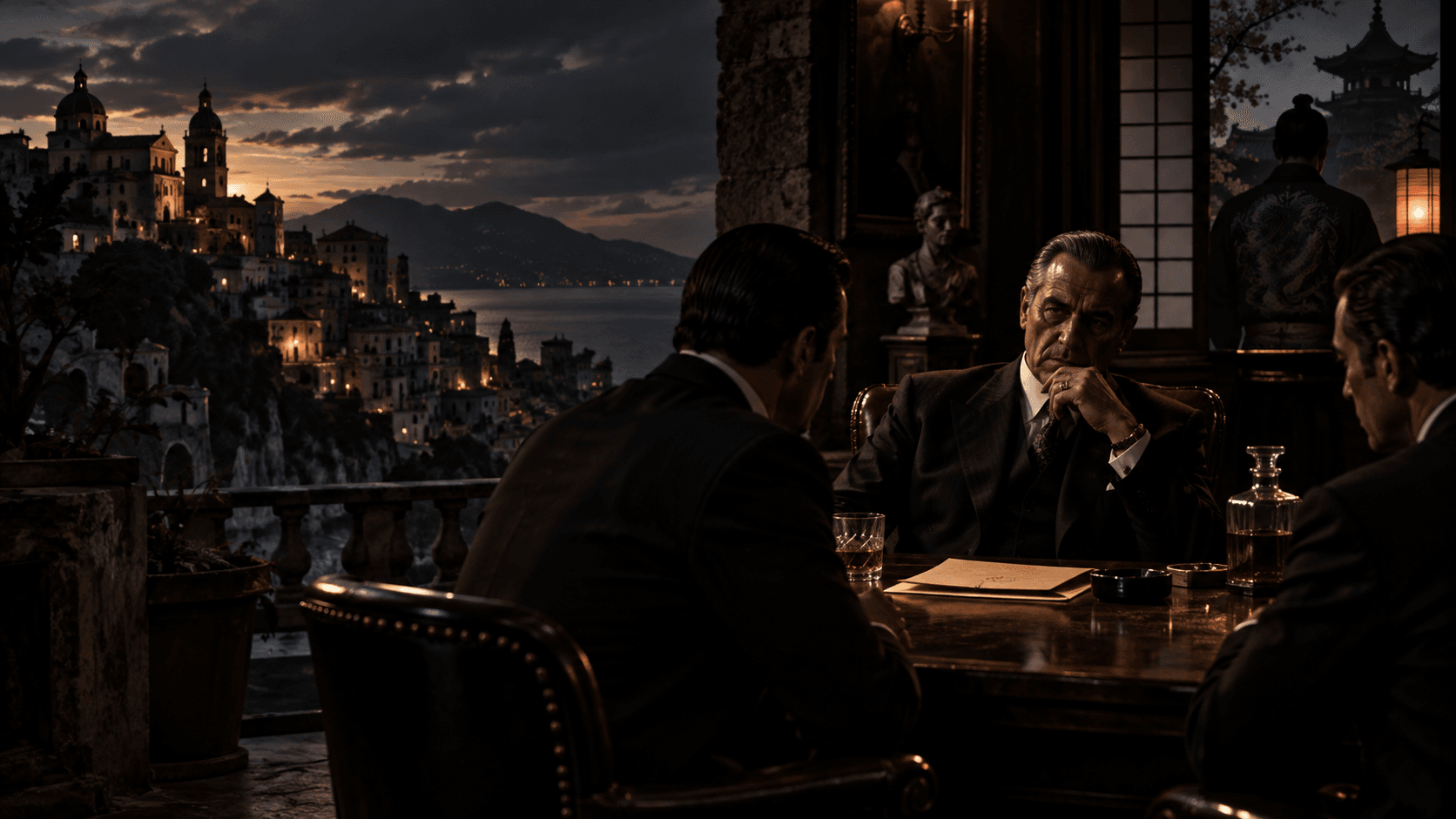
MAFIA: HOW CRIME BECAME AN ORGANIZED EMPIRE
From Sicily's protection networks to America's crime families and Japan's Yakuza, organized crime grew into systems of money, loyalty, fear and power.
The mafia was never only a man with a gun.
At its most dangerous, organized crime became something colder: a parallel institution. It collected money. Enforced rules. Settled disputes. Punished betrayal. Bought protection. Corrupted politics. Sold fear as if it were security.
That is why mafia-style organizations can survive for generations. They do not merely break the law. They grow in places where law feels weak, distant, corrupt or unreliable.
The central question is therefore not only why people commit crimes. It is why some criminal groups become systems of money, loyalty, silence and power.
For related PRESDA context on power, morality and institutions, read Good vs Evil and Native Americans and the history of sovereignty.
What Does Mafia Actually Mean?
Mafia is often used casually to mean any organized crime group, but historically it refers most strongly to Sicilian Cosa Nostra and mafia-style organizations that combine criminal business, territorial influence, intimidation, secrecy and illegal governance.
Not every criminal organization is technically a mafia.
A street gang, drug cartel, smuggling network, prison gang, corrupt militia, cybercrime group or trafficking syndicate may be organized and violent without sharing the same history, structure or social role.
The word mafia is most useful when it describes a group that does more than commit crimes: it claims power over people, markets and territory.
Sicily And The Origins Of Cosa Nostra
Cosa Nostra grew in 19th-century Sicily, a society marked by weak institutions, local elites, land conflict, fragmented authority and distrust of state power.
In that environment, private protection became a business. Landowners, merchants, farmers and local power brokers could face theft, violence or coercion. Men who could provide protection, enforce agreements or intimidate rivals gained influence.
The problem was that protection easily became extortion. A group that sells safety can also create the danger from which safety is needed.
That is the dark logic of mafia power: it fills a trust vacuum, then profits from keeping the vacuum alive.
Omertà And The Culture Of Silence
Omertà is commonly described as a code of silence: do not cooperate with authorities, do not inform, do not bring disputes to the state.
It was not simply romantic loyalty. It was enforced by fear, reputation, social pressure and violence.
Silence protected the organization and isolated victims. If no one testified, prosecutors struggled. If communities believed the state could not protect them, silence became rational survival.
The mafia's power therefore depended not only on violence, but on making people believe that speaking was more dangerous than submission.
Mafia Hierarchy Without The Myth
Mafia groups have used hierarchy, initiation, rank, crews, bosses, intermediaries and rules of obedience, though structures vary by organization and period.
Popular culture imagines perfect discipline. Reality was messier: rivalries, family wars, defections, informants, personal ambition, paranoia and betrayal.
Hierarchy made criminal activity more durable, but it did not eliminate chaos.
The mafia was organized, not orderly.
Cosa Nostra, Camorra, 'Ndrangheta And Sacra Corona Unita
Italy has several historically distinct organized-crime organizations.
Cosa Nostra is associated with Sicily. The Camorra is rooted in Campania and Naples-area criminal worlds, often described as more fragmented. The 'Ndrangheta developed in Calabria and became especially powerful internationally. Sacra Corona Unita emerged in Apulia.
They are not interchangeable branches of one corporation.
They differ in history, territory, structure, family ties, criminal markets and relationships with local society.
Why The 'Ndrangheta Became So Powerful
The 'Ndrangheta became particularly powerful because of strong kinship structures, international expansion, involvement in global cocaine trafficking and ability to infiltrate legitimate economies.
Family-based organization can make infiltration harder because trust rests on blood ties and local identity as well as profit.
European and Italian authorities have repeatedly identified 'Ndrangheta networks as major players in international organized crime.
Its power shows how a group rooted in a poor region can become a global criminal actor when it connects local loyalty to international markets.
Italian Migration And The American Mafia
Italian migration carried millions of people to the United States, most of them law-abiding workers and families seeking survival and opportunity.
Italian-American organized crime emerged within immigrant neighborhoods shaped by poverty, discrimination, weak policing, political machines and illicit markets.
It is important not to confuse Italian identity with organized crime. The American mafia involved a small criminal minority, not Italian-American life as a whole.
Crime families gained influence where they could provide illegal goods, enforce debts, corrupt officials or control rackets.
Prohibition Changed Everything
The US Prohibition era transformed criminal organizations by making alcohol illegal while demand remained huge.
Illegal alcohol created enormous revenue. It rewarded coordination, violence, bribery, logistics and territorial control.
Groups that had been involved in gambling, extortion or local rackets could grow into richer, more connected organizations.
Prohibition did not invent organized crime. It industrialized opportunity.
Lucky Luciano, The Commission And The Five Families
Charles Lucky Luciano is associated with the reorganization of Italian-American organized crime in the early 20th century.
After violent conflicts among New York factions, the mafia world moved toward a more businesslike structure. The Commission was designed to mediate disputes among major families and reduce destructive wars.
New York's Five Families became central to American mafia history: Bonanno, Colombo, Gambino, Genovese and Lucchese.
This was not a corporate boardroom with clean rules. It was an attempt to stabilize criminal power.
Al Capone: Myth Vs Reality
Al Capone became the most famous gangster of Prohibition Chicago.
The myth presents him as a glamorous outlaw: suits, cigars, charisma and defiance.
The reality was violence, corruption, fear, illegal alcohol and political influence. Capone's public image was partly theater. His organization depended on intimidation and criminal profit.
He was ultimately convicted not for the murders associated with his world, but for tax evasion.
Capone's fame tells us as much about American media mythology as about organized crime itself.
Money, Unions, Construction And Legitimate Business
Historically, organized crime sought influence in gambling, labor unions, construction, waste management, ports, trucking, restaurants, nightlife and other businesses.
The point was not always direct ownership. It could be influence, intimidation, kickbacks, labor control, bid manipulation or protection payments.
At a high level, illegal wealth becomes more powerful when it can touch legitimate markets and politics.
That is why organized crime is not only a policing problem. It is an institutional problem.
Corruption And Intimidation
Mafia power relies on two complementary tools: corruption and intimidation.
Corruption makes the state look available for purchase. Intimidation makes resistance feel dangerous.
Together they undermine trust. If citizens believe courts, police, contracts or elections can be bought or threatened, criminal organizations gain space.
The mafia does not need to defeat the state everywhere. It needs to make the state unreliable enough in the places that matter.
Why Communities Sometimes Tolerated Mafia Power
Some communities tolerated mafia organizations because they feared them. Others depended on them for jobs, favors, dispute resolution or access to resources when the state seemed absent.
That does not make the mafia benevolent.
It means criminal power can embed itself inside real social needs. A group may offer help to one person while exploiting another. It may sponsor a festival while extorting a business. It may punish a thief while corrupting an election.
Mafia legitimacy is built from contradiction.
Why The Mafia Appears When The State Cannot Provide Trust
Academic theories often describe mafia as private protection or illegal governance.
Where people distrust police, courts, contracts and government, someone who can enforce agreements may become valuable.
The mafia may initially sell protection. Then it creates, exaggerates or exploits the danger people need protection from.
This is the central institutional lesson: the mafia grows where trust is scarce and violence can be priced.
A strong state is not only one with police. It is one whose citizens believe they can seek justice without needing a criminal intermediary.
Governments Fight Back
Traditional mafia organizations were weakened by prosecutors, informants, surveillance, financial investigations, witness protection, anti-mafia laws and public resistance.
But the fight was costly.
Breaking mafia power required turning silence into testimony and fear into evidence. That meant protecting witnesses, following money and treating organized crime as a system rather than a set of isolated crimes.
The most successful prosecutions attacked structure, not only individual acts.
The Maxi Trial
The Maxi Trial in Palermo began in 1986 and became a landmark prosecution of Sicilian Cosa Nostra.
It relied heavily on anti-mafia investigative work and testimony from pentiti, mafia members who became state witnesses.
The trial resulted in hundreds of convictions and exposed the organization in a way that challenged the old claim that the mafia did not really exist as a unified criminal phenomenon.
It was a legal earthquake.
Falcone, Borsellino And The Anti-Mafia Struggle
Giovanni Falcone and Paolo Borsellino became symbols of Italy's anti-mafia struggle.
They understood Cosa Nostra as a structured organization and helped build methods for following money, using informants and connecting crimes into a larger picture.
In 1992, Falcone was assassinated in the Capaci bombing. Borsellino was killed weeks later in the Via D'Amelio bombing.
The assassinations shocked Italy and intensified public outrage against mafia power.
Their deaths showed both the danger of the mafia and the fear that effective law enforcement could provoke inside it.
RICO In The United States
The Racketeer Influenced and Corrupt Organizations Act, known as RICO, became one of the most important US tools against organized crime.
RICO allowed prosecutors to target patterns of racketeering and the enterprise behind crimes, rather than treating each offense as isolated.
This mattered because mafia power works through continuity: repeated acts, shared command, influence, money and intimidation.
RICO did not eliminate organized crime, but it helped weaken the traditional American mafia's leadership and structure.
Yakuza: The Japanese Underworld
The Yakuza are often compared to the mafia, but the comparison should be cautious.
Yakuza groups developed in Japan through different social, legal and historical contexts. Their roots are often associated with tekiya, itinerant peddlers and market groups, and bakuto, gambling networks, in Edo-period and later contexts.
They became known for hierarchical relationships, rituals, offices, symbols and a degree of public visibility that differed from many Western criminal organizations.
Calling them the Japanese mafia is useful only as a rough analogy.
Oyabun, Kobun, Tattoos And Yubitsume
Yakuza relationships have often been described through oyabun-kobun bonds: parent-role and child-role ties of loyalty and obligation.
Full-body tattoos became culturally associated with Yakuza identity, though tattoos in Japan have broader histories and should not be reduced to crime.
Yubitsume, the cutting of part of a finger as apology or punishment, is a documented practice, but movies can turn it into exotic spectacle.
The point is not to romanticize ritual. It is to understand how hierarchy, shame, loyalty and discipline were symbolized.
Yamaguchi-Gumi And Postwar Development
Yamaguchi-gumi became Japan's largest and most famous Yakuza organization.
After World War II, black markets, reconstruction, labor, entertainment districts, construction and political turbulence created opportunities for underworld groups.
Some Yakuza organizations historically maintained offices, business cards and public visibility in ways that surprised foreign observers.
Visibility did not make them harmless. It reflected a particular Japanese legal and social context that later changed sharply.
Modern Anti-Yakuza Laws And Decline
Japan's anti-yakuza laws and exclusion ordinances made it harder for Yakuza groups to use banks, offices, contracts, real estate, insurance and ordinary business relationships.
Police pressure, aging membership, social stigma, financial restrictions and legal exclusion contributed to major membership decline.
Authorities also distinguish traditional boryokudan groups from newer anonymous or loosely organized criminal groups that may operate through fraud, cybercrime or ad hoc networks.
This shows adaptation: when old structures become costly, crime can fragment into newer forms.
Triads, Russian Organized Crime And Cartels
Chinese triads, Russian organized crime groups and Latin American cartels are not interchangeable with Sicilian mafia or Yakuza organizations.
Triads have histories connected to Chinese secret societies, migration and criminal enterprise. Russian organized crime developed through Soviet and post-Soviet conditions, prisons, corruption, markets and state transition. Latin American cartels often focus heavily on drug production, trafficking routes, territorial control and paramilitary violence.
A cartel, triad, Yakuza group and Sicilian mafia may differ in history, structure, business model and relationship to the state.
Organized crime is global, but it is not one global organization.
Hollywood Vs Reality
The Godfather, Goodfellas, The Sopranos and Japanese Yakuza cinema shaped how millions imagine organized crime.
Popular culture romanticized honor, family, loyalty, luxury, style and tragic masculinity.
Historical reality was uglier: extortion, fear, murder, corruption, addiction, labor exploitation, ruined businesses, traumatized families and communities forced into silence.
Great films can reveal parts of the psychology of power. They can also make predators look noble.
The danger is mistaking aesthetic darkness for truth.
Mafia: Myth Vs Reality
MYTH: The mafia is one worldwide organization.
REALITY: Different organizations developed independently in different societies.
MYTH: Every Italian criminal organization is the Mafia.
REALITY: Italy has several historically distinct organized-crime organizations.
MYTH: Mafia bosses live exactly like The Godfather.
REALITY: Film created powerful mythology around intimidation, corruption and violence.
MYTH: Yakuza are simply the Japanese Mafia.
REALITY: The comparison is useful but their history, organization and legal context differ.
MYTH: Mafia loyalty is stronger than money.
REALITY: History is full of defections, informants, internal wars and betrayals.
MYTH: Modern organized crime disappeared.
REALITY: Traditional organizations changed, fragmented and adapted rather than simply vanishing.
Why Mafia Organizations Survive
Mafia-style organizations survive when they become embedded in social and economic life.
They adapt across generations by changing markets, corrupting institutions, using family or loyalty networks, exploiting fear and investing in legitimacy.
They are hardest to fight when people see them as permanent.
That is why public courage matters. Prosecutors, journalists, witnesses, business owners, priests, teachers, families and ordinary citizens have all played roles in resisting mafia power.
A mafia can rule through silence only while enough people believe silence is safer.
The Organized Empire
The most successful mafia organizations were dangerous not because they behaved like chaotic street gangs, but because they tried to behave like alternative institutions.
They created rules. Collected money. Enforced agreements. Punished betrayal. Built political relationships. Used violence behind the appearance of order.
That is what made them powerful, and what made them corrosive.
The mafia's greatest weapon was never simply the gun. It was the ability to convince people that its power was permanent, and that silence was safer than resistance.
FAQ
Frequently Asked Questions
What does mafia mean?
Historically, mafia most strongly refers to Sicilian Cosa Nostra and mafia-style organizations that combine criminal business, territorial influence, secrecy, intimidation and illegal governance.
Are Cosa Nostra, Camorra and 'Ndrangheta the same?
No. They are historically distinct Italian organized-crime organizations with different regional roots, structures and criminal histories.
Why did Prohibition strengthen organized crime?
Prohibition created huge illegal demand for alcohol, rewarding groups that could organize smuggling, bribery, violence, distribution and territorial control.
Are Yakuza the Japanese mafia?
The comparison is common but imperfect. Yakuza groups developed in Japan's distinct historical, legal and social context and differ from Sicilian mafia organizations.
Did organized crime disappear?
No. Traditional organizations were weakened in many places, but organized crime adapted, fragmented and moved into new markets and structures.
PRESDA Dispatch
Stay Informed. Stay Aware.
A sharp briefing across AI, gaming, sport, business, world affairs, paparazzi, and lifestyle.