Pompeii: Walking Through a City Frozen in Time
Explore Pompeii’s Roman streets, eruption evidence, houses, casts and discoveries, with practical guidance on tickets, transport and accessibility.
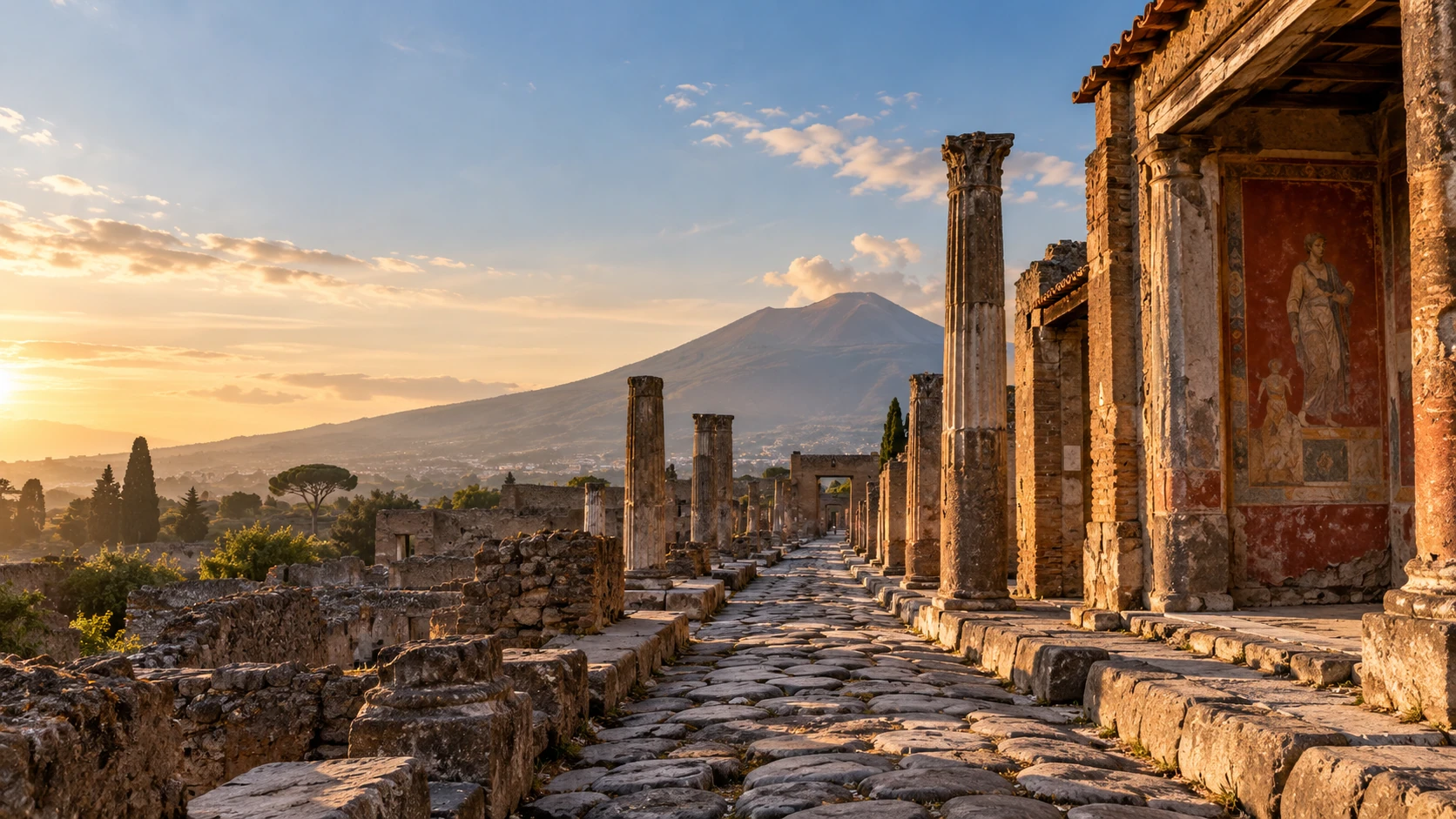
PRESDA AI-generated editorial illustration inspired by Pompeii and Vesuvius. It is not an archaeological photograph or a reconstruction verified against a site plan.
A street in Pompeii can feel disarmingly ordinary. There is a threshold, a shop counter, a place where someone arranged a room to impress a visitor. Then the broken roofline opens to Vesuvius, and the distance between an ordinary day and a catastrophe becomes impossible to ignore. The city’s power lies in that tension: familiar human activity surviving through an event that destroyed a community.
“Frozen in time” is a useful invitation, but an imperfect description. Pompeii is an archaeological site shaped by destruction, salvage, excavation, restoration and interpretation. Its houses do not provide a complete photograph of Roman society, and its victims cannot be reduced to stories invented from their poses. The most rewarding visit combines curiosity with caution about what the evidence can actually tell us.
A city with a history before the disaster
Pompeii was a developing town long before AD 79, shaped by regional Italian cultures and eventually Roman power. Its public buildings, homes, workshops and religious spaces reveal a commercial city rather than an isolated pleasure resort. UNESCO recognises Pompeii together with Herculaneum and Torre Annunziata because these sites offer complementary evidence of ancient settlement and daily life. They are connected historically, but they are not interchangeable places or one ticketed attraction. UNESCO: the archaeological areas
Read the streets as connections between activities. A grand entrance leads into a household, a counter opens towards customers, and public space gathers different kinds of authority. The surviving material also reflects inequality. Wealthy residents could surround themselves with painted rooms and gardens, while other people worked in constrained spaces or lived under slavery. Admiring a mosaic should not erase the labour and hierarchy behind the house that displayed it.
What happened in AD 79?
Vesuvius buried Pompeii during a destructive eruption in AD 79. Falling volcanic material and later hot, fast-moving mixtures of gas and debris were parts of the disaster, not a single cinematic wave of liquid lava. Buildings collapsed, people fled and others died. Archaeologists study different contexts to understand the sequence; it is misleading to assign every victim one identical final experience. The wider eruption also affected other settlements around the Bay of Naples. Park interpretation: the eruption and its victims
The precise calendar date remains debated. August 24 is the traditional date associated with the manuscript transmission of Pliny’s account, while archaeological evidence has supported an autumn alternative. A charcoal inscription discovered in Regio V, recording a date equivalent to October 17 without a year, became a significant part of that discussion. Its context and the material’s fragility inform an interpretation, not a mechanically certain date stamp for the eruption. AD 79 is secure; presenting one disputed day as universally settled is not. Park report on the charcoal inscription
Buried, revisited and excavated
The site did not simply vanish from all human activity until modern archaeologists arrived. The park records post-eruption removal of building materials and later uses of the buried landscape. Systematic excavations began in 1748 under Bourbon patronage. Those early interventions and subsequent methods helped shape what survives and what visitors now see. The exposed city is therefore both ancient evidence and the result of a long modern history of investigation. Pompeii after the eruption
Excavation also creates responsibility. Once a wall painting is uncovered, it must withstand conditions very different from burial. Water, weather, vegetation and visitor pressure make maintenance as important as discovery. A temporarily closed house is not necessarily a failure of the visit; it may be evidence of the work required to keep the place available in the future. Check current openings instead of treating an old guidebook’s route as a promise.
The Forum: start with the civic city
The Forum offers a useful starting point for understanding Pompeii as an urban community. Look beyond the dramatic view towards Vesuvius and examine the relationship between open space, temples and civic buildings. The nearby basilica belonged to public and commercial life, not the Christian architectural meaning many visitors first associate with the word. A guide or the official site map helps connect these remains rather than treating each column as an isolated monument. Official excavation map
Move from that public centre into a smaller street before deciding that you have understood the city. Scale changes the questions. Who could enter a room? What could be seen from a doorway? Where did service and display meet? These are more useful prompts than trying to reconstruct conversations that no source preserves. Pompeii rewards looking closely at transitions between spaces as much as recognising famous names.
Houses, paintings and the limits of interpretation
The House of the Vettii is a major example of domestic display, associated with two men identified as freedmen who became wealthy. Its paintings and organisation illuminate status, aspiration and the performance of prosperity. They do not allow us to know every thought of the inhabitants. A room’s decoration can suggest cultural interests without becoming a transcript of its owners’ beliefs. Smarthistory: House of the Vettii
The Villa of the Mysteries, beyond the main urban circuit, is famous for its painted figures. The name itself should not encourage overconfidence about interpreting every scene. Include it only if your ticket and available time cover the suburban route. Standing in a decorated room is more meaningful when you first understand where it sits in the wider house and landscape. Do not touch painted surfaces or lean on ancient walls to improve a photograph. Park research on the Villa of the Mysteries
Food, work and entertainment
Thermopolia, food-and-drink counters with containers set into masonry, make everyday commerce visible. The decorated example in Regio V has attracted particular attention. Calling it a Roman fast-food restaurant can help a first-time visitor picture its function, but the comparison should not erase differences in household organisation, menus and social life. Material remains support particular conclusions, not a complete modern restaurant review. Park account of the Regio V thermopolium
The amphitheatre, built around 70 BC, shifts the focus to public spectacle. Its scale shows how collective entertainment occupied urban space. Pair it with the theatre area if that theme interests you, but do not confuse an arena with a theatre: they hosted different forms of performance. A visit organised around food, water or entertainment can be more coherent than a race through every highlighted house. Park guide to the excavations
Human remains are evidence, not ready-made stories
Pompeii’s casts are not people transformed into stone. The technique associated with Giuseppe Fiorelli from 1863 filled voids left in the deposit after bodies decomposed, preserving external forms while skeletal material could remain inside. Their emotional force is real, but a pose or an ornament cannot by itself establish identity, kinship or the exact circumstances of a death. Approach displays with the respect due to human remains. Park explanation of the casts
A 2024 ancient-DNA study challenged familiar interpretations of some groups. Biological sex and genetic relationships did not match several stories previously attached to the casts. That does not mean DNA can recover a person’s entire social identity; it shows why visual assumptions must be tested. The discovery is important precisely because it replaces a satisfying narrative with a more careful question. Archaeology advances when an appealing explanation is allowed to change. Max Planck Institute: DNA evidence
Planning a visit: tickets, entrances and time
At our 21 October 2026 check, the official tariff listed Pompeii Express at €20, Pompeii+ at €25 and the wider three-day combination at €30. Express excludes the suburban villas. Tickets are personal, and a daily limit applies. Follow the park’s own link to Vivaticket, read the product’s inclusions and confirm the tariff for your date. A tour package can legitimately cost more, but it should explain the additional service. Official tickets and opening times
The Circumvesuviana Naples–Sorrento line serves Pompei Villa dei Misteri for the Porta Marina and Piazza Esedra entrances. The national-rail station called Pompei is a different arrival point. Check the entrance your guide intends to use before buying transport. Allow several hours and choose priorities; the site is too extensive for a brief dash to do it justice. Combining Pompeii, another archaeological site and Vesuvius in a single day can leave little time for understanding any of them. Official arrival information
Comfort, access and a respectful departure
Wear shoes suited to uneven stone, carry drinking water and plan shade breaks in hot weather. Spring and autumn can be more comfortable than midsummer, but conditions vary and rain makes surfaces slippery. Consult the day’s opening notices and forecast. Travellers with mobility requirements should use the official Pompeii for All information, whose route starts at Piazza Anfiteatro, and discuss their specific needs with the park. An accessible route does not mean that every ancient doorway is accessible. Pompeii for All
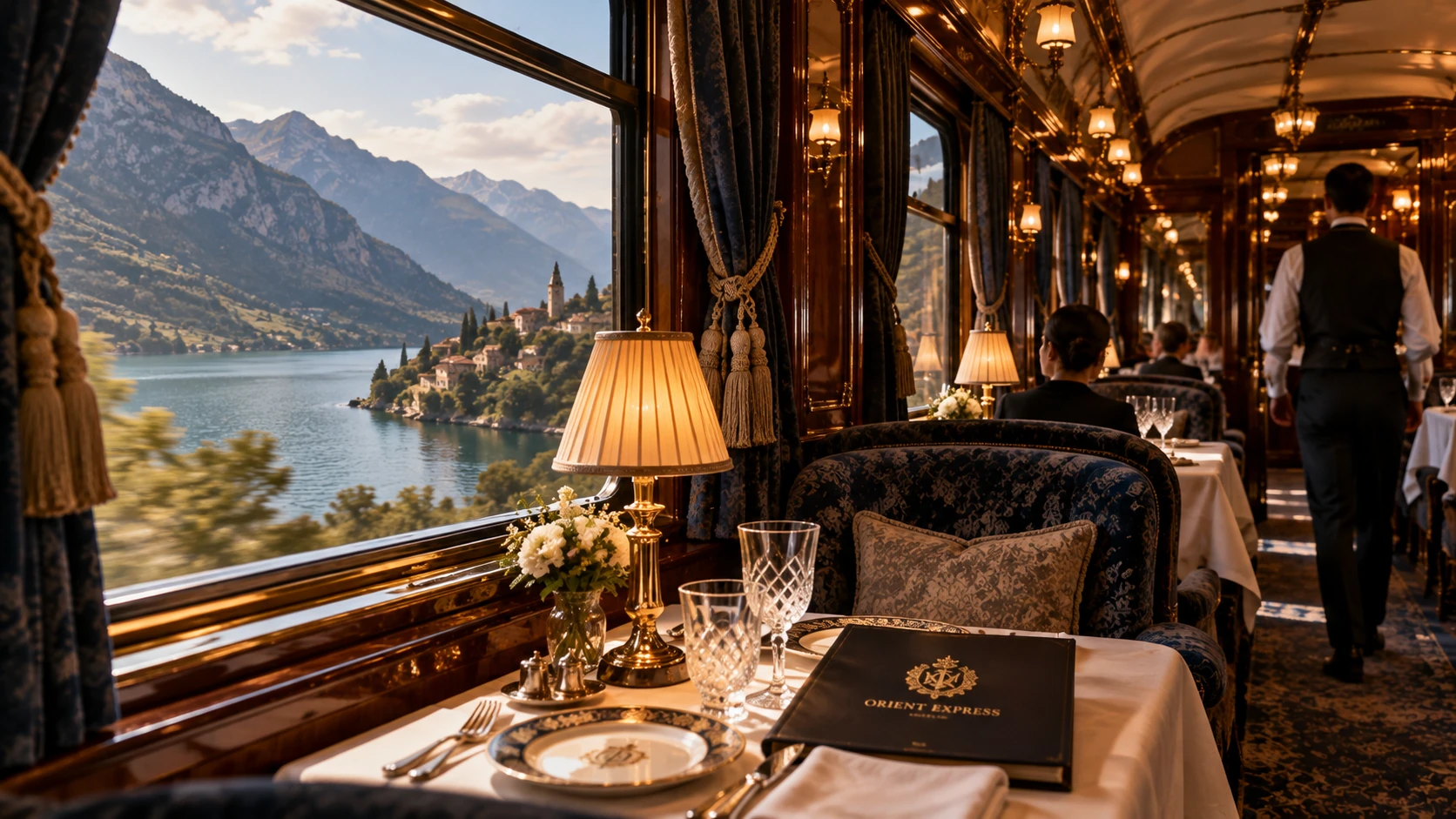
Leave stones and fragments where they belong, observe barriers and accept that preservation sometimes limits access. The supplied hero is an AI-generated editorial illustration, not a documentary photograph or a map of surviving buildings. For another journey through European travel history, read PRESDA’s Orient Express feature. Pompeii is not most moving when we pretend to know everything about its inhabitants. It is most moving when ordinary traces make their lives tangible while the unanswered questions remain visible.
FAQ
Frequently Asked Questions
What is this PRESDA article about?
Explore Pompeii’s Roman streets, eruption evidence, houses, casts and discoveries, with practical guidance on tickets, transport and accessibility.
Which category does this story belong to?
This story is part of PRESDA's Travel coverage.
Who published this article?
Pompeii: Walking Through a City Frozen in Time was published by PRESDA Editorial on PRESDA.
PRESDA Dispatch
Stay Informed. Stay Aware.
A sharp briefing across AI, gaming, sport, business, world affairs, paparazzi, and lifestyle.