RAPA NUI: THE MYSTERY OF THE GIANT MOAI STATUES
Who carved Rapa Nui’s moai, why they stood on ahu and what an experiment shows about how the statues could have walked.
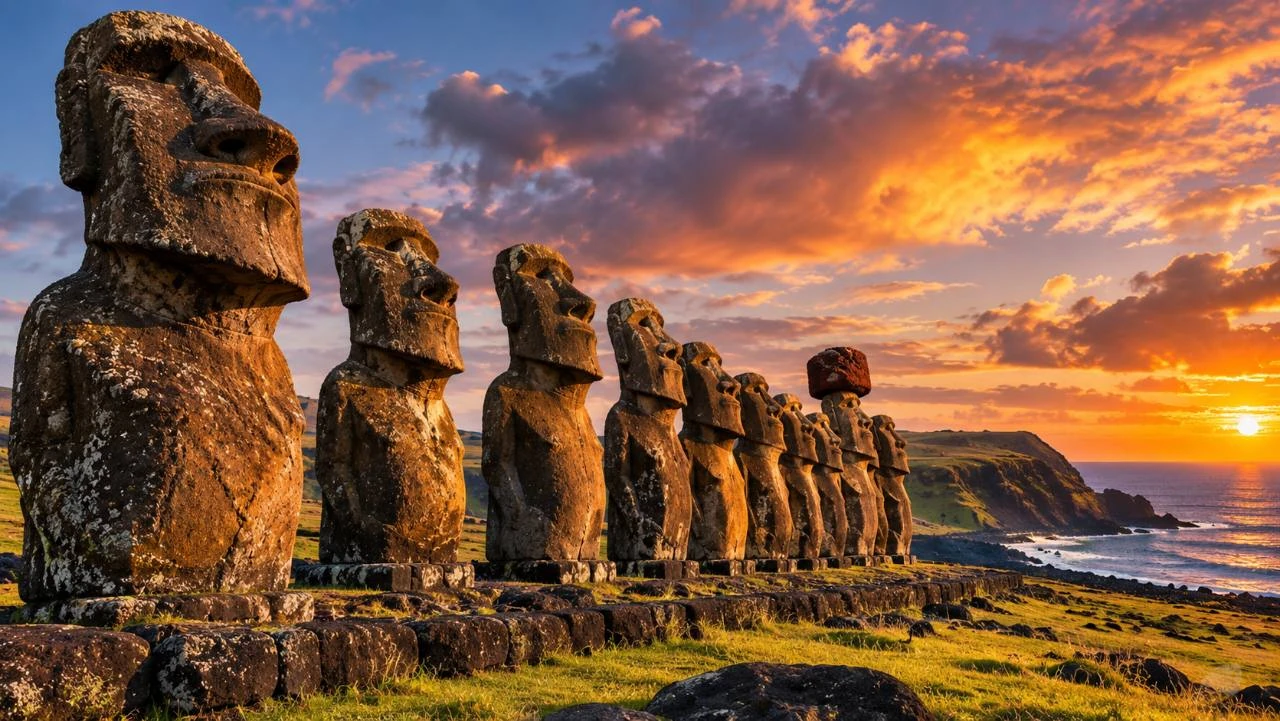
Editorial illustration supplied for PRESDA.
At Rano Raraku, a volcanic crater on Rapa Nui, one of the best clues to the making of the island’s giant statues is a figure that never left the rock. Unfinished moai preserve stages of the carving process that are difficult to see in a completed sculpture. Elsewhere, figures stand on raised stone platforms, while others lie beside old roads or remain partly buried on the quarry slopes. Together they allow archaeologists to ask different questions about carving, transport, ceremony and the way people changed the landscape over time. Museo de Rapa Nui UNESCO World Heritage Centre
Who made the moai and what did they represent?
| Evidence | What researchers ask |
|---|---|
| Unfinished carving at Rano Raraku | How was the figure cut from the rock? |
| Statues beside transport routes | Do the shape and position fit a transport hypothesis? |
| Stone platforms and restored figures | How did the statues relate to ceremonial spaces? |
The moai were made by the Polynesian people of Rapa Nui, an island in the southeastern Pacific that is today administered by Chile. The island’s museum counts nearly 900 moai across several kinds of site. A count depends on what researchers identify as a separate statue and whether incomplete forms and fragments are included. The number covers far more than the rows of upright figures familiar from photographs. It includes sculptures at sites that served different purposes and figures at different points in their working lives. Museo de Rapa Nui UNESCO World Heritage Centre
Ancestors and ceremonial platforms
Many moai stood on ceremonial platforms known as ahu. UNESCO describes a connection with the veneration of ancestors. At many coastal settings the figures face back toward the island, where people lived, rather than out to sea. That orientation helps make sense of their place in community life. It is not a rule that identifies every monument at every site. The platform, associated stones and position within a settlement contain evidence alongside the statue itself. A museum inventory of ahu and moai therefore tells a different story from a photograph of a face removed from its surroundings. Museo de Rapa Nui UNESCO World Heritage Centre
The distinction matters when visiting a site that has been restored. A standing row can demonstrate the scale of a platform and bring together features studied during excavations. Where archaeologists re-erected statues or repaired a structure, the view also reflects recent conservation decisions. A fallen figure records a different stage in that place’s history. Neither is a reason to assume that every platform looked the same when it was in use, or that the order in which monuments were built can be read straight from what stands today. UNESCO World Heritage Centre
Why the quarry is more than a backdrop
Much of the work took place at Rano Raraku, where volcanic tuff offered large surfaces from which to cut the main figures. A visitor can see forms partly freed from the bedrock and figures in other positions on the slopes. Researchers compare these with completed statues to understand the order of work. One useful distinction is between a feature required early for moving or supporting a statue and a feature that could be finished later. Texture and rock type are useful clues, too. Red stone elements called pukao, present on some moai, add another line of inquiry because they were separate pieces and had their own source. Museo de Rapa Nui UNESCO World Heritage Centre
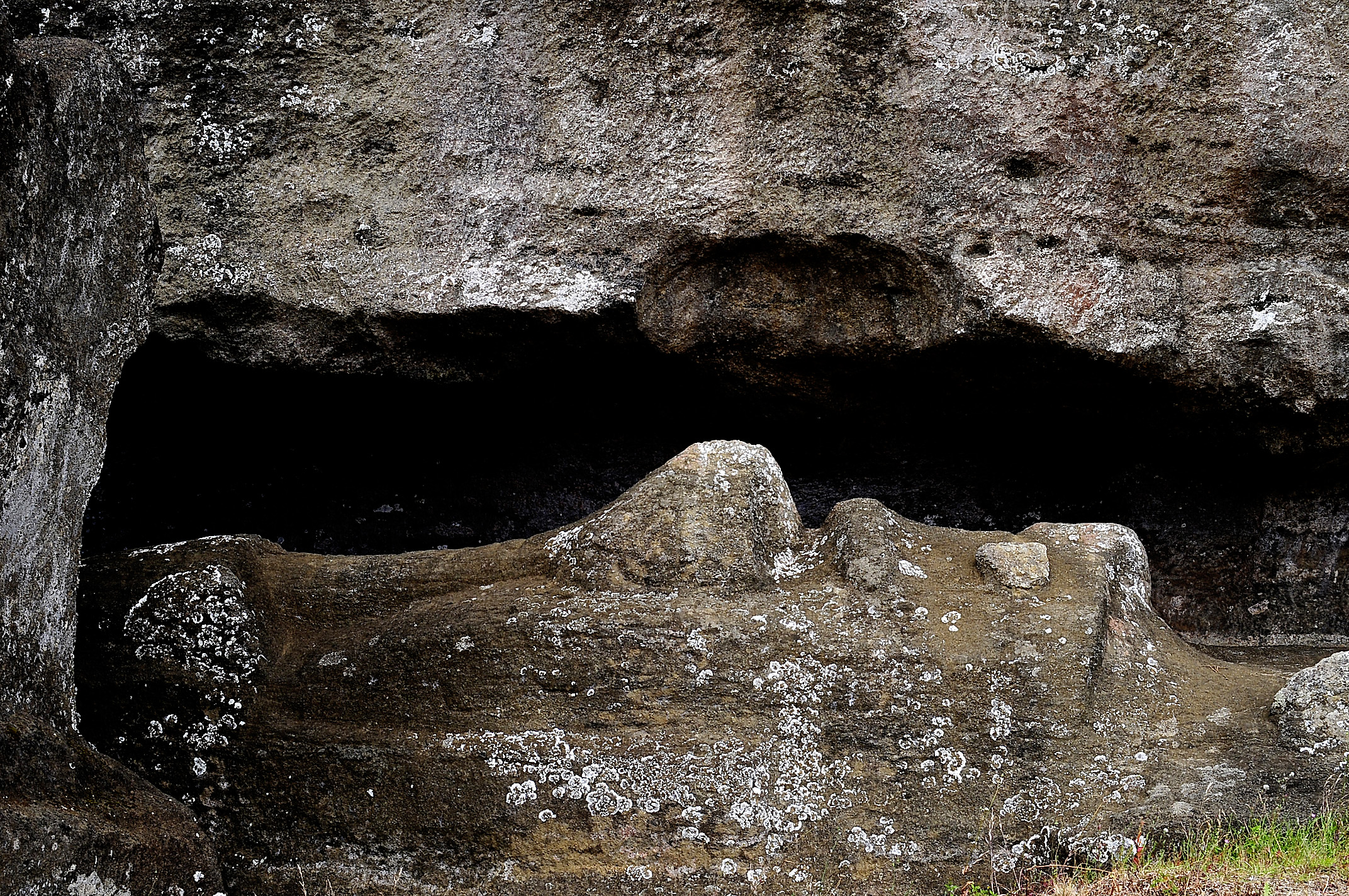
An unfinished moai in the volcanic rock of the Rano Raraku quarry, Rapa Nui.
Why the famous heads have bodies
Some of the quarry statues appear to be isolated heads because only their upper parts rise well above the ground. The sculptures include bodies. Soil accumulated around some of them. The visible part of a figure therefore depends on its position and on what has happened to the ground around it. A comparison with an exposed statue may reveal a torso, arms and hands that would otherwise remain hidden from view. Describing all the statues as heads obscures what the sculptors made and what archaeologists actually have to measure. Museo de Rapa Nui
Could the statues really walk?
The walking hypothesis describes a mechanical process. A team rocks an upright figure from side to side with ropes, moving its base forward in small steps. An experiment with a replica showed that controlled movement of this kind is possible for the form tested. Researchers supporting the hypothesis also compare statues found beside roads with those mounted on platforms. Shape, balance, the position of the base and how a figure might fall can help distinguish a statue prepared for transport from one ready for a platform. The argument rests on the combination of these clues and the experiment. Journal of Archaeological Science research team
What the experiment establishes and where it stops
A successful demonstration establishes feasibility under its own conditions. It does not identify the crew that moved a particular ancient statue or prove everyone used the same approach. The route, the preparation of a sculpture and the size of a figure all matter. A hypothesis about walking can explain one part of a journey while leaving separate questions about how the figure left the quarry, how it was set on an ahu and how a separate pukao was handled. A good answer keeps those tasks distinct. What interests archaeologists most is whether observations made on the island fit the expectations of a given model better than its alternatives. Journal of Archaeological Science research team
What happened to the island’s communities?
The older story often told about Rapa Nui puts the monuments at the centre of a collapse caused by the islanders themselves. The loss of trees, changing land use and the end of particular practices are questions that require evidence of their own. The relationship between those developments and a supposed sharp drop in population has been challenged. A 2024 study of genomes from 15 ancient individuals found no evidence for the seventeenth-century population crash it was designed to test. A study of that size still has limits, and it answers a specific question. It does not cancel documented suffering after European contact, including the nineteenth-century Peruvian slave raids. 2024 ancient-genome study in Nature
The interpretation also changes what readers notice. A monument reflects a community able to organise skilled work, and the landscape records livelihoods beyond statue building. If we begin with a prediction that the inhabitants must have caused their own destruction, we risk treating every carved figure as evidence for that story. The dates of events, records of contact and the archaeology of how people farmed and lived need to be weighed in their own right. The people of Rapa Nui and their descendants also have a stake in how that history is narrated. Museo de Rapa Nui 2024 ancient-genome study in Nature
What Rapa Nui protects today
Rapa Nui National Park joined the UNESCO World Heritage List in 1995. Chile’s National Forestry Corporation describes its administration with the Indigenous Ma’u Henua community. What matters in a visit is not simply seeing the largest figure. Standing paths, stone features and the parts of a site left undisturbed help preserve context. Rules about access protect material evidence and places that carry cultural meaning. A picture is more useful when it says which site it shows and whether it shows a restored arrangement. For another PRESDA look at how Indigenous people preserve and interpret their history, read the feature on the Ainu. UNESCO World Heritage Centre Chile’s National Forestry Corporation
What a missing piece can tell us
A figure’s eyes, its uppermost stone and its platform may have different histories. If a carving stands today without an element that survives elsewhere, an archaeologist has to ask whether it was never installed, was taken away, was lost in a fall or was excluded from a restoration. The same missing feature can have more than one explanation. Quarry and platform evidence can help constrain the choices, but the conclusion may differ from site to site. That is one reason specific site names are valuable in descriptions of the moai. Museo de Rapa Nui UNESCO World Heritage Centre
How the same monument can enter several histories
The stone outcrop, the finished figure and the restored platform each belong to different events. An object moved or photographed later can also acquire an archive of its own. Keeping the quarry, the platform and the present arrangement in view helps readers distinguish what is known about the carving from what is known about its later history. Museo de Rapa Nui UNESCO World Heritage Centre
When an interpretation concerns an entire island, its evidence must cover more than one impressive site. A record of where figures are found lets researchers ask which relationships recur and which are local. Museo de Rapa Nui
FAQ
Frequently Asked Questions
Who built the moai?
The Polynesian people of Rapa Nui carved and erected them.
Were the moai just heads?
No. Many have carved bodies. Soil conceals the lower parts of some quarry figures.
Did the statues walk?
An experimental replica could move upright with ropes. That supports one hypothesis without proving how every ancient statue traveled.
PRESDA Dispatch
Stay Informed. Stay Aware.
A sharp briefing across AI, gaming, sport, business, world affairs, paparazzi, and lifestyle.