Scientists Develop Technology to Send Smells Over the Internet
Ohio State's Scentronic prototype recognizes five odors and triggers remote fragrance release. Explore the research, human tests, limitations and applications.
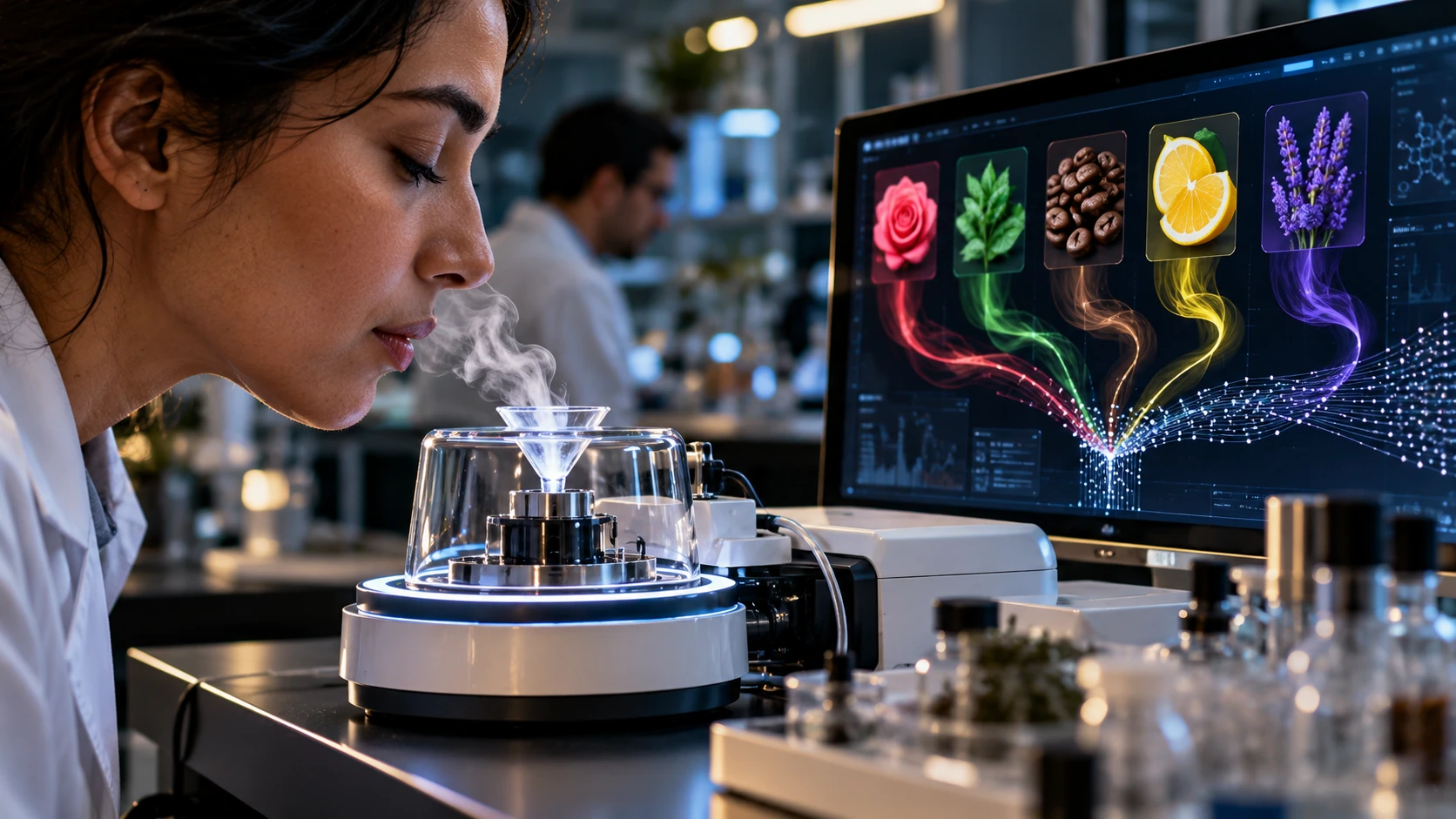
PRESDA AI-generated editorial illustration, not a photograph of the Scentronic prototype. The pictured fragrances do not represent the five odors tested in the study.
Coffee can travel across a video call as an image, a description or the sound of a grinder. Its aroma has remained harder to share. Researchers at The Ohio State University and Zhejiang Laboratory have now demonstrated Scentronic, a system linking electronic odor detection to a remote fragrance dispenser. The achievement is a working connection between sensing and release, with an important boundary: data crosses the internet, while the smell is produced locally from material already inside the receiver. Study record and abstract
The work, published in Science Advances on October 21, 2026, is led by Chunyu Yang and colleagues. It combines machine learning, gas sensing, network communication and a wearable piezoelectric interface. Calling it a technology for sending smells is convenient shorthand. Understanding what it actually sends reveals both why the experiment matters and why an ordinary phone cannot yet download the fragrance of any object placed in front of it. Research DOI
How does Scentronic send a smell?
The system first collects a pattern of responses from gas sensors exposed to an odor. A trained machine-learning model assigns that pattern to a recognized category. An online connection passes the result to a receiving device, which releases a corresponding prepared fragrance. In the demonstration, the categories were coffee, beer, cake, orange and red wine. These five familiar examples define the demonstrated repertoire, rather than an unrestricted ability to copy the chemical world. Reuters interview with lead author Chunyu Yang
Think of the distinction between identifying a song and recording every vibration that produced it. Naming an odor category does not specify every molecule, concentration and temporal change in the original sample. A receiver supplied with a coffee formulation can create a recognizable coffee-like experience, but that does not establish an exact reconstruction of a particular roast, brewing method or kitchen. The useful innovation is the automated chain connecting an encounter with an odor to a remote sensory response.
An electronic nose is a trained measuring instrument
An electronic nose does not smell in the biological sense. Sensors generate signals; software learns relationships between those signals and labeled examples. Its success therefore depends on the samples and conditions used during training. Identifying something among five expected categories is a different problem from deciding what an unfamiliar mixture contains. A useful consumer system would need to handle variation, interference and uncertain inputs, rather than always forcing a confident label onto them.
The human comparison is revealing. According to the US National Institute on Deafness and Other Communication Disorders, airborne molecules stimulate receptors on olfactory sensory neurons, which send signals to the brain. A molecule can activate combinations of receptors. Smell also contributes strongly to flavor through aromas reaching the nose from the mouth. A digital interface must ultimately deliver a chemical stimulus that this biological system can perceive; a screen notification alone cannot do the job. NIDCD: how smell works
What did the experiments establish?
The published abstract describes an integrated platform for remote sensing and olfactory stimulation, with additional demonstrations combining smell and taste. The result establishes that these components can operate together. It does not establish a universal scent codec, clinical effectiveness or the accuracy of every possible real-world transmission. Those are separate claims requiring separate experiments. Science Advances study abstract
Science X's account of the paper reports tests with 14 healthy volunteers: identification was about 73% for individual scents and about 71% for pairs. Those are human recognition results in a limited experiment, not an overall accuracy score for the AI detector. The same account reports a 0.6-second response in one part of the system, while classifying more complex food odors took seconds to tens of seconds. The figures should not be converted into a promise of instantaneous, flawless smell transmission. Science X: experimental results and limitations
These distinctions matter because a successful sensory demonstration can fail at several different points. The detector might choose the wrong category; the dispenser might release an inconsistent amount; a participant might perceive the intended fragrance but name it differently. Larger studies, clearer controls and tests outside the laboratory would help separate these possibilities. The reported identification percentages show a measurable experience, while leaving substantial room for improvement.
Why the receiver still needs scented liquids
The receiving device is physical equipment, not a software update that gives existing hardware a new sense. Yang told Reuters that expanding the repertoire would require both training the detector on additional odors and supplying suitable scented liquids. Reservoirs and atomizers take space, so a phone-connected accessory is a more straightforward possibility than placing an unlimited fragrance library inside a handset. No commercial launch date or consumer price was established in the reporting reviewed for this article. Reuters: prototype constraints
That creates a different distribution problem from streaming music. A downloaded file can be copied repeatedly, but a fragrance supply must be manufactured, delivered and replenished. For a product designer, maintaining the same experience between refills would be as important as getting the wireless connection right. Consent also belongs in the design: users should be able to decide whether, when and how strongly a remote device releases a scent.
A new step in an established research field
Scentronic did not invent electronic smell delivery. A separate Nature Communications paper in 2024 investigated miniaturized odor generators and AI-assisted wearable interfaces for mixed reality. That work addressed response time, energy use and compactness. Its results provide context for the broader engineering effort, but they should not be attributed to the Ohio State system or used to inflate Scentronic's performance. Different prototypes answer different experimental questions. Nature Communications: earlier wearable olfactory research
The distinction is especially useful when a demonstration is described as a breakthrough. An advance can lie in integrating components into a practical experimental chain rather than discovering an entirely new physical principle. Comparing systems requires the same definitions of recognition, delivery, delay and user experience. A fast actuator and a reliable detector are both valuable, yet neither alone guarantees convincing reproduction.
Applications worth testing, rather than promising
The authors describe potential uses in sensory research and multisensory interaction. Controlled delivery could help researchers investigate how people perceive odors; combining it with visual or taste cues could create new experimental environments. Such possibilities are not evidence that Scentronic diagnoses or treats a disease. Clinical use would require appropriate validation, and consumer use would require careful assessment of repeated exposure, usability and reliability. Study scope
For shopping, entertainment or remote social contact, the central question is whether a small, dependable library adds enough value to justify dedicated equipment. That is an open product question, not a forecast of inevitable adoption. As PRESDA's examination of undersea cables shows, digital experiences depend on physical infrastructure. Scentronic makes that dependence unusually tangible: a network carries instructions, and a local device supplies the material that turns those instructions into an experience. PRESDA: the internet's physical network
FAQ
Frequently Asked Questions
What is this PRESDA article about?
Ohio State's Scentronic prototype recognizes five odors and triggers remote fragrance release. Explore the research, human tests, limitations and applications.
Which category does this story belong to?
This story is part of PRESDA's AI coverage.
Who published this article?
Scientists Develop Technology to Send Smells Over the Internet was published by PRESDA Editorial on PRESDA.
PRESDA Dispatch
Stay Informed. Stay Aware.
A sharp briefing across AI, gaming, sport, business, world affairs, paparazzi, and lifestyle.