Video Games: From Arcades to a Global Empire
From Atari and Mario to PC, mobile and Minecraft: explore gaming’s history, cultural impact, business models and uncertain future.
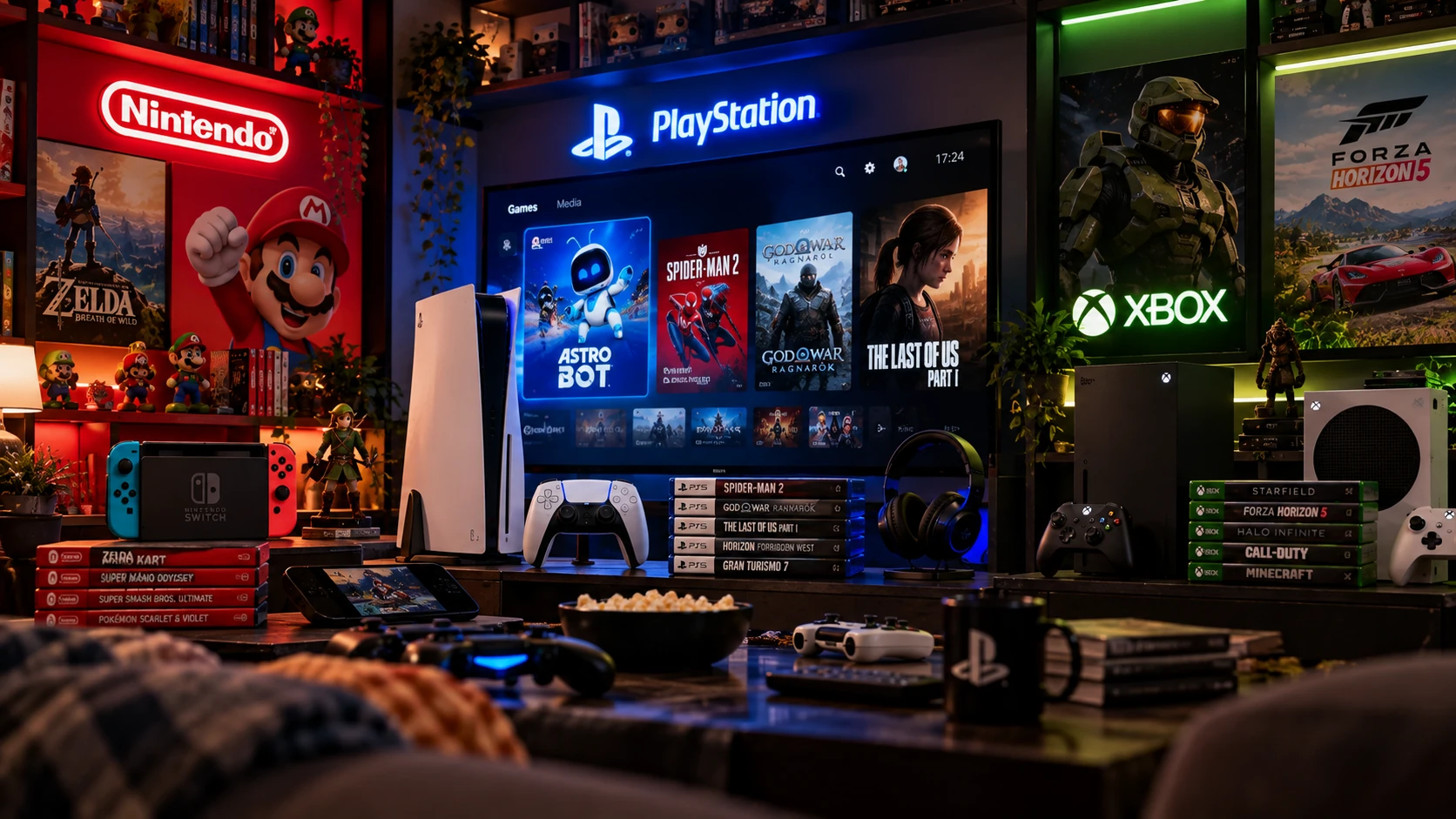
PRESDA AI-generated editorial illustration of an imagined gaming room. Screens, packaging and the fictional FIFA 27 label are not verified products or gameplay captures.
A coin drops into a cabinet. A television becomes a tennis court. Decades later, a phone becomes a portal to a shared world, and a bedroom doubles as a broadcast studio. The history of video games is not simply a march towards more realistic pictures. It is the story of who could play, who could make games and who controlled the spaces where people met.
By 2026, gaming encompasses arcades, consoles, computers, smartphones, competitive arenas and creative communities. These markets overlap but do not move in unison. A blockbuster can thrive while its publisher cuts jobs; an inexpensive independent game can command more attention than an elaborate production. Understanding that diversity is more useful than declaring one machine, genre or country the winner.
Before Pong: an invention with several beginnings
There is no uncontested birthday for the video game. Laboratory experiments, computer programs and television-based devices all contribute to its ancestry. Spacewar!, developed at MIT in 1962, demonstrated interactive play on an expensive research computer. The Magnavox Odyssey brought television gaming into homes in 1972. These were different technical and commercial achievements, not interchangeable claims to being first. Computer History Museum: graphics and games timeline The Strong: Spacewar!
Atari's Pong, engineered by Allan Alcorn and released in 1972, made the idea immediately understandable: move a paddle, return a ball, beat another person. Its importance lay in turning an unfamiliar technology into a social experience that needed little explanation. The screen was simple, but the contest was human. Calling Pong the first video game erases its predecessors; calling it a decisive commercial breakthrough captures its importance. The Strong: Pong
The arcade creates a public culture
Space Invaders in 1978 and Pac-Man in 1980 helped give arcades recognizable characters, sounds and rituals. Players watched one another, learned techniques and competed for high scores. A cabinet occupied physical space, and its economics depended on repeat play. Short sessions, escalating difficulty and the possibility of another attempt were therefore both design choices and business decisions. The Strong: Space Invaders The Strong: Pac-Man
Arcades also made the medium visible outside specialist circles. Their games could be understood by spectators, even when mastery required practice. Later competitive gaming would use networks and streaming platforms, but the older relationship between player, audience and performance was already present. The arcade did not disappear everywhere at once, and its importance varied by country and by genre.
Atari, cartridges and a crash with limits
The Atari Video Computer System, launched in 1977 and later known as the Atari 2600, helped establish the cartridge console as a household product. Separating software from the machine meant that buying new experiences no longer required buying a new television-game device. It also created a valuable relationship between hardware owners, publishers and retailers. Computer History Museum: the development of home gaming
The 1983 crash was a severe disruption of the North American console business, not the extinction of gaming worldwide. Excess inventory, uneven software quality and competition from home computers contributed to the crisis. The familiar story of one unsuccessful E.T. game single-handedly destroying the industry is an appealing shortcut, but it cannot explain a market-wide collapse. Computers and other regional markets continued to matter.
Nintendo and Sega turn machines into identities
Nintendo's Famicom arrived in Japan in 1983; the Nintendo Entertainment System followed in North America in 1985. Super Mario Bros. made running and jumping into a remarkably expressive vocabulary. Its levels taught players through arrangement, repetition and surprise. Mario became more than a mascot: a familiar character could introduce people to unfamiliar mechanics and help sell successive generations of hardware. The Strong: Super Mario Bros.
Sega gave that rivalry a different rhythm. Sonic the Hedgehog, introduced in 1991, emphasized speed and attitude, becoming closely associated with the Mega Drive, called Genesis in North America. Advertising sharpened the contrast, but the competition was also about software libraries, distribution and how teenagers imagined themselves. The outcome was not predetermined by processor specifications. The Strong: Sonic the Hedgehog
PlayStation and the move into three dimensions
Sony launched PlayStation in Japan on December 3, 1994, with North American and European launches following in 1995. Optical discs offered different storage and manufacturing possibilities from cartridges. Polygonal environments, recorded sound and cinematic presentation helped expand what publishers could build, while also creating new problems in camera control, navigation and production cost. PlayStation: the original console
Three-dimensional games were not invented by Sony, and technical progress did not make earlier styles obsolete. The change was a wider commercial adoption of experiences organized around explorable space. Grand Theft Auto III, released in 2001, helped popularize the urban open world as a place to navigate, improvise and interrupt. Its influence extended beyond its crime fiction to the structure of many later games. The Strong: Grand Theft Auto III
PC gaming develops its own language
The computer was never merely a console with a keyboard. It supported strategy, simulation, role-playing, experimentation and modification alongside action games. Doom in 1993 illustrated how distribution and player participation could reinforce design: shareware encouraged discovery, networked play changed the social experience and user-made modifications extended the game's life. The Strong: Doom
That tradition remains visible in modding communities and independent development. Digital stores lowered some distribution barriers while making discoverability a new obstacle. A creator can reach customers without manufacturing cartridges, yet still struggle for visibility among thousands of releases. Open hardware configurations also create testing and compatibility work that a fixed console specification can reduce.
Xbox and the connected living room
The original Xbox launched in 2001, and Xbox Live followed in 2002. Halo: Combat Evolved helped establish the platform's identity, while connected services gradually made friends lists, accounts and online competition central to console life. Microsoft did not invent networked gaming; it helped package it as an integrated living-room service. Xbox: twenty years of play
Connectivity changed the relationship between release and completion. A game could receive patches, expansions and seasonal updates after purchase. That could repair problems and sustain communities, but it also made continued access dependent on servers, licensing and the publisher's priorities. The social benefit of a persistent world comes with a practical question: what survives when its operator leaves?
Football, war and the power of recurring franchises
EA's FIFA games turned licensed football into an annual ritual for many players. The branding changed to EA Sports FC in 2023 after EA and FIFA ended that naming arrangement. FIFA remains a football governing body and a separate brand; EA's current series should not automatically be called FIFA. The imagined “FIFA 27” lettering in this article's illustrated hero is not a verified game announcement. EA: the transition to EA Sports FC
Call of Duty began in 2003 and developed into a major military-action franchise spanning campaigns, multiplayer and other formats. Its history shows how familiar controls, shared competition and recurring releases can build durable habits. GTA follows a different rhythm, with large releases and long-running online engagement. Neither franchise's audience can be reduced to a single motive, and commercial success is not a measure of historical or artistic accuracy. Call of Duty: twentieth anniversary
Minecraft and the player as a maker
Minecraft's blocks turned construction into a language that could be learned through play. Survival, exploration, building and collaboration coexist rather than requiring every player to follow one script. Mojang's anniversary history records the milestone of 300 million copies sold in 2023. That is a dated sales milestone, not a claim about the number of people playing today. Minecraft: anniversary timeline
The larger lesson is that players can supply part of a game's cultural life. Buildings, modifications, tutorials and shared challenges travel beyond the original software. This does not eliminate the work of professional developers. It adds another layer of authorship, with questions about moderation, compensation and ownership whenever creativity becomes part of a commercial platform.
The smartphone changes the scale
Mobile gaming expanded access by placing games on devices people already carried. Touch controls, short sessions and easy distribution supported new designs and reached audiences poorly represented by the old image of a dedicated console enthusiast. Free-to-play reduced the initial price barrier, but revenue could come from advertising, subscriptions or optional purchases instead of an upfront sale.
Those models require careful interpretation. Free installation does not mean zero spending, and a download is not an active player. Some games offer generous entertainment without payment; others make progression, randomized rewards or repeated prompts central to monetization. The relevant question is not whether mobile games are “real” games, but how their systems respect a player's time, money and attention.
How large is the industry in 2026?
Newzoo's June 2026 retrospective estimated global games revenue at $201.6 billion for 2025, up 9.1% on its previous-year measure. It placed PC revenue at $43.6 billion. These are the research firm's market estimates, not an audited worldwide census, and they should not be mixed with hardware revenue or other definitions of the entertainment economy. Newzoo: revised 2025 global games market
The date matters because forecasts are revised as evidence arrives. Full-year 2026 is still unfinished at this article's October 21 review. Announced release schedules, hardware availability, exchange rates and consumer spending can change the result. Comparisons claiming games are bigger than several other industries combined often obscure different measurement methods. A clear boundary is more informative than an impressive total.
Better technology, different artistic choices
Graphics processors, faster storage, motion capture and improved audio have expanded developers' tools. Ray tracing can model aspects of light transport, while reconstruction techniques can help produce higher-resolution output from lower-resolution rendering. Neither feature guarantees good art direction or enjoyable interaction. Performance, responsiveness, accessibility and the clarity of visual information remain design choices.
The same applies to scale. A larger map creates more space to fill, maintain and test. A smaller game can use constraints to produce greater coherence. Two-dimensional art, text adventures and turn-based mechanics survive because they express different ideas, not because their creators failed to discover modern hardware. Progress in games is an expansion of possibilities rather than a single ladder.
Culture, community and the cost of success
Games now provide shared references across films, music, fashion, online video and everyday conversation. They can connect distant friends, offer spaces for experimentation and support serious creative work. They can also expose people to harassment, manipulative spending systems or exclusionary communities. These outcomes depend on design, moderation and context; neither universal celebration nor blanket condemnation explains them well.
Preservation is a cultural challenge as well as a technical one. Hardware fails, storefronts close and online dependencies can make purchased experiences inaccessible. Museums preserve objects and documentation, but saving a cartridge is not always equivalent to saving the conditions in which a networked game was played. Keeping the history legible requires software, equipment, records and the memories of players and developers. The Strong: electronic games collections
The future is plural
Cloud delivery, handheld PCs, mixed reality and generative tools may alter how games are produced and accessed. Their adoption depends on latency, price, comfort, rights and whether they serve a compelling experience. Generative AI also raises unresolved questions about training permissions, creative labor and reliable output. Possibility should not be presented as a launch date or a guaranteed industry transformation.
The most durable thread from the arcade to 2026 is not graphical realism. It is the capacity to make rules feel meaningful through action, discovery and other people. The business struggle behind those experiences is examined separately in PRESDA's analysis of PlayStation, Xbox and Nintendo. The machines matter, but the medium is larger than the machines.
FAQ
Frequently Asked Questions
What is this PRESDA article about?
From Atari and Mario to PC, mobile and Minecraft: explore gaming’s history, cultural impact, business models and uncertain future.
Which category does this story belong to?
This story is part of PRESDA's AI coverage.
Who published this article?
Video Games: From Arcades to a Global Empire was published by PRESDA Editorial on PRESDA.
PRESDA Dispatch
Stay Informed. Stay Aware.
A sharp briefing across AI, gaming, sport, business, world affairs, paparazzi, and lifestyle.