The Console Wars: PlayStation, Xbox and Nintendo
How Sony, Microsoft and Nintendo compete: console history, dated sales figures, exclusives, subscriptions, acquisitions and strategy in 2026.
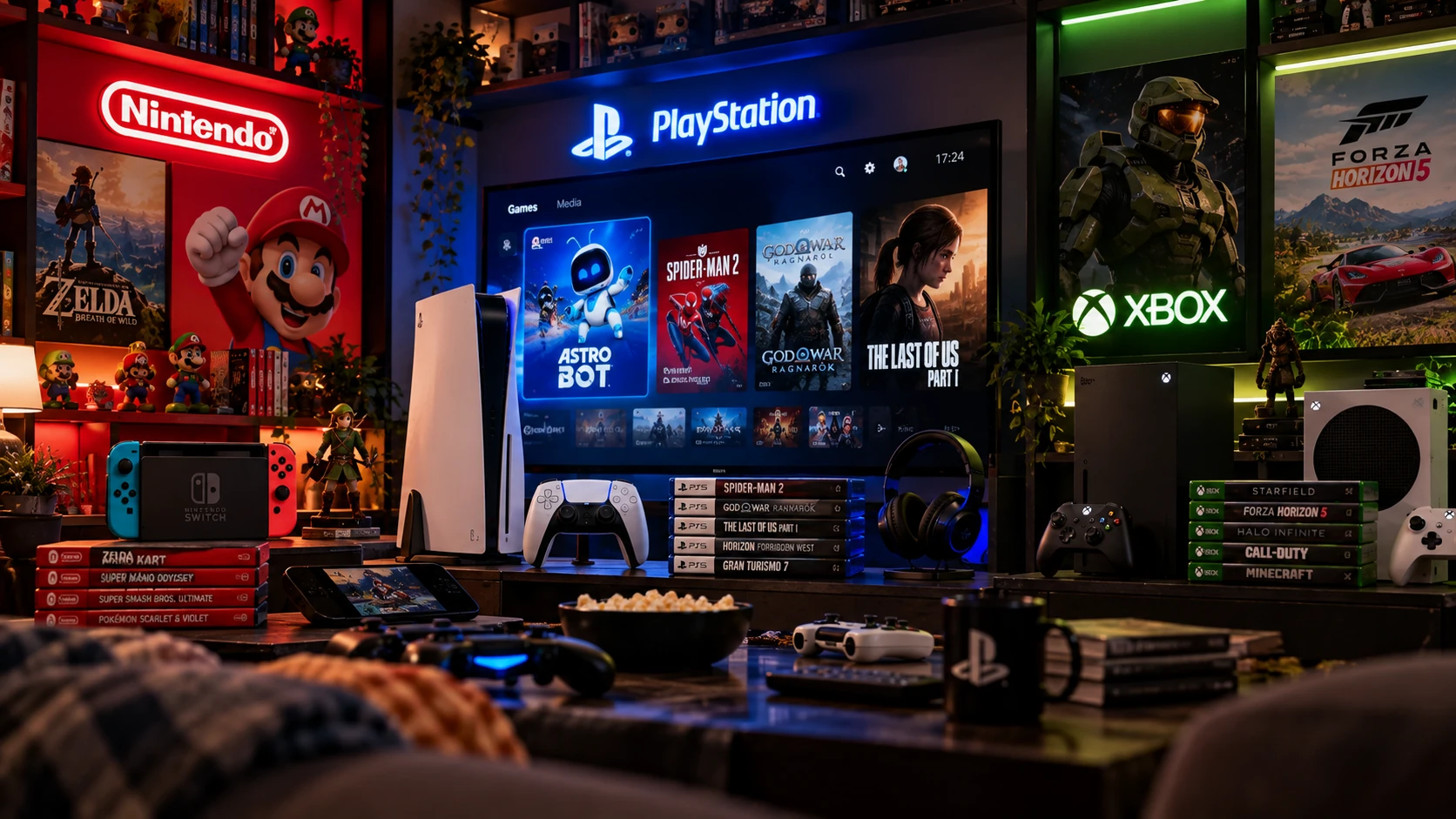
PRESDA AI-generated editorial illustration of an imagined multi-console room. Product arrangements, screens and packaging are illustrative, not official brand photography or verified gameplay.
The most revealing image of the console wars is no longer three machines beneath a television. It is a player moving between a console, a computer and a handheld, carrying an account, a library and a group of friends. Sony, Microsoft and Nintendo still compete for hardware sales, but they increasingly disagree about what winning should mean.
PlayStation concentrates a powerful console ecosystem around software, services and recognizable franchises. Xbox combines hardware with publishing, PC distribution and subscriptions. Nintendo connects distinctive devices to characters and experiences that are difficult to substitute. In 2026 these are overlapping businesses, not three identical armies fighting over one fixed territory. This analysis reviews public information available on October 21, 2026.
Before the three-way rivalry
The modern contest grew out of an earlier struggle. Nintendo and Sega made software identity central to the 1980s and 1990s console market. Mario and Sonic helped families distinguish not just products but imagined styles of play. Their competition also demonstrated that third-party support, retail relationships and timing could matter as much as a machine's technical promise. The Strong: Sonic and the console rivalry
Sony's original PlayStation arrived in Japan in December 1994. Its disc-based software and three-dimensional games helped establish a new platform with broad publisher support. Microsoft entered with Xbox in 2001. Nintendo remained, while Sega eventually left console manufacturing. The present trio was therefore the result of changing industrial fortunes, not an arrangement that existed from gaming's beginning. PlayStation: 1994 history Xbox: the original launch
Generations are useful, but imperfect
Sony's main sequence runs from PlayStation in 1994 to PS2 in 2000, PS3 in 2006, PS4 in 2013 and PS5 in 2020. Microsoft moved from Xbox in 2001 to Xbox 360 in 2005, Xbox One in 2013 and Series X and Series S in 2020. These are first-launch years, not a claim that every country received each console simultaneously. Sony: company timeline Xbox: twenty-year retrospective
Nintendo's path crosses the home and portable categories. GameCube, Wii and Wii U preceded the hybrid Switch, launched in 2017, and Switch 2, released on June 5, 2025. The handheld business also mattered independently through Game Boy and Nintendo DS. Comparing devices only by a numbered “generation” can hide different launch dates, audiences and intended uses. Nintendo: hardware sales history Nintendo: Switch 2 launch
PlayStation: the strength and burden of scale
Sony built a business in which the console brings customers into a wider network of games, payments, social connections and subscriptions. Franchises such as Gran Turismo, God of War and The Last of Us help define its identity, while third-party games contribute to the platform's everyday appeal. A large installed base can attract developers, whose releases make that base more valuable.
Scale also raises expectations. Expensive productions need substantial sales or sustained spending to justify their costs, and a delayed release can leave a noticeable gap. Selective PC releases broaden the potential audience but complicate the meaning of exclusivity. Sony's own financial reporting separately identifies revenue from games published on non-PlayStation platforms, confirming that the business already extends beyond its consoles. Sony: FY2026 first-quarter supplemental data
Xbox: a platform and a publisher
Xbox's strategic question is whether the most valuable customer must own an Xbox console. Windows gaming, subscriptions and multiplatform releases offer other routes to revenue. Forza Horizon 5's standard PlayStation 5 release on April 29, 2025 provides a concrete example: a franchise associated with Xbox can also sell on Sony's machine. It does not follow that every Xbox game has the same release policy. Forza: the PlayStation 5 release
This strategy can enlarge an audience while weakening the old argument that particular software requires particular hardware. It creates a genuine tension rather than a simple surrender or victory. Microsoft can benefit from rival platforms as a publisher while still wanting its own devices and services to remain attractive. Revenue, profit, customer retention and hardware shipments may therefore tell different stories.
Nintendo: differentiation rather than imitation
Nintendo's strongest proposition is the combination of familiar intellectual property and a distinctive way to play. The Wii emphasized motion control; the Switch joined television and portable use in one device. Mario, Zelda and Animal Crossing give that hardware a recognizable purpose. The strategy does not require matching a rival's highest graphics specification in every generation.
Switch 2 develops the hybrid model rather than abandoning it. Nintendo's specifications include a higher-resolution built-in display, mouse sensors in Joy-Con 2 controllers and support for different output modes. Up to 4K television output and up to 120 frames per second are conditional capabilities, not a promise of simultaneous maximum resolution and frame rate in every game. Nintendo: Switch 2 technical specifications
What the sales figures actually establish
Sony's business-data page reports more than 95 million PS5 units sold into distribution by June 30, 2026. Nintendo lists 156.59 million original Switch units and 23.68 million Switch 2 units as of that same date. These cumulative manufacturer figures describe machines across different lifetimes. They are not a count of unique households or an apples-to-apples measure of 2026 performance. Sony: hardware sell-in data Nintendo: hardware totals
Microsoft does not provide a matching regularly updated Series X and Series S cumulative total in the disclosures used here, so this article does not turn an analyst estimate into an official figure. Sell-in means sales into the distribution channel; sell-through refers to purchases by end customers. Active accounts, subscriptions and software revenue answer still other questions. A chart that mixes them can create a false winner.
Innovation is more than graphical power
The shift from cartridges to discs changed storage and manufacturing. Online accounts changed continuity between games. Motion controls and hybrid play changed where and how people could participate. Solid-state storage reduced some loading constraints, while controller feedback made touch another channel for information. Each innovation requires thoughtful software to become more than a specification on a box.
PS5 Pro, launched on November 7, 2024, illustrates the modern mid-generation upgrade. Sony emphasizes improved rendering and PlayStation Spectral Super Resolution, its reconstruction technology. It remains part of the PS5 family, not a separate PS6 generation. Benefits vary with the game, its updates, display equipment and the balance chosen between image quality and performance. Sony: PS5 Pro launch
Failures reveal the limits of brand loyalty
Nintendo's Wii U sold 13.56 million hardware units over its life, according to Nintendo's published totals. That is a stark contrast with the original Switch. It does not mean every Wii U game failed artistically, but it shows that recognizable characters cannot guarantee widespread hardware adoption. Product clarity, software cadence and the usefulness of a device's distinctive feature all matter. Nintendo: Wii U and Switch totals
Microsoft's Xbox 360 hardware failures produced a major warranty response. In July 2007, the company announced a $1.05 billion to $1.15 billion pre-tax charge for anticipated warranty costs. In 2013, it reversed controversial Xbox One connectivity and game-sharing policies before launch. These episodes concern different problems, but both show that customers judge reliability and control as well as game libraries. Microsoft: Xbox 360 warranty Xbox: June 2013 policy reversal
Sony has also discovered that a strong platform cannot guarantee success for every service game. Concord was taken offline on September 6, 2024, with refunds announced for purchasers. The case illustrates the difficulty of attracting a sustainable community in a crowded market. It does not justify inventing a development budget or attributing the outcome to one unverified cause. PlayStation: Concord withdrawal and refunds
Subscriptions sell access, not permanent ownership
PlayStation Plus, Xbox Game Pass and Nintendo Switch Online are not interchangeable bundles. Their tiers can combine online features, rotating libraries, older games and other benefits in different ways. Availability varies by country, device and plan. A game entering a subscription does not necessarily remain forever, and cancelling access is different from keeping a separately purchased copy. PlayStation: Plus benefits and conditions Xbox: current Game Pass catalogue
Policies also change. Microsoft's April 21, 2026 update said future Call of Duty releases would no longer join Ultimate or PC Game Pass at launch, instead arriving in the following holiday season, about a year later. A September announcement described cloud-playtime changes planned for November. At this article's October review, those November arrangements are upcoming, not already implemented facts. Xbox: April 2026 Game Pass update Xbox: planned November cloud changes
Acquisitions redraw the competition
Microsoft announced its ZeniMax acquisition in 2020 at $7.5 billion in cash. Its Activision Blizzard transaction, completed on October 13, 2023, added a much larger portfolio. The widely quoted $68.7 billion was the announced deal value inclusive of Activision Blizzard's net cash, not a universal label for every accounting measure of the purchase. Microsoft: ZeniMax announcement Microsoft: Activision deal terms SEC: completion filing
Regulators examined the ability to restrict access to valuable content. The UK's final process involved a restructured arrangement concerning cloud rights and Ubisoft. The lesson is that owning a studio does not remove contractual and regulatory constraints. Nor does buying famous intellectual property guarantee a coherent release schedule, successful integration or creative stability. UK Competition and Markets Authority: merger record
Exclusivity now comes in several forms
A game may be exclusive to one console family but also available on PC. Another may arrive elsewhere after a delay, or allow cross-play without cross-progression. These are separate permissions and technical features. A shared publisher, account or franchise name does not establish which purchases or saved progress transfer between platforms.
For players, the practical comparison begins with actual games, friends and existing purchases. Then come accessibility options, storage, controllers, repair arrangements and the cost of the relevant subscriptions. The cheapest machine is not necessarily the least expensive setup over several years. Conversely, paying for the most powerful model may bring little benefit to someone whose preferred games do not use its advantages.
The competitive landscape in 2026
The three companies also compete with PC ecosystems, phones and the attention demanded by established online games. Hardware cycles do not reset a player's friendships or digital library. Backward compatibility and continuity can reduce the disruption of upgrading, while an incompatible purchase or unavailable service can make switching costly. This is why the modern competition often concerns an account relationship rather than one transaction.
Sony's June 2026 monthly-active-user figure was 125 million accounts. Its definition covers accounts that played games or used online services during the last month of the quarter. It is not a PS5 owner count and not a PlayStation Plus subscriber total. Keeping those distinctions visible prevents a large engagement number from becoming a misleading hardware claim. Sony: activity metric and definition
What would winning look like?
There is no single scoreboard that captures artistic influence, profitability, consumer value and installed hardware. Nintendo can succeed through differentiated devices, Sony through an active console ecosystem and Microsoft through software distributed across many screens. These approaches can coexist, but each faces execution risks, cost pressures and the need to earn trust over time.
The most useful future test is whether competition produces better games, fairer access and durable libraries, not simply louder declarations of victory. Unannounced hardware dates and speculative sales forecasts should remain speculation. For the broader story behind these platforms, read PRESDA's history of video games from arcades to a global industry.
FAQ
Frequently Asked Questions
What is this PRESDA article about?
How Sony, Microsoft and Nintendo compete: console history, dated sales figures, exclusives, subscriptions, acquisitions and strategy in 2026.
Which category does this story belong to?
This story is part of PRESDA's AI coverage.
Who published this article?
The Console Wars: PlayStation, Xbox and Nintendo was published by PRESDA Editorial on PRESDA.
PRESDA Dispatch
Stay Informed. Stay Aware.
A sharp briefing across AI, gaming, sport, business, world affairs, paparazzi, and lifestyle.