THE SIEGE OF MECCA: HOW GUNMEN SEIZED ISLAM’S HOLIEST MOSQUE IN 1979
In November 1979, Juhayman al-Otaybi’s followers seized the Grand Mosque. The siege lasted two weeks and sent rumors far beyond Mecca.
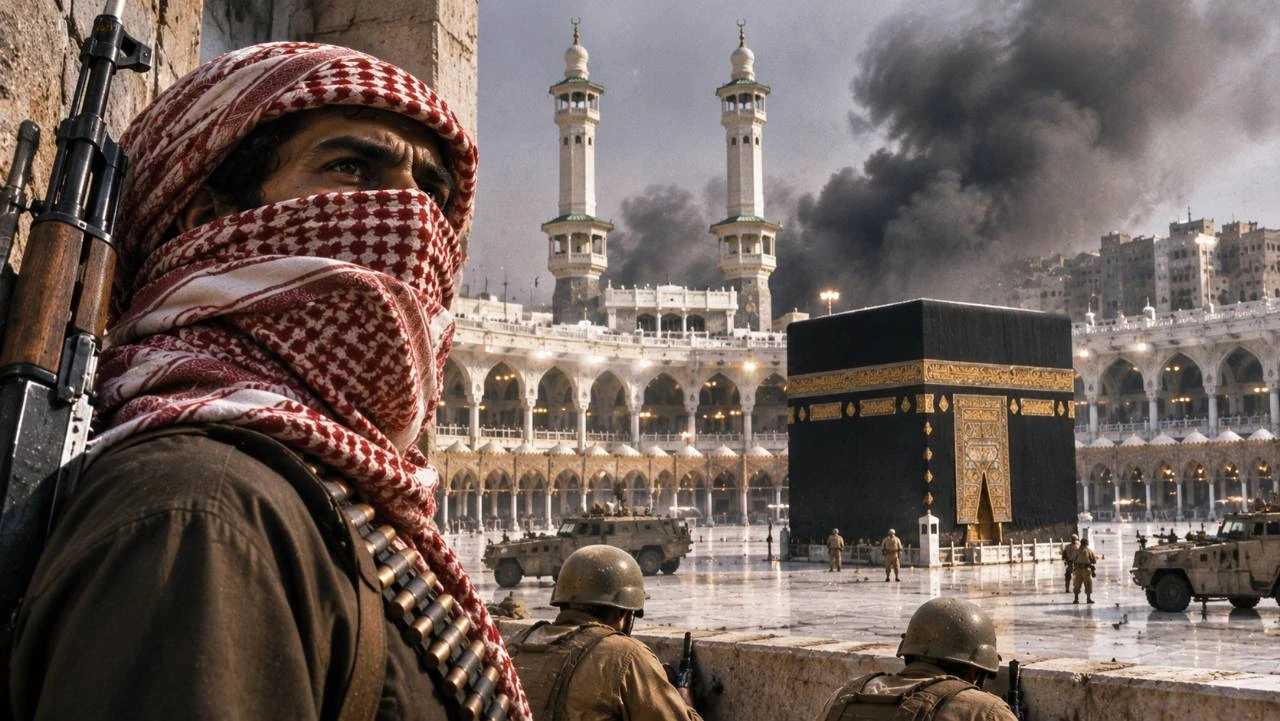
AI-generated historical illustration. The people, vehicles and layout are imagined and do not document the events of 1979.
On 20 November 1979, armed followers of Juhayman al-Otaybi seized the Grand Mosque in Mecca, the sanctuary that surrounds the Kaaba. Worshippers were caught up in a crisis that lasted roughly two weeks. Saudi forces regained control on 4 December. The episode took place at the beginning of the Islamic year 1400, a date that mattered to the attackers’ claims. For those at the mosque, a day of worship suddenly became a struggle to get to safety. Pascal Ménoret: the 1979 Mecca siege
Who led the seizure?
Juhayman led a faction that had broken away from a broader religious movement with roots in Medina. Its followers declared Muhammad ibn Abdullah al-Qahtani to be the Mahdi, an expected figure in Islamic tradition. That identification was the faction’s claim. Historians Thomas Hegghammer and Stéphane Lacroix trace the group through local religious networks and a break with Saudi institutions. Their research helps explain why the gunmen’s Saudi origins matter to understanding the event. Hegghammer and Lacroix: research on Juhayman’s movement
Why the sanctuary mattered
The Kaaba is the point toward which Muslims turn in prayer. The presence of worshippers and the sacred status of the mosque shaped the crisis and the authorities’ response. Saudi religious scholars addressed the permissibility of force in the sanctuary. Al-Qahtani died during the siege, and Saudi authorities captured Juhayman, who was later executed. Published accounts differ on the number of dead and on details of foreign assistance. The end date and the identity of the forces that regained control are more firmly established than many of those particulars. Pascal Ménoret: the 1979 Mecca siege
How rumors outran the news
A U.S. Embassy telegram from 21 November shows diplomats still trying to establish who was responsible. Its provisional report even put al-Qahtani at the head of the seizure. The initial uncertainty matters because false accusations about American involvement circulated abroad. A diplomatic cable can show what officials believed on a particular day. Its proximity to the event cannot make every early report accurate. U.S. Office of the Historian: contemporary reports and rumors
What the siege can explain
The seizure exposed a conflict that had developed within Saudi Arabia over years. Its timing invites comparison with other upheavals in 1979, including the Iranian Revolution. A shared year alone does not establish a common origin. Research into Juhayman’s movement points to a particular history of religious organizing, internal splits and confrontation with Saudi authorities. That history puts the people and institutions involved back at the center of an episode often remembered only for its setting. Hegghammer and Lacroix: research on Juhayman’s movement
The repercussions in Islamabad
On 21 November, the crisis had consequences far from Saudi Arabia. Protesters attacked the U.S. embassy in Islamabad, Pakistan. American diplomatic records connect the unrest with rapidly circulating claims of U.S. involvement in Mecca. The attack in Islamabad belongs to the history of the siege’s reception abroad. It shows how quickly a claim about an event at a sacred site could spread before reliable accounts reached the public. U.S. Office of the Historian: Islamabad and the Mecca reports
Related reading · The Abbasid Caliphate · The fall of Constantinople
FAQ
Frequently Asked Questions
When did the siege of Mecca take place?
It began on 20 November 1979 and ended on 4 December, when Saudi forces regained control.
Who were Juhayman and al-Qahtani?
Juhayman led the faction. His followers proclaimed Muhammad al-Qahtani to be the Mahdi.
Was the siege an operation by Iran?
Historical research identifies a Saudi-led faction with local roots. Early rumors of foreign responsibility are not evidence of sponsorship.
PRESDA Dispatch
Stay Informed. Stay Aware.
A sharp briefing across AI, gaming, sport, business, world affairs, paparazzi, and lifestyle.