THE FALL OF CONSTANTINOPLE: SULTAN MEHMED II’S HISTORIC CONQUEST
How Mehmed II captured Constantinople on May 29, 1453: the siege, Byzantine defenders, Ottoman strategy, civilian suffering and the city’s transformation.
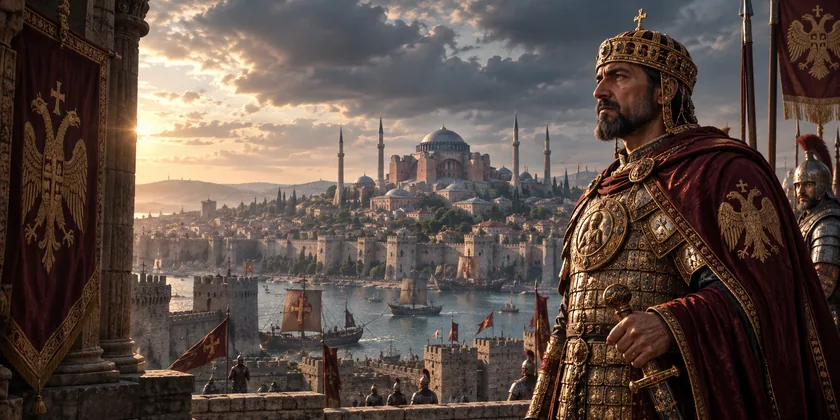
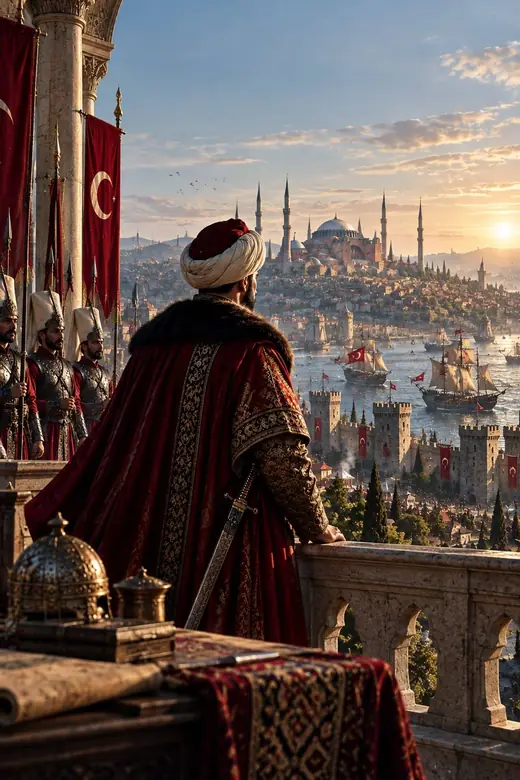
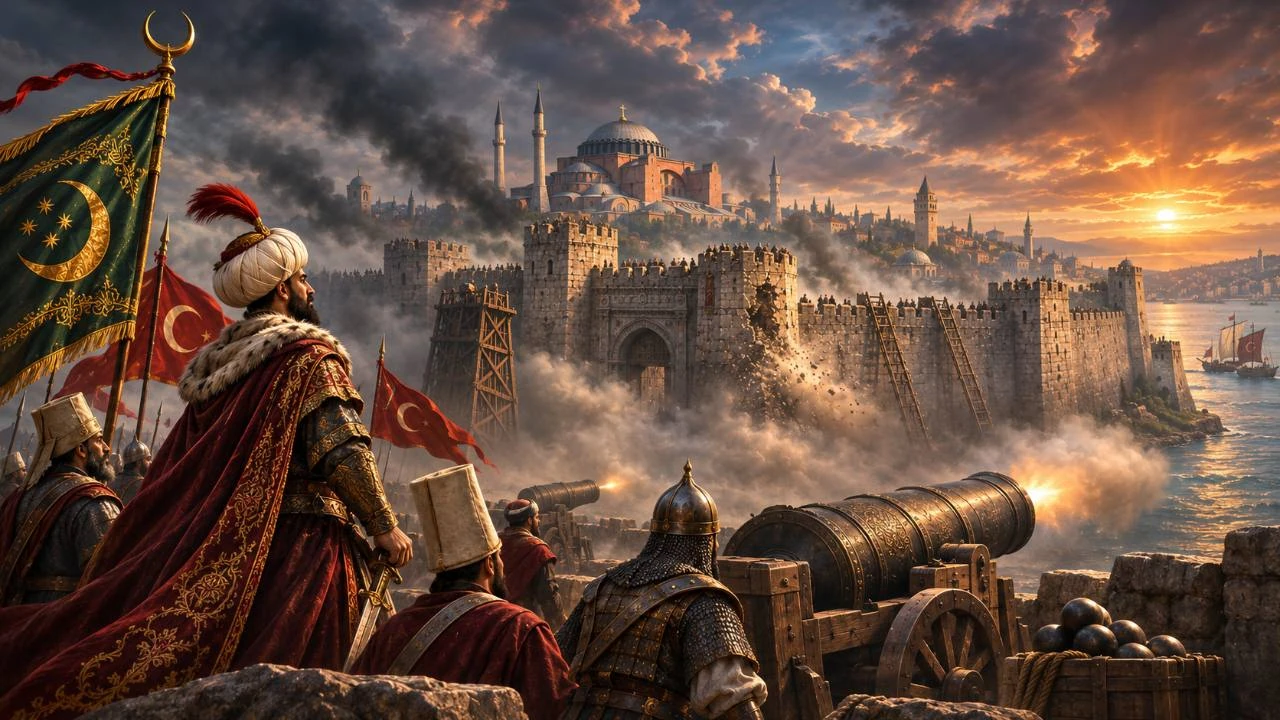
AI-generated historical illustration supplied for PRESDA. Mehmed’s pose, uniforms, flags, cannon, battle and city layout are imagined. Hagia Sophia’s minarets shown in the scene belong to its later Ottoman history, not its appearance before the conquest. This is not a documentary reconstruction of May 29, 1453.
On May 29, 1453, Ottoman forces under Sultan Mehmed II captured Constantinople after a siege lasting nearly two months. For the conqueror, the city offered the centre of an expanding imperial project. For the defeated Byzantine population, it brought violent loss and a profound political rupture. Both perspectives belong to the history. The conquest ended Byzantine imperial rule in its capital, but it did not erase the people, religious traditions or cultural achievements that had shaped the city. Byzantine and Christian Museum: the fall and its cultural aftermath
Why Constantinople mattered
The city occupied a strategic position between the Balkans and Anatolia, linking the Black Sea and the Mediterranean through the Bosporus. Its importance was not simply the strength of a wall. It combined imperial prestige, trade, religious institutions and a remarkably layered urban landscape. UNESCO’s account places its Byzantine and Ottoman monuments within more than two millennia of history, a useful reminder that no single conquest explains the whole city. UNESCO: the historic areas of Istanbul
By 1453, the Byzantine state was far smaller than the empire that had once dominated the eastern Mediterranean. The sack by the Fourth Crusade in 1204 and the recovery of the city in 1261 were essential parts of that earlier history. Mehmed faced a capital whose symbolic importance exceeded its remaining resources. His opponent, Emperor Constantine XI Palaiologos, sought outside assistance while trying to defend an extensive fortified perimeter. British Library: the last day of Constantinople and manuscript accounts
Mehmed’s strategy combined land and sea
Ottoman preparations brought together troops, ships, engineering and gunpowder artillery. Heavy bombards threatened masonry, while the fleet restricted the arrival of supplies and reinforcements. The conflict was not a simple meeting of two culturally uniform armies: Mehmed drew on Muslim and Christian vassals, and the defenders included Italian allies. Logistics and political relationships mattered alongside weapons. A cannon could damage a wall, but it could not organise a successful siege by itself. OpenStax, Rice University: Ottoman expansion and siege artillery
Ships in the Golden Horn
One of the siege’s best-known manoeuvres was the movement of Ottoman ships overland into the Golden Horn, bypassing the chain that protected its entrance. The operation increased pressure on the defenders by creating additional threats around the city. It should be understood as part of a wider campaign of bombardment, repair, blockade and assault. Reducing the outcome to one ingenious move, or one enormous gun, hides the prolonged contest that made the final attack possible. Mark Cartwright, World History Encyclopedia: the siege of 1453
May 29: conquest and catastrophe
The final assault broke the defence on May 29. Constantine XI died during the city’s fall, although dramatic accounts of his last moments cannot all be treated as equally secure. The capture brought killing, pillage and enslavement as well as an Ottoman victory. Those consequences are part of the event, not a footnote to military success. Precise troop and casualty totals vary between sources, so large, confident numbers require particular caution. Mark Cartwright, World History Encyclopedia: the siege of 1453
Making an Ottoman capital
Mehmed’s achievement did not end with entering the city. He made it his capital and pursued rebuilding, resettlement and institutional reorganisation. Restoring roads, water supplies, markets and religious foundations helped sustain the imperial centre. Some resettlement was coerced, a reminder that reconstruction was also an exercise of power. Hagia Sophia’s conversion from church to mosque became one of the most visible expressions of the new order. Ashmolean Museum, Oxford: Mehmed II and the rebuilding of Istanbul
The name Istanbul gradually displaced Constantinople in common usage; it was not simply invented overnight in 1453. Likewise, the Byzantine world did not vanish on the day the walls fell. Orthodox institutions and artistic traditions continued under changed political conditions. Other former Byzantine centres also had their own later histories. A decisive imperial rupture and substantial cultural continuity can both be true. Metropolitan Museum of Art: the Balkans, 1400–1600
What the famous stories leave out
The conquest did not single-handedly start the Renaissance. Greek scholars had travelled to Italy and contributed to humanist learning before 1453, including Manuel Chrysoloras in the late fourteenth century. The fall intensified some movements of people and knowledge, but a long intellectual transformation cannot be assigned to one battle. Historical turning points help organise a timeline; they should not replace explanations of processes already under way. Metropolitan Museum of Art: the Balkans, 1400–1600
The Byzantine and Christian Museum records how the last emperor became a figure of legend, including the story of a ruler turned to marble who would return. Such traditions reveal how communities understood loss; they are not evidence that the event occurred as the legend describes. Mehmed’s historic conquest is best understood through this distinction: the city changed rulers, its inhabitants faced upheaval, and its many histories continued to develop beyond the battlefield. Byzantine and Christian Museum: the fall and its cultural aftermath
Related reading: The Ottoman Empire’s rise and transformation.
Related reading: The Byzantine Empire and the long survival of Eastern Rome.
FAQ
Frequently Asked Questions
When did Constantinople fall to Mehmed II?
Ottoman forces captured Constantinople on May 29, 1453, after a siege beginning in April.
Who defended the city?
Emperor Constantine XI led the Byzantine defence, supported by troops and volunteers including Italian allies.
Did the conquest erase Byzantine culture?
No. It ended Byzantine imperial rule in the capital, but Orthodox institutions, communities and artistic traditions continued under Ottoman rule.
Was Istanbul a new name invented in 1453?
No. The name developed from existing usage and gradually displaced Constantinople in common speech.
PRESDA Dispatch
Stay Informed. Stay Aware.
A sharp briefing across AI, gaming, sport, business, world affairs, paparazzi, and lifestyle.