Tunisia Protests Intensify as Police Clash with Demonstrators
October 2026 clashes in Tunis and southern towns: competing accounts of deaths, public-service grievances, opposition demands and Kais Saied's position.
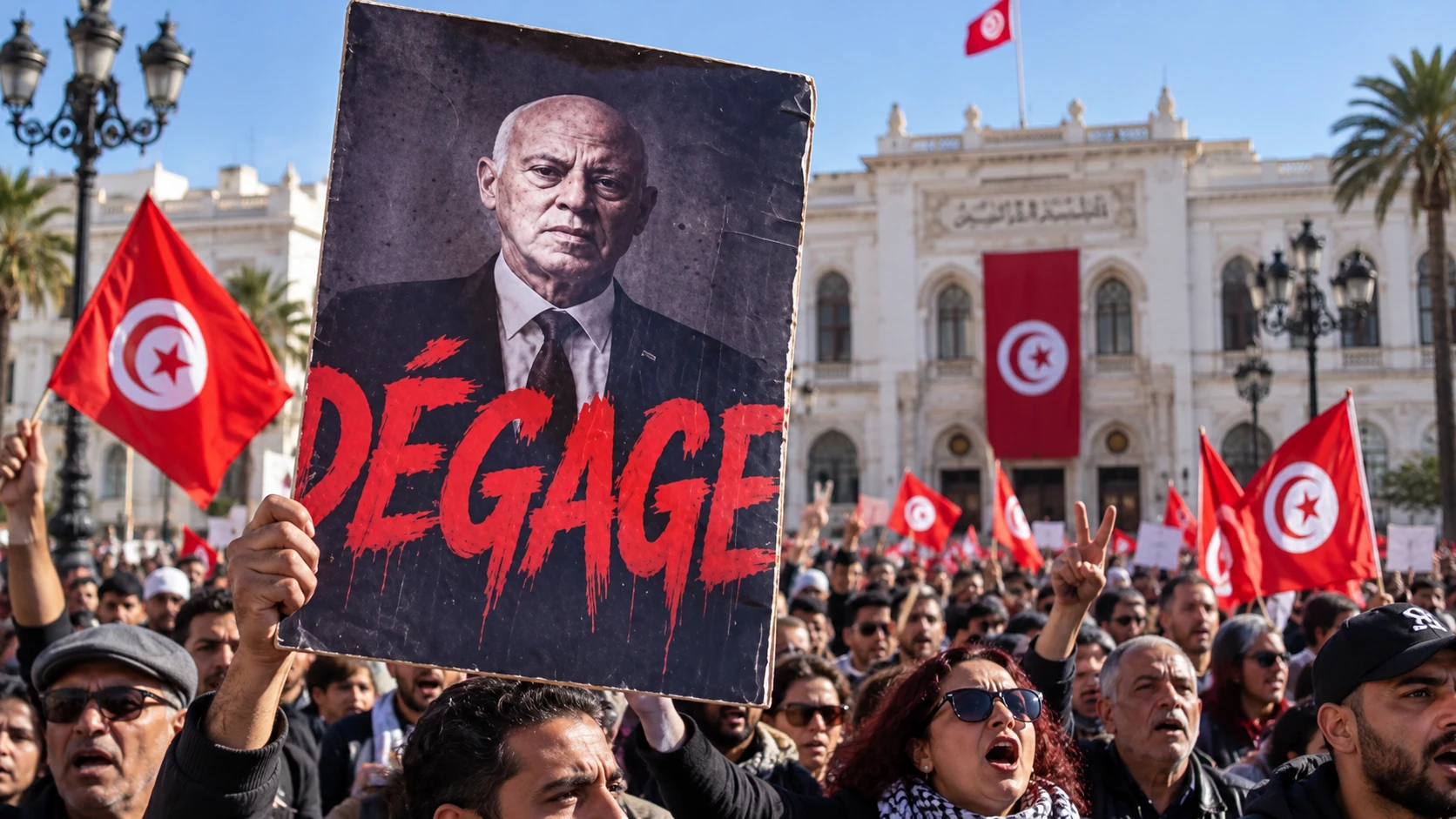
PRESDA AI-generated editorial illustration. The crowd, placards and location are imagined, not a photograph documenting the October 2026 protests.
Police used tear gas against protesters in Ettadhamen, on the outskirts of Tunis, on October 22, 2026, after the death of a man detained on suspicion of drug dealing. Reuters also reported clashes in Jebeniana and Agareb in the Sfax governorate. The incidents brought several distinct local grievances into view during a week of wider political tension. Their causes and participants should not be collapsed into a single, centrally organized uprising. Reuters, October 22 reporting
The urgent questions concern accountability for deaths, the conduct of security forces and whether public institutions can answer families' demands. Those questions are sharpened by a broader dispute over President Kais Saied's concentration of power and the quality of everyday services. They do not make an allegation of abuse an established forensic finding, or turn every demonstration into an endorsement of the same political programme.
Ettadhamen: a death with competing accounts
The detained man's family alleged that police violence caused his death. Local media reported a different account, saying he died after swallowing drugs. Reuters said the interior ministry was not immediately available for comment. Neither account is treated here as a verified medical conclusion. The ministry's absence of an immediate response is also not a confirmation of the family's allegation. Reuters on the conflicting accounts
Determining what happened requires evidence such as a reliable custody timeline, medical findings and an accountable investigation. The sources reviewed for this article do not provide that final determination. The distinction is not a reason to dismiss the family's demand for answers. It is the basis for reporting that demand accurately, without claiming to have resolved a disputed death from a distance.
Southern towns and the separate Sfax student protest
In Jebeniana, relatives said a man died during a security chase. Reuters reported similar clashes in Agareb without establishing in that dispatch that every incident had the same trigger. Separately, students in Sfax protested after a female student with a cardiac problem died. Her colleagues blamed a delayed ambulance response and called for a Friday strike. Their allegation is not an independently established medical finding. Reuters on Jebeniana, Agareb and Sfax
These are distinct deaths and disputes. This report does not present a combined protest death toll or claim the student died in a police confrontation. An arrest-related death, a reported chase and an alleged emergency-service failure involve different responsibilities and kinds of evidence. Keeping them separate makes it possible to understand why people are angry without giving readers a false picture of a single event.
Why the October 17 march matters
The latest confrontations followed a large demonstration in central Tunis on October 17. Reuters reported thousands of participants in a march led by the UGTT trade union and civil-society groups. Protesters accused Saied of weakening democracy and mishandling the economy. The report described worsening services, recurring water and electricity interruptions, and shortages of medicines and essential goods as part of the backdrop. Reuters on the October 17 demonstration
That earlier march helps explain the political atmosphere, but it does not prove that its organizers directed the later neighborhood confrontations. Trade-union mobilization, opposition activism, family demands and student action can overlap while retaining different aims. Crowd size also requires care: the available reporting supports thousands at the October 17 demonstration, not an invented nationwide total for the clashes five days later.
Economic hardship is also a public-services story
The pressure was visible before October. AP's August reporting described a protest organized by the Nafas movement amid water and power shortages, medicine scarcity and rising living costs. Participants included people outside the traditional party opposition. That earlier reporting shows that grievances about daily services were already feeding political mobilization; it should not be recycled as if those interviews had taken place during this week's clashes. AP's August reporting
A missed ambulance, an unavailable medicine and a power cut are different service failures, yet each raises the same practical question for a household: can the state respond when it is needed? That connection helps explain why apparently local complaints can carry national political weight. It does not establish a single cause for every failure or justify inventing economic indicators not documented in the sources.
What the opposition demands, and what Saied says
Opposition demonstrations in August called for restored freedoms and the release of imprisoned political figures, activists and journalists, according to Reuters. Saied denies political repression. The same reporting records his position that authorities are enforcing the law and pursuing suspected corruption or conspiracies against the state. Those claims belong to a broader political dispute and do not answer the specific, unresolved questions about the October deaths. Reuters on opposition demands and Saied's position
Reuters' October 17 account says Saied rejects accusations of dictatorship and has accused opponents of engineering economic crises to stir unrest. The accusation must be attributed to him, not adopted as the explanation for shortages or demonstrations. Equally, opponents' descriptions of his rule are their political assessment, not substitutes for documenting particular decisions and their consequences. Reuters on the president's response
The institutional conflict behind the street protests
Saied's consolidation of power began in July 2021 with the suspension of parliament and dismissal of the government, followed by further institutional changes. AP reported in September 2026 that Tunisia's highest court upheld convictions in a major state-security case involving opposition figures, lawyers and rights defenders. These developments provide context for concerns about judicial independence, without establishing the merits of each unrelated criminal allegation. AP on the court decision and political background
The struggle is therefore about both material conditions and the institutions through which complaints can be investigated. Demands for services and demands for civil liberties are not mutually exclusive. A fair account can report both the state's declared responsibility to enforce law and citizens' demand that officials be accountable, while requiring evidence for claims made by either side.
What can be concluded now?
The reporting reviewed through October 23 confirms unrest in the Tunis area and southern towns, contested accounts of deaths and a wider mobilization over governance and living conditions. It does not establish a definitive cause of death in each case, a complete arrest or injury tally, or an inevitable political outcome. Those limits are part of the story, not blanks to fill with speculation.
For historical context about the region, PRESDA's separate feature on Carthage and Tunisia's ancient past is available as background, not an explanation of contemporary events. The approved hero accompanying this report is an AI-generated editorial illustration. Its crowd, placards and setting must not be treated as photographic evidence of the October protests or of any participant's presence.
FAQ
Frequently Asked Questions
What is this PRESDA article about?
October 2026 clashes in Tunis and southern towns: competing accounts of deaths, public-service grievances, opposition demands and Kais Saied's position.
Which category does this story belong to?
This story is part of PRESDA's World coverage.
Who published this article?
Tunisia Protests Intensify as Police Clash with Demonstrators was published by PRESDA Editorial on PRESDA.
PRESDA Dispatch
Stay Informed. Stay Aware.
A sharp briefing across AI, gaming, sport, business, world affairs, paparazzi, and lifestyle.