Ebola Spreads Beyond Congo as Nigeria Confirms an Imported Case
Nigeria confirms an imported Bundibugyo case. Dated WHO figures, Kenya's linked cluster, transmission, contact tracing and vaccine research explained.
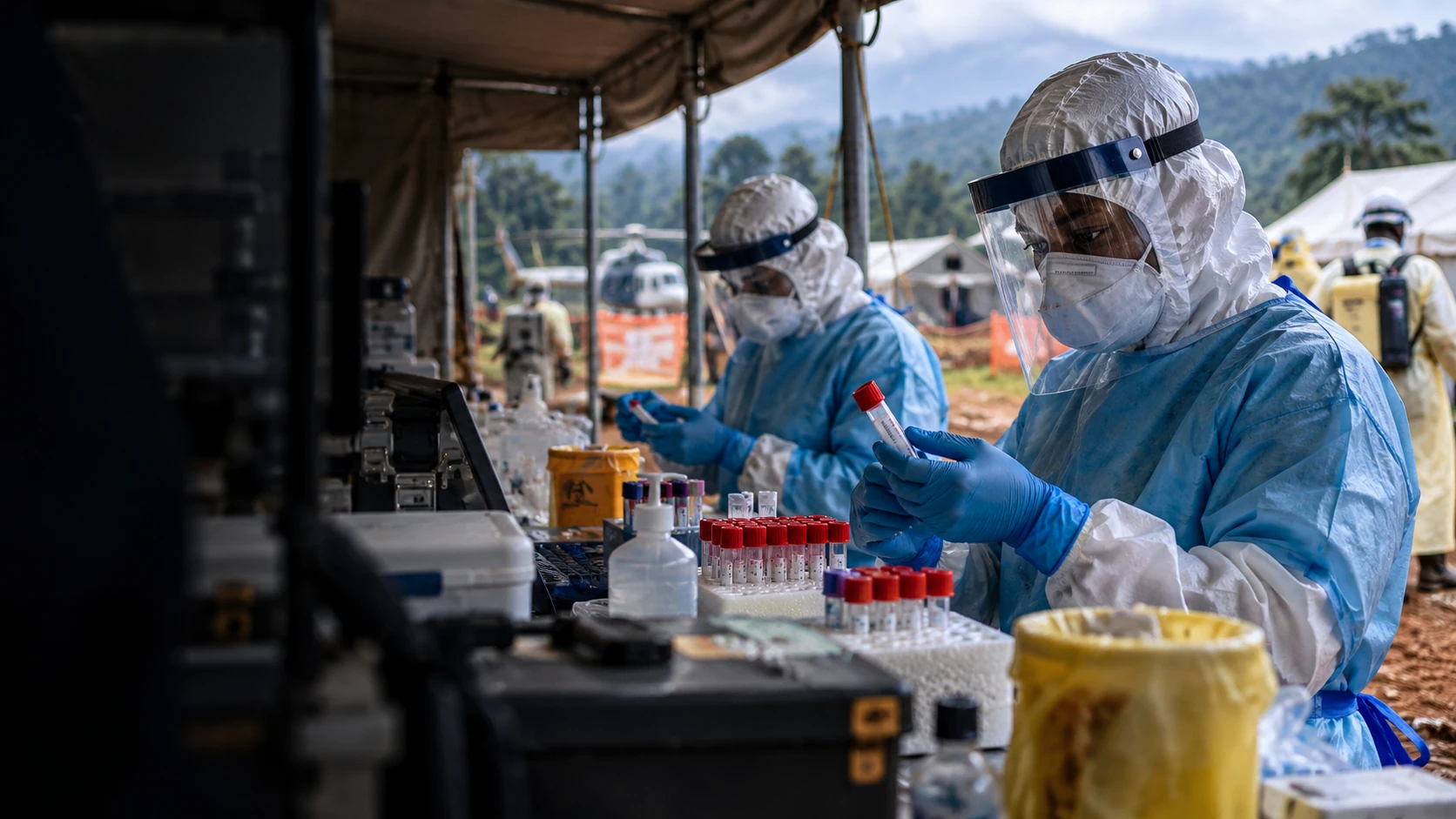
PRESDA AI-generated editorial illustration. This imagined field laboratory does not depict actual patients, health workers or an identified Ebola response operation.
Nigeria has confirmed an imported case of Bundibugyo virus disease, extending the international reach of the Ebola outbreak that began in the Democratic Republic of the Congo in May 2026. Confirmation of one patient in Abuja is a serious public-health event. It is not, on its own, evidence of sustained community transmission in Nigeria. WHO's October 20 statement describes a patient in isolation, an activated national response and investigations into her exposure history. WHO: Nigeria's imported case
The distinction is central to understanding this outbreak. A country can diagnose a traveler infected elsewhere, identify secondary cases among close contacts, or face transmission chains spreading through communities. Those situations require different assessments. A map that colors every country in the same way can conceal more than it explains.
What is known about the Nigerian patient?
According to WHO, the woman arrived from Uganda on October 3, developed symptoms on October 7 and sought care at a private facility in Abuja on October 11. Laboratory confirmation came on October 20. Authorities initially identified 44 contacts for monitoring and strengthened infection-control measures at the facility. That is a dated contact count, not a guarantee that investigators have identified everyone who may have been exposed. WHO case chronology and response
On October 22, AP reported that Africa CDC was investigating whether the first patients detected in Kenya and Nigeria had interacted at Entebbe airport on October 3. The possible link remained under investigation. AP also reported disagreement over claims that the Nigerian patient had traveled to Congo. The source of infection must therefore remain unresolved in this account; a transit itinerary does not establish where transmission occurred. AP reporting on the Africa CDC briefing
The numbers, with their reporting dates
WHO's weekly report using data through October 19 records 9,637 confirmed cases and 4,646 confirmed deaths in Congo, across 66 health zones in eight provinces. It gives a crude case-fatality ratio of 48.2%. These are reported confirmed cases and deaths, not an estimate of every infection. Surveillance gaps, delays and evolving outcomes affect interpretation. WHO weekly situation report 23
A later ECDC update, published October 22 and citing Congolese data through October 20, gives 9,704 confirmed cases and 4,687 related deaths in Congo. The difference reflects different reporting cutoffs; the two snapshots should not be blended into a single supposedly simultaneous total. The same ECDC update lists nine confirmed cases, including one death, in Kenya as of October 22. ECDC dated country update
AP's October 22 account of Africa CDC data reports that only about 20% of confirmed cases were among known contacts and roughly 60% of deaths occurred in the community rather than treatment centers. Those indicators describe gaps in detection and access to care. They are not additional case totals and should not be added to WHO's figures. Africa CDC indicators reported by AP
Which countries have reported cases, and what does that mean?
Congo remains the center of sustained transmission. In Kenya, the nine confirmed cases were linked to an imported patient, with infections among relatives and healthcare personnel. The US CDC's October 20 summary says Kenya's health ministry had reported no community spread. A documented cluster involves transmission, but it is not equivalent to evidence of widespread, unlinked community circulation. Nigeria's single imported case must likewise be distinguished from such circulation. US CDC country summary
Uganda previously recorded 20 confirmed cases and two confirmed deaths; its earlier outbreak was declared over internationally on August 27 after the surveillance interval. France recorded one imported infection in June with no identified secondary transmission. WHO also documented two patients diagnosed in Congo and medically evacuated to Germany. Those patients are included in Congo's count, not evidence of acquisition in Germany. South Sudan's preparedness activities and geographic risk should not be mistaken for a confirmed case. UKHSA outbreak chronology WHO on imported cases and evacuations US CDC on South Sudan's status
How Bundibugyo virus is transmitted
Ebola disease spreads through direct contact of broken skin or mucous membranes with infected blood or body fluids, including contact with contaminated objects. WHO says people do not transmit the disease before symptoms develop. The incubation period is two to 21 days. Close care of a sick person, unsafe handling of a deceased person and inadequate protection in healthcare settings are important routes of exposure. Mere travel through a country does not establish infection. WHO Ebola disease fact sheet
Early symptoms can resemble other illnesses. Laboratory testing is needed to confirm a suspected infection; a photograph, fever or travel history cannot diagnose it. Prompt, professionally organized care matters. WHO emphasizes that intensive supportive treatment, including rehydration and management of symptoms, can improve survival. The lack of an approved virus-specific medicine does not mean there is no useful treatment or no reason to seek care. WHO on diagnosis and supportive care
Why tracing contacts remains essential
Contact tracing identifies people with a plausible exposure, follows their health and enables rapid assessment if symptoms appear. The task is not simply to collect names. Teams need safe access, reliable communication, laboratory capacity and enough trust for families to report illness. WHO describes insecurity, population displacement and restricted humanitarian access as major obstacles in Congo. WHO outbreak response overview
Nigeria's incident management system and facility-level infection-control response are designed to interrupt transmission early. WHO also calls for preparedness at points of entry and in both public and private healthcare facilities. Its October 20 statement advises against restrictions on travel and trade with affected countries. That recommendation should be distinguished from the separate entry rules governments may impose. WHO regional preparedness recommendations
Vaccine research is not the same as proven protection
There is no licensed vaccine or specific therapeutic established for Bundibugyo virus disease in the reviewed October guidance. Vaccines licensed against Ebola virus of the Zaire species cannot simply be assumed equally effective against Bundibugyo. ECDC describes candidate platforms in development and research into possible cross-protection with Ervebo. Use within a research protocol is not proof of efficacy against this virus. ECDC on vaccines and research
In an October 22 interview with Channels Television, Africa CDC director-general Jean Kaseya discussed clinical trials, including an Egyptian-manufactured candidate. That describes research activity, not an approval or a demonstrated reduction in deaths. Results require evaluation of safety and effectiveness. PRESDA's feature on the history and future of medicine provides broader context for the distinction between a promising intervention and an established treatment. Kaseya interview
What remains uncertain
The Nigerian patient's precise exposure, the completeness of contact lists and the true extent of missed transmission remain under investigation. This article was checked on October 23, 2026, using the dated surveillance snapshots identified above. New cases or revised classifications can change the picture. The immediate factual conclusion is narrower than an alarmist regional headline: an imported case has been confirmed in Nigeria while Congo's large outbreak continues and Kenya manages a linked cluster. The hero is an AI-generated illustration, not a photograph of these patients or an actual response operation.
FAQ
Frequently Asked Questions
What is this PRESDA article about?
Nigeria confirms an imported Bundibugyo case. Dated WHO figures, Kenya's linked cluster, transmission, contact tracing and vaccine research explained.
Which category does this story belong to?
This story is part of PRESDA's World coverage.
Who published this article?
Ebola Spreads Beyond Congo as Nigeria Confirms an Imported Case was published by PRESDA Editorial on PRESDA.
PRESDA Dispatch
Stay Informed. Stay Aware.
A sharp briefing across AI, gaming, sport, business, world affairs, paparazzi, and lifestyle.