NEW ULTRASOUND PATCH HELPS PEOPLE REACH DREAM SLEEP 43 MINUTES FASTER
In a small two-night study, an experimental ultrasound patch shifted first REM sleep earlier. The result does not establish an insomnia treatment.
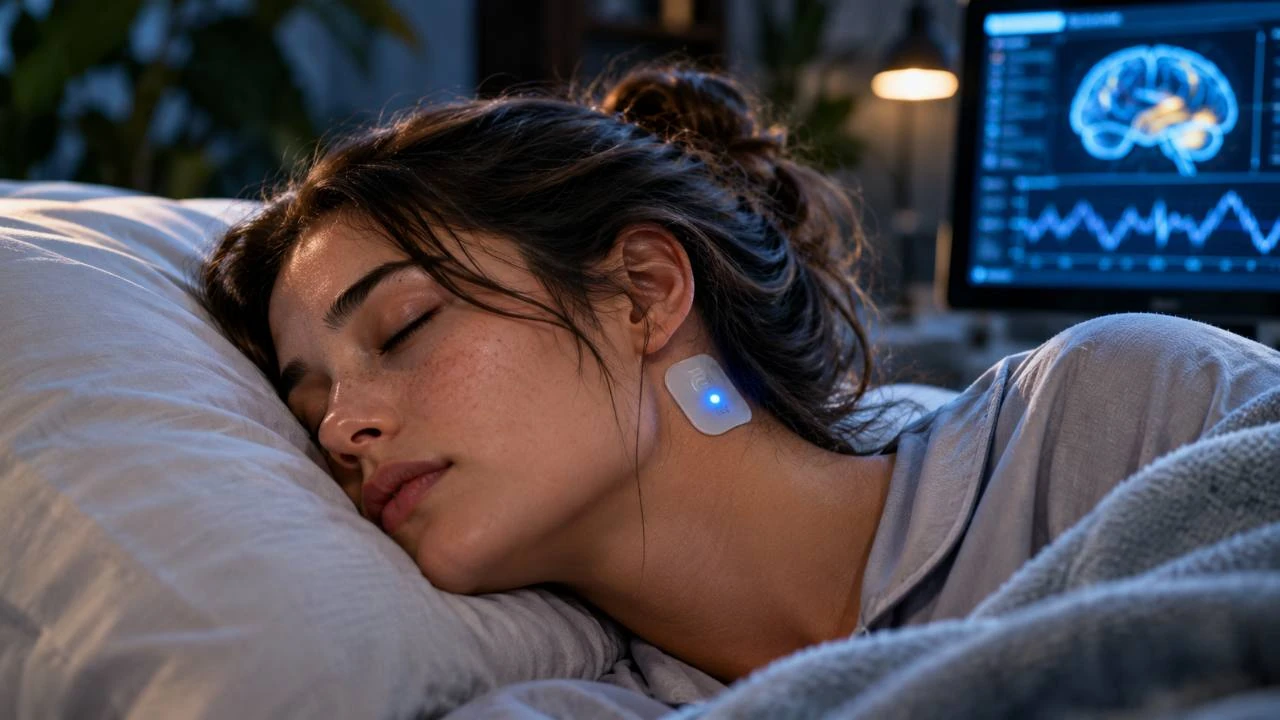
Editorial illustration supplied for PRESDA. Patch placement and screen graphics are conceptual.
An experimental wearable called NEUSLeeP was associated with an earlier first bout of rapid eye movement, or REM, sleep in a small study published in Nature Communications in June 2026. Across 26 usable recordings compared between nights, average time to first REM fell from 177 minutes to 134.7 minutes. The authors reported the change as about 43 minutes. It concerns the timing of a specific stage after sleep begins. It does not mean that people fell asleep 43 minutes sooner. Nature Communications study Study methods and figures
What the researchers actually measured
The team enrolled 28 people, including 16 in a healthy group and 12 in a group with insomnia symptoms. Two participants’ sleep records were too noisy to use. On the first night, participants underwent a sham condition. On the second, they received active focused ultrasound. A trained sleep specialist scored the recordings. The share of total sleep spent in REM rose from 16.3% to 20.9%, a rise of 4.6 percentage points. The study found no significant changes in overall sleep efficiency or awakenings. Study methods and figures
| Measure | Sham night | Active ultrasound night |
|---|---|---|
| Time to first REM | 177 min | 134.7 min |
| Share of sleep in REM | 16.3% | 20.9% |
REM sleep is one stage of a cycle
REM is associated with vivid dreams, but the researchers measured sleep stages, rather than what participants dreamed about. Specialists recognise stages from physiological signals such as brain activity and eye movements. A first REM episode is different from the moment a person first falls asleep and from the amount of time they remain asleep. This is why results on the timing and duration of REM cannot substitute for measures of insomnia symptoms or daytime function. PRESDA’s guide to sleep paralysis explains another way that REM physiology and awareness can overlap. NIH guide to sleep stages
How the patch works in the laboratory
The flexible device combines electrodes that record electrical activity with a component that delivers focused ultrasound through the skull. The researchers aimed the ultrasound at the subthalamic nucleus, a deep structure involved in networks they were investigating. The wearable format addresses a practical engineering question: can researchers keep the interface stable long enough to collect signals while someone sleeps? The study tests that approach under research conditions. Its results do not establish that a home wearable can locate the target or safely reproduce the effect without oversight. Nature Communications study Study methods and figures
Why the two-night order matters
Everyone had the sham session first. The researchers chose that order because they did not know whether effects from the active session might carry over into a later sham night. The trade-off is that the effect of the patch cannot be cleanly separated from an effect of sleeping in the lab for a second night. A larger study could account for that with a design suited to testing carryover, randomisation and additional nights. The reduction in REM latency was statistically significant in the healthy subgroup and in the combined analysis. The insomnia subgroup alone did not establish a clear timing benefit. Study methods and figures
What would make the finding clinically useful?
A follow-up would need to test whether the effect repeats across independent groups and persists beyond a single active night. Practical outcomes would include daytime functioning, perceived sleep quality and whether people actually have less difficulty getting to sleep or staying asleep. Safety, tolerability and targeting would also need further study. This experiment provides evidence that researchers could measure and influence one part of sleep in a controlled setting. It does not establish an insomnia therapy. Nature Communications study Study methods and figures
Why the same average can hide different nights
An average compresses records from people who enter REM at different times. The paper reports a wide spread in first-REM timing under both conditions. A mean that shifts by 43 minutes is therefore compatible with much smaller changes for some participants and bigger changes for others. The 4.6-point rise in REM share is another separate measure. It tells us how the recorded sleep time was distributed across stages. It cannot establish by itself that participants felt more rested. Individual records and follow-up outcomes are necessary to judge the practical significance. Study methods and figures
FAQ
Frequently Asked Questions
Did people fall asleep 43 minutes sooner?
The reported change was in the time to first REM, not sleep onset.
Did the trial show a treatment for insomnia?
No. The small, fixed-order experiment did not establish clinical benefit for insomnia.
PRESDA Dispatch
Stay Informed. Stay Aware.
A sharp briefing across AI, gaming, sport, business, world affairs, paparazzi, and lifestyle.